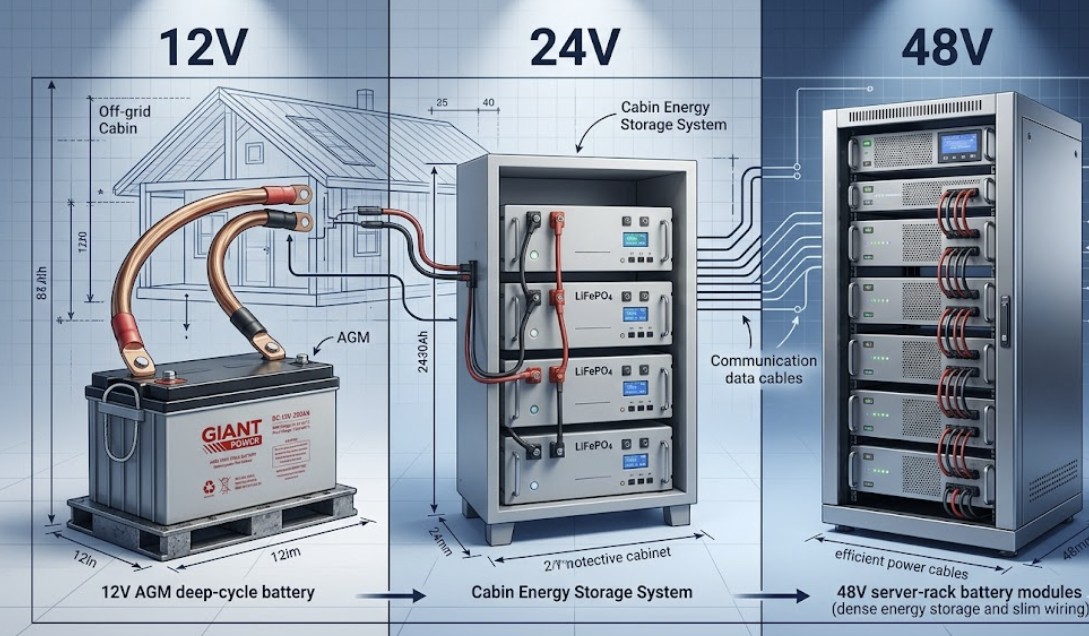
Choosing between a 12V vs 24V vs 48V solar system is not simply about voltage — it directly impacts wiring cost, system efficiency, inverter performance, expandability, and overall reliability.
We analyze this decision from an engineering and real-world off-grid perspective, comparing:
- Wire gauge (AWG) requirements
- Line loss and voltage drop
- Inverter efficiency and idle consumption
- Battery bank scaling
- Solar array size recommendations
- Real-world cabin, van, and residential use cases
This guide is structured for off-grid cabin owners, van builders, and solar installers who want technical clarity without bias.
Table of Contents
Understanding System Voltage in Solar Power
Solar systems operate at 12V, 24V, or 48V nominal battery voltage. The voltage level determines:
- Current flow
- Wire thickness
- Heat loss
- Efficiency
- Maximum inverter size
- System scalability
The fundamental relationship is: P=V×I
Where:
- P = Power (Watts)
- V = Voltage
- I = Current (Amps)
To better understand the physics behind voltage and current, refer to the [National Electrical Code (NEC) standards] for safe off-grid electrical design.
For the same power output, increasing voltage reduces current. Lower current results in:
- Smaller wire size
- Lower voltage drop
- Reduced heat loss
- Higher efficiency
Example: 3000W Load
| System Voltage | Current Required |
|---|---|
| 12V | 250A |
| 24V | 125A |
| 48V | 62.5A |
This is the core engineering reason why larger systems move toward 24V and 48V solar systems.
12V vs 24V vs 48V Solar System Use Case Categories
We categorize systems based on real-world power consumption.
12V Solar Systems (Under 1000W)
Best for:
- Camper vans
- RV systems
- Portable solar setups
- Small cabins
- Backup power
Typical Loads:
- LED lights
- Phone charging
- Small fridge
- Water pump
- Laptop
Advantages:
- Simple wiring
- Widely available components
- Easy troubleshooting
- Compatible with automotive devices
Limitations:
- High current at moderate power
- Large wires required above 1000W
- Poor scalability
Safety Favor: If you decide to stick with a 12V system, you have to be obsessive about monitoring. Because 12V systems handle such high amperage, a small drop in battery health can lead to system failure. I always recommend the [Victron SmartShunt 500A]. It turns your phone into a high-precision fuel gauge for your battery. It’s a “favor” because it’s cheaper than the versions with a physical screen, but gives you the exact same professional-grade data via Bluetooth.
Check current price on Amazon –>
12V is perfect for minimalists. If you are building a very small, portable retreat, follow our [solar setup for micro cabin] guide for a 12V step-by-step installation.
24V Solar Systems (1000W–3000W)
A 24V setup simplifies your build significantly. Check our [24V solar system wiring diagram] to see the exact cable paths.
Best for:
- Off-grid cabins
- Medium solar systems
- Small homes
- Workshop power
Running a constant 75W–100W load like Starlink is significantly more efficient at 24V. See the [Starlink DC conversion] benefits here.
Typical Loads:
- Refrigerator
- TV
- Microwave
- Power tools
- Internet equipment
Advantages:
- Reduced wire thickness
- Better inverter efficiency
- Moderate scalability
- Balanced cost
Limitations:
- Requires DC-DC converter for 12V appliances
- Slightly more complex wiring
To build the “Sweet Spot” 24V system I recommend for cabins, don’t buy two 12V batteries and wire them in series. That creates balancing issues. Instead, get a native [LiTime 24V 100Ah Battery]. It’s the cleanest way to reach 2.56kWh of storage in a single, compact unit. It handles the 24V charging cycles much more efficiently and simplifies your wiring from a “rats nest” to a professional, streamlined layout.
Check current price on Amazon –>
48V Solar Systems (3000W+)
Best for:
- Full-time off-grid homes
- Large cabins
- High-power appliances
- Air conditioning
- Electric heating
Typical Loads:
- Washing machines
- Air conditioners
- Well pumps
- Electric cooking
- Workshop equipment
If you’re stepping up to a 48V system for a full-time off-grid home, the [Victron MultiPlus-II 48/3000] is the only inverter-charger I trust. Its idle consumption is incredibly low, meaning it won’t “steal” your battery power just by being turned on. Most importantly, its surge capacity is legendary—it can start well pumps and small AC units that would trip a 12V or 24V inverter instantly. It is the definitive choice for professional 48V architecture.
Check current price on Amazon –>
Limitations:
- Higher initial cost
- More complex installation
- Requires skilled planning
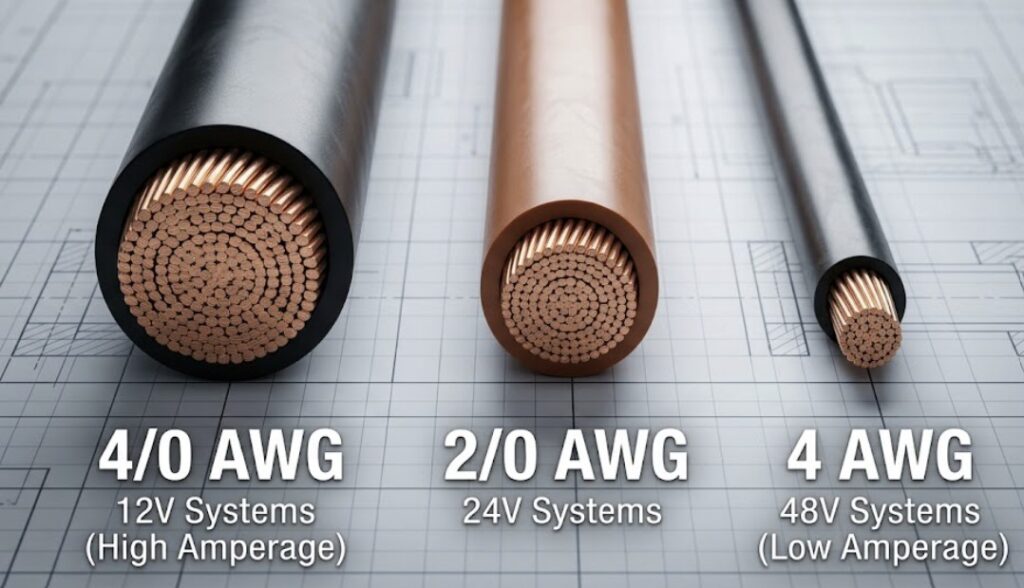
AWG Wire Size Comparison: 12V vs 24V vs 48V Solar System
Wire size is one of the largest cost drivers in solar systems.
Example: 3000W inverter (10 ft battery cable)
| Voltage | Current | Recommended Wire |
|---|---|---|
| 12V | 250A | 4/0 AWG |
| 24V | 125A | 2/0 AWG |
| 48V | 62A | 4 AWG |
This demonstrates:
- 12V requires extremely thick copper
- 48V drastically reduces cable cost
Reducing wire gauge not only saves money but also simplifies your [solar panels for tiny home cost] by cutting down on expensive heavy-gauge copper.
Line Loss and Voltage Drop Explained for Cabin Owners
Voltage drop occurs when electricity travels through wire resistance.
Formula:
Voltage Drop = Current × Resistance
Higher current = higher voltage drop.
Example: 50 ft cable run
| Voltage | Current | Voltage Drop |
|---|---|---|
| 12V | 100A | High |
| 24V | 50A | Medium |
| 48V | 25A | Low |
You can use a [Voltage Drop Calculator] to see exactly how much power you are losing across your specific cable lengths
This is why:
- 12V systems struggle with long distances
- 48V systems perform best in cabins and homes
If your [400 sq ft cabin power consumption] exceeds 15 kWh per day, a 48V system is no longer optional—it’s an engineering necessity.
12V vs 24V vs 48V Solar System Efficiency Comparison
Efficiency improves as voltage increases.
Reasons:
- Lower current losses
- Better inverter performance
- Smaller charge controllers
Typical Efficiency Comparison:
| System | Efficiency Range |
|---|---|
| 12V | 85%–92% |
| 24V | 88%–94% |
| 48V | 92%–97% |
Inverter Efficiency and Idle Power Consumption
Higher voltage systems often include more efficient inverters.
Example Comparison
| Voltage | Inverter Size | Idle Consumption |
|---|---|---|
| 12V | 3000W | 30-50W |
| 24V | 3000W | 20-35W |
| 48V | 5000W | 15-25W |
Why this matters:
Idle draw runs 24 hours per day.
Example: 40W idle × 24 hours = 960Wh per day
That equals:
- Nearly 1kWh daily loss
- Significant battery drain
48V systems minimize idle losses.
Your system voltage dictates your inverter choice. Compare the top-tier options for each voltage in our [Renogy vs Victron inverter] buyer’s guide.
Solar Array Sizing Guidelines
Engineering rule of thumb:
| Solar Array Size | Recommended Voltage |
|---|---|
| Under 1000W | 12V |
| 1000W-3000W | 24V |
| Over 3000W | 48V |
These ranges align with:
- Wire cost
- Efficiency
- Scalability
Battery Bank Scaling Comparison
Battery banks grow differently based on voltage.
Example: 4.8kWh battery
| Voltage | Configuration |
|---|---|
| 12V | 4 × 12V 100Ah parallel |
| 24V | 2S2P configuration |
| 48V | 4 batteries in series |
Higher voltage:
- Fewer cables
- Cleaner installation
- Better balancing
Whether you wire in series or parallel, choosing high-quality cells is vital. Check our top picks for the [best solar battery for cabin] to find 24V and 48V ready units.
12V vs 24V vs 48V Solar System Wiring Layout
Example system flow:
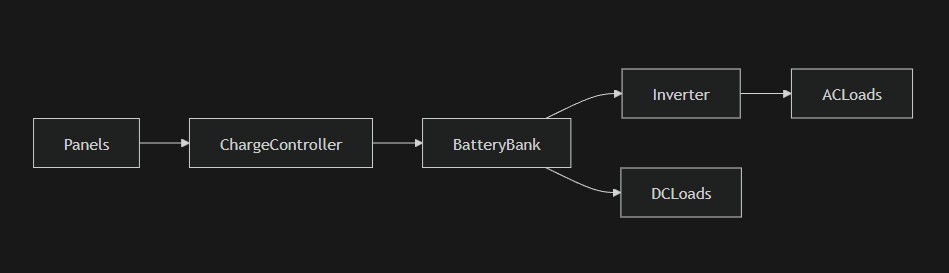
Higher voltage systems simplify wiring:
- Fewer parallel connections
- Reduced cable complexity
Charge Controller Sizing Comparison
Charge controller current decreases as voltage increases.
Example: 2000W solar array
| Voltage | Controller Current |
|---|---|
| 12V | 166A |
| 24V | 83A |
| 48V | 41A |
Benefits:
- Smaller controller
- Lower cost
- Less heat
A higher voltage allows you to use a more compact and affordable controller. Compare the performance in our [Victron vs Renogy charge controllers] guide.
Component Availability Comparison
| Component | 12V | 24V | 48V |
|---|---|---|---|
| Appliances | Excellent | Good | Limited |
| Inverters | Excellent | Excellent | Excellent |
| Charge Controllers | Excellent | Excellent | Excellent |
| DC Appliances | Excellent | Limited | Rare |
12V still wins for:
- Mobile systems
- Marine setups
- RV systems
Distance Performance Comparison
Example: Cabin with panels 100 ft away
| Voltage | Performance |
|---|---|
| 12V | Poor |
| 24V | Good |
| 48V | Excellent |
Higher voltage allows:
- Long wire runs
- Reduced voltage drop
- Better performance
Real-World Example Systems
Small Cabin — 12V System
| Load | System |
| Lights Laptop Small fridge | 400W solar 200Ah battery 1000W inverter |
Best choice: 12V
For a 400-square-foot space, 24V is usually the most balanced choice. See our full breakdown of [400 sq ft cabin power needs] to size your array correctly.
Medium Cabin — 24V System
| Load | System |
| Refrigerator Microwave TV Pump | 1500W solar 400Ah battery 3000W inverter |
Best choice: 24V
Full Off-Grid Home — 48V System
| Load | System |
| Washer AC Well pump Workshop | 4000W solar 10kWh battery 5000W inverter |
Best choice: 48V
Cost Comparison Overview
| System | Initial Cost | Wire Cost | Expandability |
|---|---|---|---|
| 12V | Low | High | Poor |
| 24V | Medium | Medium | Good |
| 48V | High | Low | Excellent |
Safety Considerations
| Higher voltage reduces: | Higher voltage increases: |
| Cable overheating Fire risk Voltage drop | Installation complexity Safety requirements |
Scalability Comparison
| Voltage | Scalability |
|---|---|
| 12V | Poor |
| 24V | Good |
| 48V | Excellent |
48V systems scale best for:
- Growing families
- Expanding cabins
- Long-term off-grid homes
When to Choose Each System
| Choose 12V When | Choose 24V When | Choose 48V When |
| Under 1000W Portable system Simple install | 1000W-3000W Medium cabin Balanced efficiency | Over 3000W Full-time off-grid Long-term system |
12V vs 24V vs 48V Solar System Final Engineering Comparison
| Feature | 12V | 24V | 48V |
|---|---|---|---|
| Wire Size | Largest | Medium | Smallest |
| Efficiency | Lowest | Medium | Highest |
| Cost | Low Start | Balanced | High Start |
| Expandability | Poor | Good | Excellent |
| Best Use | Small systems | Cabins | Homes |
Conclusion
The 12V vs 24V vs 48V solar system decision depends entirely on power demand, distance, and scalability.
- 12V remains ideal for small portable systems
- 24V offers balance for cabins and medium setups
- 48V dominates large off-grid and residential solar
Choosing correctly at the beginning prevents:
- Expensive rewiring
- Inefficiency
- Limited expansion
The optimal voltage is determined not by preference — but by engineering requirements and future energy demand.
Once you’ve selected your voltage, the next step is following a [complete off-grid power blueprint for retreat cabins] to ensure every component is properly integrated.
Is a 12V solar system still worth it today?
Yes, a 12V solar system is still highly practical for small-scale applications such as camper vans, boats, portable solar setups, and small cabins where total power demand stays below 1000W. These systems are widely supported, components are inexpensive, and installation is straightforward, making them ideal for beginners or users with minimal electrical requirements. However, as energy demand increases, 12V systems quickly become inefficient due to high current draw, thicker wiring requirements, and increased voltage drop over longer cable runs.
Why do larger solar systems use 48V instead of 12V?
Larger solar systems use 48V because higher voltage significantly reduces current, which lowers wire size requirements, decreases voltage drop, and improves system efficiency. This becomes critical in systems above 3000W, where 12V systems would require extremely thick cables, larger breakers, and more expensive infrastructure. A 48V system also allows larger inverters, better battery performance, and easier scalability, making it the preferred choice for full-time off-grid homes and high-power applications.
Is 24V the best compromise between 12V and 48V?
A 24V solar system often represents a balanced middle ground between 12V and 48V, offering improved efficiency and reduced wire size without the complexity or cost of a full 48V installation. It is commonly used in medium-sized off-grid cabins, workshops, and small homes that require between 1000W and 3000W. However, while 24V offers advantages over 12V, it still does not match the scalability and efficiency of 48V systems for larger installations.
How does system voltage affect solar panel wiring?
System voltage determines how solar panels are connected in series and parallel configurations, with higher voltage systems typically using more panels in series to achieve required charging voltages. This reduces amperage and allows smaller wiring between panels and charge controllers, improving efficiency and lowering installation costs. In contrast, 12V systems often rely on parallel wiring, which increases current and requires thicker cables.
Can I upgrade from 12V to 24V or 48V later?
Upgrading from 12V to 24V or 48V is possible but often expensive because it usually requires replacing the inverter, charge controller, wiring, and sometimes batteries. Many users underestimate how quickly their energy needs grow, which makes starting with a higher voltage system more practical in the long term. Planning for expansion early can prevent costly redesigns later.
Do higher voltage solar systems charge batteries faster?
Higher voltage systems do not directly charge batteries faster, but they allow larger solar arrays and more efficient power transfer, which can result in faster overall charging. Reduced current losses and improved MPPT charge controller efficiency help deliver more usable power to batteries. This advantage becomes noticeable in medium and large systems.
Is 48V solar more dangerous than 12V?
While 48V systems operate at higher voltage levels, they are still considered low-voltage DC systems and are commonly used safely in residential solar installations. However, higher voltage requires proper installation practices, correct circuit protection, and appropriate wiring standards. When installed correctly, 48V systems are just as safe and often safer due to reduced cable heating.
Do 48V systems require special appliances?
Most appliances in solar systems run on AC power from an inverter, meaning the battery voltage does not affect appliance compatibility. However, DC appliances designed for 12V systems may require a step-down converter when used in 24V or 48V setups. Many modern solar installations primarily use AC appliances, reducing the need for DC compatibility.
How does inverter efficiency change with system voltage?
Inverters generally operate more efficiently at higher voltages because lower current reduces internal heat losses and improves performance. A 48V inverter typically has lower idle consumption and higher peak efficiency compared to a 12V inverter. Over time, this efficiency improvement reduces battery drain and improves overall system performance.
What size inverter works best for each voltage system?
12V systems typically use inverters up to 2000W or 3000W, 24V systems commonly support 3000W to 4000W inverters, and 48V systems easily handle 5000W or larger inverters. Higher voltage systems allow more powerful inverters without requiring oversized cables. This makes 48V systems ideal for high-power appliances.
Is wire cost really that different between 12V and 48V?
Yes, wire cost differences can be substantial because 12V systems require thick copper cables such as 4/0 AWG, while 48V systems can often use much smaller cables like 4 AWG. Copper is expensive, and large systems may require long cable runs, making higher voltage systems significantly cheaper in wiring costs. This is one of the biggest advantages of 48V installations.
Which 12V vs 24V vs 48V solar system is best for off-grid cabins?
In a 12V vs 24V vs 48V solar system comparison, small off-grid cabins often use 12V systems, medium cabins typically benefit from 24V, and full-time off-grid homes usually require 48V. The best choice depends on total power demand and future expansion plans. Choosing too small of a system voltage often leads to inefficiency.
Is a 24V system harder to install than 12V?
A 24V system is slightly more complex than a 12V system because it may require voltage converters for 12V appliances and additional wiring considerations. However, the difference is relatively small, and most installers find 24V systems manageable. The complexity becomes more noticeable when scaling to hybrid DC systems.
Why do off-grid homes usually use 48V systems?
Off-grid homes use 48V systems because they provide better efficiency, scalability, and support for high-power appliances like air conditioning, washing machines, and well pumps. Lower current reduces heat loss and allows larger solar arrays. These benefits make 48V the standard for residential off-grid solar.
Does battery life depend on system voltage?
Battery life depends more on battery chemistry, depth of discharge, and charging quality than system voltage. However, higher voltage systems often operate more efficiently, which can reduce stress on batteries and improve long-term performance. This indirect benefit can extend battery lifespan.
Can I upgrade later after choosing a 12V vs 24V vs 48V solar system?
Upgrading after choosing a 12V vs 24V vs 48V solar system is possible but often costly because inverters, charge controllers, and battery configurations usually must be replaced. Many users eventually outgrow 12V systems and upgrade to 24V or 48V as energy demand increases. Planning for expansion early helps avoid expensive system redesigns.
Which system is best for a small off-grid cabin?
A small off-grid cabin typically benefits from a 12V or 24V system depending on total power requirements. If power usage stays below 1000W, 12V works well, but if the cabin includes appliances like refrigerators or microwaves, 24V becomes more efficient. Planning for future expansion often favors 24V.
Does system voltage affect solar panel efficiency?
System voltage does not change panel efficiency directly, but higher voltage systems improve overall system efficiency by reducing losses between panels and batteries. Better power transfer results in more usable energy. This makes higher voltage systems more effective overall.
Is 48V solar more future-proof?
Yes, 48V systems are considered the most future-proof because they allow easy expansion, support large battery banks, and handle high-power appliances. Many modern off-grid systems are designed around 48V architecture. This reduces the likelihood of costly upgrades later.
Which voltage is easiest for beginners?
12V systems are easiest for beginners because components are widely available, installation is straightforward, and troubleshooting is simpler. Many starter solar kits use 12V architecture. However, beginners planning larger systems may benefit from starting at 24V.
Should I choose system voltage based on inverter size?
Yes, inverter size is a major factor when selecting system voltage because larger inverters require higher voltage systems to avoid excessive current. Systems above 3000W typically benefit from 24V or 48V. Matching voltage to inverter size improves performance.
How does wiring change in a 12V vs 24V vs 48V solar system?
Wiring size decreases significantly when moving from 12V to 24V or 48V in a 12V vs 24V vs 48V solar system because current is reduced as voltage increases. This means 12V systems require very thick copper cables, while 48V systems can use much smaller and more affordable wiring. The savings become substantial in larger installations or long cable runs.
Does inverter size affect a 12V vs 24V vs 48V solar system decision?
Yes, inverter size plays a major role in selecting a 12V vs 24V vs 48V solar system because large inverters require high current at lower voltages. Systems above 3000W usually benefit from 24V or 48V to reduce cable size and improve efficiency. This helps prevent overheating and improves reliability.
Which 12V vs 24V vs 48V solar system is most future-proof?
A 48V system is usually the most future-proof option in a 12V vs 24V vs 48V solar system comparison because it supports larger battery banks and higher power appliances. Many modern off-grid homes use 48V as a standard. This reduces the need for upgrades later.
Do higher voltage systems reduce voltage drop?
Higher voltage systems reduce voltage drop because current decreases as voltage increases, which lowers resistance losses in cables. This is particularly important in off-grid cabins where panels may be located far from battery banks. Reduced voltage drop improves overall efficiency and energy delivery.
18 thoughts on “12V vs 24V vs 48V Solar System: Engineering Comparison, Wire Size, Efficiency, and Real-World Use Cases”