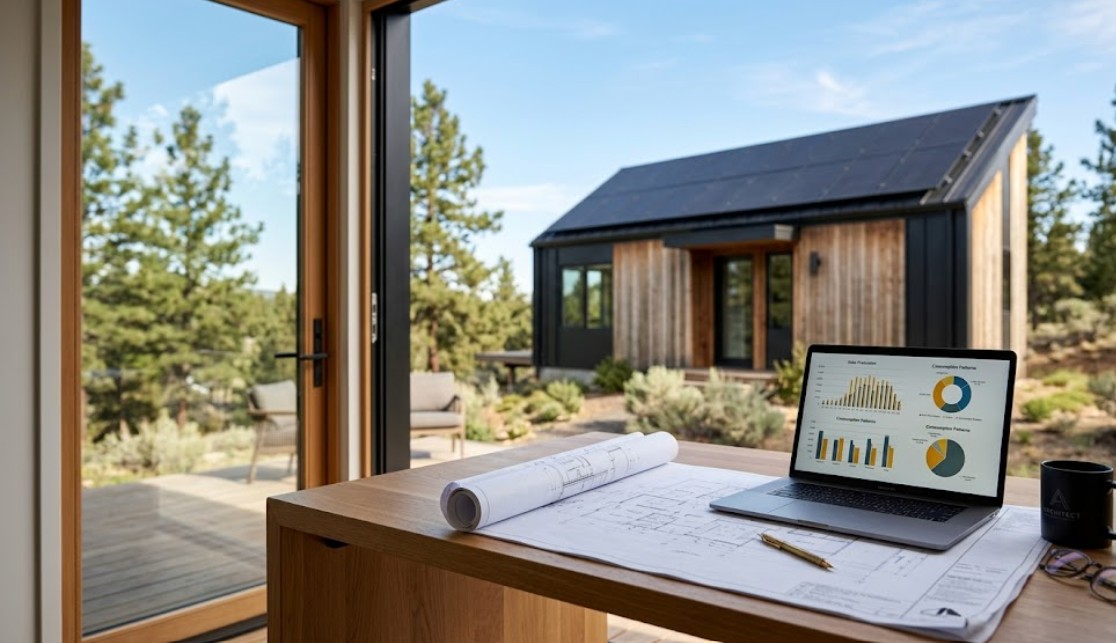
A 400 square foot cabin represents one of the most efficient and practical sizes for off-grid living. However, properly calculating 400 sq ft cabin power needs determines whether your system performs reliably year-round or struggles during peak demand.
We present a comprehensive technical guide covering:
- Real energy consumption calculations
- Solar panel sizing for 400 sq ft cabins
- Battery storage recommendations
- Appliance load planning
- Seasonal energy adjustments
- Cost-efficient off-grid power system design
This guide delivers precise numbers, real-world system configurations, and engineering-level breakdowns to help design a reliable off-grid energy system.
This planning guide works best when paired with our real-world [400 sq ft cabin power consumption] analysis to ensure your math matches your lifestyle.
Table of Contents
Understanding 400 Sq Ft Cabin Power Requirements
A 400 sq ft cabin typically consumes between:
| Cabin Type | Daily Power Use | Monthly Power Use |
|---|---|---|
| Ultra-Minimal Cabin | 2–4 kWh | 60–120 kWh |
| Standard Off-Grid Cabin | 5–8 kWh | 150–240 kWh |
| Comfortable Cabin | 8–12 kWh | 240–360 kWh |
| High-Comfort Cabin | 12–15 kWh | 360–450 kWh |
Most off-grid builders target 6–10 kWh per day for reliable comfort without overspending.
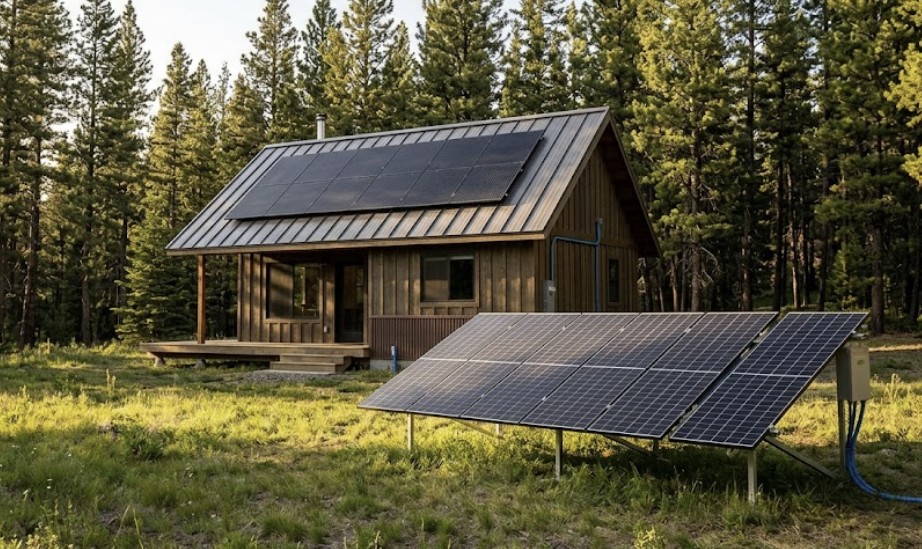
Typical Appliance Power Consumption for a 400 Sq Ft Cabin
The largest factor in determining 400 sq ft cabin power needs is appliance selection. Efficient appliances dramatically reduce solar system size and cost.
Core Cabin Appliance Load
| Appliance | Wattage | Hours/Day | Daily Consumption |
|---|---|---|---|
| LED Lighting (6 bulbs) | 8W each | 5 hours | 0.24 kWh |
| 12V Refrigerator | 60W avg | 24 hours | 1.44 kWh |
| Laptop | 50W | 4 hours | 0.20 kWh |
| Phone Charging | 10W | 3 hours | 0.03 kWh |
| Water Pump | 400W | 0.5 hours | 0.20 kWh |
| Internet Router | 12W | 24 hours | 0.29 kWh |
| TV (LED) | 80W | 3 hours | 0.24 kWh |
A standard router is easy to power, but a satellite dish is a different story. See our full guide on [Starlink power consumption for off-grid cabins].
Total Daily Consumption
Typical baseline usage: ≈ 2.64 kWh per day (Minimal system)
Add optional appliances:
| Optional Appliance | Daily Usage |
|---|---|
| Microwave | 0.3 kWh |
| Coffee Maker | 0.2 kWh |
| Small AC | 2–4 kWh |
| Electric Heater | 4–8 kWh |
| Washing Machine | 0.5–1 kWh |
Realistic comfortable 400 sq ft cabin power needs: 6–8 kWh per day
Solar Panel Size for 400 Sq Ft Cabin Power Needs
To calculate solar panels:
Solar Panels Required = Daily Energy ÷ (Panel Output × Sun Hours)
Example:
- Daily use: 8 kWh
- Panel size: 400W (0.4 kW)
- Sun hours: 4 hours
Calculation: 8 ÷ (0.4 × 4) = 5 panels
Recommended Solar Panel Configurations
| Daily Usage | Panels (400W) | System Size |
|---|---|---|
| 4 kWh | 3 panels | 1.2 kW |
| 6 kWh | 4 panels | 1.6 kW |
| 8 kWh | 5 panels | 2.0 kW |
| 10 kWh | 7 panels | 2.8 kW |
Check your local solar peak hours using the [Global Solar Atlas] to ensure maximum efficiency.
Most 400 sq ft cabin power needs: 1.5 kW — 2.5 kW solar system
Battery Storage Requirements for 400 Sq Ft Cabin
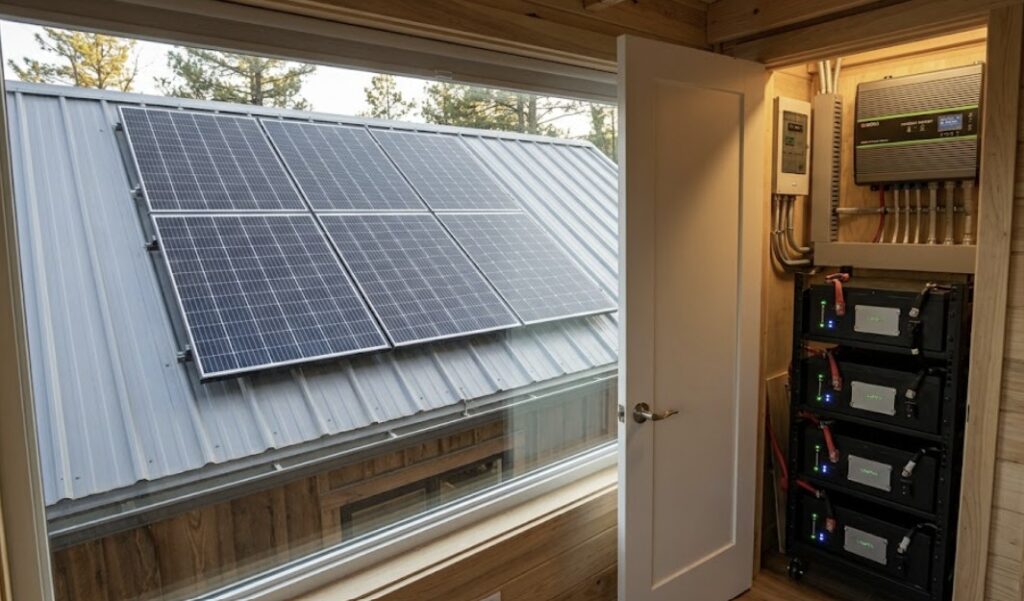
Battery storage ensures power availability at night and during cloudy days.
Battery Sizing Formula
Battery Capacity = Daily Use × Days of Autonomy
Typical autonomy:
- Minimal: 1 day
- Recommended: 2–3 days
- Full off-grid: 3–5 days
Example Calculation
8 kWh per day × 2 days = 16 kWh battery storage
Recommended Battery Sizes
| Cabin Usage | Battery Capacity |
|---|---|
| Minimal | 5–8 kWh |
| Standard | 10–15 kWh |
| Comfortable | 15–20 kWh |
| Full Off-Grid | 20–30 kWh |
To hit the 10-15 kWh storage “sweet spot” mentioned above without a mess of wires, I recommend using two [LiTime 24V 230Ah Plus Units]. Each battery packs 5.12 kWh of usable energy. By wiring just two of these in parallel, you get a massive 10.24 kWh reservoir that is easy to monitor and much safer than wiring eight smaller 12V batteries together. It’s the cleanest way to build a “standard” cabin bank in 2026.
Check current price on Amazon –>
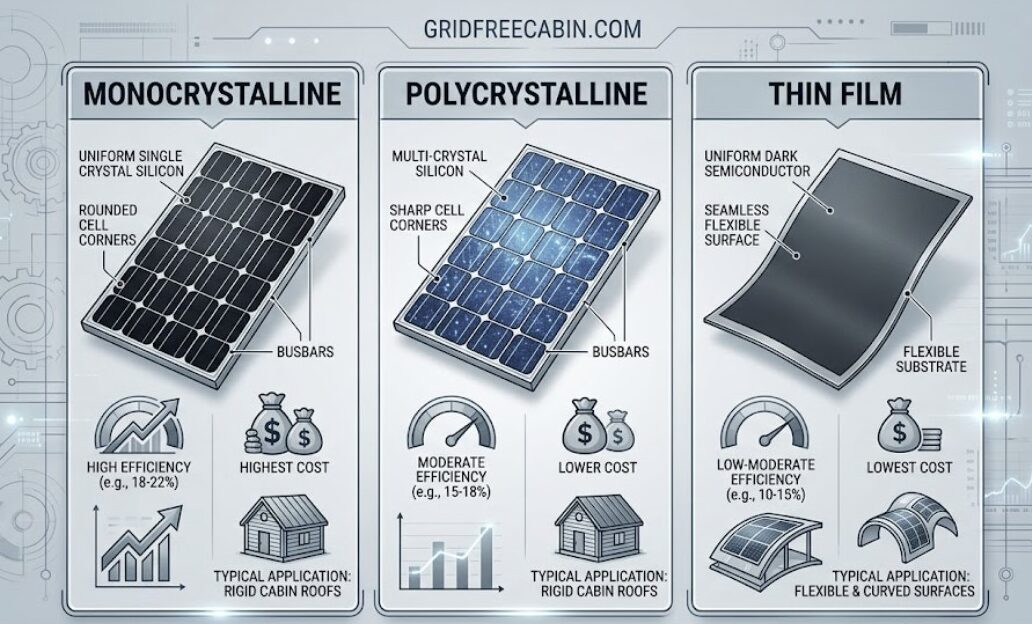
Best Solar Panel Types for Small Cabin Systems
| Panel Type | Efficiency | Best For |
|---|---|---|
| Monocrystalline | 20–25% | Small roofs |
| Polycrystalline | 15–18% | Budget builds |
| Thin Film | 10–13% | Portable setups |
Monocrystalline panels are ideal for 400 sq ft cabins because:
- Limited roof space
- Higher efficiency
- Better winter performance
400 Sq Ft Cabin Power Needs by Lifestyle
Minimal Cabin Setup
Daily usage:
- Lights
- Fridge
- Phone
- Laptop
Total: 3–4 kWh per day
Solar System:
- 3 panels (400W)
- 5–8 kWh battery
Standard Off-Grid Cabin
Daily usage:
- Lights
- Refrigerator
- Laptop
- TV
- Water pump
Total: 6–8 kWh per day
Solar System:
- 4–5 panels
- 10–15 kWh battery
High-Comfort Cabin
Daily usage:
- Small AC
- Microwave
- Appliances
- Heating
Total: 8–12 kWh per day
Solar System:
- 6–8 panels
- 15–25 kWh battery
Seasonal Adjustments for 400 Sq Ft Cabin Power Needs
Winter dramatically changes solar production.
| Season | Sun Hours | Output Drop |
|---|---|---|
| Summer | 5–7 hours | Maximum |
| Spring/Fall | 3–5 hours | Moderate |
| Winter | 2–3 hours | Reduced |
Winter Strategy:
- Increase panel count by 25–50%
- Increase battery storage
- Use propane heating instead of electric
The “Heating & Cooling” Conflict (HVAC in 400 Sq Ft)
One of the biggest mistakes when planning 400 sq ft cabin power needs is using electric resistance heating. Even in a small cabin, electric heaters can instantly overwhelm an off-grid solar system and drain batteries within hours.
Why Electric Heating Breaks Small Solar Systems
Electric resistance heaters typically consume:
- Small space heater: 1,200W – 1,500W
- Oil radiator heater: 800W – 1,500W
- Electric baseboard heater: 1,000W – 2,000W
If used for just 6 hours:
- 1,500W × 6 hours = 9 kWh per day
That single heater alone equals the entire daily power budget of most 400 sq ft cabins.
This forces:
- Larger battery bank
- More solar panels
- Higher inverter capacity
- Increased system cost
In many cases, electric heating doubles or triples system size.
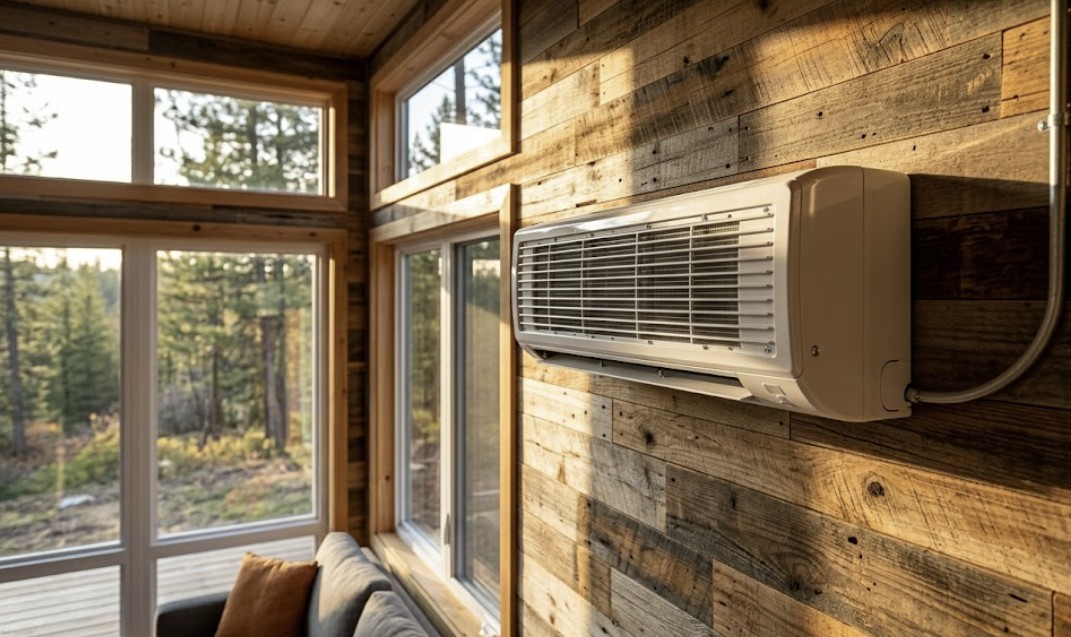
Why Mini-Split Heat Pumps Are the Best HVAC Option
Mini-split heat pumps are significantly more efficient because they move heat instead of generating it.
Don’t let a $20 space heater destroy your $5,000 battery bank. If you want climate control that actually works off-grid, the [Senville LETO 9000 BTU Mini Split] is the gold standard. Because it uses an inverter compressor, it doesn’t “slam” your solar system with a massive startup surge. In its “Eco Mode,” it can keep a 400 sq ft cabin comfortable for a fraction of the energy a standard heater would consume. It’s the single best investment for year-round off-grid comfort.
Check current price on Amazon –>
For a 9,000 BTU Mini-Split: Typical consumption:
- Cooling Mode: 300W — 700W
- Heating Mode: 400W — 900W
- Eco Mode: 200W — 450W average
Eco Mode Example: 400W × 8 hours = 3.2 kWh per day
Compared to resistance heater: 1,500W × 8 hours = 12 kWh per day
| Mini-Split Savings: | Up to 75% less electricity Smaller battery requirement More stable off-grid performance |
| Additional benefits: | Quiet operation Soft startup (lower inverter stress) Year-round heating and cooling |
For most 400 sq ft cabins, a 9,000 BTU inverter mini-split is the optimal HVAC solution.
Propane and Wood as Supplemental Heating
To further reduce 400 sq ft cabin power needs, many off-grid cabins combine:
- Mini-split for mild temperatures
- Wood stove or propane heater for deep winter
This hybrid approach dramatically reduces solar system size while maintaining comfort.
For a deeper dive into integrating wood stoves and passive solar orientation to lower your HVAC load, see our [advanced retreat cabin design strategies].
The “Shoulder Season” Strategy
The shoulder seasons — fall and spring — are often the most overlooked challenge in 400 sq ft cabin power planning.
During these seasons:
- Days are shorter
- Sun angle is lower
- Weather is unpredictable
- Heating and cooling both may be needed
This creates a double energy demand while solar production decreases.
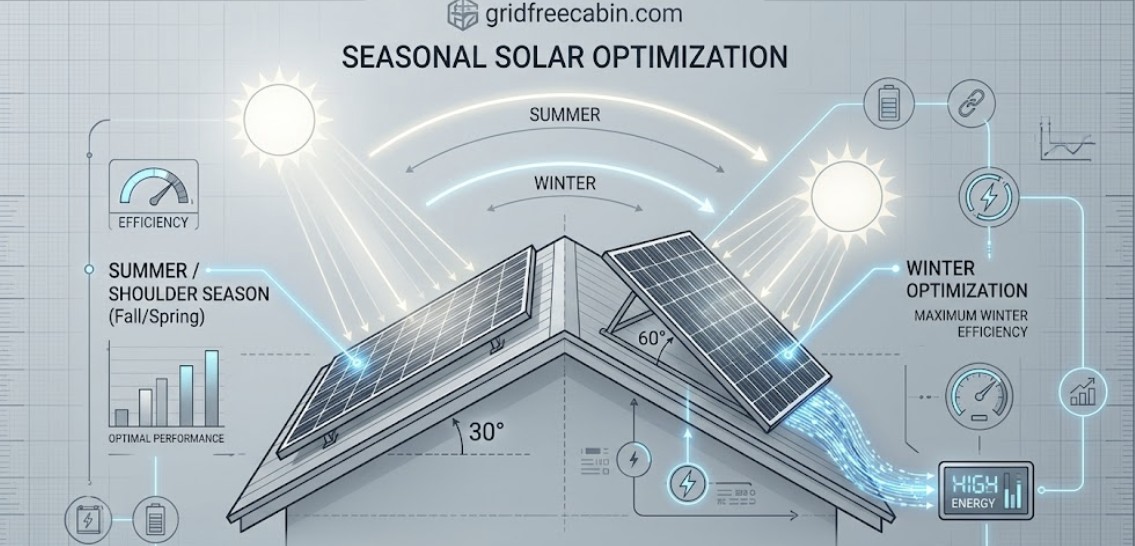
Why Solar Panel Angle Matters More for Small Cabins
Fixed roof-mounted panels are optimized for summer production. However, small cabins depend heavily on winter and shoulder season performance.
Recommended tilt angles:
- Summer: 15°–25°
- Spring/Fall: 30°–45°
- Winter: 50°–65°
Most people mount their panels flat on the roof and lose 25% of their winter power. I always tell my clients to use [Renogy Adjustable Tilt Mounts]. For a 400 sq ft cabin, being able to tilt your panels up to 60° in the winter can be the difference between needing to run a noisy generator and staying fully charged by noon. It’s a low-cost hardware fix that yields a massive technical gain in the “shoulder seasons.”
Check current price on Amazon –>
Technical Gain From Adjustable Solar Mounts
Adjustable mounts can increase energy harvest:
- Spring/Fall: 10%–15% increase
- Winter: 20%–25% increase
- Annual average gain: 10%–20%
For a 2 kW solar array:
- Winter production: 5 kWh/day
- With adjustable tilt: 6–6.5 kWh/day
That extra 1–1.5 kWh can:
- Reduce generator use
- Prevent battery depletion
- Support heating loads
Recommended Adjustable Mount Types
Best options for 400 sq ft cabins:
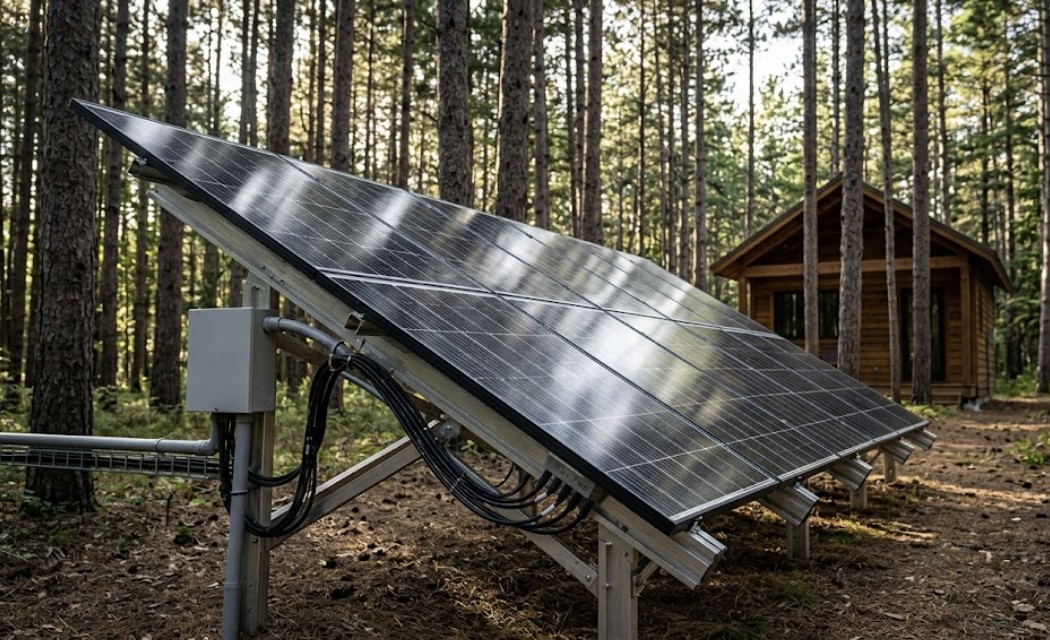
- Manual tilt ground mounts
- Adjustable roof brackets
- Seasonal tilt rack systems
Ground mounts are especially useful because:
- Easier to adjust
- Easier snow removal
- Higher winter performance
Shoulder Season Energy Strategy for 400 Sq Ft Cabins
Optimal setup includes:
- 9,000 BTU Mini-Split in Eco Mode
- Adjustable solar panel mounts
- 10–15 kWh battery bank
- Backup generator (optional but recommended)
This approach ensures reliable power during the most challenging months.
Roof vs Ground Mounted Solar Panels
Roof Mount
| Pros | Cons |
| Lower cost Less wiring Space efficient | Fixed angle Harder maintenance |
Ground Mount
| Pros | Cons |
| Adjustable tilt Higher efficiency Easier maintenance | Fixed angle Harder maintenance |
If you choose a ground mount for easier tilt adjustments, make sure to implement a [stealth setup to conceal panels] from potential theft or wildlife damage.
Generator Backup for Small Cabin Systems
Backup generators improve reliability.
Typical generator sizes:
| Cabin Type | Generator Size |
|---|---|
| Minimal | 1000W |
| Standard | 2000W |
| Comfortable | 3000W |
Backup generators are used:
- Cloudy weeks
- Winter months
- High appliance demand
Inverter Size for 400 Sq Ft Cabin
The inverter converts DC battery power to AC.
Recommended inverter sizes:
| Power Usage | Inverter Size |
|---|---|
| Minimal | 1000W |
| Standard | 2000W |
| Comfortable | 3000W |
Most 400 sq ft cabins use: 2000W pure sine wave inverter
Complete 400 Sq Ft Cabin Power System Example
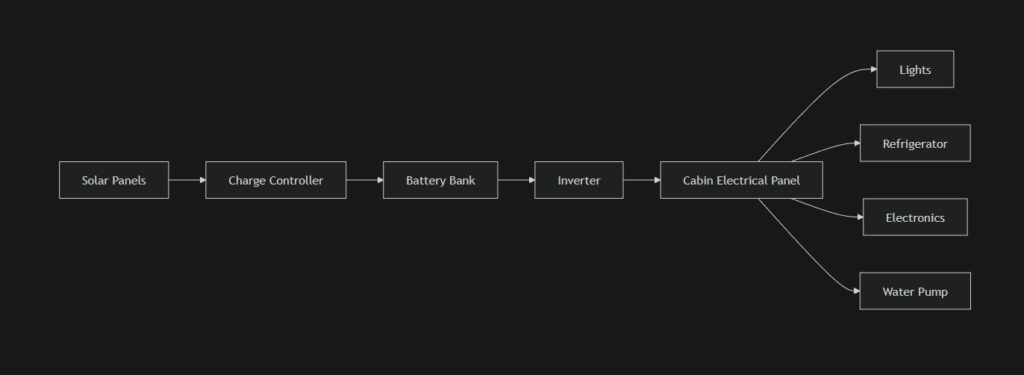
Typical System:
- 5 × 400W solar panels
- 12 kWh lithium battery
- 2000W inverter
- Charge controller
- Backup generator
Daily Output: ≈ 8–10 kWh
This configuration supports:
- Lights
- Refrigerator
- Laptop
- Internet
- Water pump
- TV
Estimated Cost of 400 Sq Ft Cabin Solar System
| Component | Cost Range |
|---|---|
| Solar Panels | $1,200–$3,000 |
| Battery Bank | $3,000–$8,000 |
| Inverter | $500–$1,500 |
| Charge Controller | $300–$800 |
| Wiring & Mounting | $500–$1,500 |
Total of $5,500 – $14,000
Once you know your power needs, the next step is budgeting. See our [solar panels for tiny home cost] guide to see how tax credits can lower your total price.
Mermaid Diagram: 400 Sq Ft Cabin Solar System Layout
Energy Efficiency Tips to Reduce 400 Sq Ft Cabin Power Needs
Use 12V Appliances
Advantages:
- Less inverter loss
- Higher efficiency
- Smaller battery needed
Install LED Lighting
LED lighting reduces:
- Energy use by 80%
- Heat generation
- System size
Use Propane for Heating and Cooking
Electric heating consumes:
- 1,500W continuous power
Propane reduces:
- Solar system cost
- Battery size
400 Sq Ft Cabin Power Needs vs Cabin Size Comparison
| Cabin Size | Daily Use | Panels |
|---|---|---|
| 200 sq ft | 3–5 kWh | 2–3 |
| 400 sq ft | 6–8 kWh | 4–5 |
| 800 sq ft | 10–15 kWh | 6–10 |
| 1500 sq ft | 25–30 kWh | 15–20 |
If your project is closer to 200 sq ft, follow our specialized [solar setup for micro cabin] guide for more compact and portable options
Off-Grid vs Grid-Connected Cabin Power
| Off-grid | Grid-connected |
| Higher upfront cost No monthly bills Full independence | Lower upfront cost Monthly electricity cost Limited remote locations |
Common Mistakes When Planning 400 Sq Ft Cabin Power Needs
Undersized Battery Bank
Results:
- Nighttime outages
- Reduced system lifespan
Too Few Solar Panels
Results:
- Poor winter performance
- Generator dependency
Overusing Electric Heating
Results:
- Massive battery requirement
- System overload
Recommended 400 Sq Ft Cabin Power Setup (Best Overall)
Ideal configuration:
- 2 kW solar array
- 12–15 kWh battery
- 2000W inverter
- Backup generator
This setup balances:
- Reliability
- Cost
- Efficiency
Final 400 Sq Ft Cabin Power Needs Summary
Typical 400 sq ft cabin:
- Daily use: 6–8 kWh
- Solar panels: 4–6 panels
- Battery storage: 10–15 kWh
- Inverter: 2000W
With proper planning, a 400 sq ft cabin can operate:
- Fully off-grid
- Year-round
- With minimal maintenance
A well-designed system delivers independence, reliability, and long-term cost savings while maintaining modern comfort in a compact off-grid cabin.
How much electricity does a 400 sq ft cabin typically use?
A 400 sq ft cabin typically uses between 5 and 10 kWh per day depending on lifestyle, appliances, and climate. A minimal off-grid setup with LED lights, a small refrigerator, and device charging may only require 3–5 kWh per day. A more comfortable cabin including a water pump, internet, television, and small appliances usually requires 6–8 kWh daily. Cabins using electric heating or air conditioning can push power needs to 10–15 kWh per day, significantly increasing solar panel and battery requirements.
How many solar panels are needed for a 4400 sq ft cabin power needs?
Most 400 sq ft cabins require between 4 and 6 solar panels rated at 400 watts each. This typically provides between 1.6 kW and 2.4 kW of solar capacity, which is enough to generate 6–10 kWh of electricity per day depending on sunlight hours. Cabins in northern climates or areas with limited sunlight may require additional panels to maintain reliable year-round power, especially during winter months.
What size battery is best for a 400 sq ft off-grid cabin?
A battery bank between 10 kWh and 15 kWh is ideal for most 400 sq ft cabins. This size provides one to two days of backup power during cloudy weather or nighttime usage. Minimal cabins may function with 5–8 kWh of storage, while high-comfort cabins with more appliances often benefit from 15–20 kWh to maintain consistent power without relying heavily on a generator.
Can a 400 sq ft cabin run completely off-grid year-round?
Yes, a 400 sq ft cabin can run completely off-grid year-round with proper system design. A well-balanced setup typically includes a 2 kW solar array, 12–15 kWh battery storage, a 2000W inverter, and a backup generator. Using energy-efficient appliances, propane heating, and LED lighting significantly improves reliability and reduces system costs, making full off-grid living practical even in colder climates.
What appliances use the most power in a 400 sq ft cabin power needs?
The largest power consumers in a 400 sq ft cabin are electric heating, air conditioning, refrigerators, microwaves, and water pumps. Electric heaters and air conditioners use the most electricity and can quickly increase system size requirements. Refrigerators run continuously and represent one of the biggest daily loads. Choosing efficient appliances, using propane for heating and cooking, and limiting high-wattage devices helps reduce overall power needs and keeps the solar system affordable and reliable.
How does a mini-split affect my solar needs in a 400 sq ft cabin power needs?
A 9,000 BTU mini-split is the most efficient HVAC option for this size, but it is still a high-draw appliance. In “Eco Mode,” it may pull 300W–600W. If you plan to run it for 8 hours a day, you must add at least 3–5 kWh to your daily energy budget.
11 thoughts on “400 Sq Ft Cabin Power Needs: Complete Off-Grid Energy Planning Guide”