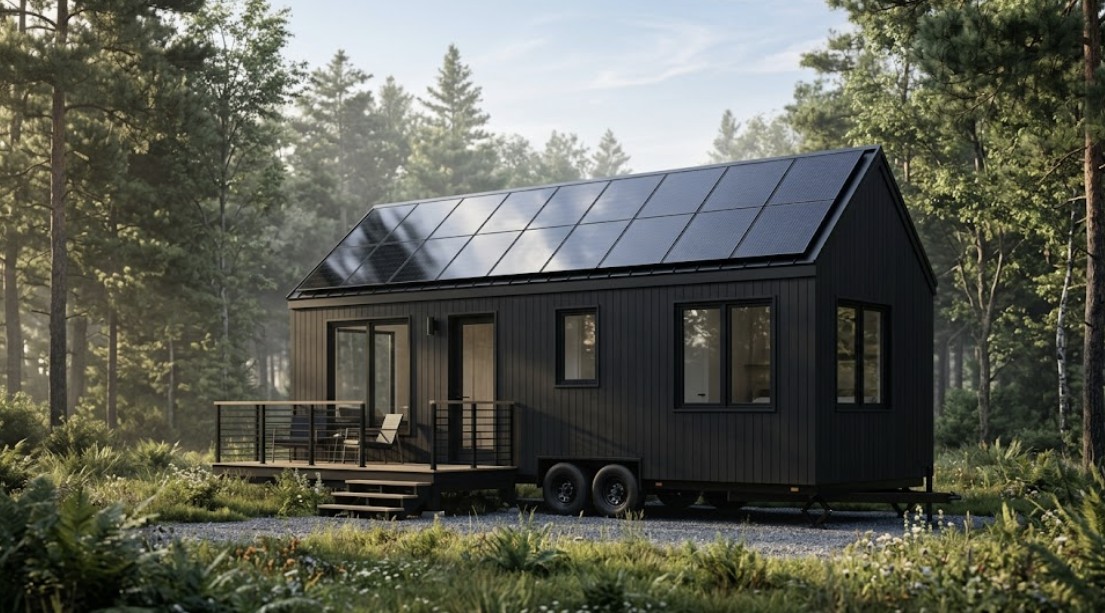
Solar energy and tiny homes form one of the most efficient and cost-effective combinations in modern housing. When we design solar panels for tiny home cost calculations, we typically find dramatically lower installation expenses, faster payback periods, and greater energy independence compared to traditional homes.
Because tiny homes require less electricity, solar systems between 1kW and 5kW can power most setups — significantly reducing total investment while maintaining full energy coverage.
This comprehensive guide provides:
- Real solar panels for tiny home cost breakdowns
- Equipment pricing tables
- System sizing examples
- Off-grid vs grid-tied comparisons
- Battery storage pricing
- ROI and payback analysis
- Installation planning diagrams
- Practical real-world configurations
Table of Contents
How Much Do Solar Panels for Tiny Home Cost in 2026?
The average solar panels for tiny home cost ranges between:
| System Size | Typical Tiny Home Usage | Average Cost (Before Incentives) | After 30% Tax Credit |
|---|---|---|---|
| 1 kW | Minimal appliances | $2,800 — $3,800 | $1,960 — $2,660 |
| 2 kW | Basic living | $4,800 — $6,500 | $3,360 — $4,550 |
| 3 kW | Full-time living | $7,500 — $9,800 | $5,250 — $6,860 |
| 4 kW | Heavy appliance usage | $9,500 — $12,000 | $6,650 — $8,400 |
| 5 kW | Off-grid full power | $12,000 — $16,000 | $8,400 — $11,200 |
Most tiny homes fall into the 2kW to 3kW range, making solar installation significantly more affordable than traditional homes.
Average Total Solar Setup Cost
Don’t waste weeks trying to source incompatible cables and connectors. For a tiny home, I recommend starting with the [Renogy 400W Premium Solar Kit]. It’s the most reliable “foundation” on the market. It includes four high-efficiency panels and the Rover 40A MPPT controller, which is smart enough to handle an expansion to 800W later just by adding more panels. Buying this kit saves you roughly $350 in individual shipping costs and “compatibility headaches.”
Check current price on Amazon –>
Typical full system cost:
- Grid-tied tiny home: $3,500 — $9,000
- Off-grid tiny home: $8,000 — $18,000
- Portable/mobile setup: $2,500 — $7,500
Solar Panels for Tiny Home Cost by Power Consumption
Your energy usage determines your solar system size. Here’s a realistic breakdown.
| Tiny Home Appliances | Daily Usage (kWh) |
|---|---|
| LED Lights | 0.3 kWh |
| Mini Fridge | 1.0 kWh |
| Laptop + Electronics | 0.8 kWh |
| Water Pump | 0.5 kWh |
| Small AC Unit | 2.5 kWh |
| Microwave | 1.2 kWh |
| Electric Stove | 2.0 kWh |
If your home is slightly larger or you plan to use more appliances, you should consult our detailed breakdown of [400 sq ft cabin power needs] to avoid undersizing your system.
Typical Tiny Home Energy Usage
| Usage Type | Daily Consumption | Solar System Needed |
|---|---|---|
| Minimal | 3-5 kWh | 1-2 kW |
| Moderate | 6-10 kWh | 2-3 kW |
| Full-time | 10-15 kWh | 3-4 kW |
| Off-grid heavy | 15-20 kWh | 4-5 kW |
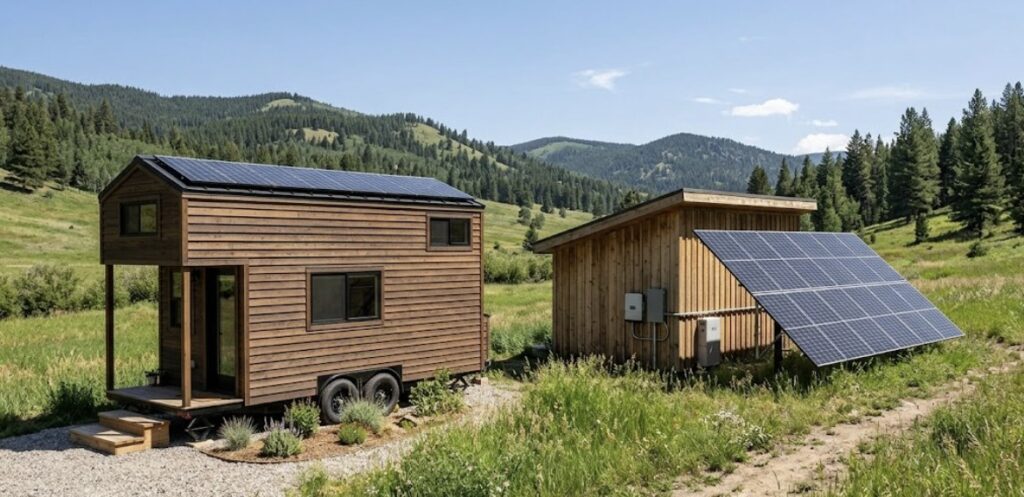
Solar Panels for Tiny Home Cost: Equipment Breakdown
Solar Panel Cost
| Panel Type | Cost per Panel | Efficiency | Best Use |
|---|---|---|---|
| Monocrystalline | $200 — $400 | 19-23% | Best for small roofs |
| Polycrystalline | $150 — $300 | 15-18% | Budget option |
| Flexible Panels | $180 — $350 | 14-17% | Mobile tiny homes |
| Portable Panels | $250 — $600 | 18-22% | Temporary setups |
While price is important, performance per square inch is what matters in a small home. Look at our technical picks for the [best solar panels for tiny house] to maximize your ROI.
Battery Storage Cost
| Battery Type | Capacity | Cost |
|---|---|---|
| Lithium Iron Phosphate | 5 kWh | $2,500 — $4,500 |
| Lithium Ion | 10 kWh | $6,000 — $9,000 |
| Lead Acid | 5 kWh | $1,500 — $2,500 |
| Portable Solar Generator | 2-5 kWh | $1,200 — $3,000 |
In a tiny home, every cubic inch is worth its weight in gold. The [LiTime 12V 100Ah Mini LiFePO4] is significantly smaller than standard Group 31 batteries but offers the same 1.28kWh of energy. It’s the “Architect’s choice” for fitting a massive battery bank under a kitchen bench or inside a tiny utility closet without sacrificing storage space for your actual life.
Check current price on Amazon –>
Battery storage increases solar panels for tiny home cost, but dramatically improves independence.
Solar Panels for Tiny Home Cost by Installation Type
Roof-Mounted Solar System
| Advantages | Disadvantages |
| Compact installation Clean design No additional land required | Limited panel capacity Harder maintenance |
Typical Cost: $3,000 — $8,000
Ground-Mounted Solar System
| Advantages | Disadvantages |
| More solar capacity Easier maintenance Better sun positioning | Requires land space Slightly higher installation cost |
Typical Cost: $5,000 — $12,000
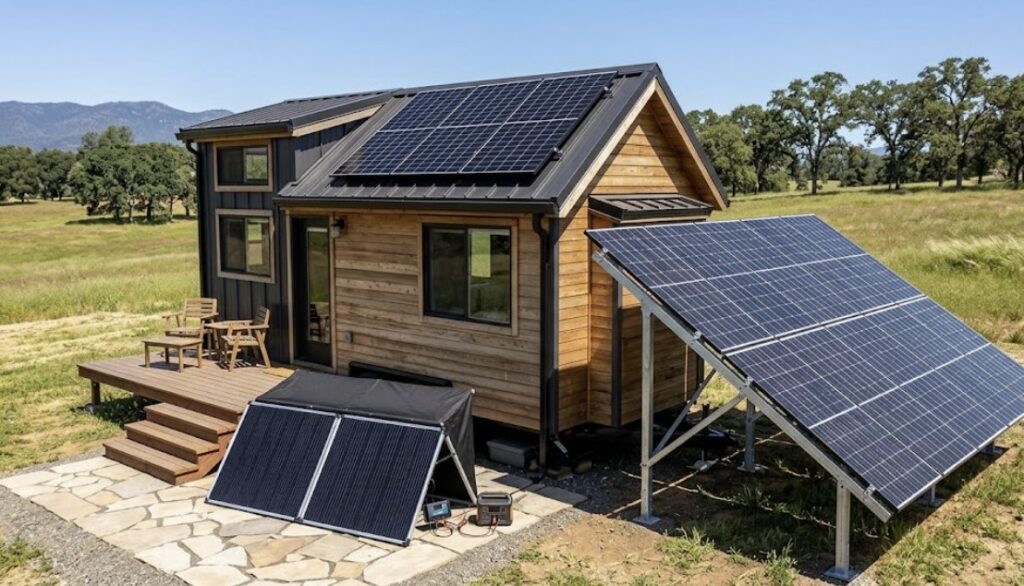
Portable Solar Setup
The biggest hidden cost of tiny home solar is professional labor ($3,000+). To skip this entirely, I suggest the [EcoFlow DELTA Pro Ultra]. It’s a portable power station that handles 6144W of AC output. For a tiny home, this is your battery, inverter, and charge controller in one box. You can plug your panels directly into it and be powered up in 10 minutes. When you factor in the $0 installation cost, this is the fastest way to reach your break-even point.
Check current price on Amazon –>
Typical Cost: $2,500 — $7,500
Solar Panels for Tiny Home Cost: Off-Grid vs Grid-Tied
| System Type | Cost | Independence | Maintenance |
|---|---|---|---|
| Grid-Tied | $3,500 — $9,000 | Low | Minimal |
| Hybrid | $6,000 — $14,000 | Medium | Moderate |
| Off-Grid | $8,000 — $18,000 | Full | Higher |
Most tiny homes benefit from a 24V or 48V configuration to handle off-grid loads efficiently. Read more about [why 24V off-grid solar systems are best for cabins] and tiny homes.
Calculating ROI: How Fast Does a Tiny House Solar System Pay for Itself?
Typical Savings:
- Monthly electricity savings: $30 — $90
- Annual savings: $360 — $1,080
ROI is predictable with current tech. We analyzed if solid-state is worth the wait in our [LiFePO4 vs solid state batteries for solar] guide.
Payback Timeline
| System Cost | Annual Savings | Payback Period |
|---|---|---|
| $4,000 | $600 | 6.6 years |
| $6,000 | $750 | 8 years |
| $8,000 | $900 | 8.8 years |
Tiny homes often reach ROI faster than traditional homes.
The speed of your ROI depends entirely on your [400 sq ft cabin power consumption]. Higher usage usually leads to a faster payback period.
How The Federal Solar Tax Credit Works in 2026
The Federal Solar Tax Credit has long been one of the most effective ways to reduce solar panels for tiny home cost. However, major policy changes in 2026 significantly altered how homeowners, businesses, and tiny home owners can qualify for incentives.
Understanding the current tax credit structure is essential before calculating your solar investment, especially for tiny homes where system sizes and budgets are smaller and more sensitive to incentive changes.
You can find the official filing requirements and eligible expenses under the [IRS Investment Tax Credit (ITC) guidelines].
Residential Federal Solar Tax Credit Expired in 2025
As of December 31, 2025, the Residential Solar Tax Credit (Section 25D) officially expired. This means:
- Homeowners installing solar in 2026 no longer qualify for the 30% federal tax credit
- Tiny homes used as primary residences do not receive federal incentives
- Only commercial solar installations remain eligible
This change increases the solar panels for tiny home cost for residential installations, making careful budgeting and system sizing more important than ever.
However, there are still scenarios where tiny home owners may qualify.
To track any new legislative updates or state-specific rebates, check the [DSIRE database for renewable energy incentives].
Commercial Solar Tax Credit Still Available Through 2027
The Commercial Federal Solar Tax Credit (Section 48) remains available and offers substantial savings for qualifying tiny home setups.
This applies if your tiny home is used for:
- Airbnb or short-term rental
- Rental property
- Farm or homestead business
- Tiny home community
- Mobile business or office
Key deadlines:
| Timeline | Requirement |
|---|---|
| July 3, 2026 | Safe harbor deadline |
| December 31, 2027 | Installation deadline |
| December 31, 2030 | Extended completion if safe-harbored |
This creates a limited window to significantly reduce solar panels for tiny home cost for income-producing properties.
Commercial Solar Tax Credit Percentage in 2026
For systems under 1 Megawatt (which includes nearly all tiny homes):
- Base Credit: 30%
- Maximum Credit: Up to 70% with adders
Available tax credit adders:
| Tax Credit Bonus | Additional Credit |
|---|---|
| Energy Communities | +10% |
| Domestic Content | +10% |
| Low-Income Areas | +10% to +20% |
These incentives can dramatically reduce installation costs for qualifying tiny home businesses.
Safe Harboring: Locking in Your Solar Tax Credit
Safe harboring allows businesses to reserve tax credit eligibility before installing their solar system.
Requirements include:
- Spend at least 5% of project cost
- Purchase solar equipment
- Take delivery before July 3, 2026
Recommended investment:
- 6–7% upfront to avoid price fluctuation issues
Safe harboring extends installation flexibility and helps reduce risk when planning solar for tiny homes.
Energy Community Tax Credit Bonus (+10%)
Tiny homes located in certain regions may qualify for an additional 10% tax credit.
Eligible areas include:
- Former coal mining areas
- Fossil fuel-dependent regions
- Brownfield redevelopment sites
- High unemployment energy communities
This incentive encourages renewable energy adoption in transitioning energy regions.
Domestic Content Bonus (+10%)
Projects using U.S.-manufactured materials may qualify for an additional 10% tax credit.
Requirements:
- 100% U.S. steel and iron
- 45% U.S. manufactured components (2026)
- 55% requirement starting 2027
Eligible components:
- Solar panels
- Inverters
- Mounting hardware
- Electrical components
Ground-mounted tiny home systems often qualify more easily.
Low-Income Community Bonus (+10% to +20%)
This incentive applies to:
- Multi-family housing
- Community solar projects
- Low-income developments
Requirements:
- Poverty rate ≥ 20%
- Income below 80% area median
System size must be under 5 MW AC, making most tiny home developments eligible.
This program has a 1.8 GW annual cap, meaning availability may run out each year.
Commercial Solar Tax Credit Recapture Rules
To retain the tax credit, systems must remain in qualifying use for five years.
Recapture schedule:
| Year | Repayment Percentage |
|---|---|
| Year 1 | 100% |
| Year 2 | 80% |
| Year 3 | 60% |
| Year 4 | 40% |
| Year 5 | 20% |
| After Year 5 | 0% |
Recapture may occur if:
- System ownership changes
- System is destroyed
- Property use changes
- System no longer qualifies
Direct Pay Option for Nonprofits and Government Entities
Eligible entities include:
- Nonprofits
- Tribal governments
- Municipalities
- Rural electric cooperatives
Benefits:
- Receive direct payment instead of tax credit
- Available until 2027
- Extended to 2030 with safe harbor
For systems under 1 MW:
- Full 30% direct payment available
Battery Storage Tax Credit in 2026
Battery storage systems still qualify independently.
Requirements:
- Minimum 3 kWh battery capacity
- Must meet energy storage eligibility requirements
Eligible storage systems:
- Lithium batteries
- Solar generators
- Hybrid battery systems
Battery incentives help offset overall solar panels for tiny home cost.
What If You Don’t Owe Enough Taxes?
Businesses can:
- Carry credits back 3 years
- Carry credits forward 22 years
- Transfer credit to third party
This flexibility allows maximum tax credit usage.
2026 Federal Solar Tax Credit Summary
| Category | Status |
|---|---|
| Residential Solar Credit | Expired |
| Commercial Solar Credit | Active |
| Maximum Credit | Up to 70% |
| Safe Harbor Deadline | July 3, 2026 |
| Installation Deadline | December 31, 2027 |
| Extended Completion | 2030 |
| Battery Credit | Available |
These changes significantly impact solar panels for tiny home cost, making commercial-use tiny homes the most financially advantageous solar investments in 2026.
Solar Panels for Tiny Home Cost vs Traditional Home
| Home Type | Average System Size | Average Cost |
|---|---|---|
| Tiny Home | 1-5 kW | $3,500 — $15,000 |
| Small Home | 5-7 kW | $12,000 — $20,000 |
| Large Home | 8-12 kW | $20,000 — $35,000 |
Tiny homes require 60-80% less solar investment.
Regional Pricing Factors: How Location Affects Your Solar Budget
Solar costs vary based on sunlight availability.
| Location | Solar Efficiency | Recommended Size |
|---|---|---|
| California | High | 2-3 kW |
| Texas | High | 2-3 kW |
| Florida | High | 2-3 kW |
| Midwest | Medium | 3-4 kW |
| Northeast | Medium-Low | 3-5 kW |
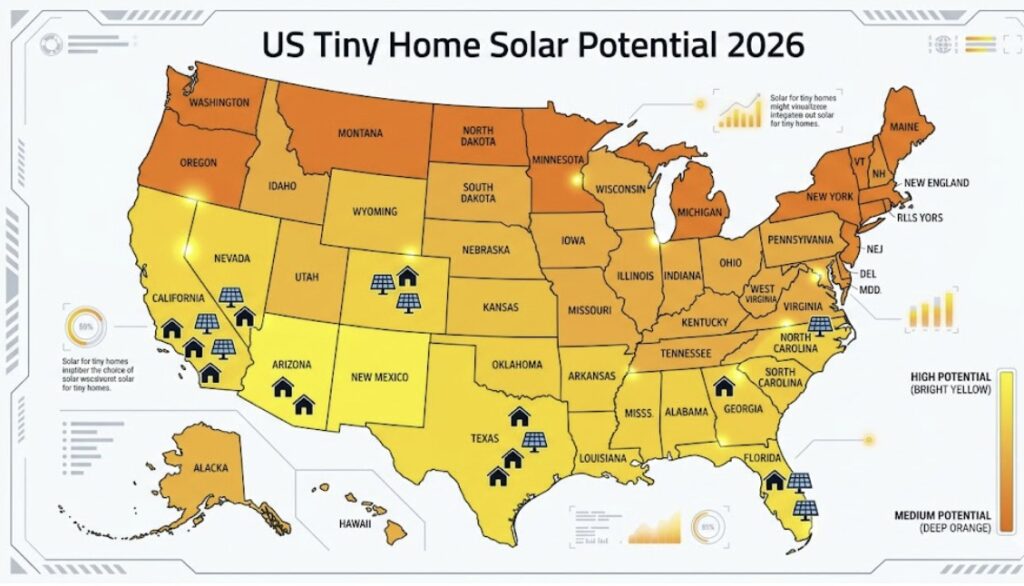
Check your specific zip code’s solar potential using the [NREL Solar Radiation Data Manual].
Solar Panels for Tiny Home Cost: Required Equipment List
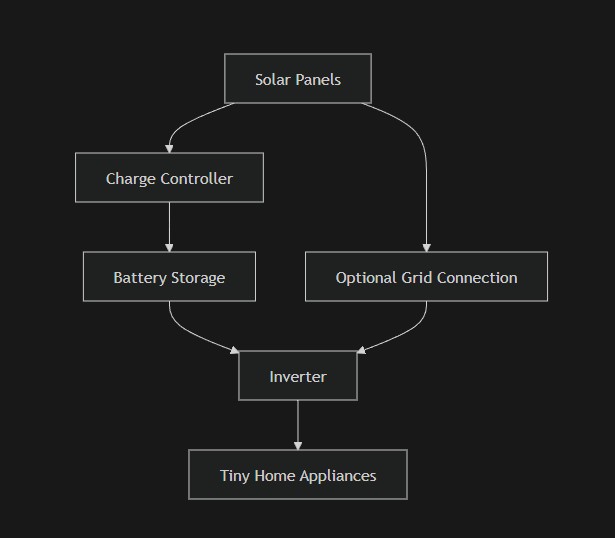
Complete solar system includes:
- Solar panels
- Inverter
- Charge controller
- Battery bank
- Wiring
- Mounting racks
- Breaker box
- Monitoring system
Equipment Cost Breakdown
| Component | Average Cost |
|---|---|
| Solar Panels | $2,000 — $6,000 |
| Inverter | $800 — $2,000 |
| Battery | $2,000 — $8,000 |
| Mounting Hardware | $300 — $900 |
| Wiring | $200 — $600 Copper prices fluctuate, making your [solar panel wire size] a significant part of your electrical budget, especially in systems with long cable runs. |
| Installation | $1,500 — $4,000 |
Your choice between budget and premium brands like [Renogy vs Victron] will be the biggest variable in your total equipment cost.
Solar Panels for Tiny Home Cost: Example Setup
Example 3kW Tiny Home Solar Setup
- 8 solar panels (400W each)
- 5kWh battery
- Hybrid inverter
Estimated Cost:
| Component | Price |
|---|---|
| Panels | $3,200 |
| Battery | $3,000 |
| Inverter | $1,200 |
| Installation | $2,000 |
Total: $9,400
After tax credit: $6,580
Tiny Home Solar System Design Diagram
Solar Panels for Tiny Home Cost: DIY vs Professional Installation
DIY Installation
Cost Savings:
- Save $1,500 — $4,000
- Ideal for off-grid users
Risks:
- Wiring mistakes
- Reduced warranty coverage
Professional Installation
Advantages:
- Warranty protection
- Faster setup
- Better efficiency
Cost: $1,500 — $4,000
If you decide to go the DIY route for a very small space, follow our step-by-step [solar setup for micro cabin] guide to ensure a safe installation.
Solar Panels for Tiny Home Cost: Best Panel Efficiency
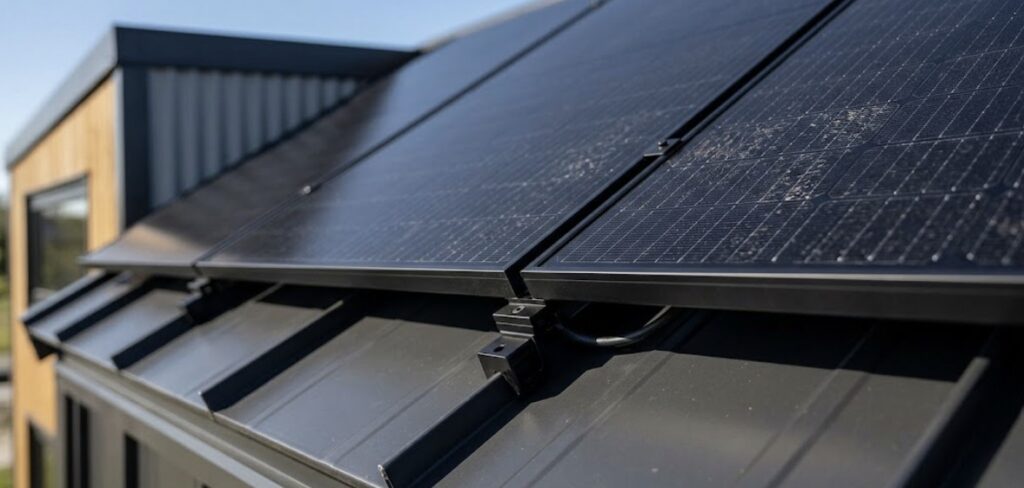
High-efficiency panels reduce space needs.
| Panel Type | Efficiency | Space Needed |
|---|---|---|
| Standard Panels | 17% | More space |
| High Efficiency | 22% | Less space |
| Premium Panels | 23% | Minimal space |
Tiny homes benefit most from high efficiency panels.
Solar Panels for Tiny Home Cost: Financing Options
Common financing:
- Solar loans
- Personal loans
- Manufacturer financing
- Solar leases
Typical Loan Example:
- $7,000 system
- 5-year loan
- Monthly payment: ~$120
Often offset by electricity savings.
Solar Panels for Tiny Home Cost: Maintenance Expenses
Solar panels require minimal maintenance.
Keeping your system secure in remote areas is as important as cleaning it. We cover protection strategies in our [complete off-grid power blueprint for retreat cabins].
Annual maintenance cost:
- Cleaning: $50 — $150
- Inspection: $100 — $200
- Replacement (10-15 years): inverter
Panels typically last 25-30 years.
Solar Panels for Tiny Home Cost: Long-Term Savings
25-Year Savings Estimate
| Annual Savings | 25-Year Savings |
|---|---|
| $500 | $12,500 |
| $750 | $18,750 |
| $1,000 | $25,000 |
Tiny homes maximize savings faster.
Is Solar Worth It for Tiny Homes?
Solar panels for tiny home cost provide:
- Lower installation cost
- Faster ROI
- Energy independence
- Off-grid capability
- Reduced environmental impact
Most tiny homeowners recover costs within 6-9 years.
Final Solar Panels for Tiny Home Cost Summary
Typical Cost Range:
- Small system: $2,500 — $5,000
- Medium system: $5,000 — $9,000
- Full off-grid: $9,000 — $18,000
Best Value Setup:
- 2-3 kW system
- 5 kWh battery
- Hybrid inverter
Average Budget Recommendation: $6,000 — $9,000
Solar panels for tiny home cost remain one of the most affordable pathways to full energy independence, making tiny homes the ideal candidates for solar power adoption.
How much do solar panels for a tiny home typically cost in 2026?
The cost of solar panels for a tiny home in 2026 typically ranges between $4,000 and $18,000 depending on system size, battery storage, and installation type. Smaller grid-tied systems without batteries tend to fall on the lower end, while fully off-grid systems with battery storage cost more. Because tiny homes require less electricity, the total investment is significantly lower than traditional home solar systems, making solar one of the most practical upgrades for tiny home owners.
Can a tiny home run completely on solar power?
Yes, most tiny homes can run entirely on solar power, especially when paired with battery storage. Tiny homes typically consume far less energy than standard houses, which makes full off-grid living much easier to achieve. A properly sized system with batteries can power lighting, refrigeration, water pumps, electronics, and even small air conditioning systems. Many tiny home owners choose solar specifically for energy independence and the ability to live in remote locations.
How long does it take for a tiny home solar system to pay for itself?
The average payback period for solar panels on a tiny home is between four and eight years, depending on electricity savings, system cost, and whether installation is DIY or professional. Because tiny homes use less energy and require smaller systems, they often reach payback faster than traditional homes. After the system pays for itself, owners typically enjoy very low or zero electricity costs for the remaining lifespan of the system, which is usually 20 to 25 years.
Do tiny homes need battery storage for solar panels?
Battery storage is not always required but is highly recommended, especially for off-grid tiny homes. Batteries allow you to store solar energy during the day and use it at night or during cloudy weather. Without batteries, grid-tied systems rely on utility power when solar production drops. For tiny homes located in remote areas, battery storage is essential to maintain consistent power and avoid outages.
Is installing solar on a tiny home easier than on a traditional house?
Yes, installing solar panels on a tiny home is usually easier and faster than on a traditional house. Tiny homes have smaller roofs, shorter wiring distances, and simpler electrical systems. This reduces both labor time and installation complexity. Many tiny home owners even choose DIY installations because the smaller system size makes the project more manageable.
What factors affect solar panels for tiny home cost the most?
Several factors influence the total cost, including system size, battery storage, installation type, and location. Off-grid systems with batteries are typically the most expensive, while grid-tied systems without storage are the least expensive. Panel efficiency, mounting style, and professional versus DIY installation also affect pricing. Weather conditions and sunlight availability in your region can also influence how large your system needs to be.
Is solar still worth it for tiny homes in 2026 without the residential tax credit?
Solar can still be worth it even without the residential tax credit because tiny homes require smaller and more affordable systems. Lower electricity consumption, minimal maintenance costs, and long system lifespans still provide strong long-term savings. Additionally, tiny homes used for rentals or business purposes may still qualify for commercial solar incentives, which can significantly reduce upfront costs.
8 thoughts on “Solar Panels for Tiny Home Cost: Complete 2026 Pricing Guide, System Sizes, and Real-World Budget Breakdown”