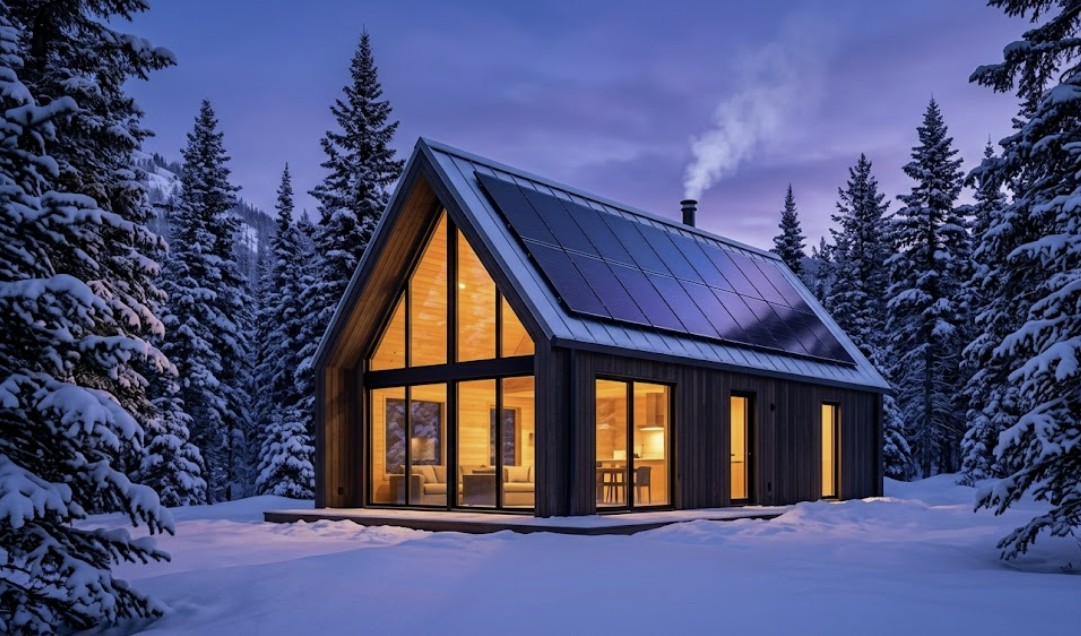
A 400 sq ft cabin power consumption profile is very different from a standard home. Small cabins are designed for efficiency, but actual electricity use depends on heating, cooling, appliances, insulation quality, occupancy habits, and whether the cabin operates on-grid or fully off-grid.
Most 400 sq ft cabins consume between 8 kWh and 25 kWh per day, with efficient off-grid cabins averaging 10–15 kWh daily, while cabins using electric heating, air conditioning, water heaters, and full-size appliances can exceed 20+ kWh per day.
Understanding exact 400 sq ft cabin power consumption is essential for:
- Solar system sizing
- Battery bank calculations
- Generator backup planning
- Monthly electricity budgeting
- Off-grid independence
- Preventing inverter overload
This guide provides exact calculations, realistic appliance loads, solar sizing formulas, and expert design recommendations.
Table of Contents
Average 400 Sq Ft Cabin Power Consumption
A well-designed 400 sq ft cabin typically falls into one of three usage categories:
| Cabin Type | Daily Usage (kWh/day) | Monthly Usage (kWh/month) | Typical Setup |
|---|---|---|---|
| Minimal Off-Grid Cabin | 6–10 | 180–300 | Lights, fridge, laptop, fan |
| Standard Full-Time Cabin | 10–18 | 300–540 | Kitchen, hot water, TV, appliances |
| High-Consumption Cabin | 18–30+ | 540–900+ | HVAC, electric heating, washer, dryer |
For accurate 400 sq ft cabin power consumption planning, square footage alone is never enough. Appliance selection matters more than cabin size.
For example:
- Mini fridge vs full-size refrigerator
- Propane stove vs electric range
- Wood stove vs electric heater
- Tankless propane water heater vs electric water heater
These choices can double or triple total power demand.
How to Calculate 400 Sq Ft Cabin Power Consumption
We use the standard formula:
Daily Energy (Wh)=Power (W)×Hours UsedThen convert watt-hours to kilowatt-hours:
Daily Energy (kWh)=1000Total WhStop guessing your appliance wattage based on stickers. Labels show “peak” power, but real consumption is often much lower. I always tell my clients to use a [P3 Kill A Watt Meter]. You plug your fridge or laptop into it for 24 hours, and it tells you exactly how many kWh it consumed. It’s the only way to get a “bulletproof” number for your solar sizing and avoid overspending $2,000 on batteries you don’t actually need.
Check current price on Amazon –>
Translating your consumption into a purchase list is next. Once you have these numbers, head over to our [400 sq ft cabin power needs] guide to design your hardware setup.
Real Appliance Load Example for a 400 Sq Ft Cabin
| Appliance | Watts | Hours/Day | Daily Use (Wh) |
|---|---|---|---|
| Mini Refrigerator | 150 | 8 | 1,200 |
| LED Lights (6) | 60 | 5 | 300 |
| Laptop | 65 | 6 | 390 |
| Wi-Fi Router | 20 | 24 | 480 |
| TV | 100 | 4 | 400 |
| Microwave | 1,000 | 0.3 | 300 |
| Coffee Maker | 800 | 0.25 | 200 |
| Water Pump | 700 | 0.5 | 350 |
| Ceiling Fan | 75 | 8 | 600 |
| Phone Charging | 20 | 3 | 60 |
While water pumps consume power, you can maximize every drop by recycling your shower and laundry water. Check out this guide on [residential greywater recycling systems] to reduce your total well-pump runtime.
Total Daily Use
4,280 Wh/day = 4.28 kWh/day
This is highly efficient and excellent for solar-powered living.
If you plan to work remotely, [Starlink power consumption for off-grid cabins] can add 1.5–2.5 kWh to your daily total.
However, add electric heating:
| Appliance | Watts | Hours/Day | Daily Use |
|---|---|---|---|
| Space Heater | 1,500 | 8 | 12,000 Wh |
Now total becomes: 16.28 kWh/day
Heating is the single biggest driver of 400 sq ft cabin power consumption.
Electric heating can break an off-grid budget. We discuss passive solar design and better insulation strategies in our [complete off-grid power blueprint for retreat cabins].
400 Sq Ft Cabin Power Consumption With Heating and Cooling
Electric Heating
Extremely expensive for off-grid systems.
| Heater Type | Typical Daily Use |
|---|---|
| Space Heater | 8–15 kWh |
| Baseboard Heating | 10–20 kWh |
| Electric Furnace | 15–30+ kWh |
While I usually advise against electric heat off-grid, if you must use it, don’t use a standard fan heater. I specify the [De’Longhi Mica Thermic Panel]. Unlike coil heaters that cycle on and off with massive surges, Mica technology provides a more consistent, radiant heat that is gentler on your inverter. It’s silent, wall-mountable (perfect for a 400 sq ft footprint), and much more efficient at maintaining a “base temperature” without crashing your battery bank.
Check current price on Amazon –>
Better Alternatives
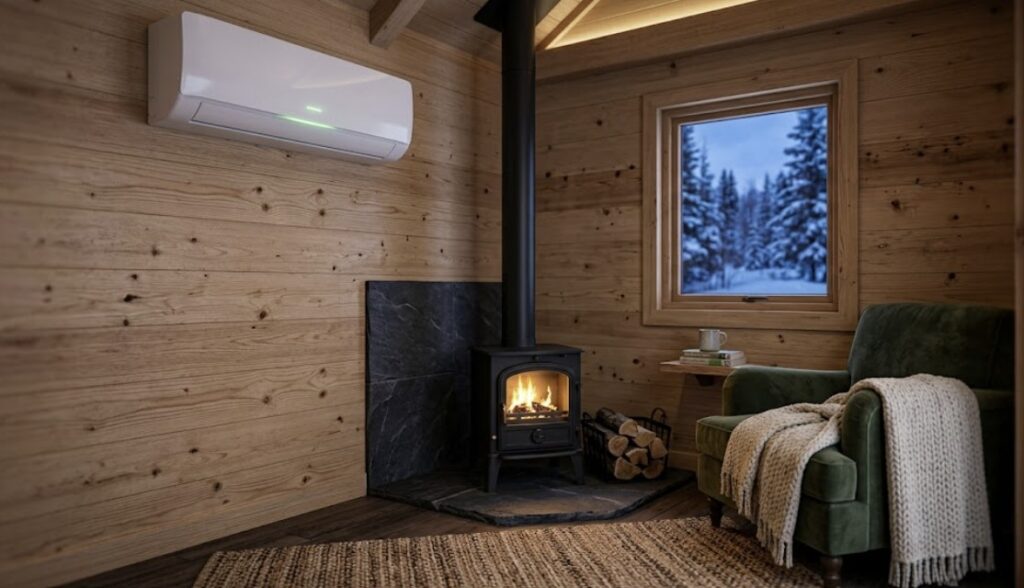
- Wood stove
- Propane heater
- Mini split heat pump
- Pellet stove
Air Conditioning
| Cooling Type | Daily Usage |
|---|---|
| Window AC | 3–8 kWh |
| Mini Split | 2–6 kWh |
| Portable AC | 4–9 kWh |
Mini splits provide the best efficiency for controlling 400 sq ft cabin power consumption.
For the most up-to-date efficiency ratings on mini-split heat pumps, consult the [AHRI Directory of Certified Product Performance].
Solar Sizing for 400 Sq Ft Cabin Power Consumption
To size solar panels:
Solar Panels Needed=Panel Output×Peak Sun HoursDaily kWhExample
Assume:
- Daily use = 10 kWh
- Panel size = 400W (0.4 kW)
- Peak sun = 4 hours
Calculation:
0.4×410=6.25You need: 7 solar panels
To cover an 8-15 kWh daily load without overspending, focus on the [best budget solar panels for off-grid cabin] that offer high durability without the premium price tag.
Add 20–30% reserve for cloudy weather: Recommended system: 8–9 panels
To meet a 10 kWh daily demand with limited roof space, you need high-efficiency hardware. See the [best solar panels for tiny house] for 2026.
Battery Bank for 400 Sq Ft Cabin Power Consumption
Battery sizing formula:
Battery Capacity=DoD×EfficiencyDaily kWh×Days of AutonomyExample
Assume:
- Daily use = 10 kWh
- 2 days autonomy
- DoD = 80%
- Efficiency = 90%
Calculation:
0.8×0.910×2=27.7 kWhRecommended: 25–30 kWh lithium battery bank
This supports reliable year-round off-grid living.
A 25–30 kWh lithium bank is a serious investment. Ensure you pick the right chemistry by checking our picks for the [best solar battery for cabin] in 2026.
Recommended Inverter Size
Inverter sizing depends on:
- Continuous load
- Startup surge load
Example Surge Loads
| Appliance | Running Watts | Startup Surge |
|---|---|---|
| Refrigerator | 150 | 800 |
| Water Pump | 700 | 2,500 |
| Microwave | 1,000 | 1,500 |
Possible simultaneous surge: 4,000W+
Recommended inverter: 3,000W continuous / 6,000W surge
This is the safest configuration for serious 400 sq ft cabin power consumption planning.
Handling surge loads like water pumps requires a robust inverter. Compare the surge capabilities of top brands in our [Renogy vs Victron] technical breakdown.
Monthly Cost of 400 Sq Ft Cabin Power Consumption
If your cabin is grid-tied or has a main electrical panel, you need to see your “energy leaks” in real-time. I recommend the [Emporia Smart Home Energy Monitor]. It installs directly into your breaker box and sends second-by-second data to your phone. It’s a “favor” because it identifies exactly which appliance is spiking your monthly bill, allowing you to adjust your habits before you commit to a solar upgrade.
Check current price on Amazon –>
Using U.S. average electricity rates:
Example
| Monthly use | Rate | Calculation |
| 400 kWh/month | $0.17/kWh | 400 x 0.17 = 68400 x 0.17= 68 |
Estimated monthly bill:
$68/month
With electric heating: 800–1,200 kWh/month
Monthly bill becomes: $136–$204+
Heating changes everything.
Electricity rates vary wildly by state. Check the latest data from the [U.S. Energy Information Administration (EIA)] to refine your budget
Best Energy-Saving Upgrades
Reducing 400 sq ft cabin power consumption is cheaper than buying more solar panels.
Highest ROI Improvements
| 1. LED Lighting | Cuts lighting loads by 75–90%. |
| 2. Propane Water Heating | Removes one of the largest electrical loads. |
| 3. Mini Split HVAC | Far more efficient than space heaters. |
| 4. Better Insulation | Reduces heating and cooling costs permanently. |
| 5. Energy Star Appliances | Especially refrigerators and washers. |
| 6. Smart Load Scheduling | Avoid running multiple surge appliances simultaneously. |
| 7. South-Facing Solar Design | Improves passive heating and solar production. |
400 Sq Ft Cabin Power Consumption by Lifestyle
| Lifestyle | Estimated Daily Use |
|---|---|
| Weekend Cabin | 4–8 kWh |
| Full-Time Minimalist Living | 8–12 kWh |
| Remote Work Cabin | 10–15 kWh |
| Family Cabin | 15–25 kWh |
| Luxury Tiny Home | 20–30+ kWh |
Lifestyle matters more than size.
A 400 sq ft cabin with electric heating and a washer/dryer may use more power than a 2,000 sq ft efficient home.
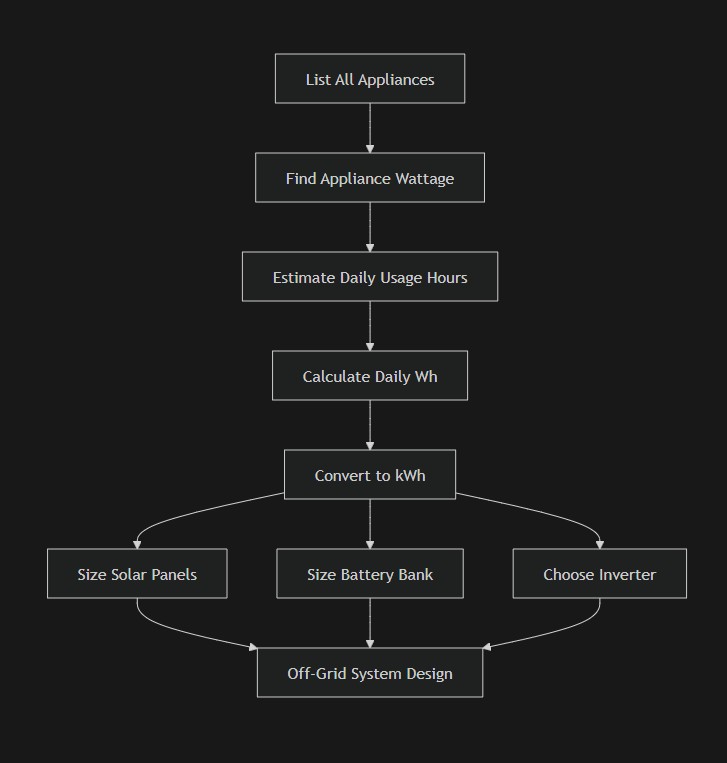
Mermaid Diagram: Cabin Energy Planning Workflow
Common Mistakes in 400 Sq Ft Cabin Power Consumption Planning
| Underestimating Heating Loads | This causes most solar failures. |
| Ignoring Surge Loads | Generators and inverters fail here. |
| Oversizing Cheap Lead-Acid Batteries | Lithium is usually better long-term. |
| Using Full-Size Residential Appliances | Compact appliances dramatically reduce costs. |
| No Backup Generator | Even strong solar systems need emergency backup. |
High consumption often leads to high amperage. Avoid melting wires by choosing the right system voltage see our [12V vs 24V vs 48V solar system] engineering comparison.
Ignoring how the cold affects your storage is a recipe for darkness. Read our expert tips on [winter solar charging lithium batteries] before the first frost hits.
Final Answer: How Much Power Does a 400 Sq Ft Cabin Use?
Most 400 sq ft cabin power consumption falls between: 8 to 18 kWh per day
Efficient off-grid cabins: 6 to 12 kWh/day
Cabins with electric HVAC and heavy appliances: 20+ kWh/day
The exact number depends on:
- Heating method
- Appliance efficiency
- Occupancy
- Climate
- Solar exposure
- Insulation quality
- Water heating system
- Full-time vs seasonal use
The smartest approach is always:
Reduce demand first, then size solar second.
That strategy delivers the lowest cost, the highest reliability, and true long-term energy independence.
What is the average 400 sq ft cabin power consumption per day?
The average 400 sq ft cabin power consumption usually ranges between 8 kWh and 18 kWh per day. A highly efficient off-grid cabin with LED lighting, propane heating, and compact appliances may only use 6 to 10 kWh daily, while a cabin with electric heating, air conditioning, and full-size appliances can exceed 20 kWh per day.
How much electricity does a 400 sq ft cabin use per month?
A typical 400 sq ft cabin power consumption per month falls between 240 kWh and 540 kWh for standard living. If the cabin uses electric heating or cooling systems, monthly electricity usage can increase to 700 kWh or more depending on climate and seasonal demand.
How many solar panels are needed for 400 sq ft cabin power consumption?
For average 400 sq ft cabin power consumption of 10 kWh per day, most cabins need around 7 to 9 solar panels using 400-watt panels with 4 peak sun hours daily. The exact number depends on local sunlight conditions, appliance load, and whether the cabin is used full-time or only on weekends.
Can solar panels run a 400 sq ft cabin completely off-grid?
Yes, solar panels can fully support 400 sq ft cabin power consumption if the system is properly sized. A complete off-grid setup usually includes solar panels, a lithium battery bank, an inverter, and a backup generator. Energy-efficient appliances and non-electric heating systems make full off-grid living much easier and more affordable.
Does electric heating increase 400 sq ft cabin power consumption?
Yes, electric heating is the biggest factor that increases 400 sq ft cabin power consumption. A single 1,500-watt space heater running for 8 hours can use 12 kWh per day by itself. This is why many cabin owners choose propane heaters, wood stoves, pellet stoves, or mini split heat pumps instead.
What size battery bank is needed for 400 sq ft cabin power consumption?
For 400 sq ft cabin power consumption of around 10 kWh per day, most off-grid systems require a battery bank between 20 kWh and 30 kWh for reliable backup and cloudy-day protection. The final battery size depends on the number of autonomy days needed and the battery type used.
What is the best inverter size for 400 sq ft cabin power consumption?
Most cabins require a 3,000W inverter with at least 6,000W surge capacity. This supports standard 400 sq ft cabin power consumption and handles startup surges from refrigerators, pumps, microwaves, and other motor-driven appliances without system shutdown.
How can I reduce 400 sq ft cabin power consumption?
The best way to reduce 400 sq ft cabin power consumption is by improving insulation, using LED lights, installing Energy Star appliances, switching to propane water heating, and avoiding electric resistance heating. A mini split heat pump is also one of the most effective upgrades for lowering total electricity demand.
8 thoughts on “400 Sq Ft Cabin Power Consumption: Complete Energy Guide for Off-Grid and Grid-Tied Living”