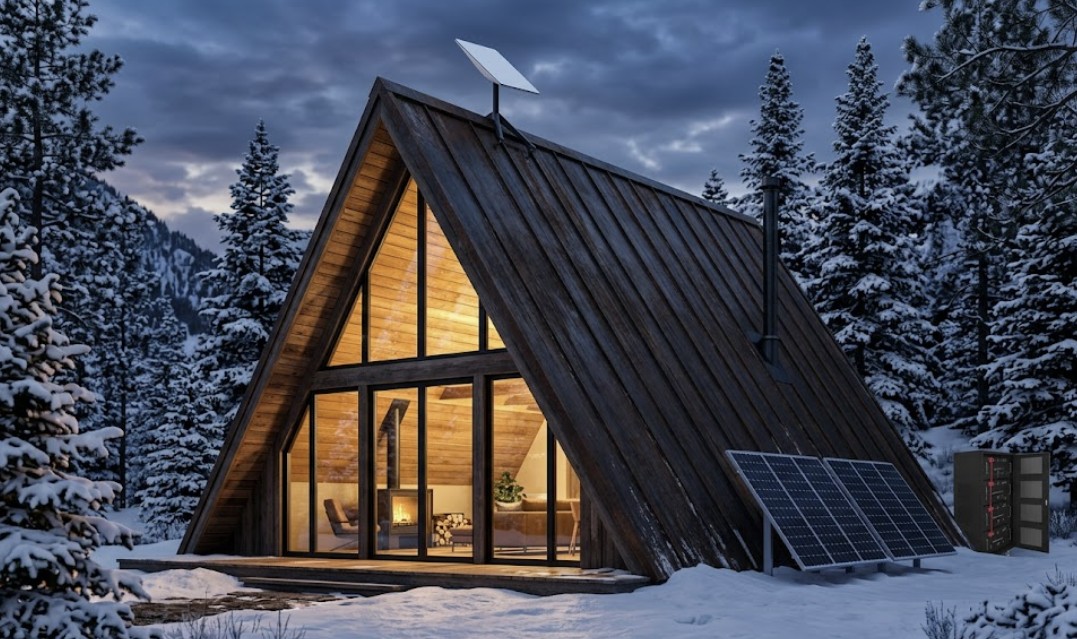
eliable internet in remote cabins is no longer a luxury. With Starlink, off-grid homeowners can work remotely, stream media, monitor security systems, and stay connected in places where fiber and cellular service fail. The real challenge is not connectivity—it is managing Starlink power consumption for off-grid cabins efficiently.
Power planning becomes critical when every watt matters. A poorly designed setup can drain batteries overnight, overload solar systems, and create expensive generator dependence. A properly optimized system can run Starlink continuously with stable performance and minimal energy waste.
In this guide, we break down real Starlink wattage, Gen 2 vs Gen 3 consumption, snow melt power spikes, DC conversion benefits, battery sizing formulas, and solar panel recommendations for year-round off-grid cabin use.
Table of Contents
Understanding Starlink Power Consumption for Off-Grid Cabins
Starlink is not a low-power device. Unlike traditional LTE routers using 10–20W, Starlink uses significantly more electricity because the phased-array antenna actively tracks satellites and includes heating functions for snow and ice removal.
Power usage depends on:
- Starlink hardware generation
- Weather conditions
- Snow Melt mode activation
- Obstructions causing higher antenna effort
- Router efficiency
- AC vs DC power conversion losses
- Runtime per day
Average Starlink Power Draw by Model
| Starlink Model | Average Power Consumption | Peak Power Usage | Snow Melt Active |
|---|---|---|---|
| Standard Gen 3 | 75–100W | 150W+ | Yes |
| Performance Gen 3 | 75–100W | 150W+ | Higher under extreme snow |
| Performance Gen 2 | 110–150W | 180W+ | Yes |
| Flat High Performance | 110–150W | 180W+ | Yes |
| Starlink Mini | Much lower | Depends on usage | Limited |
For most off-grid cabins, the main concern is the standard Gen 3 dish or Performance kit.
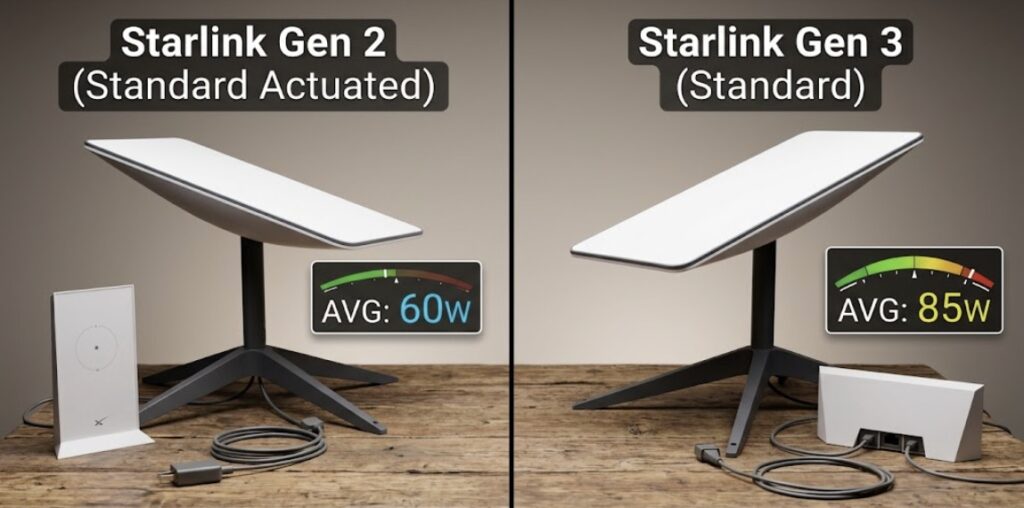
The official Starlink Performance Gen 3 specification lists average power consumption at 75–100W, while Gen 2 Performance hardware averages 110–150W. This difference has a major impact on battery bank design.
You can verify current hardware specifications and peak power ratings on the official [Starlink Support page].
Why Starlink Power Consumption Matters More in Off-Grid Cabins
A grid-connected home barely notices an extra 2 kWh per day. An off-grid cabin absolutely does.
Starlink itself may become the single largest continuous power load. To see how this fits into your total energy budget, check our [400 sq ft cabin power consumption] guide.
If Starlink runs 24/7:
- 75W average = 1.8 kWh/day
- 100W average = 2.4 kWh/day
- 150W average = 3.6 kWh/day
That is often more than:
- cabin refrigeration
- LED lighting
- laptops
- Starlink itself may become the single largest continuous power load
This is why Starlink power consumption for off-grid cabins must be planned before installation—not after batteries start failing.
Daily Energy Usage Calculation for Starlink
We calculate daily usage using:
Daily Watt-hours=Watts×HoursExample:
100W × 24 hours = 2400Wh/day
That equals: 2.4 kWh per day
If your cabin runs on a 12V battery system:
Amp-hours=Battery VoltageWatt-hours2400Wh ÷ 12V = 200Ah/day
If your cabin runs on a 12V battery system, the amperage is high. For systems with constant loads like Starlink, we recommend reviewing our [12V vs 24V vs 48V solar system] engineering comparison to see the benefits of higher voltage.
That is substantial. For a single internet connection, many users are surprised by how large the power requirement becomes.
Starlink Gen 2 vs Gen 3 for Off-Grid Solar Systems
Choosing the correct hardware matters more than many realize.
Gen 3 Advantages
- Lower average power draw
- AC + DC power supply compatibility
- Better efficiency
- Improved weather resistance
- IP68/IP69K durability
- Better snow melt management
- Easier integration with backup batteries
Gen 2 Limitations
- Higher power draw
- Mostly AC-focused setup
- More inverter losses
- Proprietary cabling
- Higher operational cost long-term
Comparison Table
| Feature | Gen 2 Performance | Gen 3 Performance |
|---|---|---|
| Average Power Usage | 110–150W | 75–100W |
| DC Input Support | Limited | Yes |
| Operating Temp | -30°C to 50°C | -40°C to 60°C |
| Environmental Rating | IP56 | IP68/IP69K |
| Snow Melt | 75mm/hr | 85mm/hr |
| Battery Efficiency | Lower | Higher |
For off-grid cabins, Gen 3 is usually the clear winner.
Snow Melt Mode and Winter Power Spikes
Winter dramatically changes Starlink power consumption for off-grid cabins.
When Snow Melt activates:
- standard operation may rise from 75W to 100–150W+
- continuous snowfall increases sustained draw
- Pre-Heat mode consumes the most power
In heavy snow regions, winter solar production also drops while Starlink power needs rise—the worst possible combination. To estimate how many snowy days you’ll face annually, use the [Global Solar Atlas] to check historical winter irradiance and climate data.
Managing winter spikes requires a robust system design. We cover these seasonal challenges in our [complete off-grid power blueprint for retreat cabins].
Snow Melt Modes
- Off
- Automatic
- Pre-Heat
For cabins using battery-only systems, Automatic mode is usually the best balance.
Pre-Heat should only be used during active snow events or severe icing conditions.
How DC Conversion Reduces Starlink Power Consumption
One of the best upgrades for off-grid cabins is DC conversion.
Most cabin systems use:
- 12V battery banks
- 24V battery banks
- solar charge controllers
- inverter systems
Standard Starlink operation often follows this inefficient path:
Battery DC → Inverter AC → Starlink Power Supply → Internal DCThis double conversion wastes 20–30% of total energy. The physics of ‘conversion loss’ explain why double-converting power is wasteful. Learn more about [AC/DC conversion efficiency] standards.
Skipping the inverter is the smartest move for efficiency. You can find detailed schematics on how to integrate DC loads in our [24V solar system wiring diagram].
Also check our [Renogy vs Victron inverter] analysis.
DC Conversion Path
Battery DC → PoE Injector → StarlinkEfficiency Favor: If you run Starlink through your inverter, you are literally throwing away 20% of your battery energy in heat. The “pro” move is to convert Starlink to native DC power. I always recommend the [Tycon Systems PoE Injector]. Combined with a 12V/24V to 48V step-up converter, this allows you to power your Dishy directly from your batteries. It’s a “favor” because it can reduce your daily consumption from 1.8kWh to almost 0.9kWh—effectively doubling your battery life for the same internet usage.
Check current price on Amazon –>
Real-World Comparison
| Setup Type | Average Power Draw |
|---|---|
| Original AC Setup | 55W |
| AC Setup + Short Cable | 49W |
| DC PoE Conversion | 28W |
That reduction can nearly cut energy consumption in half.
For off-grid cabins, DC conversion is often the single best optimization available.
Battery Bank Sizing for Starlink
Battery sizing should support:
- overnight operation
- cloudy-day reserve
- winter conditions
- snow melt spikes
Steady, safe discharge is key for constant loads. See how current and future tech compare in our [LiFePO4 vs solid state batteries for solar] analysis.
Example: 2 Days Backup
Assume:
- Starlink average = 100W
- runtime = 24 hours
- reserve = 2 days
Calculation: 100 × 24 × 2 = 4800Wh
For lithium batteries at 24V: 4800Wh ÷ 24V = 200Ah minimum
Recommended practical size: 24V 300Ah+
This allows healthy depth of discharge and system longevity.
For lithium batteries at 24V, a 300Ah bank is ideal. Choosing the right cells is vital; see our picks for the [best solar battery for cabin] to find units that handle constant discharge effectively.
Recommended Battery Sizes
| Use Pattern | Suggested Battery Bank |
|---|---|
| Weekend cabin use | 24V 100–150Ah |
| Daily remote work | 24V 200–300Ah |
| Full-time living | 24V 300–500Ah |
| Winter heavy snow | 24V 400Ah+ |
Solar Panel Sizing for Starlink Off-Grid Systems
Solar must cover:
- Starlink daily use
- battery recharge
- cloudy weather margin
Example Solar Requirement
Daily load: 2.4 kWh/day
Assume: 4 peak sun hours
Formula:
Solar Watts Needed=Peak Sun HoursDaily Wh2400Wh ÷ 4 = 600W minimum
Practical recommendation: 800–1200W solar array
This provides:
- winter margin
- charging reserve
- support for other cabin appliances
To cover 2.4 kWh/day just for internet, you need efficient hardware. Check out the [best solar panels for tiny house] for 2026 to maximize your limited roof space.
Solar Sizing Table
| Cabin Usage | Recommended Solar |
|---|---|
| Light weekend use | 400–600W |
| Full-time internet + work | 800–1200W |
| Winter off-grid living | 1200–2000W |
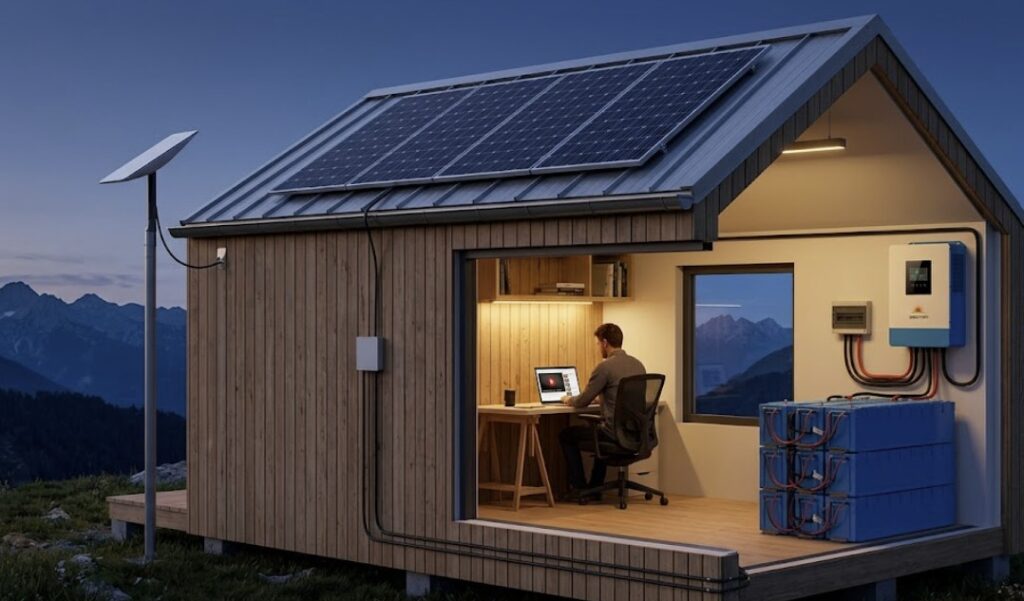
Best Practices to Reduce Starlink Power Consumption for Off-Grid Cabins
1. Use Sleep Schedules
Turn Starlink off overnight if not needed.
Even 8 hours off saves: 800Wh/day at 100W
That is a major battery improvement.
2. Improve Dish Placement
Obstructions increase tracking effort and instability.
A clear sky view improves:
- reliability
- speed
- power efficiency
3. Use DC Power Instead of AC
This is often the highest ROI upgrade.
4. Disable Unnecessary Router Loads
Use efficient networking hardware rather than oversized Wi-Fi systems.
5. Avoid Permanent Pre-Heat Mode
Use only when conditions require it.
6. Monitor Real Consumption
Use:
- smart shunts
- battery monitors
- inverter dashboards
The “No Surprises” Favor: Starlink is a “phantom load”—it changes its consumption based on satellite tracking and weather without you noticing. I specify the [Victron SmartShunt] for every Starlink setup. Unlike basic voltmeters, this tells you exactly how many amps the dish is pulling in real-time. It’s the only way to catch a “Snow Melt” spike before it drains your bank to zero. If you see the draw climb above 100W on a clear day, you’ll know something is wrong before your lights go out.
Check current price on Amazon –>
Starlink Performance Kit for Harsh Remote Cabins
For cabins in:
- mountain snow zones
- high-wind regions
- coastal storm areas
- industrial remote sites
the Performance Kit may justify higher cost.
Advantages include:
- stronger durability
- better weather tolerance
- higher snow melt capability
- wider resilience
- improved backup battery support
Its official 10-year mission design makes it attractive for permanent remote installations.
For mild-weather cabins, standard Gen 3 usually provides better cost efficiency.
Mermaid Diagram: Ideal Starlink Off-Grid Power Flow
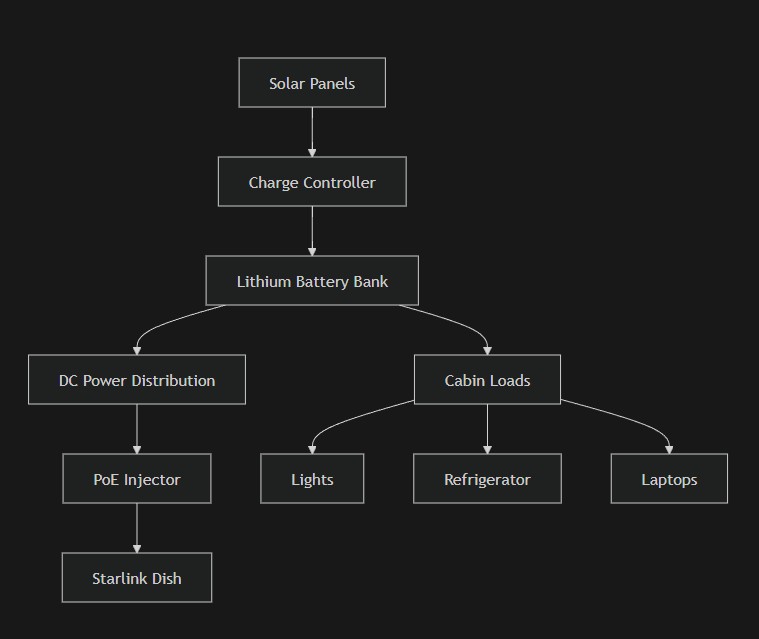
This design minimizes inverter losses and improves total system efficiency.
Recommended Setup for Reliable Off-Grid Internet
Our preferred setup for most cabins:
- Starlink Gen 3 Standard or Performance
- 24V lithium battery bank
- 800–1200W solar array
- MPPT charge controller
- DC PoE conversion
- smart battery monitoring
- overnight scheduling automation
This creates reliable internet without generator dependence.
Redundancy Favor: During deep winter or when your main system is under maintenance, you don’t want to lose your only connection to the outside world. I suggest keeping a dedicated [EcoFlow RIVER 2] just for Starlink. It acts as a high-efficiency UPS (Uninterruptible Power Supply). You can charge it during peak solar hours and let it run the dish at night, keeping your main cabin batteries reserved for critical loads like your fridge and water pump.
Check current price on Amazon –>
Pairing your Starlink with the right charge controller is essential. See how the top brands handle low-power efficiency in our [Victron vs Renogy charge controllers] comparison.
Final Verdict on Starlink Power Consumption for Off-Grid Cabins
Starlink power consumption for off-grid cabins is absolutely manageable—but only when designed correctly.
| The biggest mistakes are: | The biggest wins come from: |
| underestimating daily watt-hours ignoring snow melt winter loads relying on inverter-heavy AC setups undersizing batteries installing without DC optimization | Gen 3 hardware DC conversion proper solar sizing strong battery reserve intelligent power scheduling |
For most cabins, the goal is not simply making Starlink work. The goal is making it sustainable, efficient, and dependable in every season.
When planned correctly, Starlink becomes one of the best upgrades an off-grid cabin can have—without becoming the reason your batteries die overnight.
How much Starlink power consumption should we expect for off-grid cabins every day?
Starlink power consumption for off-grid cabins usually ranges between 1.5 kWh and 3.5 kWh per day depending on the Starlink model, weather conditions, and how many hours the system runs each day. A standard Gen 3 setup normally uses around 75W to 100W during regular operation, while older Gen 2 Performance systems can average 110W to 150W. If Starlink runs continuously for 24 hours at 100W, daily consumption reaches approximately 2.4 kWh. During winter, Snow Melt mode can increase usage even further, especially during heavy snowfall or freezing rain. This is why we always calculate Starlink power consumption for off-grid cabins based on worst-case winter conditions rather than average summer performance.
Is Starlink Gen 3 better than Gen 2 for reducing Starlink power consumption for off-grid cabins?
Yes, Gen 3 is clearly better than Gen 2 when we want to reduce Starlink power consumption for off-grid cabins because it uses less electricity, offers better efficiency, and supports both AC and DC input options. Gen 3 Performance hardware typically averages 75W to 100W, while Gen 2 Performance systems often consume 110W to 150W. This lower power draw reduces the required battery bank size, lowers solar panel requirements, and minimizes generator backup needs. Gen 3 also provides stronger weather resistance, improved snow melt performance, and better long-term reliability, making it the preferred choice for most new off-grid cabin installations.
Can Starlink run on a 12V battery system in an off-grid cabin?
Yes, Starlink can run on a 12V battery system, but careful planning is necessary because Starlink power consumption for off-grid cabins is much higher than normal internet equipment like LTE routers. A system using 2,400Wh per day at 12V requires around 200Ah of usable battery capacity every day, which can drain smaller battery banks very quickly. Many off-grid users prefer a 24V battery setup because it improves efficiency and reduces cable losses, but a 12V system can still work well if we use proper DC conversion and a quality PoE setup. The main goal is to avoid unnecessary inverter losses and ensure enough battery reserve for overnight use and cloudy days.
Does Snow Melt mode increase Starlink power consumption for off-grid cabins?
Yes, Snow Melt mode significantly increases Starlink power consumption for off-grid cabins because the dish uses additional electricity to warm the antenna surface and melt snow or ice that could block satellite signals. Under normal conditions, Starlink may use around 75W to 100W, but when Snow Melt activates, power usage can rise to 100W to 150W or more depending on weather severity. Pre-Heat mode uses even more power because it keeps the dish warm continuously instead of only reacting when snow is detected. For cabins in snowy climates, winter system design must include these extra loads to prevent battery shortages and unexpected internet outages.
What is the best battery size for Starlink power consumption for off-grid cabins?
The best battery size depends on how often we use Starlink, but for full-time internet access we usually recommend at least a 24V 200Ah lithium battery bank as the minimum starting point for managing Starlink power consumption for off-grid cabins. A more reliable year-round setup often requires 24V 300Ah or more, especially in winter or cloudy climates where solar charging is less consistent. Weekend cabins with limited internet use may work with smaller battery banks, but full-time cabins used for remote work, security systems, and daily streaming need larger reserves. Since Starlink operates as a continuous load, battery sizing should always prioritize overnight runtime and weather-related backup capacity.
How many solar panels are needed for Starlink in an off-grid cabin?
Most off-grid cabins need between 600W and 1,200W of solar capacity to handle Starlink power consumption for off-grid cabins reliably, although the exact number depends on sunlight hours, season, and total household energy demand. If Starlink uses around 2.4 kWh per day and the location receives four peak sun hours daily, the technical minimum is about 600W of solar panels. In practice, we recommend more capacity because winter sunlight is weaker and cloudy days reduce production significantly. For year-round use, especially when refrigerators, pumps, laptops, and heating systems also run from solar, 800W to 1,200W or more provides much better long-term reliability.
Does DC conversion really reduce Starlink power consumption for off-grid cabins?
Yes, DC conversion is one of the most effective ways to reduce Starlink power consumption for off-grid cabins because it removes the wasted energy caused by converting battery power from DC to AC and then back to DC again inside the Starlink power supply. Standard inverter setups often lose 20% to 30% of available energy during this process. With a direct DC PoE conversion setup, many users report power usage dropping from around 55W to as low as 28W depending on hardware and cable length. This improvement greatly increases battery runtime, reduces solar demand, and makes the entire off-grid system more efficient, especially for cabins where every watt matters.
Should we leave Starlink on 24/7 in an off-grid cabin?
Not always, because leaving Starlink on all day and night increases Starlink power consumption for off-grid cabins and may waste a large amount of stored battery energy if internet access is only needed during specific hours. Turning the system off for eight hours overnight can save around 800Wh per day at 100W usage, which significantly improves battery health and reduces solar pressure. However, if the cabin depends on remote security cameras, smart monitoring systems, weather alerts, or emergency communications, keeping Starlink online continuously may be necessary. The best solution is often using scheduled sleep periods based on real daily usage instead of running the system 24/7 by default.
8 thoughts on “Starlink Power Consumption for Off-Grid Cabins: Complete Guide to Solar Sizing, Battery Capacity, and DC Efficiency”