Table of Contents
Why Bifacial Solar Panels for Cabins Are a Game-Changer
To truly hit that 30% gain in a cabin environment, you need a panel with a high bifaciality factor. I specify the [BougeRV 200W Bifacial Panel]. Unlike standard panels, this unit has a transparent backsheet that allows the rear cells to breathe and capture albedo light from snow or gravel. It’s the “favor” that transforms your ground-mount array from a standard system into a high-performance power plant that keeps your batteries full even when the sun is low.
Check current price on Amazon –>
For remote cabins where energy reliability is critical and installation space is limited, this dual-sided generation creates a measurable advantage. Field data and simulation studies consistently show energy gains ranging from 10% to 30%, depending on terrain reflectivity, panel elevation, and seasonal conditions.
Cabin owners benefit from:
- Reduced generator dependence
- Improved winter performance
- Higher system efficiency in compact layouts
- Better long-term energy yield
How Bifacial Solar Panels Work in Cabin Environments
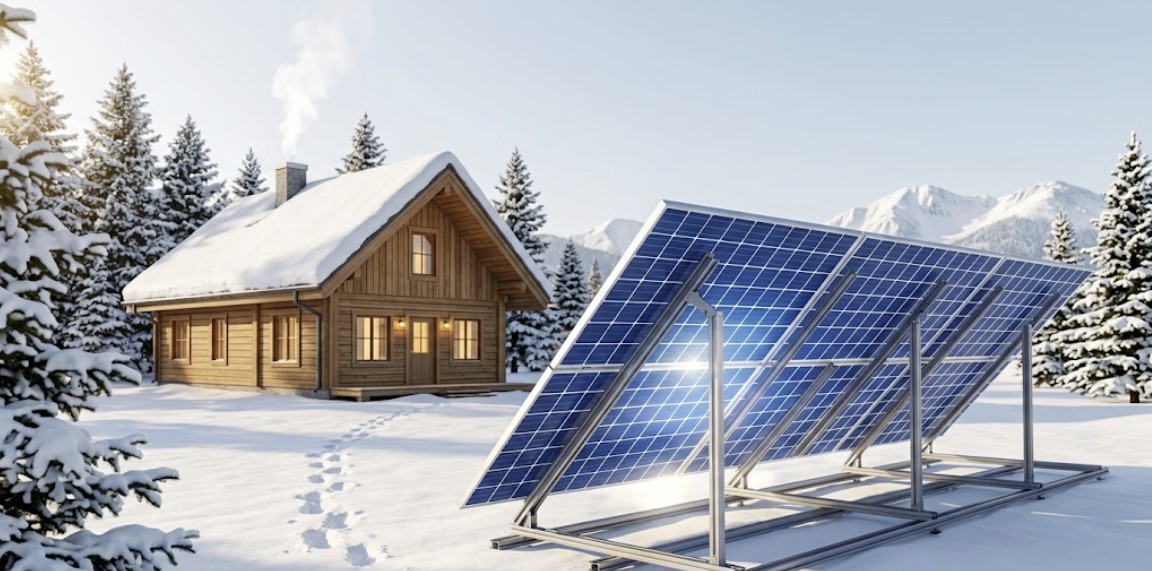
Bifacial solar panels for cabins operate by converting both direct sunlight and reflected irradiance into electricity. The front side behaves like a conventional photovoltaic module, while the rear side absorbs diffuse and reflected light from surfaces such as snow, sand, gravel, or light-colored ground cover.
Core Performance Mechanism
- Direct Irradiance (Front Side): Primary energy source
- Diffuse Light (Both Sides): Captured during cloudy conditions
- Reflected Light (Rear Side): Key to increased output
Key Technical Factors
| Parameter | Impact on Output |
|---|---|
| Albedo (0–1 scale) | Higher reflection = higher rear gain |
| Panel Height | More elevation increases rear exposure |
| Tilt Angle | Optimizes both front and rear capture |
| Ground Surface | Light surfaces maximize performance |
For cabins in snowy regions, albedo values can reach up to 0.9, dramatically increasing rear-side production during winter months.
These values are based on [NASA’s Earth Observatory data on surface albedo], which quantifies how different terrains reflect solar energy.
Advantages of Bifacial Solar Panels for Cabins
Bifacial solar panels for cabins provide measurable technical and economic advantages when installed correctly.
1. Higher Energy Yield
Bifacial modules consistently outperform monofacial panels:
- 10%–20% gain in standard conditions
- Up to 30% in high-reflectivity environments
2. Superior Winter Performance
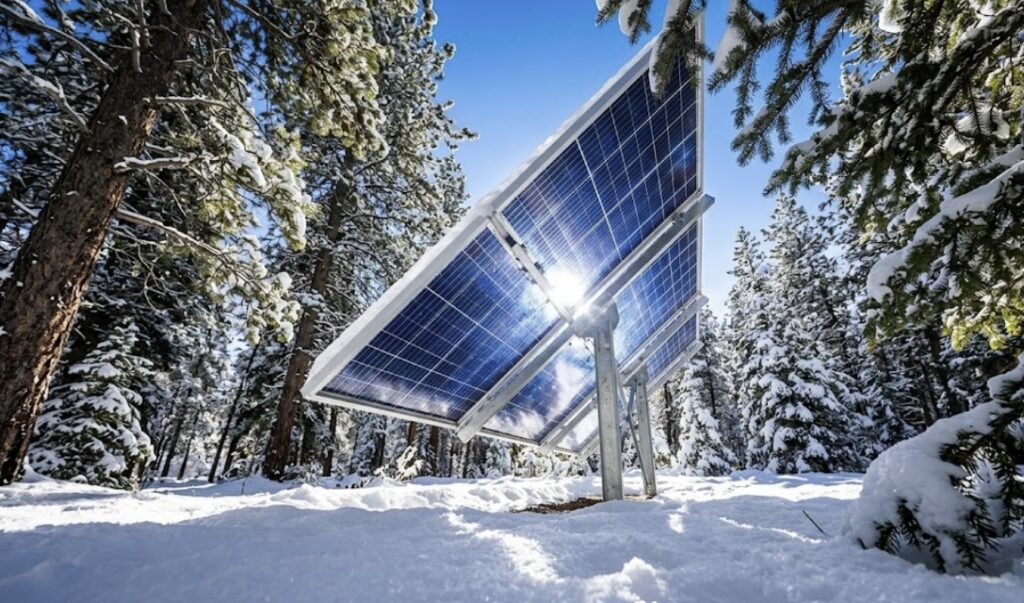
Snow acts as a natural reflector, turning winter into a high-production season rather than a limitation.
To fully capitalize on this winter boost, your storage system must be capable of handling cold-weather charging. We recommend reviewing our guide on [winter solar charging lithium batteries] to ensure your LiFePO4 bank doesn’t freeze while your panels are peaking.
3. Improved Low-Light Efficiency
Cabins often face shaded or cloudy conditions. Bifacial panels capture diffuse light more effectively, maintaining stable output.
4. Increased Durability
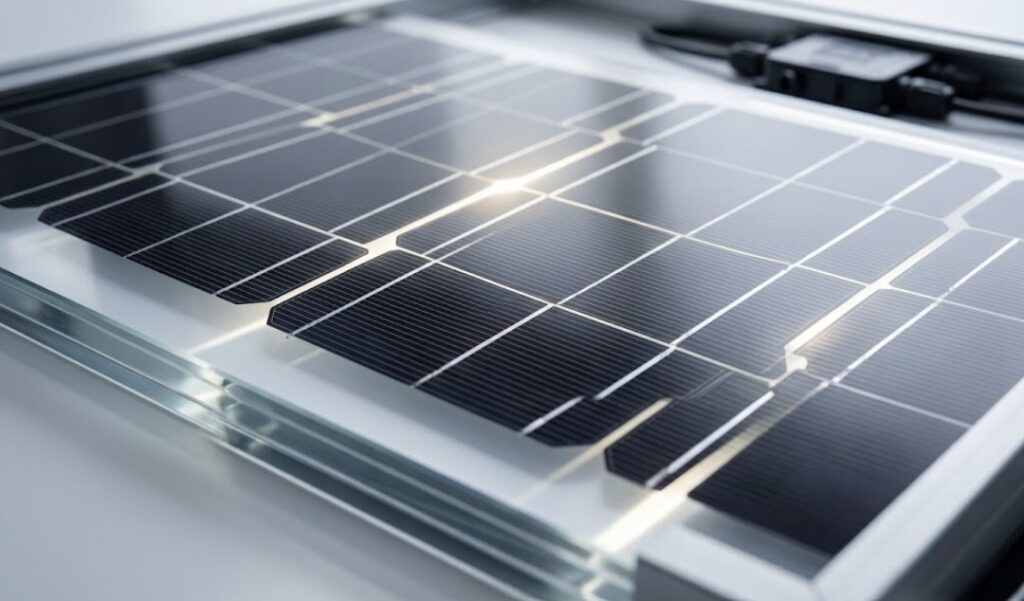
Most bifacial panels use dual-glass construction:
- Resistant to moisture ingress
- Lower degradation rates
- Extended lifespan (25–30 years)
5. Maximizing ROI: Best Bifacial PV Module Low LCOE Calculations
When analyzing the financial viability of off-grid infrastructure, selecting the best bifacial pv module low lcoe (Levelized Cost of Energy) rating becomes far more critical than simply looking at the upfront price per watt. LCOE measures the lifetime cost of your solar generation system divided by its total energy output:
$$LCOE = \frac{Total\ Lifetime\ Costs}{Total\ Lifetime\ Energy\ Output}$$Because bifacial modules capture reflected light from the ground (the albedo effect) via their rear glass substrate, they generate up to 11% to 30% more kilowatt-hours over their operational lifespan compared to traditional monofacial panels. This structural bump in lifetime energy harvest effectively drives the overall cost per kilowatt-hour straight down, making the system significantly cheaper over a 25-year cycle.
To hit the lowest possible LCOE in an independent cabin setup, your hardware selection must balance raw nominal efficiency with extreme climate durability. Industrial-grade dual-glass N-Type TOPCon bifacial modules currently dominate the low-LCOE metrics. Unlike older P-type silicon wafers, N-type architecture suffers from virtually zero Light-Induced Degradation (LID) and boasts a highly resilient temperature coefficient (typically around -0.30%/°C). This means that during peak summer hours—when heavy cabin cooling, water pumps, or workshop loads stress your electrical system—these modules maintain higher voltage metrics, preventing your hybrid inverter from clipping and squeezing every possible watt-hour into your storage setup.
However, achieving a true low LCOE isn’t just about unboxing high-efficiency panels; it depends entirely on your structural anchoring and site installation strategy. To capitalize on the rear-side energy gain, you must maintain an array ground clearance (hub height) of at least 1 meter (3.3 feet) and utilize a high-albedo ground cover, such as crushed white gravel, dry sand, or light-colored concrete pads directly beneath the racking line. If you mount a premium bifacial panel flush against a dark asphalt cabin roof, the rear gain drops to zero, completely destroying your LCOE advantage and turning your expensive dual-face investment into a standard monofacial layout.
Engineering Formula: When sizing your overcurrent protection devices (OCPD) and solar charge controllers for low-LCOE bifacial systems, always multiply the short-circuit current ($I_{sc}$) by a minimum safety factor of 1.25 (per NEC Article 690) AND add an additional 10% to 20% "bifacial gain factor" depending on your ground reflectivity. This ensures your fuses, combiners, and breakers never suffer from nuisance tripping during high-albedo winter snow conditions.Limitations of Bifacial Solar Panels for Cabins
Despite their advantages, bifacial solar panels for cabins require precise design and installation to realize their full potential.
1. Higher Initial Cost
- Typically 5–15% more expensive than monofacial panels
- Additional mounting requirements increase installation costs
2. Installation Complexity
- Requires elevated mounting structures
- Needs careful spacing to avoid rear shading
The increased output of bifacial arrays also means higher current flow. It is vital to recalculate your [solar panel wire size] to prevent voltage drop over the longer distances common in ground-mounted cabin arrays.
3. Dependence on Ground Reflectivity
Dark or vegetated surfaces reduce rear-side gain significantly.
4. Not Ideal for Flush Roof Mounts
Cabin rooftops often limit airflow and reflection, making bifacial panels less effective unless elevated.
Because bifacial modules require air gaps and rear-side exposure, they almost always necessitate a freestanding structure. You can compare the pros and cons of these setups in our [ground mount vs roof mount solar] technical guide.
Performance Comparison: Bifacial vs Monofacial for Cabins
| Feature | Bifacial Panels | Monofacial Panels |
|---|---|---|
| Energy Output | 10–30% higher | Standard output |
| Winter Efficiency | Excellent | Reduced |
| Installation | Complex | Simple |
| Cost | Higher upfront | Lower upfront |
| Durability | Dual-glass, long life | Standard lifespan |
Optimal Installation Design for Cabins
Proper system design determines whether bifacial solar panels for cabins deliver expected performance gains.
Mounting Recommendations
You cannot mount bifacial panels flush against a surface; they need an air gap to “see” the ground. I always use [Renogy Adjustable Tilt Mounts]. For a cabin, these allow you to elevate the panels at least 2 feet off the ground or roof surface. This height is the “secret sauce” that lets reflected light hit the back of the panel. Without this elevation, you’re just paying for a bifacial panel and using it as a monofacial one—don’t leave that extra 20% of energy on the table.
Check current price on Amazon –>
Ground Surface Optimization
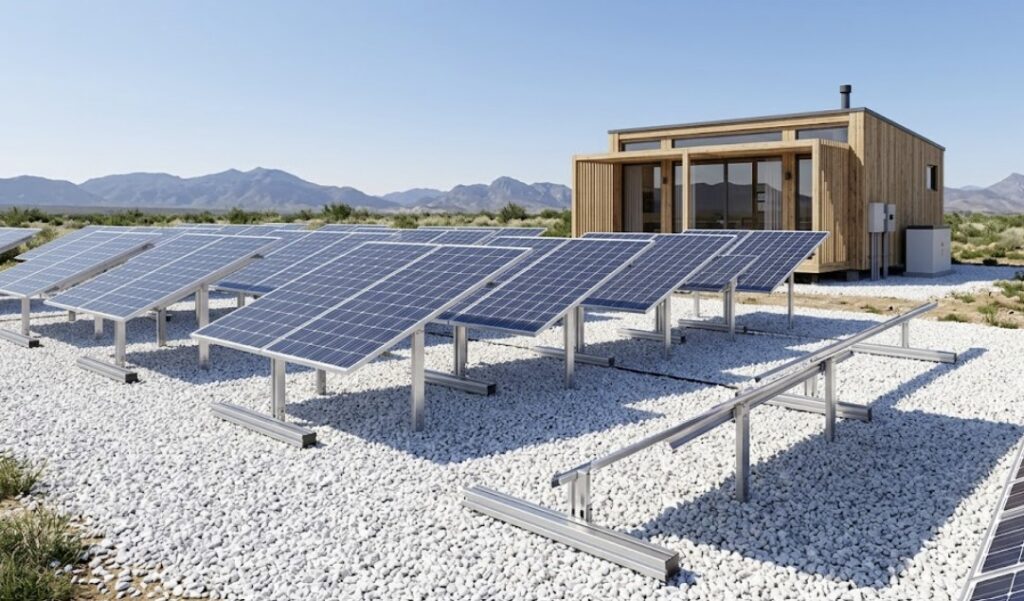
- Crushed white gravel
- Snow retention zones
- Reflective membranes
Spacing Strategy
Proper spacing avoids rear shading and improves airflow:
- Minimum spacing = panel height × 2.5
- Avoid nearby trees or obstacles
Real-World Energy Gains in Cabin Scenarios
Simulation studies and field installations demonstrate consistent improvements:
- Average annual gain: ~19%
- Snow-covered terrain: up to 25% increase
- Elevated systems: additional 3–5% gain
Cabins with open land and reflective surfaces achieve the highest performance improvements.
When Bifacial Solar Panels for Cabins Make the Most Sense
Ideal conditions include:
- Off-grid cabins with high energy demand
- Locations with snow or light-colored terrain
- Ground-mounted systems with ample space
- Areas with frequent cloud cover
This is especially true if you are powering a high-consumption lifestyle. Use our [400 sq ft cabin power consumption] audit to see if the 20-30% bifacial gain is what you need to achieve total independence.
When to Avoid Bifacial Systems
Bifacial solar panels for cabins are not always the optimal solution.
Avoid them when:
- Panels must be roof-mounted flush
- Ground is dark and non-reflective
- Budget constraints prioritize upfront cost
- Installation space is highly restricted
Alternative Energy Solutions for Cabins
| 1. High-Efficiency Monofacial Panels | Lower cost Easier installation Suitable for rooftop systems |
| 2. Solar Trackers | Increase output by 30–40% Require maintenance and moving parts |
| 3. Hybrid Systems | Combine solar with wind or generator backup Improve reliability in remote areas |
Bifacial panels can sometimes produce current spikes that exceed their STC (Standard Test Condition) ratings, especially on bright snowy days. To handle this “free energy,” you need an industrial-grade regulator. I recommend the [Victron SmartSolar MPPT 150/35]. Its high voltage ceiling (150V) allows you to wire your bifacial panels in series for maximum efficiency, and its tracking speed is fast enough to capitalize on the rapid light changes common in mountain cabin environments.
Check current price on Amazon –>
Managing the variable input from a bifacial-hybrid system requires an intelligent ‘brain.’ See how the top-tier MPPTs handle this in our [Victron vs Renogy charge controllers] comparison.
Installation Checklist for Maximum Efficiency
To fully leverage bifacial solar panels for cabins:
- Choose elevated ground-mount systems
- Use reflective ground materials
- Maintain clear spacing between panel rows
- Avoid rear-side obstructions
- Optimize tilt and orientation
- Monitor system performance regularly
Maintenance Requirements
Maintenance is minimal but essential:
- Keep ground surface reflective
- Remove debris and vegetation
- Clean panel surfaces periodically
- Inspect mounting integrity
Cost Analysis and ROI
Typical Cost Breakdown
| Component | Cost Impact |
|---|---|
| Panels | +5–15% premium |
| Mounting | Higher due to elevation |
| Installation | Increased labor |
| Maintenance | Slightly higher |
Return on Investment
- Payback period: 6–10 years (off-grid faster)
- Lifetime savings: significantly higher due to increased output
You can model your specific site’s bifacial gain using the [NREL System Advisor Model (SAM)], the industry standard for predicting photovoltaic performance.
Future Trends in Bifacial Solar for Cabins
- Improved bifaciality factors (up to 90%)
- Lower manufacturing costs
- Integration with battery storage systems
- Expansion in off-grid residential markets
Conclusion
Bifacial solar panels for cabins represent one of the most efficient solutions for maximizing off-grid energy production in 2026. Their ability to harness reflected and diffuse light transforms environmental conditions—especially snow and open terrain—into powerful energy assets. When paired with optimized installation design, these systems deliver superior performance, durability, and long-term value, making them a strategic investment for modern cabin energy independence.
Bifacial tech is a powerful tool, but it’s just one part of the puzzle. For a bird’s-eye view of how to build your entire system, follow our [complete off-grid power blueprint for retreat cabins].
What are bifacial solar panels and how are they different from traditional panels?
Bifacial solar panels are photovoltaic modules that generate electricity from both their front and rear surfaces, unlike traditional monofacial panels that only capture sunlight from one side; this dual-sided design allows them to utilize reflected and diffused light, significantly increasing total energy output under the right installation conditions.
Are bifacial solar panels for cabins suitable for year-round use?
Yes, bifacial solar panels for cabins are highly suitable for year-round energy generation because they perform efficiently in both summer and winter conditions, with winter often providing enhanced output due to snow reflection, which increases the amount of light reaching the rear side of the panels.
How do weather conditions affect the performance of bifacial panels?
Weather conditions such as cloud cover, snow, and ground reflectivity directly influence performance; cloudy conditions increase diffuse light, while snow and light-colored surfaces improve albedo, both of which enhance rear-side energy generation and stabilize output compared to traditional panels.
Do bifacial solar panels require batteries for cabin use?
Yes, most cabin systems using bifacial solar panels require battery storage to ensure a continuous power supply, especially during nighttime or extended periods of low sunlight, allowing excess daytime energy to be stored and used when needed.
How much space is required to install bifacial solar panels effectively?
The required space depends on system size and design, but bifacial panels typically need more spacing between rows and elevation above ground to maximize rear-side exposure, making them better suited for cabins with open land rather than confined rooftop installations.
Are bifacial solar panels for cabins more durable than standard panels?
Bifacial solar panels for cabins are generally more durable because they often feature a dual-glass construction instead of a traditional backsheet, which improves resistance to moisture, UV exposure, and mechanical stress, resulting in longer operational lifespans.
What type of ground surface works best under bifacial panels?
Light-colored and reflective surfaces such as white gravel, sand, or snow provide the best performance because they reflect more sunlight onto the rear side of the panels, increasing overall energy generation compared to darker surfaces like soil or grass.
Can bifacial panels work efficiently in shaded areas?
While they can capture some diffuse light, heavy shading significantly reduces both front and rear performance, so they should ideally be installed in open areas with minimal obstruction to maximize energy production.
Is installation more complicated compared to regular solar panels?
Installation is more complex because it requires precise elevation, spacing, and orientation to avoid shading the rear side, along with specialized mounting systems that allow light to reach both sides of the panel effectively.
How long do bifacial solar panels typically last?
Most bifacial panels are designed to last 25 to 30 years or more, with slower degradation rates compared to traditional panels due to their robust glass-on-glass construction and improved resistance to environmental wear.
Are bifacial solar panels for cabins worth the investment?
Bifacial solar panels for cabins are worth the investment in scenarios where ground-mounted systems and reflective environments are available, as the increased energy yield over time typically offsets the higher upfront costs and improves long-term efficiency.
Do bifacial panels perform better at higher elevations?
Yes, higher elevations can improve performance because increased panel height allows more reflected light to reach the rear surface, enhancing overall energy generation and reducing shading effects from the ground.
Can bifacial solar panels be integrated with existing cabin systems?
They can be integrated into existing systems, but adjustments may be required in mounting structures, inverter compatibility, and system layout to fully utilize their dual-sided capabilities.
How does tilt angle affect bifacial panel performance?
Tilt angle plays a crucial role in optimizing both direct and reflected light capture, with angles between 30° and 45° typically providing the best balance for cabins located in mid-latitude regions.
Do bifacial solar panels require more maintenance than standard panels?
Maintenance requirements are similar, but additional attention is needed to ensure the ground beneath the panels remains reflective and free of debris or vegetation that could reduce rear-side efficiency.
What is the typical efficiency of bifacial solar panels?
Efficiency levels are comparable to monofacial panels on the front side, usually ranging from 17% to over 22%, with additional gains coming from the rear side depending on environmental conditions.
Can bifacial panels be used in small cabin setups?
Yes, they can be used in small setups, but their advantages are most noticeable when there is enough space to elevate and position them properly for rear-side exposure.
Do bifacial solar panels for cabins reduce reliance on generators?
Bifacial solar panels for cabins can significantly reduce reliance on fuel-based generators by producing more consistent and higher energy output, especially when combined with battery storage systems.
How do bifacial panels handle extreme weather conditions?
Their dual-glass construction makes them highly resistant to extreme weather, including heavy snow, strong winds, and temperature fluctuations, making them suitable for remote cabin environments.
Is it possible to install bifacial panels without professional help?
While technically possible, professional installation is recommended to ensure proper system design, electrical safety, and optimal performance, especially given the complexity of maximizing rear-side gain.
Do bifacial solar panels generate power at night?
Like all solar panels, they do not generate power at night, but stored energy in batteries ensures continuous electricity supply for cabin use.
How does albedo impact bifacial solar performance?
Albedo directly affects how much light is reflected onto the rear side of the panels; higher albedo values result in greater energy gains, making surface selection beneath the panels a critical design factor.
Can bifacial panels be mounted vertically for cabins?
Vertical mounting is possible and sometimes beneficial in snowy environments, as it prevents snow accumulation and allows reflected light from the ground to reach the rear side efficiently.
Are bifacial solar panels for cabins compatible with hybrid systems?
Yes, bifacial solar panels for cabins can be integrated into hybrid systems that include wind turbines or backup generators, improving overall system reliability and energy independence.
What factors most influence the return on investment?
Key factors include installation quality, ground reflectivity, system size, local climate, and energy consumption patterns, all of which determine how quickly the higher upfront cost is recovered through increased energy production.
Do bifacial panels degrade faster than monofacial panels?
No, they typically degrade more slowly due to their durable materials and construction, maintaining higher efficiency levels over a longer period.
Can bifacial solar panels operate efficiently in hot climates?
Yes, they perform well in hot climates, and their ability to capture light from both sides can help maintain energy production even when high temperatures slightly reduce front-side efficiency.
What is the main limitation of bifacial technology?
The primary limitation is that performance gains depend heavily on installation conditions, meaning improper setup or low-reflectivity environments can significantly reduce their advantages.
Are bifacial panels future-proof for cabin energy systems?
Bifacial panels are considered a forward-looking technology due to their higher efficiency potential, durability, and compatibility with evolving energy storage and smart system integrations.
3 thoughts on “Bifacial Solar Panels for Cabins: Complete 2026 Guide to Maximum Off-Grid Energy Efficiency”