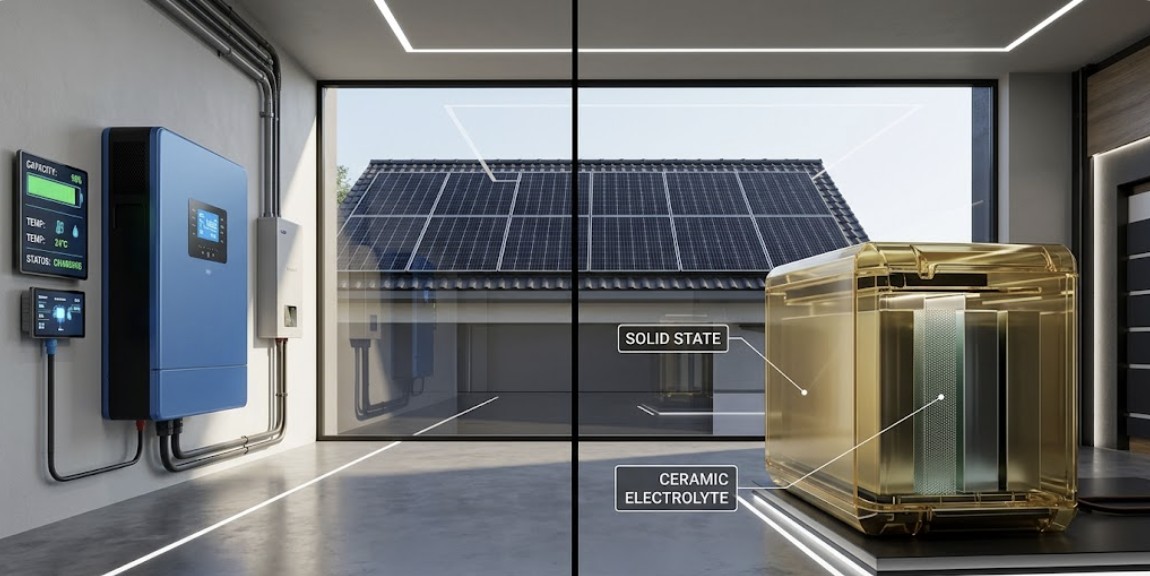
Solar storage is no longer optional for homeowners, off-grid users, RV owners, and commercial energy systems. The real decision today is not whether to install battery storage but which battery chemistry delivers the best return, safety, and long-term reliability.
When comparing LiFePO4 vs solid state batteries for solar, the answer depends on practical availability, cost per kWh, cycle life, thermal safety, and compatibility with existing solar infrastructure.
LiFePO4 (Lithium Iron Phosphate) batteries currently dominate residential and commercial solar storage because they offer proven safety, long lifespan, affordability, and mature compatibility with inverters and charge controllers. Solid-state batteries promise higher energy density, faster charging, and even greater safety, but they remain expensive, difficult to manufacture, and largely unavailable for home-scale solar systems.
This detailed guide compares LiFePO4 vs solid state batteries for solar using real-world performance data, not laboratory promises.
Table of Contents
Understanding LiFePO4 and Solid State Battery Technology
Before comparing performance, we must define how these two battery systems work.
What Is a LiFePO4 Battery?
LiFePO4 stands for Lithium Iron Phosphate, a lithium-ion battery chemistry that uses:
- Lithium iron phosphate cathode
- Graphite anode
- Liquid electrolyte
- Battery Management System (BMS)
This chemistry is widely used in:
- Residential solar storage
- Off-grid cabins, check our guide on the [best solar battery for cabin] systems.
- RV solar systems
- Marine power systems
- Backup power installations
- Commercial battery storage
LiFePO4 became the standard because it solves the fire risks of older lithium-ion chemistries like NMC while maintaining excellent efficiency and long service life.
Typical specifications include:
- 4,000–8,000+ cycles
- 90–100% Depth of Discharge (DoD)
- 95–98% round-trip efficiency
- 10–15 year lifespan
- Strong thermal stability
What Is a Solid State Battery?
A solid-state battery replaces the flammable liquid electrolyte with a solid electrolyte made from:
- Ceramic
- Sulfide
- Polymer
- Oxide-based materials
This design enables:
- Non-flammable internal structure. Research from the [U.S. Department of Energy (DOE) on Solid-State Battery basics] highlights the move away from flammable liquid electrolytes.
- Lithium metal anodes
- Much higher energy density
- Potential ultra-fast charging
- Reduced thermal runaway risk
The challenge is that solid-state battery manufacturing is still in pilot-stage production for most applications.
Most commercial development focuses on:
- Electric vehicles
- Aerospace
- Defense systems
- High-end electronics
Residential solar battery adoption remains extremely limited.
LiFePO4 vs Solid State Batteries for Solar: Core Comparison Table
The fastest way to understand LiFePO4 vs solid state batteries for solar is direct comparison.
| Feature | LiFePO4 Battery | Solid State Battery |
|---|---|---|
| Electrolyte | Liquid | Solid |
| Safety | Very High | Potentially Higher |
| Fire Risk | Extremely Low | Near Zero (theoretical) |
| Energy Density | 90–160 Wh/kg | 400–500+ Wh/kg |
| Cycle Life | 4,000–10,000+ | Projected 10,000–15,000+ |
| Charging Speed | Fast | Potentially Ultra-Fast |
| Cost per kWh | Low | Very High |
| Availability | Widely Available | Very Limited |
| Solar Compatibility | Excellent | Limited |
| Replacement & Expansion | Easy | Difficult |
| Home Installation | Mature Market | Rare |
| Best Use Today | Solar Storage | Future EV Systems |
For 2026 solar systems, LiFePO4 remains the practical winner.
Why LiFePO4 Dominates Solar Storage Today
Thermal Safety and Real-World Reliability
Safety matters more than theoretical innovation.
LiFePO4 chemistry is naturally stable because the phosphate bond is structurally strong and resistant to breakdown under heat stress.
Unlike traditional lithium-ion batteries:
- No oxygen release during overheating
- Minimal thermal runaway risk
- Low fire probability
- Stable deep cycling performance
This is why LiFePO4 is trusted for:
- Indoor home battery systems
- Garages
- RV compartments
- Boats
- Off-grid cabins
Many premium systems also include:
- IP65/IP67 enclosure protection
- Smart BMS monitoring
- Low-temperature charging protection
- Overcharge and over-discharge safeguards
Solid-state batteries may eventually be safer, but LiFePO4 already delivers proven field-tested reliability.
Long Cycle Life for Daily Solar Use
Solar batteries charge and discharge every day.
That means cycle life matters more than peak energy density.
Typical LiFePO4 systems provide:
- 1 cycle per day
- 365 cycles per year
- 4,000–8,000 cycles total
This equals:
- 10–20 years of realistic operation
This makes LiFePO4 ideal for:
- Self-consumption solar systems
- Time-of-use rate shifting
- Backup reserve systems
- Daily off-grid cycling
Solid-state batteries promise longer life, but real-world field validation is still missing.
Energy Density: Where Solid-State Batteries Win
This is the strongest argument for solid-state technology.
Why Higher Energy Density Matters
Energy density determines:
- Weight
- Physical size
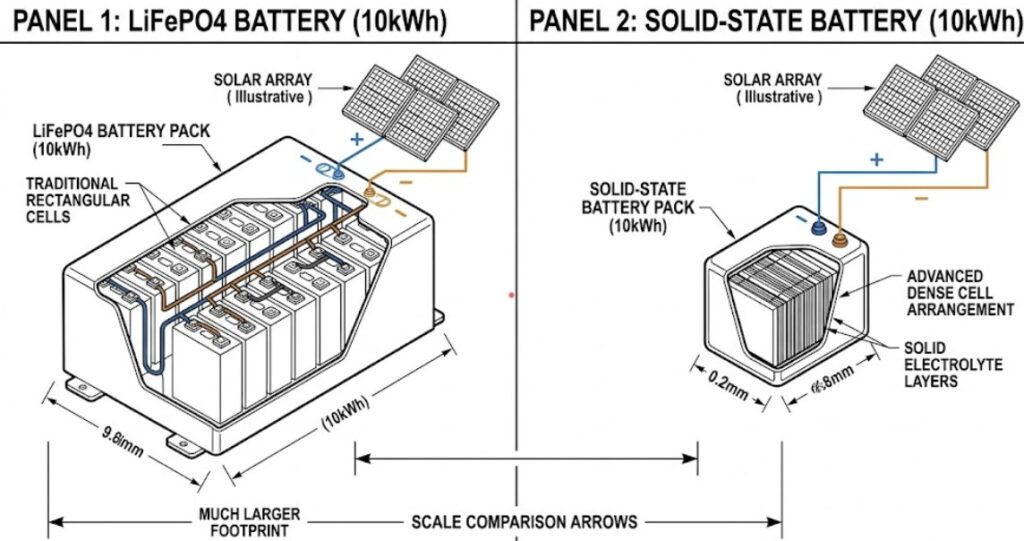
- Installation footprint
- Transport efficiency
While solid-state is more compact, LiFePO4 fits perfectly in most utility closets. See how to plan your battery space in our [400 sq ft cabin power needs] layout guide.
Solid-state batteries target:
- 400–500 Wh/kg
- Some prototypes exceeding 600 Wh/kg
LiFePO4 usually delivers:
- 90–160 Wh/kg
That means a solid-state battery could store the same energy using significantly less space.
For homeowners with limited wall space or EV manufacturers chasing range, this matters greatly.
Why It Matters Less for Home Solar
In stationary solar storage:
- Weight is less important
- Battery rooms already exist
- Wall-mounted systems are common
Most homeowners care more about:
- Cost
- Warranty
- Replacement availability
- Installer support
Not compactness.
This is why high energy density alone does not make solid-state the better solar choice.
Cost Comparison: The Biggest Deciding Factor
LiFePO4 Pricing in 2026
While market analysts talk about 2030, you need power today. My top engineering pick for 2026 is the [LiTime 48V 100Ah Server Rack Battery]. It represents the peak of LiFePO4 maturity. Why wait for solid-state when this unit already gives you 6,000+ cycles and a massive 5.12kWh of storage for a fraction of the cost? It’s the safe, “boring” (and therefore perfect) choice for a home or cabin that needs to work 24/7 without experimental risks.
Check current price on Amazon –>
Residential installed costs typically range:
| System Size | Installed Price |
|---|---|
| 5 kWh | $4,000–$7,000 |
| 10 kWh | $7,000–$12,000 |
| 15 kWh | $10,000–$18,000 |
Commercial systems continue scaling downward due to mass production.
This makes LiFePO4 economically realistic for homeowners.
The affordability of LiFePO4 is what makes modern off-grid living accessible. We break down these savings in our [solar panels for tiny home cost] 2026 pricing analysis.
Solid-State Battery Pricing
If you want to experience the energy density of tomorrow, the [ECOFLOW Portable Power Station DELTA 2] is currently the only consumer-ready solid-state system on the market. It’s significantly lighter than any LiFePO4 equivalent and allows for ultra-fast charging speeds that standard batteries can’t touch. It’s the perfect “favor” for the early adopter who needs portable power for a micro-cabin or high-end overlanding rig and wants the highest safety rating available in 2026.
Check current price on Amazon –>
Current estimates for solid-state batteries remain extremely high:
- $400–$800+ per kWh
- Sometimes significantly higher for pilot systems
This creates serious barriers for:
- Home battery storage
- Off-grid systems
- Residential solar backup
Until mass production arrives, solid-state batteries remain premium technology rather than practical infrastructure.
Return on Investment
Solar storage ROI depends on:
- Utility rates
- Incentives
- Net metering policies
- Battery lifespan
- Replacement cost
LiFePO4 offers:
- Predictable payback
- Proven warranties
- Easy maintenance
Solid-state batteries currently do not.
Charging Speed and Performance
LiFePO4 Charging Performance
Modern LiFePO4 batteries support:
- Fast charging
- High inverter compatibility
- Strong solar controller integration
- Stable performance under partial charging
This is ideal for:
- Daily solar cycling
- Generator backup charging
- Hybrid inverter systems
Solid-State Fast Charging Potential
This is where solid-state technology becomes extremely attractive.
Some developers target:
- 80% charge in under 15 minutes
This is transformative for:
- EV charging
- Fleet systems
- Emergency backup systems
However, for residential solar:
Most charging speed depends on:
- Solar production
- Inverter limits
- Utility charging windows
Not battery chemistry alone.
Fast charging is valuable, but not the primary purchase factor for solar homes.
Regardless of which chemistry you choose, you can’t manage what you don’t measure. To verify the “Round-Trip Efficiency” I mentioned above, I always specify the [Victron SmartShunt 500A]. It’s the most precise way to see exactly how much energy is staying in your cells and how much is being lost to heat. For a professional off-grid setup, this Bluetooth-enabled shunt is the “favor” that tells you the truth about your battery’s health in real-time.
Check current price on Amazon –>
To maximize charging speed, you need a high-performance regulator. See how the top brands compare in our [Victron vs Renogy charge controllers] technical review.
LiFePO4 vs Solid State Batteries for Solar Installation Practicality
Compatibility With Existing Systems
LiFePO4 batteries integrate easily with:
- Hybrid inverters
- MPPT charge controllers
- Off-grid inverters
- Generator backup systems
- Existing residential solar arrays
LiFePO4 batteries integrate seamlessly with standard 24V and 48V architectures. Review the engineering benefits in our [12V vs 24V vs 48V solar system] comparison.
Expansion is simple through:
- Parallel connections
- Series connections
- Modular stack systems
Solid-state batteries often require:
- New charging architecture
- Specialized BMS
- Proprietary system integration
This increases installer complexity and cost.
Maintenance and Replacement
If a battery fails after years of operation:
LiFePO4 offers:
- Easy replacement
- Multiple supplier options
- Standardized voltage platforms
- Mature installer network
Solid-state systems currently do not offer this flexibility.
This matters significantly for long-term ownership.
Commercialization Timeline for Solid-State Batteries
Why Solid-State Is Not Mainstream Yet
The biggest barriers are:
1. Interfacial Resistance
Solid materials must maintain perfect contact between:
- Anode
- Cathode
- Electrolyte
Even tiny imperfections reduce conductivity and performance.
2. Manufacturing Scale
Producing thin, defect-free solid electrolyte layers at scale is extremely difficult.
3. Cost
New factories require:
- Dry-room manufacturing
- High-precision production
- Advanced material sourcing
This drives prices upward.
4. Durability Validation
Long-term degradation under real solar cycling still needs commercial proof.
Expected Adoption Timeline
Most experts project:
- EV deployment first: 2027–2030
- Residential solar adoption later: 2030+
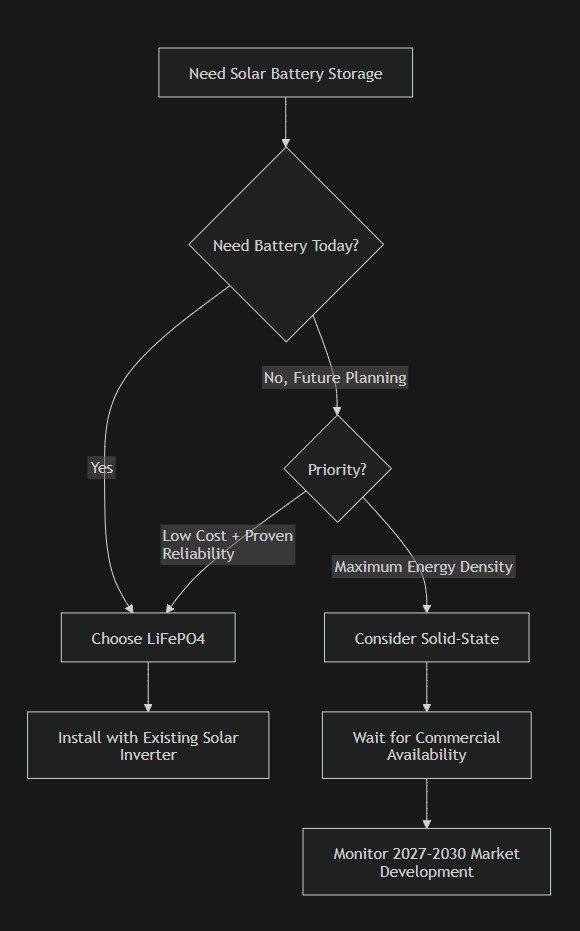
For now, LiFePO4 remains the standard.
Best Use Cases for Each Battery Type
| Choose LiFePO4 If You Need | Choose Solid-State If You Need |
| Solar battery today Home backup system RV solar storage Off-grid cabin battery bank Marine energy storage Affordable battery expansion Reliable long-term ROI | Maximum energy density Future EV technology Premium high-performance applications Aerospace-grade systems Experimental next-generation platforms |
For most solar buyers, the answer remains LiFePO4.
If you are building a reliable, budget-friendly system today, follow our [solar setup for micro cabin] or our [complete off-grid power blueprint for retreat cabins] for a proven installation path.
Mermaid Diagram: Battery Decision Flow
Final Verdict: LiFePO4 vs Solid State Batteries for Solar
When comparing LiFePO4 vs solid state batteries for solar, the best battery in 2026 is not the most futuristic it is the most reliable, available, and cost-effective.
LiFePO4 wins because it offers:
- Proven safety
- Long service life
- Strong warranties
- Excellent ROI
- Easy solar integration
- Real-world installer support
- Affordable expansion
Solid-state batteries are the future of battery innovation.
Future-proofing is smart, but today’s priority is a safe and efficient build. Ensure your wiring is ready for any technology by following a professional [24V solar system wiring diagram].
LiFePO4 is the best choice for solar right now.
For homeowners, installers, and off-grid users, practical performance beats theoretical potential.
The future belongs to solid-state.
The present belongs to LiFePO4.
Which is better in LiFePO4 vs solid state batteries for solar for home use?
When comparing LiFePO4 vs solid state batteries for solar for home use, LiFePO4 is currently the better choice because it is widely available, cost-effective, and fully compatible with existing solar systems. Homeowners need reliable daily performance, strong warranties, and easy replacement options, and LiFePO4 delivers all of these. Solid-state batteries may offer higher energy density and faster charging in the future, but for residential solar storage today, LiFePO4 remains the practical and proven solution.
Are solid state batteries safer than LiFePO4 batteries for solar systems?
In the discussion of LiFePO4 vs solid state batteries for solar, solid-state batteries are theoretically safer because they use a non-flammable solid electrolyte instead of a liquid one. This reduces the risk of leakage, overheating, and thermal runaway. However, LiFePO4 batteries are already among the safest battery chemistries available on the market due to their stable lithium iron phosphate structure. For real-world solar systems, both options are considered safe, but LiFePO4 has the advantage of years of proven field performance.
Why are LiFePO4 batteries more common than solid state batteries for solar?
LiFePO4 vs solid state batteries for solar often comes down to availability and manufacturing maturity. LiFePO4 batteries are mass-produced globally, making them affordable and easy to source for homes, RVs, and off-grid systems. Solid-state batteries are still in early commercial development and require more complex manufacturing processes, which keeps prices high and supply limited. This is why LiFePO4 dominates the solar storage market while solid-state remains mostly a future technology.
Do solid state batteries last longer than LiFePO4 batteries for solar storage?
In LiFePO4 vs solid state batteries for solar storage, solid-state batteries are expected to last longer because their solid electrolyte can reduce chemical degradation and improve cycle life. Some projections suggest they may exceed 10,000 to 15,000 cycles. LiFePO4 batteries already provide excellent longevity with 4,000 to 8,000 or more cycles in real-world use. While solid-state batteries may eventually outperform LiFePO4 in lifespan, the long-term durability of large residential systems is still not fully proven.
Is LiFePO4 cheaper than solid state batteries for solar installations?
Yes, in LiFePO4 vs solid state batteries for solar installations, LiFePO4 is significantly cheaper. Residential LiFePO4 battery systems are widely available at practical price points, making them accessible for homeowners and small businesses. Solid-state batteries remain expensive due to pilot-stage production, advanced materials, and limited manufacturing capacity. Until large-scale production reduces costs, LiFePO4 remains the far more affordable option for solar energy storage.
Can solid state batteries replace LiFePO4 batteries for solar in the future?
LiFePO4 vs solid state batteries for solar will likely change over the next decade as solid-state technology improves. Solid-state batteries have strong potential to replace LiFePO4 in some applications because they offer higher energy density, faster charging, and enhanced safety. However, replacing an entire industry takes time, especially when LiFePO4 already performs extremely well and has a mature supply chain. In the near future, both technologies may coexist, with LiFePO4 leading residential solar and solid-state growing first in electric vehicles.
Which battery is better for off-grid systems: LiFePO4 vs solid state batteries for solar?
For off-grid systems, LiFePO4 vs solid state batteries for solar strongly favors LiFePO4 because off-grid users need dependable daily cycling, simple maintenance, and proven compatibility with inverters and charge controllers. LiFePO4 batteries are specifically trusted for cabins, farms, remote homes, and backup systems because they perform well under constant use. Solid-state batteries are not yet practical for off-grid solar due to high costs, limited supply, and lack of long-term field testing.
How does temperature affect LiFePO4 vs solid state batteries for solar?
Temperature performance is an important factor in LiFePO4 vs solid state batteries for solar. LiFePO4 batteries handle high temperatures well and offer strong thermal stability, but charging performance can decline in very cold climates unless low-temperature protection is included. Solid-state batteries are expected to perform better across wider temperature ranges because solid electrolytes are less sensitive to heat and cold. However, since most solid-state systems are still under development, LiFePO4 remains the more trusted option for real outdoor solar installations.
Do LiFePO4 batteries charge slower than solid state batteries for solar?
In LiFePO4 vs solid state batteries for solar, solid-state batteries have the advantage in charging speed on paper because they may support ultra-fast charging with less degradation. Some prototypes aim for charging to 80% within minutes. LiFePO4 batteries already offer fast charging and work efficiently with solar production, hybrid inverters, and backup generators. For most home solar users, charging speed is limited more by solar panel output and inverter size than by battery chemistry itself.
Should I wait for solid state batteries instead of buying LiFePO4 for solar now?
If you are deciding between LiFePO4 vs solid state batteries for solar right now, waiting is usually not the best strategy unless your installation is years away. LiFePO4 batteries are already reliable, efficient, and financially practical for immediate solar savings and backup power. Solid-state batteries may become mainstream later, but broad residential adoption is expected closer to 2030 than today. For homeowners needing energy security now, LiFePO4 is the smarter investment.
Are LiFePO4 batteries easier to expand than solid state batteries for solar systems?
Yes, LiFePO4 vs solid state batteries for solar clearly favors LiFePO4 when it comes to expansion and modular upgrades. Many LiFePO4 battery systems allow users to add more capacity later by connecting additional modules in series or parallel without major redesign. This flexibility is valuable for homeowners who want to start small and scale over time. Solid-state batteries currently lack this level of standardization because most systems are still in early-stage development and often require proprietary hardware.
What is the best long-term investment in LiFePO4 vs solid state batteries for solar?
For long-term investment decisions in LiFePO4 vs solid state batteries for solar, LiFePO4 currently provides the strongest return because it balances upfront affordability, long lifespan, low maintenance, and immediate usability. Solid-state batteries may eventually offer better technical performance, but their high cost and uncertain large-scale reliability make them difficult to justify today. Investors and homeowners looking for dependable energy savings now will usually achieve better financial results with LiFePO4 systems.
4 thoughts on “LiFePO4 vs Solid State Batteries for Solar: Which Battery Technology Is Best for Home Energy Storage in 2026?”