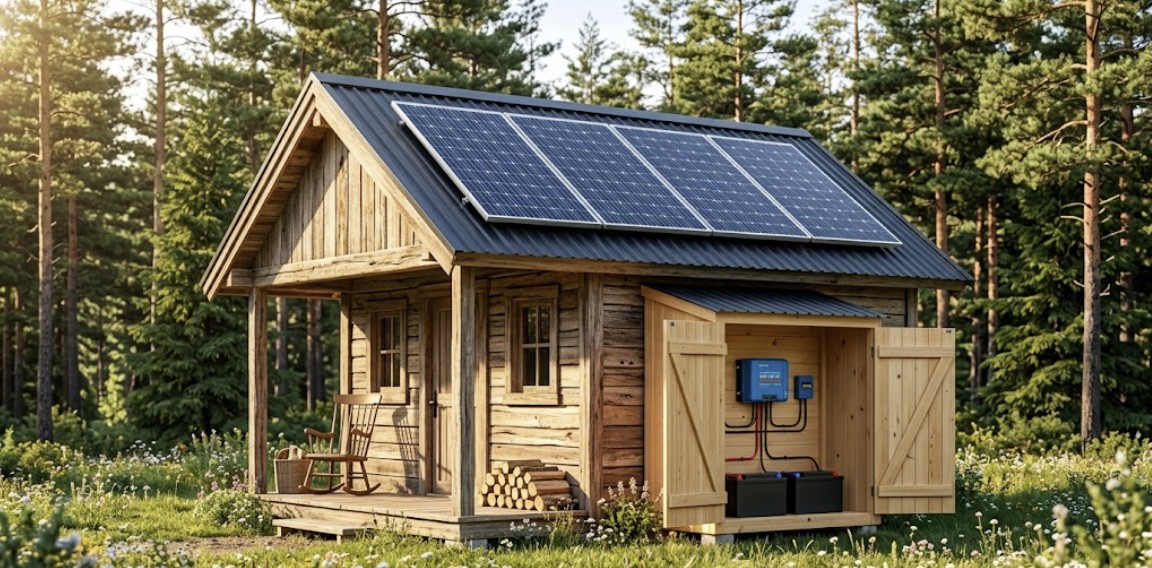
Building reliable off-grid power starts with choosing the right solar equipment—not the most expensive equipment. The best budget solar panels for off-grid cabin use balance affordability, durability, efficiency, and long-term output. For cabins, sheds, hunting lodges, and seasonal retreats, overspending on premium rooftop residential systems often makes little sense.
What matters most is dependable energy production, compatibility with batteries, and strong performance in changing weather conditions.
In 2026, solar pricing remains favorable. New panels average roughly $2.75–$3.50 per watt installed for residential systems …according to the latest [NREL Solar Cost Benchmarks], while used panels can cost as little as $0.05–$0.60 per watt for small DIY off-grid projects. For cabins, that creates excellent opportunities to build a powerful system without overspending.
This guide compares the best budget solar panels for off-grid cabin setups, explains real costs, and shows exactly how to choose the right system size.
Table of Contents
Why Off-Grid Cabins Need Different Solar Panels
Grid-tied homes and off-grid cabins have very different power demands.
A suburban home focuses on reducing utility bills. An off-grid cabin depends entirely on solar production and stored battery energy. Reliability matters more than aesthetics.
The best budget solar panels for off-grid cabin systems should prioritize:
- Strong low-light performance
- High durability in snow, wind, and rain
- Easy compatibility with battery storage
- Lower cost per watt
- Simple DIY installation potential
- Long service life
Premium ultra-high-efficiency rooftop panels may not always be the best choice. In many cabins, affordable monocrystalline panels outperform expensive luxury brands because roof space is less restricted. However, if you are building on a very small trailer where every inch counts, you should look at the [best solar panels for tiny house] rankings instead, as they focus more on power density than raw cost.
Best Budget Solar Panels for Off-Grid Cabin in 2026
Below are the strongest value options for budget-conscious cabin owners.
| Solar Panel | Best For | Average Cost | Efficiency | Warranty |
|---|---|---|---|---|
| Canadian Solar HiKu 400W | Best overall value | $3.00–$3.80/W | High | 25 years |
| Mission Solar MSE PERC | Most affordable fixed panel | $3.00–$3.40/W | Good | 12 years |
| Q Cells Q.PEAK DUO | Reliable premium budget | $3.50–$3.90/W | High | 25 years |
| EcoFlow Foldable 400W | Portable cabin systems | $1,199 unit price | High | 12 months |
| Used Refurbished Panels | Lowest upfront cost | $0.05–$0.60/W | Variable | Usually limited |
Canadian Solar HiKu 400W – Best Overall Value
This panel delivers the best mix of price, efficiency, and reliability.
| Advantages: | Excellent cost-to-performance ratio Proven dual-cell PERC technology Reliable output in partial shading Widely available Strong long-term reputation |
While industrial 400W panels like Canadian Solar are great, they are often a nightmare to ship individually to remote cabins. My “pro” budget move is the [Renogy 200W Monocrystalline 2-Pack]. These 100% copper-contact panels are modular, easier to carry up a ladder by yourself, and if one gets hit by a falling branch, half your array still works. It’s the most resilient way to build a 400W-800W system on a DIY budget in 2026.
Check current price on Amazon –>
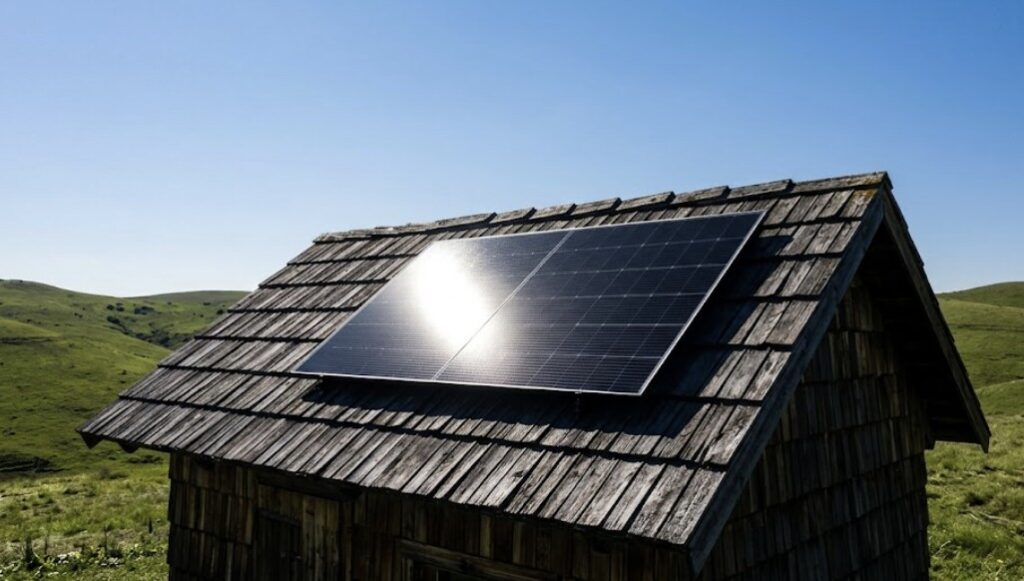
Mission Solar MSE PERC – Most Affordable Fixed Panel
Mission Solar panels are excellent for strict budget builds.
| Advantages: | Lower cost per watt Strong build quality Made in the USA Good for larger low-cost arrays |
This works especially well when extra roof or ground-mount space is available.
Used Solar Panels – Cheapest Upfront Option
| Used panels are ideal for | They are not ideal for |
| Tiny cabins Seasonal hunting cabins Shed power systems Workshop lighting Battery maintenance charging | Full-time residences Critical winter-use cabins Grid-tied systems High-load appliances |
Used panels can reduce upfront cost dramatically, but reduced lifespan and lack of warranty must be considered.
How Much Do the Best Budget Solar Panels for Off-Grid Cabin Cost?
Costs vary based on whether you buy:
- New fixed panels
- Portable folding panels
- Used/refurbished panels
Average New Solar Panel Costs
For a more granular look at how incentives and federal credits can lower these numbers, see our [solar panels for tiny home cost] 2026 pricing breakdown.
| System Size | Estimated Cost Before Incentives |
|---|---|
| 2 kW cabin system | $6,000–$8,000 |
| 4 kW cabin system | $11,000–$15,000 |
| 6 kW full cabin system | $16,000–$22,000 |
This includes:
- Solar panels
- Charge controller
- Inverter
- Racking
- Wiring
- Basic labor
Battery storage is separate.
Battery Costs
The Architect’s Economics Favor: In 2026, buying Lead-Acid batteries is actually more expensive than Lithium when you calculate the cost per cycle. For a budget cabin, the [LiTime 12V 100Ah Lithium Battery] is the “sweet spot.” It offers 4,000+ cycles compared to the 500 you’d get from a deep-cycle AGM. It’s a “favor” because you won’t have to haul 80-pound lead batteries up to your cabin every three years—this unit will outlast your cabin’s first roof.
Check current price on Amazon –>
For true off-grid living, batteries are often the biggest expense—not the panels.
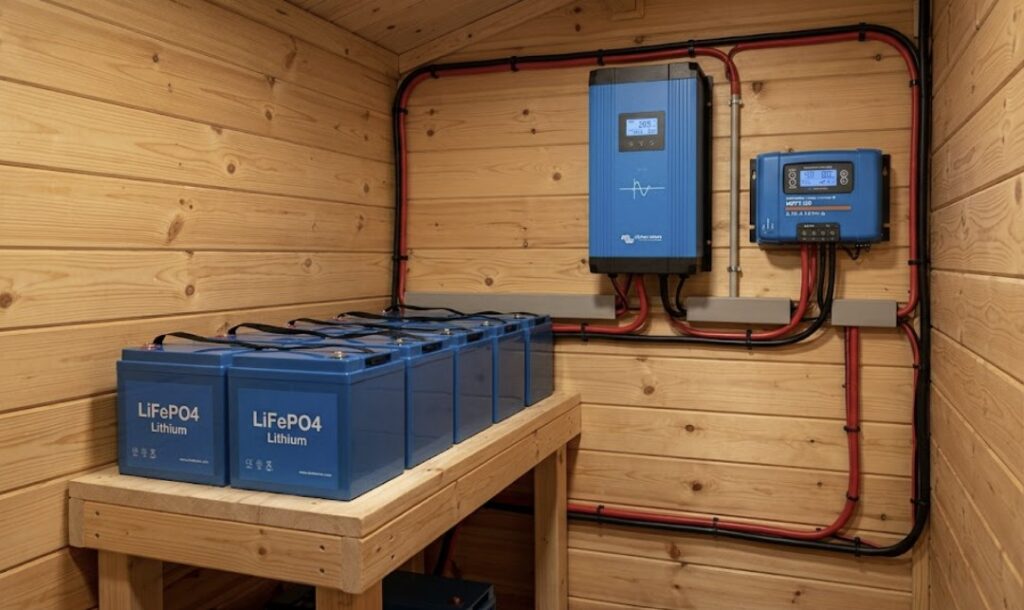
Best Budget Solar Panels for Off-Grid Cabin System Sizing
Undersizing is the most expensive mistake.
We calculate power needs first.
Common Cabin Appliance Loads
| Appliance | Daily Use | Daily Consumption |
|---|---|---|
| LED lights | 5 hrs | 300 Wh |
| Mini fridge | 24 hrs | 1,200 Wh |
| Laptop charging | 4 hrs | 240 Wh |
| Water pump | 1 hr | 500 Wh |
| TV | 3 hrs | 300 Wh |
| Microwave | 15 mins | 250 Wh |
If your cabin setup includes a satellite internet dish, don’t forget that [Starlink power consumption for off-grid cabins] can add another 1.5 to 2.4 kWh per day to your total requirement.
Total example: 2,790 Wh/day
To size safely: Add 25–30% reserve capacity.
Recommended system: 3.5–4 kWh daily production
Daily Solar Need=Peak Sun HoursDaily Watt HoursExample: 4,000 Wh ÷ 5 sun hours = 800W minimum generation
Practical recommendation: Install 1.5–2x that number for winter reliability.
That means: 1,600W–2,000W solar array
This is where the best budget solar panels for off-grid cabin systems become critical.
Monocrystalline vs Polycrystalline for Cabins
Monocrystalline
| Best for | Pros | Cons |
| Smaller roofs Higher efficiency needs Snow-heavy climates Permanent installations | Higher efficiency Longer lifespan Better cold-weather performance | Higher upfront cost |
You can track the ongoing efficiency records for these cell types on the [NREL Photovoltaic Cell Efficiency Chart].
Polycrystalline
| Best for | Pros | Cons |
| Large open land mounts Very low budgets | Lower purchase cost | Lower efficiency Larger required footprint |
For most 2026 buyers, monocrystalline wins.
Used vs New Panels for Cabin Solar
| Comparison | Used Panels | New Panels |
|---|---|---|
| Cost | Very low | Higher |
| Efficiency | Lower | Higher |
| Lifespan | Shorter | 25+ years |
| Warranty | Rare | Standard |
| Grid compatibility | Difficult | Easy |
| DIY suitability | High | High |
Used panels make sense for low-risk projects.
New panels are better for long-term primary cabins.
Budget panels are great, but don’t save money on your cables. Improper [solar panel wire size] can waste all the savings you got from buying cheaper modules.
The best budget solar panels for off-grid cabin owners are often not the cheapest, they are the best lifetime value.
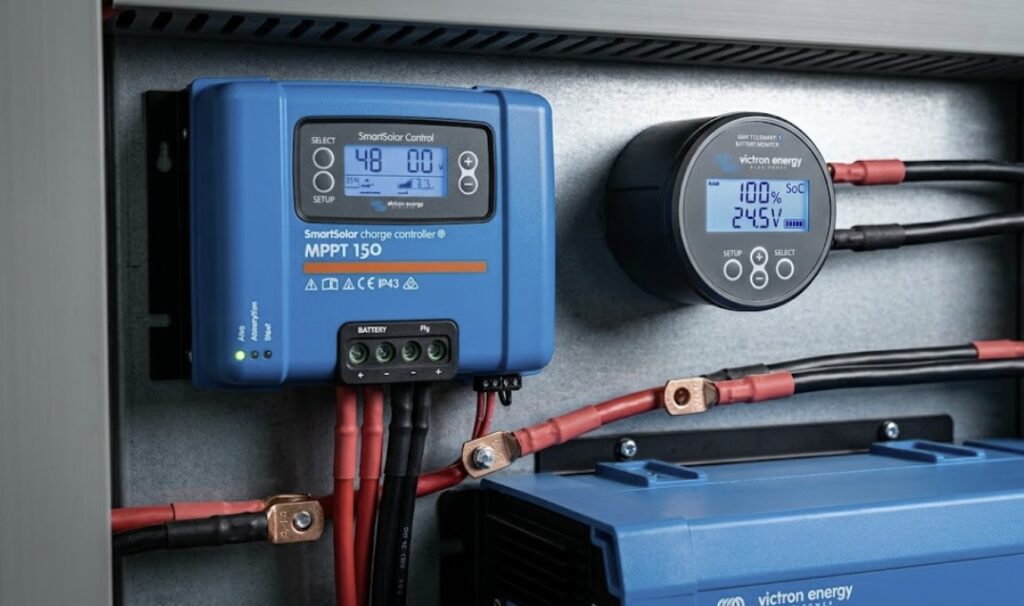
Charge Controllers Matter More Than Most Buyers Realize
Cheap controllers destroy expensive batteries.
Always prioritize:
MPPT Controllers
Better for:
- Larger systems
- Cold climates
- Long wire runs
- Maximum efficiency
Avoid low-quality PWM controllers for serious cabin systems.
Recommended brands:
- Victron
- Renogy
- EPEVER
- MidNite Solar
The “Battery Life” Favor: If you want to save money, do it on the panels, not the controller. I specify the [Renogy Rover 40A MPPT] for every budget cabin. Why? Because its tracking algorithm ensures you aren’t wasting 20% of your solar harvest like cheap PWM controllers do. It’s the “favor” that pays for itself by squeezing every possible watt out of your panels during those short, cloudy winter days.
Check current price on Amazon –>
The controller is the brain of your budget build. Choosing between [Victron vs Renogy charge controllers] is often the most important technical decision you’ll make for system longevity.
Best Inverter Choices for Off-Grid Cabins
Choose inverter size based on surge loads.
Modified Sine Wave
Cheap but limited.
Avoid for:
- Refrigerators
- Sensitive electronics
- Microwaves
- Pumps
Pure Sine Wave
Recommended for nearly all cabins.
Safer, cleaner, and far more reliable.
Budget brands:
- Growatt
- Renogy
- AIMS Power
- Victron
You can see how the top budget and premium inverters stack up in our [Renogy vs Victron] ultimate comparison.
Best Budget Solar Panels for Off-Grid Cabin in Snowy Climates
Cold regions need special planning.
Priorities include:
- Strong snow load ratings
- Better low-angle winter production
- Tilt-adjustable mounts
- Larger battery reserve
- Higher system oversizing
Winter cabins should rarely install “minimum size” systems.
We recommend:
30–50% more panel capacity than summer calculations suggest
This prevents generator dependence.
Winter reliability is the ultimate test. We cover advanced cold-weather strategies and insulation in our [complete off-grid power blueprint for retreat cabins].
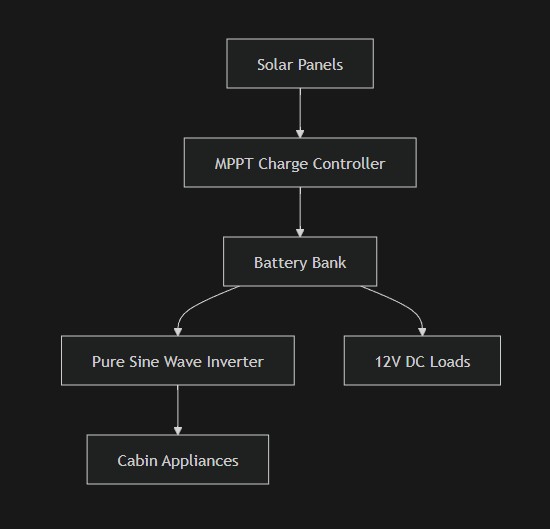
Mermaid Diagram: Simple Off-Grid Cabin Solar System
Installation Tips for Budget Cabin Solar
Roof Mount vs Ground Mount
Roof Mount
| Pros | Cons |
| Saves land space Shorter wire runs | Harder maintenance Snow clearing difficulty |
Ground Mount
| Pros | Cons |
| Easier cleaning Better tilt adjustment Easier future expansion | More racking cost |
Read our full [ground mount vs roof mount solar] comparison for details.
Ground mounts often win for serious off-grid cabins. Regardless of the mounting style, ensure your installation follows a safe and efficient [24V solar system wiring diagram] to prevent electrical fires and energy waste.
Buying Checklist Before You Order
Before Purchasing Panels
Confirm:
- True daily energy usage
- Winter sun hours
- Battery chemistry
- Inverter compatibility
- Panel dimensions
- Snow and wind ratings
- Warranty details
- Shipping costs
- Local code requirements
This prevents expensive redesigns later.
Final Verdict: Best Budget Solar Panels for Off-Grid Cabin
For most buyers in 2026:
| Best Overall: | Canadian Solar HiKu 400W |
| Best Lowest-Cost Fixed Option: | Mission Solar MSE PERC |
| Best Portable Choice: | EcoFlow Foldable 400W |
| Best Ultra-Low Budget Option: | Refurbished Used Panels |
The best budget solar panels for off-grid cabin systems are the ones that provide dependable daily energy without forcing expensive replacements later.
Low upfront cost matters.
Long-term reliability matters more.
For cabins, smart solar design always beats expensive solar branding.
What size solar system is best for an off-grid cabin?
The ideal solar system size depends entirely on how much electricity the cabin uses each day. A small weekend cabin with LED lights, phone charging, and a mini fridge may only need a 1.5 kW to 2 kW system, while a full-time off-grid cabin with water pumps, refrigeration, internet equipment, and kitchen appliances may require 4 kW to 6 kW or more. The best way to determine the correct size is to calculate your daily watt-hour usage, divide it by your average peak sun hours, and then add at least 25% extra capacity for cloudy days and winter production. Choosing the right size is more important than simply buying the cheapest solar panels because an undersized system creates constant battery shortages and generator dependence.
Are used solar panels a good idea for an off-grid cabin?
Used solar panels can be a smart budget solution for small cabins, sheds, workshops, and seasonal retreats where energy demands are low and occasional maintenance is acceptable. They are especially useful for cabins used only on weekends or during warmer months. However, used panels usually come with lower efficiency, reduced output from age-related degradation, and little to no warranty protection. They may also create issues if certification labels are missing. For a full-time off-grid cabin where reliability is critical, new monocrystalline panels are usually the better investment because they last longer, perform better in winter, and reduce the need for early replacement.
How many solar panels do I need for an off-grid cabin?
The number of panels depends on both your energy usage and the wattage of each panel. For example, if your cabin uses around 3,000 watt-hours per day and you choose 400-watt solar panels, you may need four to six panels depending on your local sunlight conditions and battery reserve requirements. In areas with fewer peak sun hours, especially during winter, more panels are necessary to maintain consistent charging. It is always better to slightly oversize the system than to install too few panels. The best budget solar panels for off-grid cabin systems should be selected based on total performance over time, not just the lowest upfront price per panel.
Is monocrystalline better than polycrystalline for cabin solar systems?
In most cases, monocrystalline solar panels are the better choice for off-grid cabins because they offer higher efficiency, better cold-weather performance, and longer operational life. This means they produce more electricity in less space, which is especially important if the cabin roof has limited mounting area. Polycrystalline panels can be cheaper initially, but they require more space and often generate less power during low-light conditions. For cabins in snowy climates, forested areas, or remote locations where reliability matters most, monocrystalline panels provide stronger long-term value even if the purchase price is slightly higher.
Do I need batteries with the best budget solar panels for off-grid cabin systems?
Yes, batteries are essential when using the best budget solar panels for off-grid cabin systems because solar panels only generate electricity during daylight hours. A true off-grid cabin needs stored energy for nighttime use, cloudy days, storms, and winter conditions when sunlight is limited. Without a battery bank, even the best budget solar panels for off-grid cabin living would stop providing power after sunset. Lithium batteries like LiFePO4 are now the preferred option because they last longer, charge faster, require less maintenance, and provide better long-term value than traditional lead-acid batteries. Although lithium batteries cost more upfront, they usually save more money over time because of their longer lifespan and higher efficiency. When choosing the best budget solar panels for off-grid cabin setups, battery quality should be considered just as important as panel quality.
What is the best inverter for the best budget solar panels for off-grid cabin use?
A pure sine wave inverter is the best choice to pair with the best budget solar panels for off-grid cabin systems because it delivers clean and stable electricity for refrigerators, microwaves, televisions, laptops, water pumps, and other sensitive appliances. Modified sine wave inverters may cost less, but they can damage electronics, shorten appliance lifespan, and create performance problems with motors and compressors. The inverter should also be properly sized for startup surge loads, not just daily power consumption. For example, a refrigerator or water pump may require much more startup power than expected. When installing the best budget solar panels for off-grid cabin living, choosing a high-quality pure sine wave inverter helps prevent expensive system failures and improves long-term reliability.
Can a 400-watt panel work with the best budget solar panels for off-grid cabin setups by itself?
A single 400-watt panel can support very small loads when using the best budget solar panels for off-grid cabin systems, but it is usually not enough to power an entire cabin by itself. One 400-watt solar panel can handle basic needs like LED lights, phone charging, laptops, small fans, and battery maintenance. However, a full off-grid cabin with refrigeration, water pumping, internet equipment, and normal household appliances usually requires multiple panels working together in a complete solar array. A single 400-watt panel may produce around 1.5 to 2 kWh per day depending on sunlight conditions, which is helpful but limited. For permanent living, the best budget solar panels for off-grid cabin use normally involve several 400-watt panels combined with battery storage and a proper inverter system.
How long do the best budget solar panels for off-grid cabin systems last?
Most of the best budget solar panels for off-grid cabin systems last between 25 and 30 years, and many continue producing useful electricity even beyond that timeframe. New high-quality monocrystalline panels slowly lose efficiency over time, usually at a degradation rate of around 0.5% per year, which means they still perform well after decades of use. Used panels may cost less upfront, but they may already be years into their lifespan and could reach lower performance levels much sooner. Proper installation, regular cleaning, snow removal, and avoiding physical damage all help extend panel life significantly. When choosing the best budget solar panels for off-grid cabin living, warranty length, brand reliability, and degradation rate often provide more value than simply selecting the cheapest available option.
Should I choose roof-mounted or ground-mounted best budget solar panels for off-grid cabin systems?
Both roof-mounted and ground-mounted systems can work well with the best budget solar panels for off-grid cabin setups, but ground-mounted systems are often the better long-term option for serious off-grid living. Ground mounts are easier to maintain, easier to clean after snowstorms, and much easier to expand later if your power needs grow. They also allow better tilt adjustment, which improves winter solar production and overall efficiency. Roof-mounted systems save yard space and can reduce wiring distance, but they are harder to access for maintenance and repairs. If your cabin roof has shading from trees, steep angles, or multiple roof sections, a ground-mounted system may significantly improve solar performance. Many owners using the best budget solar panels for off-grid cabin projects find that easier maintenance becomes more valuable than the small savings of roof installation.
3 thoughts on “Best Budget Solar Panels for Off-Grid Cabin: Complete 2026 Buyer’s Guide”