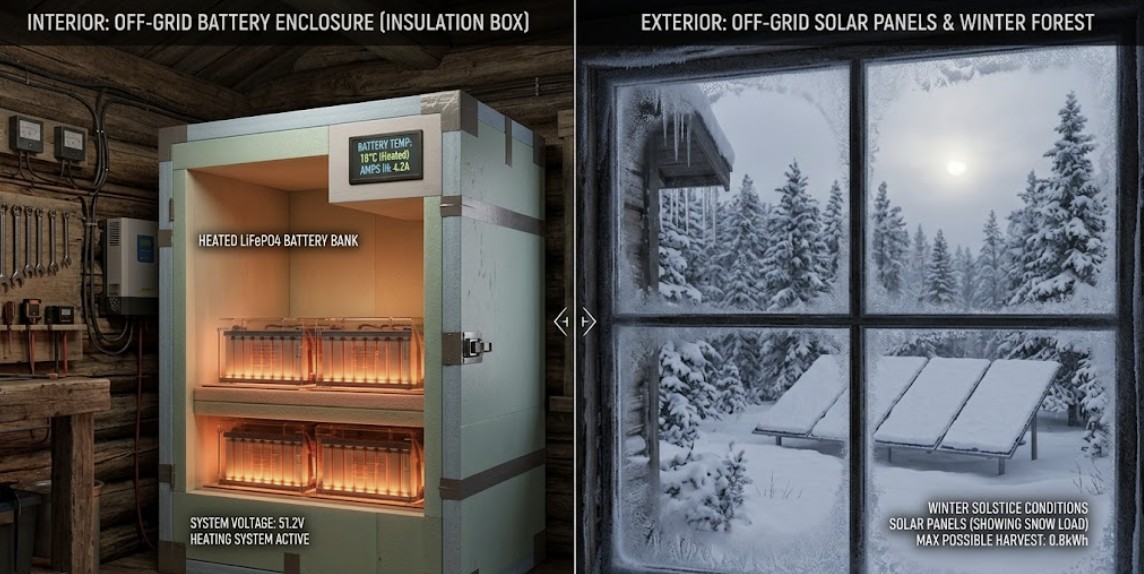
Winter solar charging lithium batteries requires a completely different strategy than summer charging. Cold temperatures reduce charging efficiency, increase internal resistance, and create serious risks like lithium plating when LiFePO4 batteries are charged below freezing. Without the right setup, winter conditions can permanently damage lithium batteries and drastically reduce solar system performance.
For off-grid cabins, RV systems, backup solar banks, and remote installations, understanding how winter solar charging lithium batteries works is essential for battery longevity and reliable energy storage. LiFePO4 batteries outperform lead-acid in many cold-weather applications, but only when charging protocols, insulation, heating systems, and battery management are properly designed.
To understand if you should choose a single large unit or a parallel bank, check out our [2x 100Ah vs 1x 200Ah battery comparison].
This guide covers real low-temperature performance data, charging limits, solar controller settings, heating solutions, enclosure design, and practical winter operation strategies.
Table of Contents
How Winter Solar Charging Lithium Batteries Changes Battery Performance
Cold weather affects every chemical process inside lithium batteries. As temperature drops, lithium-ion movement slows, electrolyte viscosity increases, and charge acceptance becomes restricted.
This causes three major problems:
- Reduced usable battery capacity
- Increased internal resistance
- Dangerous charging conditions below 32°F (0°C)
LiFePO4 batteries still perform better than lead-acid batteries during winter, but improper winter solar charging lithium batteries setup can cause irreversible damage.
Capacity Loss at Low Temperatures
Battery capacity falls significantly as temperatures decrease.
| Temperature Range | Capacity Loss | Charging Performance |
|---|---|---|
| 32°F to 50°F (0°C to 10°C) | 20–30% | Slower charging |
| 14°F to 32°F (-10°C to 0°C) | 30–40% | Very limited charging |
| -4°F to 14°F (-20°C to -10°C) | Up to 50% | Severe charging restrictions |
At -20°C, many LiFePO4 systems lose nearly half of their available discharge capacity. This massive drop in efficiency is why you must calculate your worst-case scenario. See our [400 sq ft cabin power consumption] audit to see how much extra capacity you need to survive a week of freezing weather.
This is why winter solar charging lithium batteries must prioritize temperature management before charging speed.
Why Charging LiFePO4 Below Freezing Causes Permanent Damage
Discharging below freezing is usually safe.
Charging below freezing is not.
This is the most important rule in winter solar charging lithium batteries.
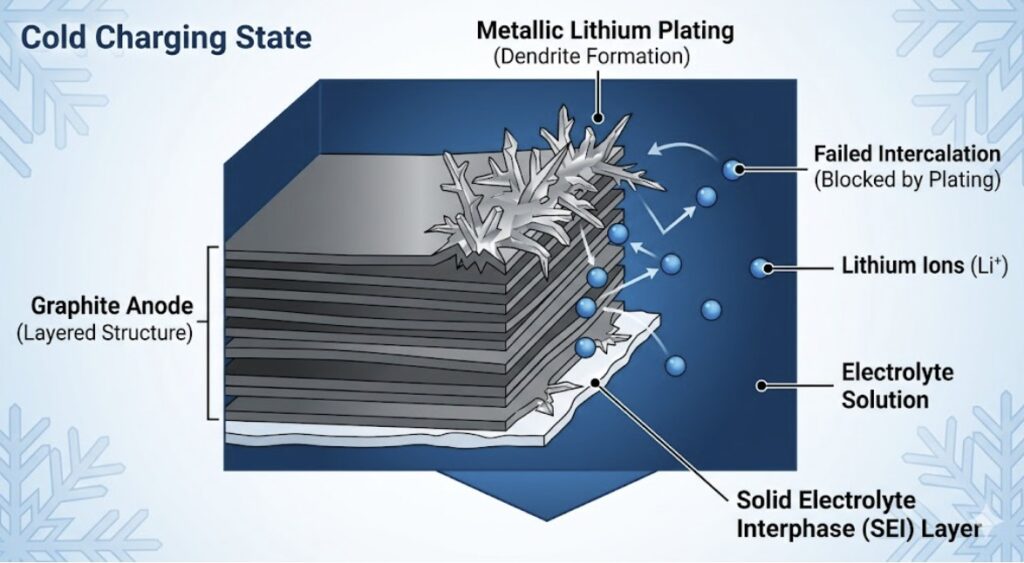
When LiFePO4 batteries are charged below 32°F (0°C), lithium ions cannot properly intercalate into the graphite anode. Instead, metallic lithium deposits form on the anode surface.
This process is called lithium plating.
What Lithium Plating Does
Lithium plating causes:
- Permanent capacity loss
- Increased internal short circuit risk
- Reduced cycle life
- Higher thermal runaway risk
- Lower voltage stability
Even one aggressive charge cycle at freezing temperatures can create irreversible degradation.
Research shows:
- At 0°C, charging at 1C caused 3.6% irreversible capacity loss in one cycle
- At -10°C, charging above 0.25C caused severe degradation
- At 0.5C, batteries lost 25% capacity after only 40 cycles
This is why winter solar charging lithium batteries requires strict charging limits.
For a deep dive into the electrochemistry of how cold affects lithium ions, refer to this [research paper on lithium plating at low temperatures].
Safe Charging Current for Winter Solar Charging Lithium Batteries
Charging current must be reduced in cold conditions.
The correct low-temperature charging limits are:
| Battery Temperature | Recommended Max Charge Rate |
|---|---|
| Above 32°F (0°C) | Normal charging |
| 32°F to 14°F (0°C to -10°C) | 0.1C |
| Below 14°F (-10°C) | 0.05C or avoid charging |
Example: For a 100Ah LiFePO4 battery:
- 0.1C = 10A max charge current
- 0.05C = 5A max charge current
Many solar charge controllers are not automatically configured for this. Manual programming is often required.
Winter solar charging lithium batteries should never rely on default charge controller settings.
Best Solar Charge Controller Settings for Winter Lithium Charging
MPPT controllers are strongly preferred over PWM for winter systems because they harvest more power during weak winter sunlight and cold panel conditions.
Recommended winter settings:
| Absorption Voltage | 14.2V to 14.4V for 12V LiFePO4 systems |
| Float Voltage | 13.4V to 13.6V |
| Temperature Compensation | Disable temperature compensation for LiFePO4. This is critical. Lead-acid batteries require temperature compensation. LiFePO4 does not. Using lead-acid temperature compensation settings can overcharge lithium batteries and create dangerous winter charging conditions. Advanced controllers from top brands handle these winter profiles much better. We compare the low-temp logic of the industry leaders in our [Victron vs Renogy charge controllers] guide. |
| Low Temperature Charge Disconnect | Essential setting: Stop charging below 32°F (0°C) |
The best winter solar charging lithium batteries setup includes a Battery Management System (BMS) with automatic low-temperature charge cutoff.
Even the best charge controller can’t “feel” the temperature inside your battery box from 10 feet away. I always install a [Victron Smart Battery Sense]. This tiny device mounts directly on the battery terminal and sends real-time temperature data to your MPPT controller via Bluetooth. If the battery is too cold, it tells the controller to stop charging instantly. It’s the $60 insurance policy that prevents you from accidentally destroying a $2,000 battery bank.
Check current price on Amazon –>
Battery Heating Systems for Winter Solar Charging Lithium Batteries
Reliability Favor: If you want to sleep soundly during a blizzard, don’t rely on external blankets. I specify the [LiTime 12V 100Ah Self-Heating Battery]. It has a built-in “brain” that detects when the temperature drops below 32°F. When your solar panels start sending power, the battery uses that energy to heat itself up to 41°F before allowing a single amp to reach the cells. It’s the ultimate “favor” because it removes the risk of lithium plating entirely without you having to lift a finger.
Check current price on Amazon –>
There are three common heating solutions:
1. Self-Heating Lithium Batteries
Premium LiFePO4 batteries include internal heating elements.
These systems:
- Detect low temperature
- Use charging current to warm cells first
- Begin charging only after safe temperature is reached
This is the best option for winter solar charging lithium batteries in remote systems.
Brands like Battle Born and EG4 offer excellent heated models. You can find our top picks for these units in our [best solar battery for cabin] 2026 rankings.
2. External Heating Pads
Battery heating pads are widely used for RVs and cabins.
If you already have non-heated batteries, you must add an active heat source. I recommend the [Facon 12V Heater Pad]. These are designed for the harsh environments of RV tanks and work perfectly wrapped around LiFePO4 cells. The “pro” feature here is the built-in thermostat: it automatically turns on at 45°F and off at 68°F. It’s the most cost-effective way to turn a “summer battery” into a year-round off-grid powerhouse.
Check current price on Amazon –>
Preheating time: 1 to 2 hours before charging
These are highly effective and affordable.
3. Heated Battery Enclosures
Insulated battery boxes combined with low-power heaters reduce heating demand and improve temperature stability.
This is ideal for off-grid solar cabins.
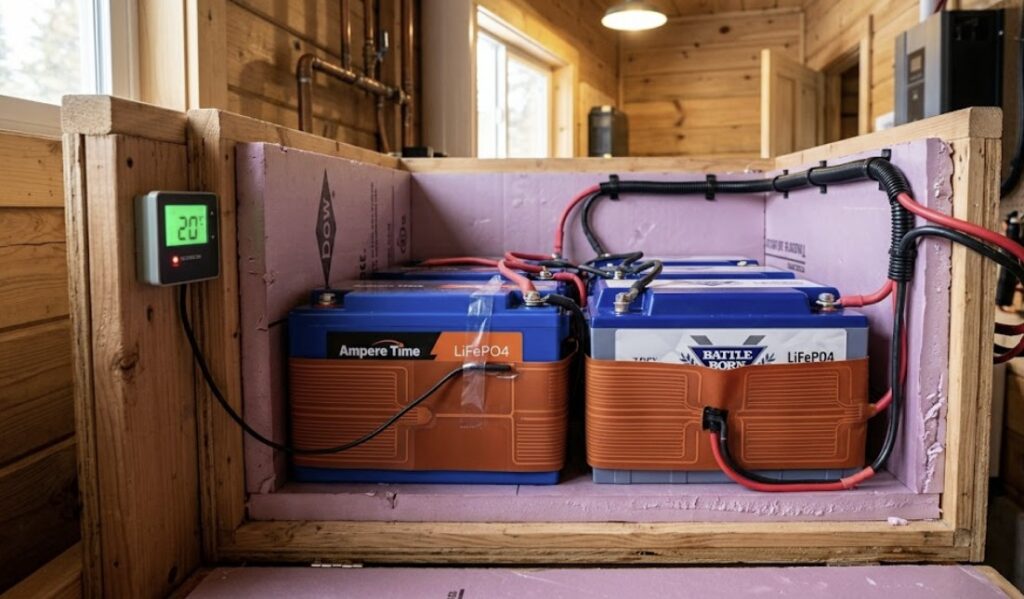
How to Build a Winter Battery Box for Solar Charging
A proper battery enclosure improves performance more than most people expect.
Winter solar charging lithium batteries should never be left fully exposed to freezing outdoor air.
Best Battery Box Features
Include:
- Rigid insulation panels
- Moisture protection
- Ventilation design
- Thermostat-controlled heating
- Waterproof exterior
- Service access panel
- Fire-safe mounting surface
Ideal Installation Location
| Best locations | Worst locations |
| Utility room Insulated shed Interior closet RV heated compartment Protected garage installation | Unheated exposed outdoor box Open metal shed Direct snow exposure Wind-facing installation areas |
Even passive insulation can dramatically improve winter charging reliability.
Winter Solar Charging Lithium Batteries vs Lead-Acid Batteries
Many users assume lead-acid is better for winter.
That is usually incorrect.
LiFePO4 performs better overall when charging protection exists.
| Feature | LiFePO4 | Lead-Acid |
|---|---|---|
| Usable Capacity | 80–90% | 50% |
| Cold Discharge Performance | Better | Poor |
| Charge Speed | Faster | Slower |
| Cycle Life | 3,000–6,000+ | 300–800 |
| Weight | Much lighter | Heavy |
| Charging Below Freezing | Restricted | Allowed with limitations |
Lead-acid can charge below freezing more safely, but overall winter solar charging lithium batteries systems deliver far superior long-term value.
Winter Solar Panel Performance and Charging Reality
Solar panels actually become more electrically efficient in cold weather.
You can verify the temperature coefficients of different cell types on the [NREL Photovoltaic Performance data page].
The problem is not panel efficiency.
The problem is:
- Shorter daylight hours
- Snow coverage
- Cloud density
- Low sun angle
- Battery charging restrictions
This means winter solar charging lithium batteries depends more on system sizing than panel efficiency.
Snow isn’t just a nuisance; it’s a giant mirror. Using [bifacial solar panels for cabins] allows you to harvest light reflecting off the snow, significantly improving charging rates during the shortest days of the year.
Winter Solar Oversizing Rule
Recommended:
Oversize solar generation by 25% to 40% for winter reliability.
To achieve this extra wattage in limited space, you’ll need the highest efficiency modules available. Check out the [best solar panels for tiny house] that perform best in low-angle winter sun.
This helps recover:
- Consecutive cloudy days
- Snow-covered panel downtime
- Battery heating energy use
- Low-temperature charge limitations
For off-grid cabins, this is often the difference between system success and generator dependence.
Best Practices for Daily Winter Operation
Reliable winter solar charging lithium batteries depends on operational habits.
Daily Winter Checklist
- Check battery temperature before charging
- Clear snow from panels immediately
- Monitor battery state of charge
- Avoid deep discharge during cold nights
- Run heavy loads during sunny daytime hours
- Use heating systems before charging begins
- Confirm BMS low-temp protection is active
Simple habits prevent expensive failures.
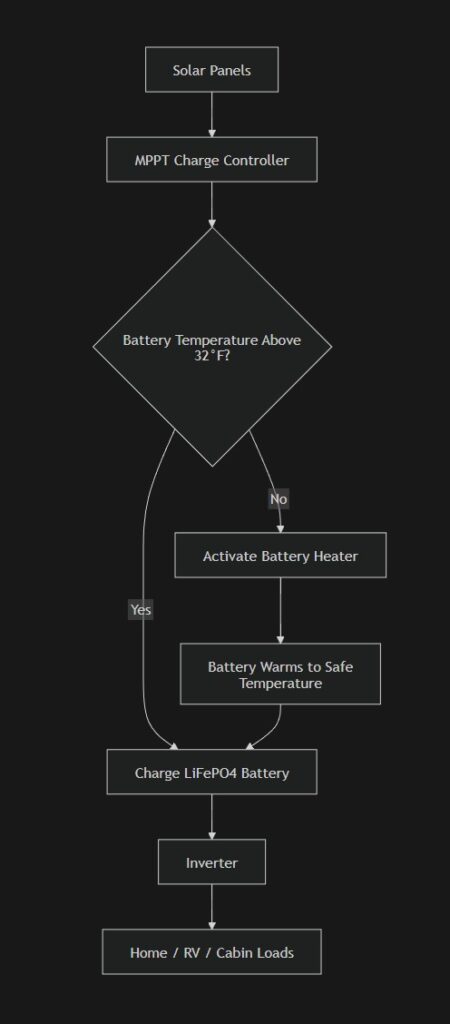
Mermaid Diagram: Winter Solar Charging Lithium Batteries System Flow
Off-Grid Cabin Lessons from Real Winter LiFePO4 Systems
Field-tested winter systems consistently show the same results.
The best performing winter solar charging lithium batteries installations use:
- Ground-mounted adjustable solar arrays
- MPPT charge controllers
- Insulated indoor battery banks
- Self-heating LiFePO4 batteries
- Oversized winter solar capacity
- Real-time system monitoring
Ground mounts are especially valuable because:
- Snow removal is easier
- Winter tilt angle can be increased
- Solar harvest improves significantly
Roof-mounted systems often underperform in snowy regions.
Read our full [ground mount vs roof mount solar] comparison for details.
Proper orientation is only half the battle. You can see how to integrate winter-ready arrays into a [complete off-grid power blueprint for retreat cabins] for total winter independence.
Most Common Winter Lithium Battery Mistakes
Avoid these critical mistakes:
| Charging Frozen Batteries: | The fastest way to destroy LiFePO4 batteries. |
| Using Lead-Acid Charger Profiles: | Incorrect voltage and temperature settings cause long-term damage. Mismatching your system voltage also complicates winter charging. Review our [12V vs 24V vs 48V solar system] comparison to see why 24V or 48V is more resilient in cold climates. |
| Ignoring Battery Heating Loads: | Heaters consume significant energy and must be included in system sizing. |
| No Low-Temperature Disconnect: | Without this protection, winter charging failures are almost guaranteed. |
| Undersized Solar Arrays: | Winter systems require more generation, not less. |
| Poor Battery Box Insulation: | Exposure destroys winter charging efficiency. |
Final Recommendations for Winter Solar Charging Lithium Batteries
The safest and most reliable winter solar charging lithium batteries strategy follows this order:
- Prevent charging below freezing
- Use BMS low-temp protection
- Install battery heating or self-heating batteries
- Build insulated battery enclosures
- Use MPPT controllers with lithium-specific settings
- Oversize winter solar production
- Monitor battery temperature daily
LiFePO4 batteries are excellent for winter solar systems when managed correctly.
Without temperature control, they fail quickly.
With proper design, they outperform lead-acid by a wide margin and provide years of dependable off-grid power, even during the harshest winter conditions.
Can winter solar charging lithium batteries work efficiently in snow-covered areas?
Yes, winter solar charging lithium batteries can work efficiently in snow-covered areas when the system is designed for cold weather performance. Solar panels often operate more efficiently in cold air because lower temperatures improve voltage output, but snow accumulation, shorter daylight hours, and weak sun angles reduce total daily production. The most effective solution is using ground-mounted panels with a steeper winter tilt angle, which helps snow slide off faster and improves solar harvest. Combined with insulated battery storage and low-temperature charging protection, winter solar charging lithium batteries remain highly reliable even in regions with heavy snowfall.
Do LiFePO4 batteries lose power overnight during winter solar charging lithium batteries operation?
Yes, LiFePO4 batteries naturally experience reduced usable capacity during cold winter nights because low temperatures slow internal chemical reactions and increase internal resistance. During winter solar charging lithium batteries operation, the battery may show normal voltage while delivering less actual capacity. This does not always mean permanent damage; it often means the battery is temporarily operating in a cold state. Once the battery warms up, performance improves. Proper insulation and maintaining the battery above freezing help reduce overnight power loss and improve morning solar charging efficiency.
Should batteries be stored indoors for winter solar charging lithium batteries systems?
Indoor storage is strongly recommended for winter solar charging lithium batteries systems whenever possible. Placing LiFePO4 batteries inside a utility room, insulated garage, heated RV compartment, or conditioned cabin space helps protect them from freezing temperatures and reduces the need for constant battery heating. Indoor placement improves charging safety, preserves battery lifespan, and reduces energy wasted on external heating systems. If indoor storage is not possible, a fully insulated and heated battery enclosure becomes essential for safe winter solar charging lithium batteries performance.
Can solar panels charge lithium batteries during cloudy winter days?
Yes, solar panels can still charge batteries during cloudy winter days, but charging speed is much slower. During winter solar charging lithium batteries operation, cloudy skies reduce solar irradiance significantly, meaning the MPPT charge controller receives far less energy from the panels. This is why winter systems should be oversized by at least 25 to 40 percent. Larger arrays help compensate for weak sunlight and allow batteries to recover charge even after multiple cloudy days. Without proper oversizing, winter solar charging lithium batteries systems often require generator backup.
Why is an MPPT controller better for winter solar charging lithium batteries?
An MPPT charge controller is better for winter solar charging lithium batteries because it can harvest more power from solar panels during weak winter sunlight and low-temperature conditions. Cold weather improves panel voltage output, and MPPT controllers are designed to convert that higher voltage into usable charging current more efficiently than PWM controllers. This extra efficiency becomes critical during short winter days when every watt matters. For off-grid cabins, RVs, and backup systems, MPPT controllers provide noticeably better winter battery charging performance and longer battery life.
Can lithium batteries freeze during winter solar charging lithium batteries use?
The battery chemistry itself does not freeze like water, but extremely low temperatures can make the electrolyte sluggish and reduce charging ability. During winter solar charging lithium batteries use, the main issue is not freezing but charging below 32°F (0°C), which causes lithium plating and permanent damage. Some batteries include low-temperature charge protection that prevents this automatically. Proper insulation and heating systems are the safest way to protect batteries from severe cold and ensure safe solar charging throughout winter.
How long should a battery heater run before winter solar charging lithium batteries begins?
Most battery heating systems should run for one to two hours before winter solar charging lithium batteries begins, depending on battery size, insulation quality, and outdoor temperature. The goal is to raise the internal battery temperature above freezing before solar charging starts. Self-heating lithium batteries manage this automatically by using incoming charge current to warm the cells first. External heating pads require manual timing or thermostat control. Rushing this process and charging too early is one of the most common causes of permanent winter battery damage.
Does winter solar charging lithium batteries require a larger battery bank?
Yes, winter solar charging lithium batteries often requires a larger battery bank because winter conditions reduce both charging opportunities and usable battery capacity. Shorter days, cloudy weather, and battery heating loads increase total energy demand while reducing solar input. A larger battery bank provides longer autonomy during storms and helps avoid deep discharges, which are especially stressful during cold weather. Many successful off-grid winter systems are designed with at least three days of backup battery storage to maintain stable operation.
Can generators support winter solar charging lithium batteries systems?
Yes, generators are commonly used as backup support for winter solar charging lithium batteries systems, especially in remote cabins and off-grid homes. When several cloudy days reduce solar production, a generator can provide emergency charging through a lithium-compatible charger or inverter charger. However, the same low-temperature charging rules still apply. The generator should not charge a frozen battery directly. Battery temperature must first be raised above freezing using heating systems or indoor warming before generator charging begins safely.
Is battery insulation enough without heating for winter solar charging lithium batteries?
Battery insulation helps significantly, but insulation alone is not always enough for winter solar charging lithium batteries in freezing climates. Insulation slows heat loss and stabilizes battery temperature, but it cannot generate heat by itself. In mild winter regions, insulation combined with indoor installation may be sufficient. In harsh climates with sub-freezing nights, heating systems are usually necessary to keep the battery above safe charging temperature. The best performance comes from combining insulation, heating, and low-temperature charge protection.
How does snow on solar panels affect winter solar charging lithium batteries?
Snow blocks sunlight completely, which can stop winter solar charging lithium batteries almost immediately if panels are fully covered. Even a thin snow layer can dramatically reduce solar production. This is why winter maintenance should include fast snow removal after storms. Ground-mounted arrays are easier to clear than roof-mounted panels and improve winter reliability. Some users also install steeper tilt angles so snow slides off naturally. Regular snow management is one of the simplest ways to improve winter solar charging lithium batteries performance.
Can RV owners safely use winter solar charging lithium batteries full-time?
Yes, RV owners can safely use winter solar charging lithium batteries full-time if the battery system includes proper low-temperature charging protection and heating solutions. Many RV lithium systems use heating pads, insulated compartments, or self-heating batteries to prevent cold charging damage. Winter camping places heavy demand on battery systems because heating fans, lighting, and appliances consume more power. A properly designed lithium setup gives better performance than lead-acid batteries and provides longer usable capacity for extended winter RV travel.
Why does voltage drop faster during winter solar charging lithium batteries use?
Voltage drops faster during winter solar charging lithium batteries use because cold temperatures increase internal resistance and reduce the speed of lithium-ion movement inside the battery. This causes the battery to deliver less energy under load and creates stronger voltage sag, especially during high-demand appliance use. Users often mistake this for battery failure, but it is often a temperature-related performance issue. Once the battery warms, voltage stability improves. Good insulation and load management reduce winter voltage drop problems.
Are self-heating batteries worth the extra cost for winter solar charging lithium batteries?
Yes, self-heating batteries are often worth the extra cost for winter solar charging lithium batteries because they eliminate much of the manual work and risk involved in cold-weather charging. These batteries automatically detect unsafe temperatures, warm themselves first, and begin charging only when conditions are safe. This protects against lithium plating and greatly simplifies winter operation for cabins, RVs, boats, and remote systems. For users who depend on reliable year-round solar storage, self-heating batteries usually provide better long-term value than replacing damaged standard batteries.
9 thoughts on “Winter Solar Charging Lithium Batteries: Complete Guide for LiFePO4 Performance, Safe Charging, and Cold Weather Solar Storage”