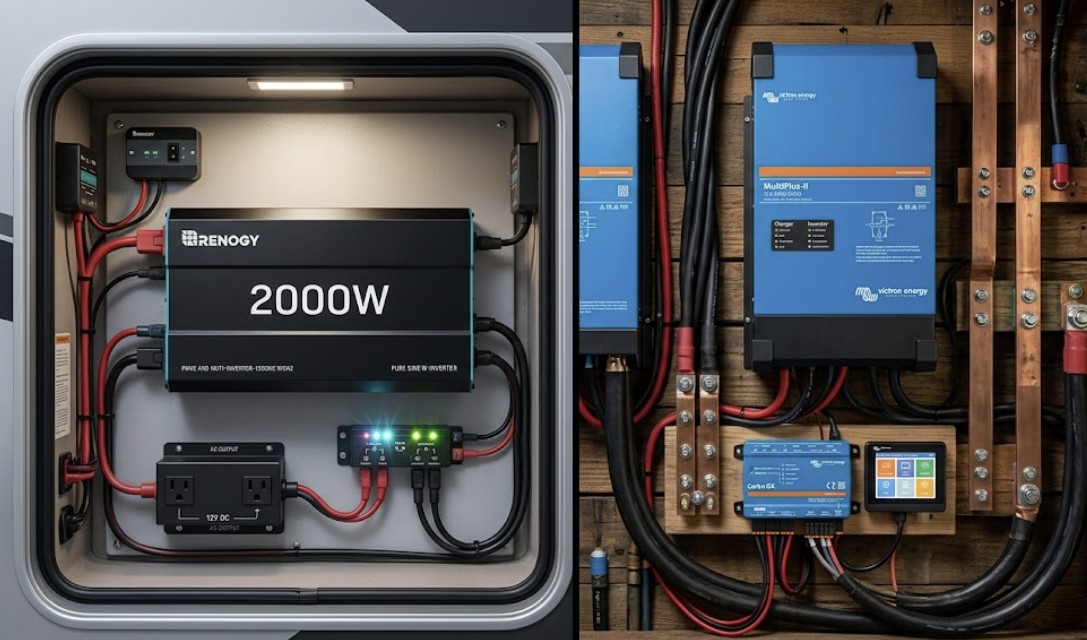
Choosing between Renogy and Victron is one of the most important decisions when building an RV electrical system, camper van setup, marine battery bank, or full-time off-grid solar installation. Both brands offer reliable pure sine wave inverter solutions, but they serve very different types of users.
In this Renogy vs Victron inverter comparison, we evaluate performance, idle power consumption, surge handling, inverter charger capability, monitoring systems, thermal reliability, repairability, long-term ownership cost, and real-world use cases. Instead of comparing marketing claims, we focus on practical engineering factors that determine which inverter performs better over years of use.
For many buyers, the question is not simply “which inverter is better?” but rather “which inverter is better for my application?”
That answer depends on duty cycle, battery chemistry, solar charging architecture, monitoring requirements, and installation environment.
Table of Contents
Understanding Pure Sine Wave Inverters Before Comparing Renogy vs Victron
A pure sine wave inverter converts DC battery power into clean AC household power that matches utility-grade electricity. This is critical for:
- Microwaves
- Refrigerators
- Medical devices
- Coffee makers
- Induction cooktops
- Air conditioners
- Power tools
- Starlink systems
- Laptop chargers
Sensitive electronics like Starlink are notorious for their high continuous draw. If you plan to run a satellite dish, make sure to check our guide on [Starlink power consumption for off-grid cabins] to see how it impacts your inverter choice.
Modified sine wave inverters can damage appliances, create motor noise, reduce efficiency, and cause overheating in compressors and chargers. For serious RV, marine, and off-grid systems, pure sine wave is the only professional choice.
Why 2000W to 3000W Is the Most Common Inverter Size
Most users choose:
| System Type | Common Inverter Size |
|---|---|
| Weekend camper van | 1000W–2000W |
| RV full-time living | 2000W–3000W |
| Off-grid cabin | 3000W–5000W |
| Residential backup | 5000W+ |
| Marine liveaboard | 2000W–5000W |
A 2000W inverter typically supports:
- Microwave use
- Coffee machine
- Hair dryer
- Laptop charging
- TV and entertainment
- Battery chargers
- Kitchen appliances
This makes the Renogy vs Victron inverter comparison especially relevant in the 2000W class.
Renogy vs Victron Inverter Comparison Table
Below is the most practical side-by-side comparison for buyers evaluating these brands.
| Feature | Renogy Pure Sine Inverter | Victron Inverter / MultiPlus |
|---|---|---|
| Price | Lower upfront cost | Premium investment |
| Idle Power Consumption | Higher | Much lower |
| Surge Performance | Good | Excellent |
| Efficiency | 90–93% typical | 94–96% typical |
| THD | <3% typical | Often <2%, sometimes <1% |
| Monitoring | Basic / optional | Advanced remote platform |
| Bluetooth | Limited models | Extensive ecosystem |
| Inverter Charger Options | Available | Excellent |
| Parallel Operation | Limited | Strong support |
| Serviceability | Consumer-level | Professional-level |
| Warranty Support | Retail-focused | Installer-grade |
| Firmware Updates | Basic | Advanced |
| Grid Integration | Limited | Excellent |
| Long-Term Reliability | Good | Exceptional |
This is where the real Renogy vs Victron inverter comparison begins.
Idle Power Consumption: One of the Biggest Real-World Differences
Many buyers ignore idle draw until battery performance starts disappearing overnight.
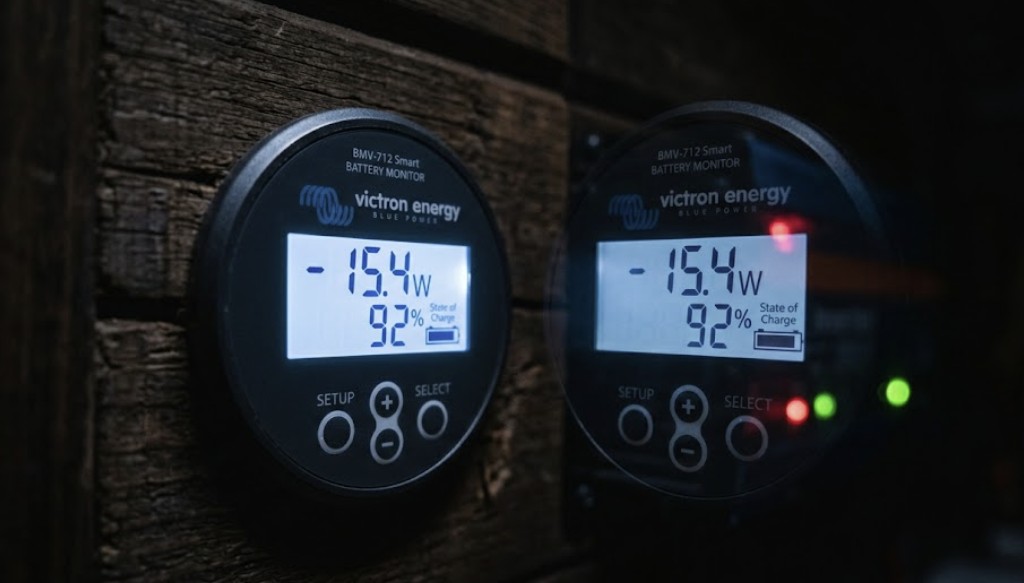
Idle power consumption refers to the power used when the inverter is ON but not actively powering appliances.
Why Idle Draw Matters
In camper vans and off-grid systems, inverter idle draw can consume large amounts of stored battery energy.
Example:
- 5A idle draw × 10 hours = 50Ah lost overnight
That can represent:
- 25% of a 200Ah battery bank
This becomes a major issue in winter, cloudy weather, and lithium systems with limited solar input.
Idle draw is a battery killer in cold climates. Learn how to manage your energy storage during the darkest months in our [winter solar charging lithium batteries] handbook.
Renogy vs Victron Idle Consumption
Typical real-world observations:
| Brand | Typical Idle Draw |
|---|---|
| Renogy | Higher |
| Victron | Significantly lower |
Victron is widely preferred for users who leave the inverter running continuously because standby losses are dramatically reduced.
This alone often justifies the price difference in a serious Renogy vs Victron inverter comparison.
If you plan on leaving your inverter on 24/7 just to keep Starlink or a small fridge running, a large 3000W inverter will kill your batteries just by “idling.” I recommend the [Victron Phoenix 12/1200]. Its idle power draw is incredibly low, and it features an “ECO mode” that puts the inverter to sleep when no load is detected, waking up every 2 seconds to check for demand. It’s the smartest way to save 50Ah of battery capacity every single night without doing a thing.
Check current price on Amazon –>
Renogy vs Victron Inverter Comparison for Efficiency and THD
Efficiency and waveform quality directly affect battery runtime and appliance protection.
Efficiency
Higher efficiency means:
- Less battery drain
- Less heat
- Longer runtime
- Smaller cooling demands
- Better inverter lifespan
η=PinPout×100%Typical values:
- Renogy: around 90–93%
- Victron: often 94–96%
That small percentage difference becomes significant over years of daily cycling.
Remember that inverter efficiency also scales with voltage. A [24V off-grid solar system for cabins] or even a 48V setup will always outperform a 12V system in real-world energy harvest.
Total Harmonic Distortion (THD)
Lower THD means cleaner AC output.
| THD Level | Result |
|---|---|
| <5% | Acceptable |
| <3% | Good |
| <2% | Excellent |
| <1% | Premium-grade |
Victron consistently performs better here.
This matters for:
- Medical CPAP machines
- Audio systems
- Sensitive chargers
- Variable-speed motors
- Refrigeration compressors
To understand why THD levels matter for medical devices and compressors, refer to the [IEEE standards for power quality].
For demanding applications, Victron leads clearly in the Renogy vs Victron inverter comparison.
Monitoring and Remote Control Systems
This is often the deciding factor.
Renogy Monitoring
| Renogy typically offers | Suitable for |
| LED indicators Basic remote switch Optional Bluetooth modules Limited app monitoring | Simple RV builds Weekend use Budget systems |
Victron Monitoring
| Victron offers | This allows |
| VE.Bus VE.Direct VE.Can Cerbo GX GX Touch VRM Portal Remote diagnostics Firmware updates Installer access | Full remote troubleshooting Historical energy analysis Battery performance review Generator automation Shore power optimization Solar charger integration |
The beauty of the Victron ecosystem is how the inverter talks to the controller. See how this integration works in our [Victron vs Renogy charge controllers] technical comparison.
In professional installations, Victron is difficult to match.
Inverter Charger Capability: Where Victron Dominates
Many users do not need only an inverter—they need an inverter charger.
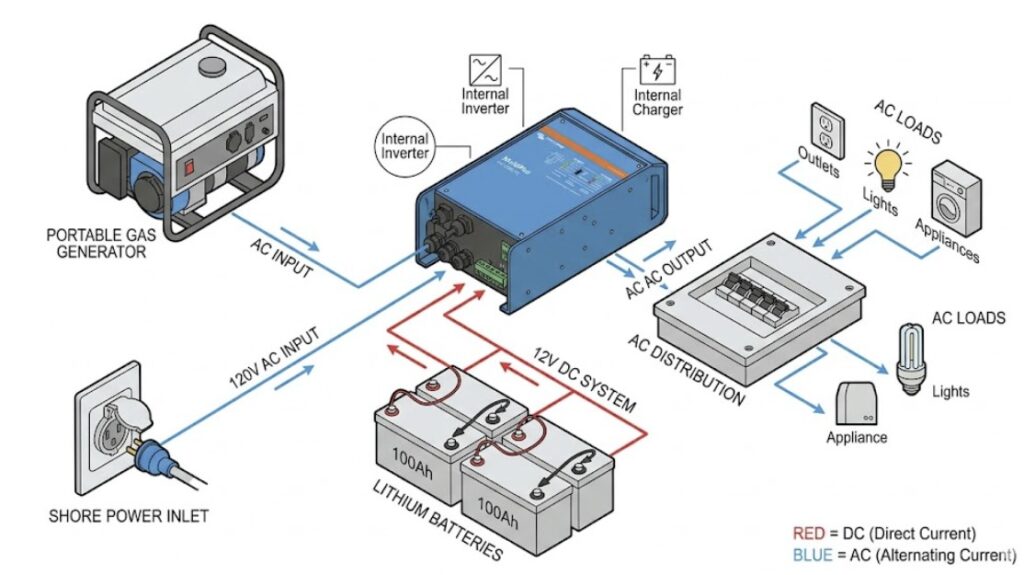
An inverter charger can:
- Convert battery DC to AC
- Charge batteries from shore power
- Automatically transfer AC loads
- Support generator charging
- Enable hybrid load management
Victron’s unique PowerAssist technology allows you to supplement limited shore power with battery energy. You can see a technical whitepaper on this in the [Victron Energy documentation library].
Renogy vs Victron for Inverter Chargers
Renogy offers solid inverter chargers for basic use.
Victron MultiPlus and Quattro systems offer:
For full-time off-grid life, the [Victron MultiPlus-II 3000W] is the only unit I specify. Why? Because of its “PowerAssist” feature. If your generator or shore power is weak, the MultiPlus will actually supplement that power with your batteries so your AC doesn’t trip the breaker. It’s a sophisticated energy manager, not just an inverter. It is virtually silent, and its 95% efficiency means you won’t waste precious solar energy as heat.
Check current price on Amazon –>
For full-time RV or residential off-grid use, this is a major advantage.
Thermal Reliability and Failure Prevention
Most inverter failures are caused by installation mistakes, not manufacturing defects.
The main causes are:
- Undersized battery cables
- Poor ventilation
- Constant overload
- High surge appliances
- Loose lugs
- Improper fusing
- Battery undervoltage
Renogy vs Victron Build Quality
| Renogy | Victron |
| Compact consumer design Forced air cooling Good for moderate duty use | Heavy-duty thermal engineering Robust internals Better derating behavior Superior high-load endurance |
If the inverter runs daily for years, Victron typically lasts longer.
This is one of the strongest factors in a long-term Renogy vs Victron inverter comparison.
Choosing Based on Real Use Cases
Best for Weekend Camper Vans
Recommended: Renogy
Why:
- Lower cost
- Reliable for occasional use
- Good for microwaves and coffee makers
- Excellent value
Best for Full-Time Van Life
Recommended: Victron
Why:
- Lower idle draw
- Better monitoring
- Remote diagnostics
- Long-term efficiency savings
Best for Off-Grid Cabins
Recommended: Victron
Why:
- Professional battery integration
- Generator support
- Long service life
- Excellent inverter charger options
For a 400-square-foot space, a 3000W inverter is the industry standard. Audit your appliances first with our [400 sq ft cabin power consumption] guide to ensure you don’t undersize.
Best for Marine Installations
Recommended: Victron
Why:
- Corrosion-resistant quality
- Remote diagnostics
- High surge performance
- Proven reliability
Best for Budget DIY Solar Systems
Recommended: Renogy
Why:
If you only need to run a microwave for 5 minutes or a coffee maker in the morning, you don’t need a professional-grade marine inverter. I suggest the [Renogy 3000W Pure Sine Inverter]. It provides a massive amount of power for the price. It’s a “favor” because it includes a remote control with a 16ft cable, allowing you to hide the noisy, bulky unit in a ventilated cabinet and still manage it from your kitchen counter. It’s the best “bang for your buck” if you aren’t living off-grid 365 days a year.
Check current price on Amazon –>
Installation Checklist for the Best Inverter Performance
Battery Cable Sizing
Never undersize DC cables.
Higher inverter loads require:
- Short cable runs
- Large copper conductors
- Proper crimp lugs
Cable sizing is where most DIYers fail. Follow our professional [24V solar system wiring diagram] to ensure your battery-to-inverter path is safe and efficient.
Fuse Protection
Install battery fuse close to battery positive terminal.
Ventilation
Maintain unrestricted airflow around inverter cooling fans.
Avoid Continuous 100% Load
Professional recommendation:
- Operate at 70–80% max load
Check Surge Loads
Appliances like:
- Refrigerators
- Air conditioners
- Compressors
- Pumps
may require 2x–3x startup surge.
Always size for surge, not only continuous watts.
Total Cost of Ownership: Not Just Purchase Price
The cheapest inverter is often the most expensive over five years.
Renogy Lower Upfront Cost
Best for:
- Limited budgets
- Temporary builds
- Seasonal systems
Victron Higher Lifetime Value
Best for:
- Daily operation
- Full-time off-grid living
- Commercial systems
- Professional installs
Savings come from:
- Lower idle losses
- Fewer failures
- Better support
- Longer service life
- Improved battery preservation
This is the hidden side of the Renogy vs Victron inverter comparison most buyers miss.
Final Verdict: Renogy vs Victron Inverter Comparison
| Choose Renogy if you want | Choose Victron if you want |
| Lower purchase cost Reliable pure sine power Weekend RV use Basic inverter needs Good value for DIY systems | Premium performance Very low idle consumption Advanced inverter charger systems Remote monitoring Professional off-grid reliability Long-term full-time operation |
Choosing an inverter is part of a larger architecture. Integrate your choice into a [complete off-grid power blueprint for retreat cabins] for a truly resilient home.
There is no universal winner.
The best inverter is the one correctly matched to your duty cycle, battery bank, and long-term usage pattern.
For occasional use, Renogy often wins.
For daily mission-critical systems, Victron usually justifies every extra dollar.
Which inverter lasts longer, Renogy or Victron?
In the Renogy vs Victron inverter comparison, Victron inverters usually last longer in demanding installations because they are designed for continuous-duty operation and professional off-grid systems. Victron uses stronger internal components, better thermal protection, heavier cooling systems, and more advanced fault protection compared to many consumer-grade models. This makes Victron a preferred choice for full-time RV living, marine systems, off-grid cabins, and solar backup installations where the inverter runs every day. Renogy inverters are also reliable when installed correctly and are excellent for moderate or occasional use, but in a long-term Renogy vs Victron inverter comparison, Victron generally wins on lifespan and durability.
Can I leave my inverter on all the time?
Yes, in a Renogy vs Victron inverter comparison, both brands can remain powered on continuously, but Victron performs much better for 24/7 use because of its lower idle power consumption. One of the biggest differences in the Renogy vs Victron inverter comparison is standby efficiency. Victron inverters consume far less battery power when no appliances are running, which makes them ideal for full-time van life, off-grid homes, and marine systems. Renogy can also stay on continuously, but higher idle draw may slowly drain the battery bank overnight, especially when solar charging is limited. This is why many buyers choose Victron for permanent installations.
Do I need an inverter charger or just a standard inverter?
In the Renogy vs Victron inverter comparison, the choice between a standard inverter and an inverter charger depends on how your electrical system is built. A standard inverter only converts battery DC power into AC household electricity for appliances. An inverter charger adds battery charging from shore power, generator input, or campground hookups while also working as an automatic transfer switch. For simple camper vans and weekend RV systems, a standard inverter may be enough. For full-time off-grid homes, large RVs, and marine systems, the Renogy vs Victron inverter comparison strongly favors Victron inverter chargers because of their advanced transfer speeds, better battery charging profiles, and stronger generator integration.
Is a 2000W inverter enough for an RV or camper van?
In the Renogy vs Victron inverter comparison, a 2000W pure sine wave inverter is often the most common and practical size for RVs and camper vans. It can usually run microwaves, coffee makers, televisions, laptops, chargers, and many kitchen appliances without problems. However, the correct size depends on the largest appliance load and startup surge. Air conditioners, induction cooktops, kettles, and hair dryers can exceed 2000W quickly. In the Renogy vs Victron inverter comparison, many users upgrade to 3000W systems when they need more surge protection or want to run multiple heavy appliances at once. Proper inverter sizing should always be based on peak load, not average daily use.
Why is idle power consumption so important in inverter selection?
Idle power consumption is one of the most important factors in the Renogy vs Victron inverter comparison because the inverter uses electricity even when no appliances are running. This standby power draw can slowly drain a battery bank overnight, especially in off-grid cabins, boats, and camper vans where battery reserves are limited. A high standby draw means more wasted solar energy, more battery cycling, and reduced system efficiency. In the Renogy vs Victron inverter comparison, Victron is known for significantly lower idle power consumption, which makes it far better for full-time use. This advantage often justifies the higher price for users who leave the inverter on every day.
Can Renogy and Victron inverters work with lithium batteries?
Yes, in the Renogy vs Victron inverter comparison, both brands work with lithium batteries including LiFePO4 systems, but Victron offers stronger lithium integration for advanced setups. Victron inverter chargers allow highly detailed programming of charge voltages, float settings, absorption times, and battery communication features, making them ideal for large lithium battery banks and professional off-grid systems. Renogy also supports lithium battery systems and works very well for DIY solar users, especially when paired with Renogy lithium batteries and solar charge controllers. In the Renogy vs Victron inverter comparison, both brands are compatible, but Victron offers more flexibility and control for complex lithium installations.
Which inverter is better for solar off-grid homes?
In the Renogy vs Victron inverter comparison, Victron is usually the better choice for full-time solar off-grid homes because these systems require maximum reliability, low standby losses, generator integration, and advanced battery management. Off-grid homes depend on the inverter every day for refrigeration, water pumps, tools, heating systems, internet equipment, and emergency backup power. Victron MultiPlus and Quattro systems are specifically built for these demanding conditions and integrate smoothly with MPPT charge controllers, Cerbo GX monitoring, and automatic generator control. Renogy can still work well for smaller cabins and budget-friendly installations, but in a serious Renogy vs Victron inverter comparison, Victron is often the premium standard.
Is Victron worth the extra money compared to Renogy?
In the Renogy vs Victron inverter comparison, Victron is often worth the extra money for users who depend on their inverter every day because the real savings appear over time rather than at the time of purchase. Lower idle power consumption saves battery capacity every night, better efficiency reduces solar charging demand, stronger surge handling protects expensive appliances, and advanced monitoring helps prevent failures before they become costly. Firmware updates and professional support also improve long-term ownership value. Renogy remains an excellent choice for budget-conscious buyers and occasional use, but in a full-time Renogy vs Victron inverter comparison, Victron often delivers the better long-term return on investment.
8 thoughts on “Renogy vs Victron Inverter Comparison: Which Pure Sine Wave Inverter Is Better for RV, Off-Grid, and Camper Van Systems?”