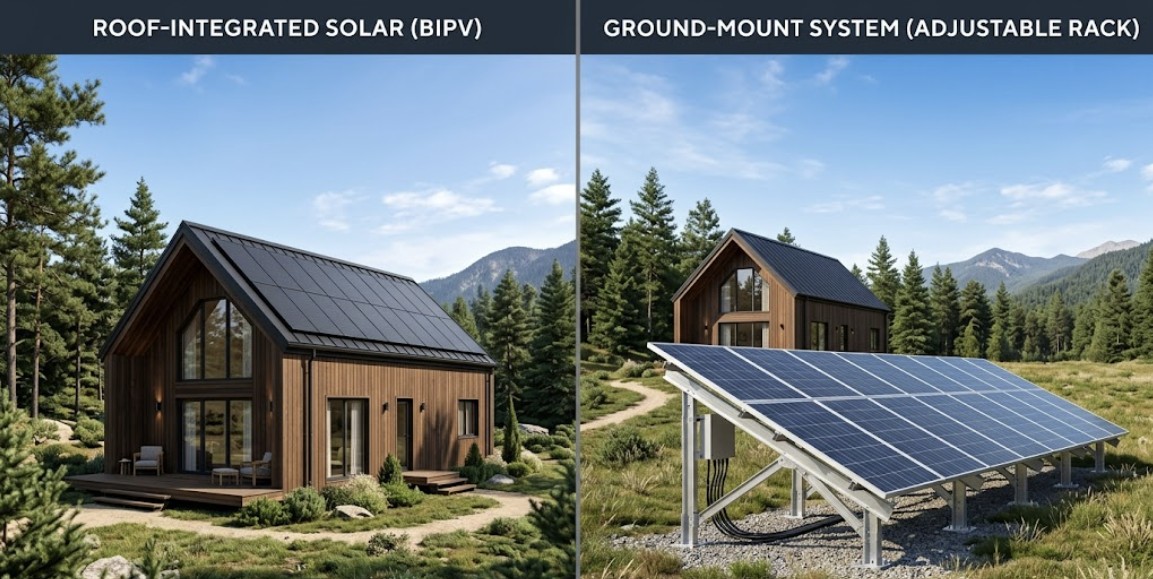
Choosing between ground-mounted and roof-mounted solar is one of the most critical engineering and financial decisions in residential and small commercial solar design. Both configurations rely on identical photovoltaic technology, yet their real-world performance, cost structure, scalability, and lifecycle value differ dramatically.
We present a precise, data-driven comparison of Ground Mount vs Roof Mount Solar, designed to maximize clarity, eliminate ambiguity, and guide optimal system selection based on measurable outcomes.
Table of Contents
Ground Mount vs Roof Mount Solar: Key Differences at a Glance
Before diving into technical depth, the core distinctions can be summarized in the table below.
| Factor | Roof-Mount Solar | Ground-Mount Solar |
|---|---|---|
| Installation Cost | Lower | Higher |
| Energy Production | Moderate | Higher (up to 25% more) |
| Installation Complexity | Simple | Complex (civil work required) |
| Maintenance Access | Difficult | Easy |
| Scalability | Limited | High |
| Land Usage | None | Requires land |
| Permitting | Easier | More restrictive |
| Lifespan Dependency | Roof lifespan | مستقل structure |
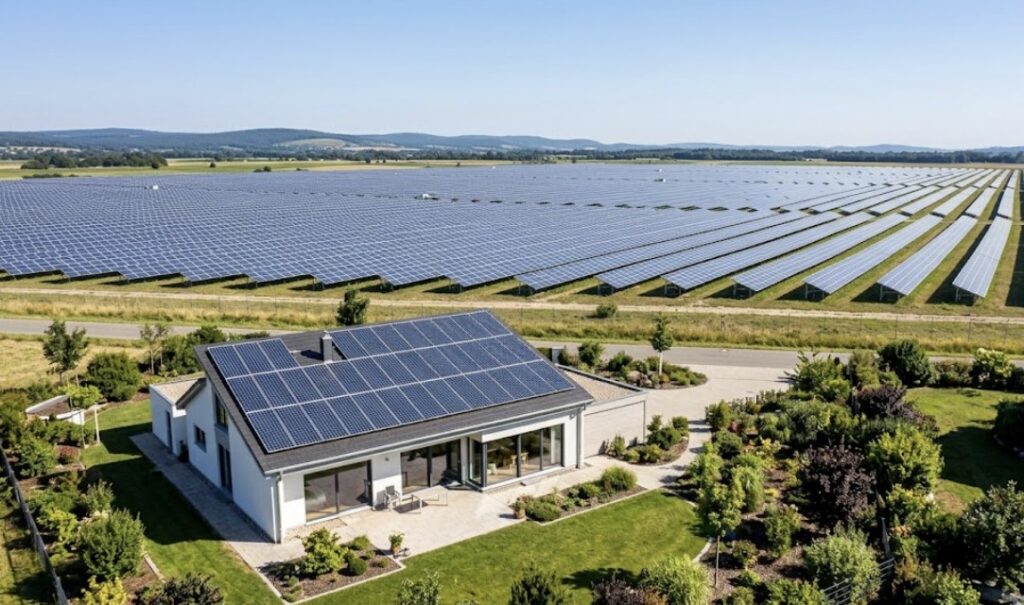
Understanding Ground Mount vs Roof Mount Solar System Design
Roof-Mounted Solar Systems
Roof-mounted systems are installed directly onto a building’s structure using rails, clamps, or ballast systems. They rely entirely on existing architecture for support.
Technical Characteristics:
- Mounted at roof pitch angle (typically 15°–40°)
- Orientation dictated by roof azimuth
- Limited airflow beneath panels
- Load constrained by structural capacity
If your roof orientation is less than ideal, you may need to compensate with more powerful hardware. Check our guide on the [best solar panels for tiny house] for 2026 to find high-efficiency modules that maximize output even at suboptimal angles.
Ground-Mounted Solar Systems
Ground-mounted systems are freestanding arrays anchored into the earth using driven piles, screws, or concrete footings.
Technical Characteristics:
- Adjustable tilt (optimal range: 25°–40° depending on latitude)
- Fully customizable orientation
- Enhanced airflow for cooling
- Independent structural engineering
Energy Output Comparison: Ground Mount vs Roof Mount Solar Efficiency
The most decisive factor in solar system performance is energy yield per installed kilowatt.
Why Ground Mount Systems Produce More Energy
Ground-mounted arrays outperform roof systems due to:
- Optimal tilt and azimuth alignment
- Lower operating temperatures
- Reduced shading constraints
- Better airflow (cooling effect)
Measured Impact:
- Efficiency gains: 10%–25% higher annual output. This extra efficiency is a game-changer if you run high-draw devices 24/7. For example, a ground-mounted array can much more easily offset the high [Starlink power consumption for off-grid cabins] during dark winter months.
- Temperature coefficient improvement: ~0.3–0.5% efficiency retained per °C
Roof System Limitations
If you are forced to use a roof mount due to space but want ground-mount performance, do not mount your panels flush. I specify [Renogy Adjustable Tilt Mounts]. Flush mounting can lose you up to 25% of your potential energy in winter. These brackets allow you to tilt your roof panels to the perfect solar angle, effectively giving you “ground-mount” precision on a roof-mount budget. It’s the single best way to overcome the structural limitations of your roof’s pitch.
Check current price on Amazon –>
Cost Analysis of Ground Mount vs Roof Mount Solar
Understanding cost requires evaluating both upfront investment and lifecycle financial performance.
Installed Cost Breakdown (2026)
| System Type | Cost per Watt | Total Cost (10kW System) |
|---|---|---|
| Roof Mount | $2.80 – $3.20 | $28,000 – $32,000 |
| Ground Mount | $3.50 – $4.10 | $35,000 – $41,000 |
Why Ground Mount Costs More
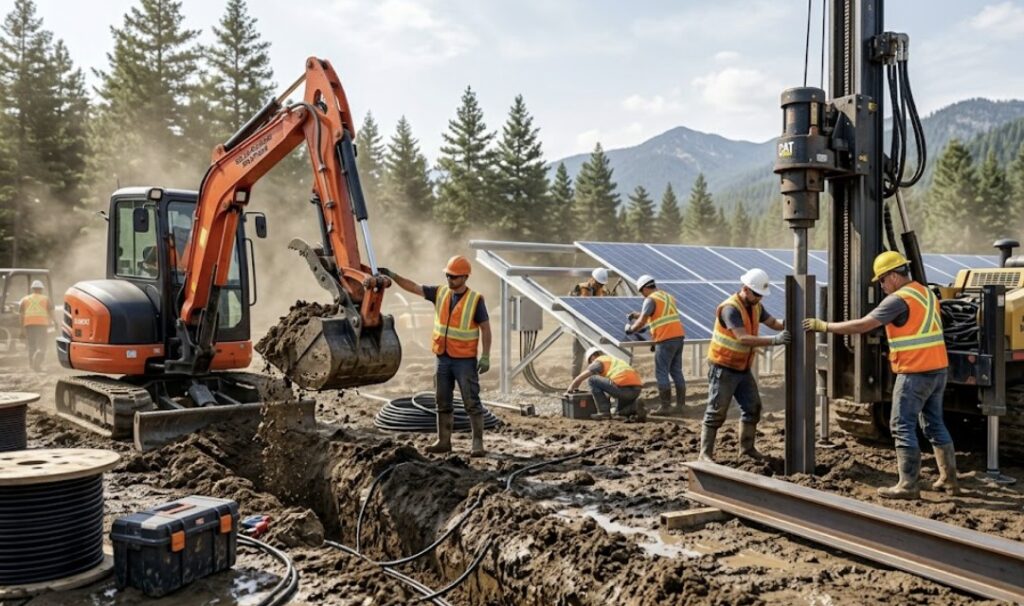
- Trenching and electrical conduit installation
- Foundation engineering (piles or concrete)
- Soil testing and site preparation
- Additional labor and materials
Trenching adds distance, and distance adds resistance. You must calculate your [solar panel wire size] carefully for ground mounts to prevent your extra energy production from being lost as heat in the underground cables.
Lifecycle ROI Consideration
Despite higher upfront costs, ground systems often achieve:
- Higher total energy output over 25 years
- Reduced maintenance costs
- No roof replacement interference
Installation Complexity and Timeline
| Roof-Mount Installation | Ground-Mount Installation |
| Duration: 1–2 days Minimal site preparation No heavy machinery required Lower labor intensity | Duration: 3–7 days (plus site prep) Requires excavation, trenching, and foundation work Dependent on soil conditions and terrain Requires heavy equipment |
Maintenance and Accessibility Comparison
Maintenance efficiency directly impacts long-term operational costs.
| Ground-Mount Advantages | Roof-Mount Challenges |
| Ground-level access simplifies cleaning and repairs This accessibility is critical in snowy regions. Ground mounts allow you to clear panels easily to maintain [winter solar charging lithium batteries] performance when roof access would be too dangerous. Faster troubleshooting and component replacement Safer maintenance conditions | No matter which system you choose, dust and pollen are your enemies. For roof-mounters, safety is the concern; for ground-mounters, it’s frequency. I suggest the [DocaPole 24ft Cleaning Kit]. It’s a “favor” because its reach allows roof-mount owners to clean their panels from the safety of a ladder or even the ground, and it makes ground-mount maintenance a 5-minute task. Remember: a dirty panel can lose 10% of its efficiency in a single month of dry weather. Check current price on Amazon –> |
Scalability and Future Expansion
| Ground Mount Systems | Roof Mount Systems |
| Easily expandable Ideal for high energy consumption households Supports EV charging and electrification upgrades | Limited by roof size Difficult or impossible to expand Fixed system capacity |
Land Use and Aesthetic Considerations
| Ground-Mount Trade-Offs | Roof-Mount Advantages |
| Requires significant yard space Visible installation may affect property aesthetics Potential fencing required for protection | Uses unused roof space Minimal visual impact Preserves land usability |
Permitting and Regulatory Factors
Permitting complexity varies significantly.
| Roof-Mounted Systems | Ground-Mounted Systems |
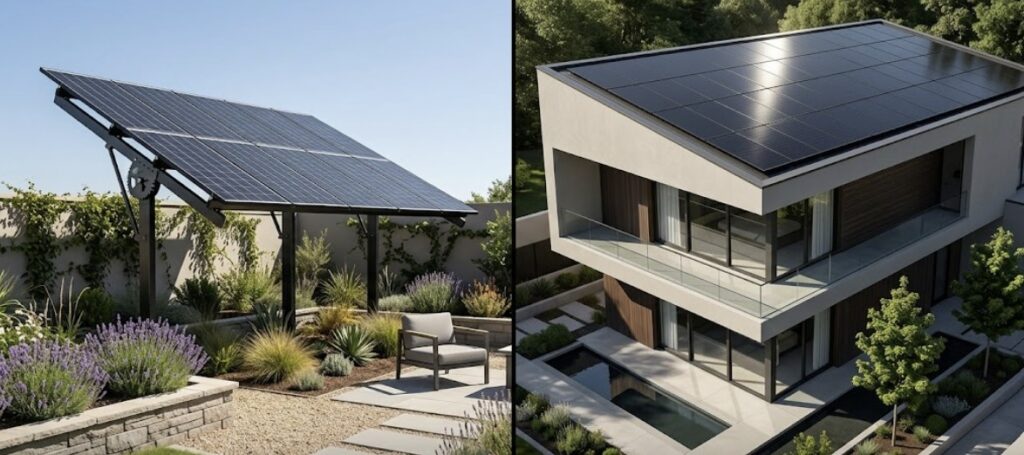
| Typically streamlined approval process No zoning complications Considered building modification | Classified as accessory structures Subject to zoning laws and setbacks —> Zoning requirements for accessory structures like ground mounts vary by county. You can find common regulatory standards in the [SEIA Residential Solar Guide]. Requires detailed site plans and approvals |
Environmental and Site Constraints
| Ground-Mount Limitations | Roof-Mount Limitations |
| Soil composition (rock, clay, water table) Terrain slope Vegetation clearing requirements | Roof condition and age Structural load capacity Orientation and shading |
Ground Mount vs Roof Mount Solar: Engineering Decision Matrix
| Scenario | Recommended System |
|---|---|
| Limited land | Roof Mount |
| Large property | Ground Mount |
| Maximum energy output | Ground Mount |
| Lowest upfront cost | Roof Mount |
| Future expansion needed | Ground Mount |
| Urban/suburban home | Roof Mount |
| Off-grid system | Ground Mount |
Advanced Technologies in Ground Mount Systems
Ground-mounted arrays unlock technologies unavailable or impractical for roof systems:
| Bifacial Solar Panels | Solar Trackers |
| To truly justify the extra cost of a ground mount, you must use Bifacial panels. I recommend the [BougeRV 200W Bifacial Panels]. Because ground mounts have an open back, these panels capture sunlight reflecting off the grass, gravel, or snow beneath them. This “albedo effect” can boost your energy harvest by an extra 15-20% without adding a single square inch to your array’s footprint. It’s an efficiency gain that roof-mounted panels simply cannot achieve. Check current price on Amazon –> | Follow sun movement throughout the day Increase output by 30–40% Higher mechanical complexity |
For a technical breakdown of how tracking affects the ‘Levelized Cost of Energy’ (LCOE), refer to the [NREL PVWatts Calculator] to model your specific site.
While bifacial panels are more expensive, they offer the best ROI on ground mounts over 25 years. We break down the pricing of these and other options in our [solar panels for tiny home cost] guide.
When Ground Mount Solar Is the Superior Choice
Ground-mounted systems are ideal when:
- Roof orientation is poor (north-facing or shaded)
- Energy demand exceeds roof capacity
- Property has ample open land
- Long-term energy independence is the goal
If you’re planning a 3kW to 5kW system for a full-time residence, we highly recommend a 48V architecture. Review our [12V vs 24V vs 48V solar system] engineering guide to see why high voltage is the perfect partner for large ground arrays.
When Roof Mount Solar Is the Better Option
Roof-mounted systems excel when:
- Budget constraints are significant
- Roof is structurally sound and well-oriented
- Land availability is limited
- Fast installation is required
Long-Term Performance and Durability
| Ground-Mount Systems | Roof-Mount Systems |
| Lifespan: 25–30+ years Durable steel structures Independent of building wear | Lifespan tied to roof condition Requires removal during roof replacement Potential added costs over time |
Final Verdict: Ground Mount vs Roof Mount Solar
The decision between Ground Mount vs Roof Mount Solar ultimately comes down to balancing three core factors:
- Space availability
- Budget constraints
- Energy production goals
Ground-mounted solar dominates in performance, scalability, and long-term output.
Roof-mounted solar leads in affordability, simplicity, and space efficiency.
For homeowners prioritizing maximum energy generation and long-term value, ground-mount systems provide unmatched advantages. For those seeking the fastest return on investment with minimal complexity, roof-mounted installations remain the most practical choice.
Whether you choose the ground or the roof, your installation must be part of a cohesive plan. Integrate your decision into a [complete off-grid power blueprint for retreat cabins] to ensure long-term success.
Conclusion
A properly engineered solar system is not defined by panel type, but by placement strategy. By analyzing site conditions, financial objectives, and long-term energy needs, we ensure the correct selection between ground-mounted and roof-mounted systems.
The difference is not marginal it is structural, financial, and performance-driven.
What is the fundamental difference between ground-mounted and roof-mounted solar systems?
The fundamental difference lies in where and how the solar array is installed, which directly influences performance, cost, and flexibility. Roof-mounted systems attach directly to an existing structure, using the building as support, which reduces material and labor requirements. Ground-mounted systems are installed independently on using engineered foundations, allowing full control over tilt, orientation, and spacing. This structural independence enables better optimization for sunlight exposure, while roof installations are limited by the existing geometry of the building.
Which type of system generates more electricity annually?
In most real-world scenarios, ground-mounted systems generate more electricity annually because they can be positioned at the ideal angle and direction for maximum solar exposure. This optimization allows them to capture sunlight more efficiently throughout the day and across seasons. Roof-mounted systems, while still effective, often operate below peak potential due to fixed roof angles, partial shading, and heat buildup, which can slightly reduce total output over time.
Is one option more cost-effective in the long run?
Cost-effectiveness depends on both initial investment and long-term energy production. Roof installations generally require less upfront capital, making them attractive for homeowners seeking quicker financial returns. However, ground-mounted systems often produce more electricity over their lifespan, which can result in greater cumulative savings. Over a 25-year period, the higher output can offset the higher installation cost, particularly in properties with high energy demand.
How does installation differ between the two system types?
Installation complexity varies significantly between the two options. Roof-mounted systems are typically installed faster because they utilize an existing structure, requiring minimal site preparation. Ground-mounted systems involve more extensive work, including trenching, foundation setup, and الأرض preparation, which increases both time and labor requirements. This added complexity allows for better customization but also requires careful planning and engineering.
Which system is easier to maintain?
Maintenance differences in Ground Mount vs Roof Mount Solar are primarily driven by accessibility and safety. Ground-mounted systems allow technicians to perform cleaning, inspections, and repairs directly at ground level, which reduces labor time and eliminates the need for specialized safety equipment. In contrast, roof-mounted systems require ladder access, harnesses, and additional precautions, increasing maintenance complexity and cost. Over time, easier access in ground installations can contribute to more consistent performance and faster issue resolution.
How does available space influence Ground Mount vs Roof Mount Solar decisions?
Space availability is a decisive factor when comparing Ground Mount vs Roof Mount Solar configurations. Roof-mounted systems are ideal for properties where land is limited because they utilize unused roof space without affecting yard usability. Ground-mounted systems require open land, making them more suitable for rural or large residential properties where sufficient area exists to install and expand the array without compromising landscaping or other uses.
Does shading impact Ground Mount vs Roof Mount Solar differently?
Shading has a significant impact in any Ground Mount vs Roof Mount Solar comparison, but ground-mounted systems offer greater flexibility in avoiding it. Since they can be placed anywhere on the property, installers can select locations with optimal sunlight exposure. Roof-mounted systems are fixed in place, meaning shading from trees, chimneys, or nearby buildings can reduce efficiency and limit overall system output.
Can Ground Mount vs Roof Mount Solar systems be expanded later?
Expansion potential is another key difference in Ground Mount vs Roof Mount Solar systems. Ground-mounted installations are highly scalable, allowing additional panels to be added as energy needs grow, which is particularly useful for homeowners planning future upgrades like electric vehicles. Roof-mounted systems are constrained by available surface area, and once the roof is fully utilized, further expansion may not be feasible.
Are there aesthetic differences between the two options?
Yes, aesthetics differ based on installation type. Roof-mounted systems are typically less visible and integrate seamlessly with the building’s design, making them more appealing for homeowners concerned about appearance. Ground-mounted systems are more noticeable since they occupy yard space, which may impact landscaping and visual appeal depending on placement and design.
How do weather conditions impact performance and durability?
Weather resilience is an important factor in Ground Mount vs Roof Mount Solar system performance. Ground-mounted systems can be engineered with optimal tilt angles and strong foundations to better withstand wind and snow loads, often shedding snow more effectively. Roof-mounted systems depend on the building’s structural integrity and may face limitations under extreme weather conditions, particularly in regions with heavy snow accumulation or high winds.
Which option is better suited for off-grid living?
For off-grid setups, Ground Mount vs Roof Mount Solar comparisons typically favor ground-mounted systems due to their flexibility and scalability. They can be designed to accommodate larger arrays and integrate easily with battery storage systems, making them well-suited for remote locations where maximizing energy independence is essential.
Do permits differ in Ground Mount vs Roof Mount Solar installations?
Permitting requirements vary between Ground Mount vs Roof Mount Solar systems, with roof-mounted installations generally being simpler to approve since they modify an existing structure. Ground-mounted systems are often treated as separate constructions, requiring additional permits, zoning approvals, and compliance with setback regulations, which can extend project timelines.
How does roof condition impact Ground Mount vs Roof Mount Solar choices?
Roof condition is a critical factor for roof-mounted installations. If the roof is aging or requires replacement in the near future, installing solar panels may lead to additional costs when the panels need to be removed and reinstalled. In such cases, a ground-mounted system can provide a more stable and independent solution that avoids interference with building maintenance.
Which system offers better long-term durability?
Durability depends on materials and environmental exposure, but ground-mounted systems often have an advantage due to their robust конструкции and independence from building wear. They are designed to withstand environmental conditions without relying on a roof’s lifespan. Roof-mounted systems are durable but are inherently linked to the condition of the building, which may limit their long-term reliability.
Can both systems use the same solar panel technology?
Yes, both installation types use the same photovoltaic panels and core components. The difference lies in how those panels are mounted and optimized. Ground-mounted systems can more easily incorporate advanced technologies, such as bifacial panels or tracking mechanisms, which can further enhance energy production.
Which option provides the fastest return on investment?
Return on investment in Ground Mount vs Roof Mount Solar varies based on upfront cost and energy output. Roof-mounted systems typically achieve a faster payback period due to lower installation expenses. Ground-mounted systems, while more expensive initially, can generate higher total savings over time due to increased energy production, particularly in high-consumption households.
How does temperature affect efficiency in Ground Mount vs Roof Mount Solar systems?
Temperature directly influences efficiency in Ground Mount vs Roof Mount Solar systems because solar panels perform better at lower operating temperatures. Ground-mounted systems benefit from improved airflow beneath the panels, which helps dissipate heat and maintain higher efficiency. Roof-mounted systems tend to retain more heat due to limited ventilation, which can slightly reduce performance in warmer conditions.
Is Ground Mount vs Roof Mount Solar better for large properties?
For larger properties, Ground Mount vs Roof Mount Solar comparisons generally favor ground-mounted systems because they can fully utilize available land to maximize energy production. Their scalability and flexibility make them ideal for meeting higher energy demands, whereas roof-mounted systems may be limited by available surface area.
Do solar installations increase property value in Ground Mount vs Roof Mount Solar setups?
Both options in Ground Mount vs Roof Mount Solar can increase property value by reducing energy costs and enhancing sustainability. Roof-mounted systems are often more appealing due to their integration with the home, while ground-mounted systems may add value through higher energy output and independence, particularly for buyers focused on long-term energy savings.
What is the best overall choice in Ground Mount vs Roof Mount Solar?
The best choice in Ground Mount vs Roof Mount Solar depends on balancing budget, space, and energy goals. Roof-mounted systems are typically the most practical for homeowners with limited land and a focus on affordability, while ground-mounted systems are better suited for those who prioritize performance, scalability, and long-term energy production.
6 thoughts on “Ground Mount vs Roof Mount Solar: The Complete 2026 Technical Comparison Guide”