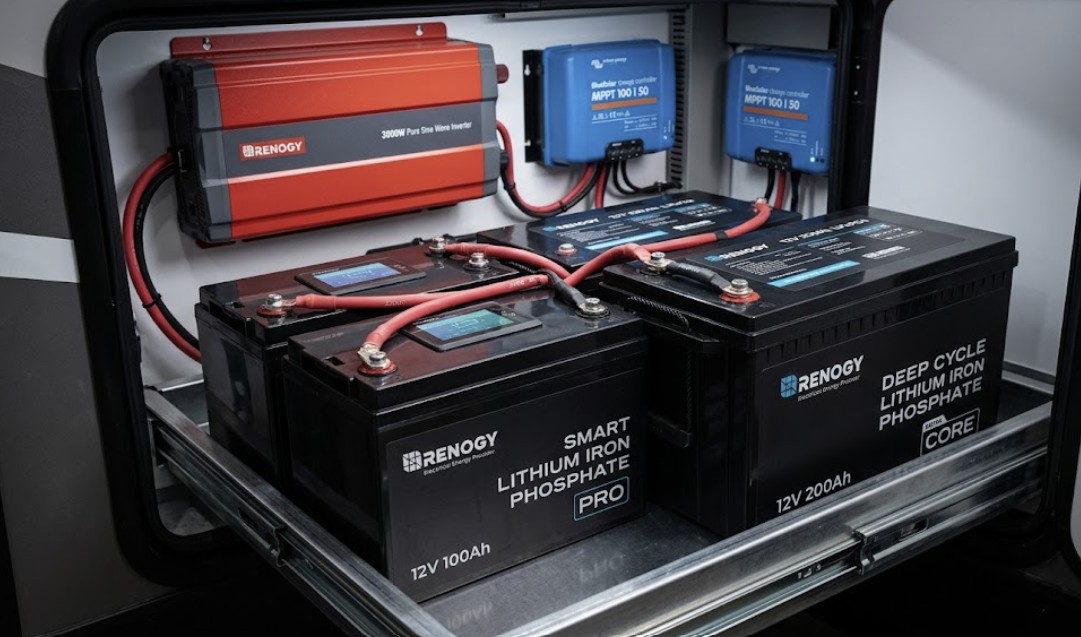
Choosing between a 2x 100Ah vs 1x 200Ah battery configuration is not just about total amp-hours. In real-world off-grid systems, RV power banks, marine electrical systems, and solar storage arrays, the architecture of the battery bank directly impacts inverter surge handling, voltage stability, redundancy, cable losses, maintenance, and long-term cycle life.
While both setups provide roughly 200Ah of nominal storage, they behave very differently under heavy loads, fast charging, low-temperature conditions, and dynamic inverter demand.
The critical difference comes down to:
- Battery Management System (BMS) limitations
- Parallel current balancing
- Wiring resistance
- Failure tolerance
- Installation flexibility
- Surge current capability
- Internal resistance behavior
For modern LiFePO4 chemistry systems powering 2000W–5000W inverters, understanding these engineering differences determines whether your system performs flawlessly or suffers from nuisance shutdowns, voltage sag, and premature battery wear.
Table of Contents
2x 100Ah vs 1x 200Ah Battery: Quick Technical Comparison
| Specification | 2x 100Ah LiFePO4 Batteries | 1x 200Ah LiFePO4 Battery |
|---|---|---|
| Total Capacity | 200Ah | 200Ah |
| Nominal Voltage | 12.8V | 12.8V |
| Energy Storage | ~2560Wh | ~2560Wh |
| BMS Redundancy | Dual BMS | Single BMS |
| Continuous Discharge Potential | Higher combined output | Limited by single BMS |
| Wiring Complexity | Moderate | Simple |
| Failure Tolerance | 50% backup remains | Total shutdown risk |
| Voltage Sag Risk | Higher if wiring unequal | Lower |
| Installation Flexibility | Excellent | Moderate |
| Surge Handling | Better for large inverters | Depends on BMS |
| Cable Requirements | Critical balancing needed | Simpler |
| Maintenance | Slightly higher | Lower |
| Expansion Capability | Excellent | Limited |
| Weight Distribution | Better | Concentrated mass |
Understanding Capacity in a Parallel Connection
Two 100Ah batteries connected in a parallel connection maintain the same system voltage while doubling amp-hour capacity.
Example:
- 1x 12V 100Ah battery = 1280Wh
- 2x 12V 100Ah parallel bank = 2560Wh
- 1x 12V 200Ah battery = 2560Wh
From a pure energy standpoint, both systems are nearly identical.
However, energy storage alone does not determine system performance. The Battery Management System (BMS), cable resistance, and discharge current behavior create major operational differences.
The BMS Discharge Delta: The Most Important Difference
Most users ignore the single biggest factor in the 2x 100Ah vs 1x 200Ah battery debate:
BMS continuous discharge current limits
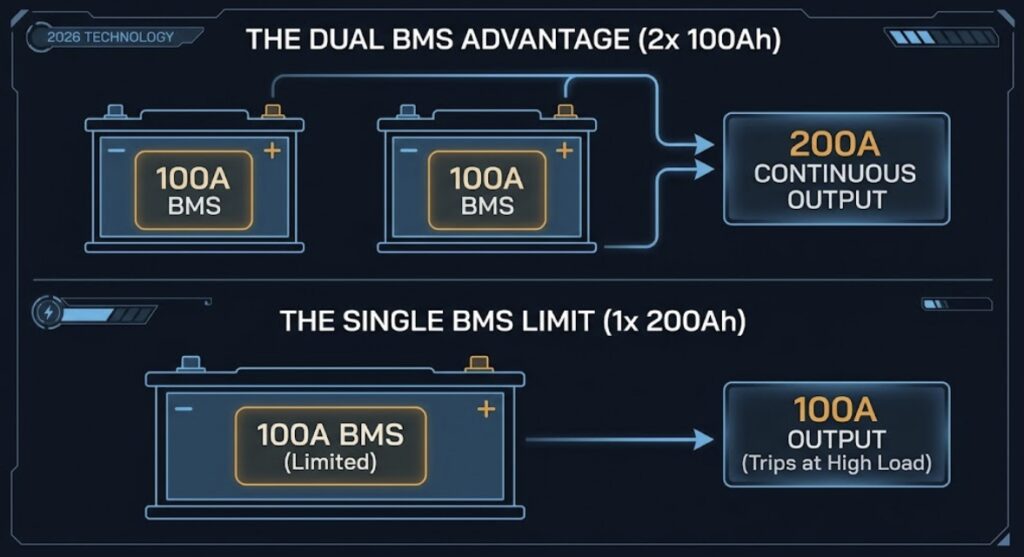
Many 200Ah LiFePO4 batteries still use a single 100A or 150A BMS.
Meanwhile, two separate 100Ah batteries each often contain their own 100A BMS. Especially when planning for [400 sq ft cabin power needs] where peak loads are frequent.
That means the combined discharge capability becomes additive.
Example
If each 100Ah battery contains:
- 100A continuous BMS
- 200A surge BMS
Then the total bank capability becomes:
Total Discharge Current=BMS1(A)+BMS2(A)Which equals:
- 100A + 100A = 200A continuous discharge
- Higher combined surge handling
A single 200Ah battery may only provide:
| Battery Configuration | Continuous Discharge | Peak Surge Handling | Inverter Compatibility |
| 2x 100Ah (Parallel) | 200A (Additive) | 400A+ Combined | Up to 3000W+ |
| 1x 200Ah (Single) | 100A – 150A (Limited) | 200A Single BMS | Up to 1500W-2000W |
This matters enormously when operating:
| High-Demand Load | Est. Amperage (12V) | 1x 200Ah (100A BMS) | 2x 100Ah (Dual BMS) |
| 3000W Inverter (Max Load) | ~250A | BMS Overload Shutdown | Stable Operation |
| Induction Cooktop | 150A | High Overload Risk | Stable Operation |
| RV Air Conditioner | 130A | Significant Voltage Sag | Stable Operation |
| Microwave Oven | 110A | BMS Limit Warning | Optimal Performance |
| Coffee Maker / Compressor | 90A | Functional | Optimal Performance |
| Power Tools (Circular Saw) | 80A+ | Functional | Optimal Performance |
Real-World Example
A 3000W inverter at 12V can demand:
I=VPApproximately: 3000 ÷ 12 = 250A
A single 200Ah battery with a 100A BMS will instantly trip.
Two 100Ah batteries with dual 100A BMS units may survive the surge depending on inverter ramp behavior and cable quality. This is why many experienced off-grid installers prefer multiple smaller LiFePO4 batteries in parallel instead of one oversized battery.
Architect’s Hardware Pick: > If you are building a high-surge system, I recommend the [LiTime 12V 100Ah LiFePO4 2-Pack] to take full advantage of the dual BMS discharge capacity. For those prioritizing a clean, single-unit setup with proven reliability, the [Renogy 12V 200Ah Core Series] remains the gold standard for stationary off-grid cabins.
[Check Price for LiTime 2-Pack on Amazon]
[Check Price for Renogy 200Ah on Amazon]
Voltage Sag and Internal Resistance
Voltage sag occurs when battery voltage drops sharply during heavy current draw.
| This is controlled by: | Internal cell resistance Cable resistance Connection quality Busbar resistance State of Charge (SOC) |
In a poorly wired parallel bank, one battery supplies more current than the other.
| That overloaded battery experiences: | Higher heat Faster cycle degradation Increased voltage sag Uneven State of Charge (SOC) Reduced cycle life |
The result is accelerated imbalance across the system.
The Wiring Resistance Trap
The biggest installation mistake in parallel battery systems is unequal cable length.
Even small resistance differences create current imbalance.
| If one battery path has lower resistance: | It discharges harder Charges faster Ages quicker |
This destroys long-term bank balancing.
You must use the correct gauge to prevent overheating, as detailed in our [Solar Panel Wire Size & Voltage Drop Guide].
Equidistant Wiring Rule
For proper current sharing:
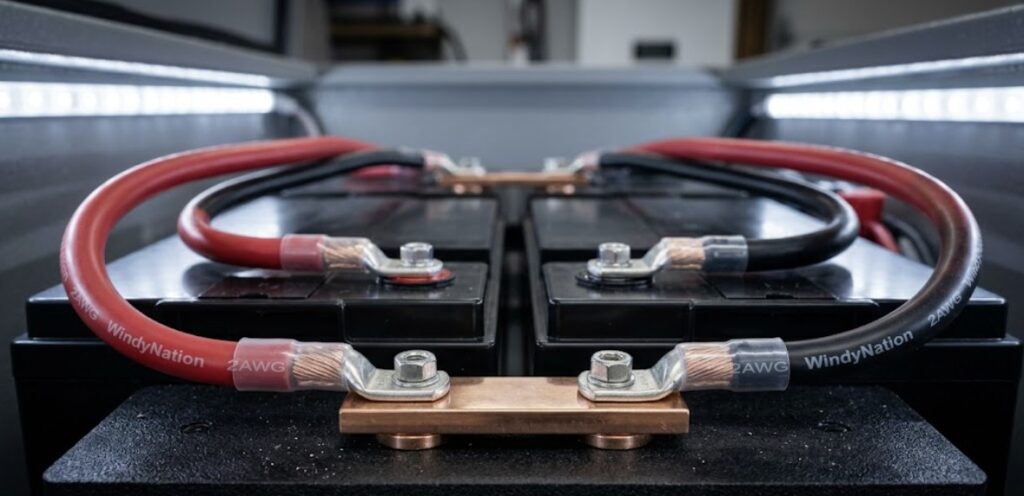
- Positive cables must be identical length
- Negative cables must be identical length
- Cable gauge must match exactly
- Busbars should have equal resistance paths
| Professional installers typically use: | 2AWG cables 1/0 AWG cables Copper busbars Symmetrical terminal routing |
Pro-Tip on Cables: To minimize voltage drop, I strictly use WindyNation 2AWG Pure Copper Battery Cables.
[View current price for 2AWG Cables on Amazon]
Incorrect Parallel Wiring
One battery sits electrically closer to the inverter.
| Result: | Unequal current distribution Persistent imbalance Increased voltage sag Reduced lifespan |
Correct Parallel Wiring
The inverter connects diagonally across the battery bank or through balanced busbars.
This ensures:
- Equal resistance
- Balanced current flow
- Uniform charging
- Equal discharge stress
Single Point of Failure vs Redundancy Factor
A single 200Ah battery creates a dangerous single point of failure.
| If the BMS fails: | Entire system shuts down No backup power exists Inverter loses all supply Solar charging may stop |
With 2x 100Ah batteries:
- One battery can fail
- Remaining battery still provides 50% capacity
- Essential loads continue operating
For mission-critical systems, redundancy matters enormously.
| This is especially important for: | Off-grid cabins Emergency backup systems Marine navigation systems Winter RV boondocking Medical equipment support |
Many professional solar installers intentionally design battery banks with partial redundancy to avoid catastrophic blackouts.
Cycle Life and Aging Characteristics
Modern LiFePO4 chemistry offers:
- 4000–8000 cycles
- 80% Depth of Discharge capability
- Low self-discharge
- Excellent thermal stability
According to the [National Renewable Energy Laboratory (NREL)] research on lithium-ion battery degradation.
However, parallel battery banks only age properly if:
- Batteries are identical
- Same production batch
- Same State of Charge
- Same cable resistance
- Same temperature exposure
Mixing old and new batteries accelerates imbalance.
Why Parallel Banks Drift Over Time
Every battery develops slightly different internal resistance.
Over hundreds of cycles:
- One battery becomes dominant
- Current sharing changes
- Heat distribution changes
- Voltage sag increases
This is why balanced busbars and periodic monitoring are mandatory.
The Monitoring Solution: To ensure your parallel bank stays balanced, the Victron SmartShunt 500A is a non-negotiable tool.
[Check Price and Reviews for Victron SmartShunt]
Physical Installation Differences
2x 100Ah Battery Advantages
| Smaller batteries are easier to | This matters heavily in |
| Carry Mount Replace Distribute by weight | Boats Vans Camper trailers Compact RVs |
Weight distribution improves vehicle balance.
Two smaller batteries also fit awkward compartments more easily.
1x 200Ah Battery Advantages
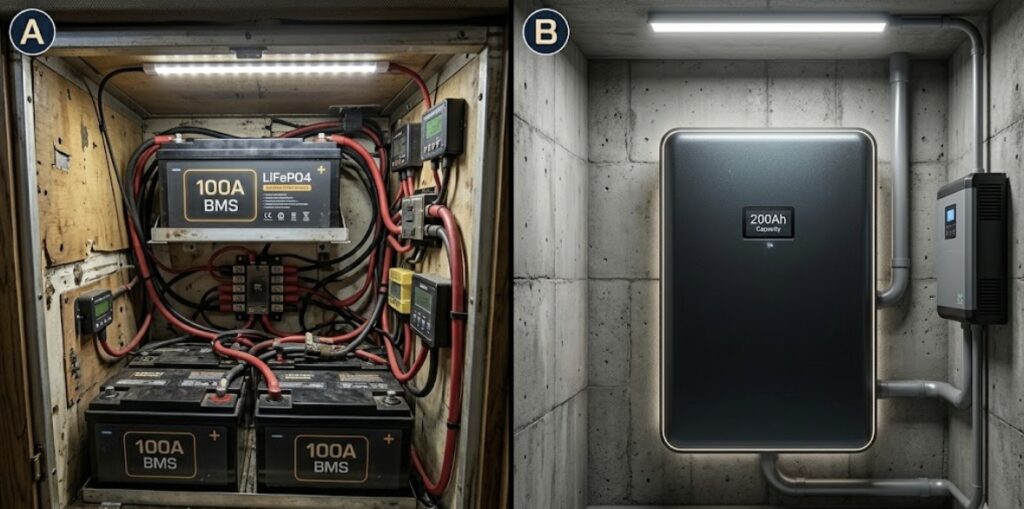
One large battery:
- Uses fewer cables
- Requires fewer terminals
- Simplifies troubleshooting
- Reduces installation time
| This setup works well in: | Dedicated battery rooms Large solar cabinets Stationary power walls |
Charging Behavior and Current Distribution
Parallel batteries share charging current automatically.
However, charging balance depends on:
- Internal resistance
- Cable symmetry
- Battery temperature
- SOC matching
Charging Example
A 60A charger connected to two balanced batteries ideally splits:
- 30A to battery #1
- 30A to battery #2
But unequal wiring may create:
- 40A to one battery
- 20A to the other
Over time, imbalance grows.
Best Charging Profile for LiFePO4
Recommended charging profile:
| Charging Stage | Voltage |
|---|---|
| Bulk/Absorption | 14.2V–14.6V |
| Float | 13.4V–13.6V |
| Low Temp Charging Cutoff | 0°C / 32°F |
| Recommended Charge Rate | 0.2C–0.5C |
For 200Ah total capacity:
- Ideal charging current = 40A–100A
Peukert’s Law and High Load Efficiency
Peukert’s Law explains how usable battery capacity declines under heavy loads.
LiFePO4 chemistry performs far better than lead-acid batteries, but high current still affects efficiency.
A battery operating near BMS limits experiences:
- Higher voltage drop
- Faster heating
- Reduced usable runtime
Because dual 100Ah batteries split current demand, each battery experiences less stress.
This can slightly improve real-world runtime under large inverter loads.
Thermal Management and Heat Distribution
Two separate batteries dissipate heat more effectively.
Heat spreads across:
- Two BMS units
- Two cell groups
- Larger surface area
A single 200Ah battery concentrates:
- Heat
- Current density
- Thermal load
Under sustained inverter demand, thermal throttling may occur earlier in a single battery system.
Cost Analysis in 2026
Lithium battery pricing continues falling due to manufacturing scale and lower raw material costs.
Average 2026 pricing:
| Configuration | Average Cost |
|---|---|
| 2x 100Ah LiFePO4 | $450–$900 |
| 1x 200Ah LiFePO4 | $500–$1100 |
The price gap is narrowing.
However, total system cost must include:
- Busbars
- 2AWG cables
- Fuses
- Disconnects
- Mounting hardware
Two-battery systems often cost slightly more due to additional components.
Fuse and Protection Requirements
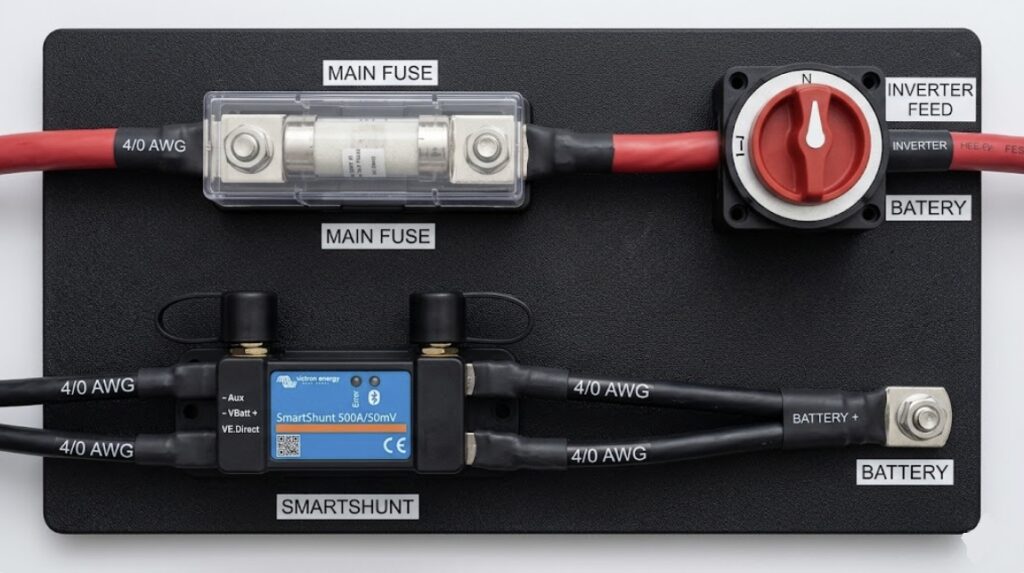
Every parallel battery should have:
- Individual fuse protection
- Proper disconnects
- Balanced cable routing
Recommended Fuse Layout
| Component | Suggested Fuse |
|---|---|
| Each 100Ah battery | 100A–150A Class T |
| Main inverter feed | 250A–400A |
| Solar controller | Sized to controller output |
Engineering Safety Note: I recommend the Blue Sea Systems Class T Fuse Block for the main inverter line.
[Check availability for Class T Fuse Blocks on Amazon]
Without individual fusing, a shorted battery can dump enormous current into another battery.
This creates severe fire risk.
When 2x 100Ah Batteries Are Better
| Choose dual 100Ah batteries if your system requires: | High inverter surge loads Redundancy Modular expansion Flexible installation Easier transport Better thermal distribution |
| Ideal applications: | RV boondocking Off-grid cabins Mobile workshops Overlanding rigs Marine systems Backup power systems |
When 1x 200Ah Battery Is Better
| Choose one 200Ah battery if your priority is: | Simpler wiring Minimal maintenance Clean installation Reduced connection points Easier monitoring |
| Ideal applications: | Small solar systems Stationary installations Compact electrical cabinets Beginner DIY setups |
Series-Parallel Expansion Possibilities
Dual 100Ah batteries offer superior Series-Parallel scalability.
Example:
- Start with 2x 100Ah parallel
- Expand later to 4x 100Ah
- Reconfigure to 24V Series-Parallel
This flexibility helps future-proof solar installations. Essential step before deciding on a [12V vs 24V vs 48V solar system] architecture for your cabin.
A single 200Ah battery limits modular growth.
Real Engineering Recommendation
For high-demand inverter systems, 2x 100Ah batteries usually outperform a single 200Ah battery because:
- Combined BMS current is higher
- Redundancy improves reliability
- Heat distribution is superior
- Current stress per battery decreases
However, this advantage only exists if:
- Wiring is perfectly balanced
- Busbars are properly designed
- Batteries are identical
- Cable resistance is controlled
Poor parallel wiring destroys these benefits.
For users unwilling to implement proper electrical balancing, one 200Ah battery is often safer and more reliable.
FAQ: 2x 100Ah vs 1x 200Ah Battery
Can I mix different brands of 100Ah batteries?
Mixing different brands in a parallel connection is strongly discouraged.
Even if both batteries are labeled:
- 12V
- 100Ah
- LiFePO4
They may still differ in:
- Internal resistance
- Cell quality
- BMS programming
- Charge curve
- Low-temperature protection
- Voltage calibration
One battery may enter protection mode earlier than the other. This creates unequal current sharing and severe imbalance over time.
| The safest practice is: | Same brand Same model Same production batch Same age Same cycle count |
Mixing batteries with different State of Charge (SOC) before connecting can also create dangerous equalization currents.
Before paralleling:
- Fully charge both batteries
- Verify identical voltage
- Confirm matching chemistry
- Use equal cable lengths
- Install proper fusing
Professional installers avoid mixed battery banks because long-term drift becomes unpredictable.
Do I need a fuse between parallel batteries?
Yes.
Every battery in a parallel bank should have its own fuse.
Without individual battery protection, a failed battery can dump extremely high current into another battery through the parallel connection.
| This can: | Melt cables Destroy terminals Cause thermal runaway Start electrical fires |
| Each battery should connect to the busbar through: | A Class T fuse ANL fuse MRBF fuse |
| Fuse size depends on: | BMS rating Cable gauge Expected inverter load |
Typical recommendations:
| Battery Size | Fuse Size |
|---|---|
| 100Ah LiFePO4 | 100A–150A |
| 200Ah LiFePO4 | 200A–250A |
Fuse placement matters.
The fuse should sit as close to the battery positive terminal as possible. This minimizes unfused cable length.
In high-current systems above 200A, Class T fuses are preferred because they interrupt fault current faster than cheaper automotive fuses.
What is the best charging profile for 200Ah of LiFePO4?
For a 12V 200Ah LiFePO4 battery bank, the ideal charging profile is:
| Charging Parameter | Recommended Value |
|---|---|
| Bulk Voltage | 14.2V–14.6V |
| Absorption Voltage | 14.2V–14.6V |
| Float Voltage | 13.4V–13.6V |
| Max Charge Current | 100A |
| Storage Voltage | ~13.2V |
| Low Temp Charge Cutoff | 0°C / 32°F |
LiFePO4 chemistry does not require long absorption stages like lead-acid batteries.
Extended absorption creates unnecessary stress.
Most high-quality Battery Management System (BMS) units internally balance cells near full charge.
A charging current between 0.2C and 0.5C is optimal.
| For a 200Ah bank: | 40A–100A charging current works best |
Oversized chargers can trigger BMS protection if charging current exceeds the battery limit.
Solar charge controllers should be programmed specifically for LiFePO4 chemistry.
Incorrect lead-acid profiles reduce cycle life and create balancing issues.
How does cold weather affect two batteries vs one large one?
Cold weather dramatically impacts lithium battery performance.
At low temperatures:
- Internal resistance rises
- Charging efficiency falls
- Available discharge current decreases
- Voltage sag increases
Use climate data from the [National Weather Service (NWS)] to determine if self-heating batteries are required in your region.
Most LiFePO4 batteries should never charge below freezing unless equipped with self-heating capability.
Dual Battery Advantage in Cold Weather
Two separate 100Ah batteries can perform better in freezing environments because:
- Heat distributes across two BMS units
- Internal warming occurs faster
- Current load splits between batteries
- Voltage sag reduces under high load
This is important when starting large inverters in winter RV conditions.
A single 200Ah battery concentrates cold-soaked thermal mass into one enclosure.
That larger thermal mass warms more slowly.
However, one larger battery may retain heat longer once warmed.
Low Temperature Discharge Behavior
LiFePO4 batteries can still discharge below freezing, but capacity declines.
Approximate usable capacity:
| Temperature | Approximate Capacity |
|---|---|
| 25°C / 77°F | 100% |
| 0°C / 32°F | 80–90% |
| -10°C / 14°F | 60–70% |
| -20°C / -4°F | 40–50% |
For winter off-grid systems, self-heated LiFePO4 batteries are strongly recommended.
Are busbars better than direct battery-to-battery wiring?
Yes.
Busbars provide:
- Equal resistance paths
- Cleaner installation
- Better current balancing
- Easier maintenance
- Improved safety
Direct daisy-chain wiring creates unequal current flow unless carefully engineered.
Copper busbars reduce resistance dramatically compared to long cable runs.
High-current inverter systems above 150A should always use proper busbars.
The Clean Build Choice: To achieve perfect electrical symmetry, use a pair of Victron Energy Busbars (250A).
[Check price for Victron Busbars on Amazon]
Does a 200Ah battery last longer than two 100Ah batteries?
Not necessarily.
Cycle life depends more on:
- Depth of discharge
- Heat
- Charge rate
- Current stress
- Voltage sag
- BMS quality
In many real-world inverter systems, dual 100Ah batteries may actually last longer because discharge load splits evenly.
Each battery experiences less strain.
However, poorly balanced parallel banks often fail sooner than single large batteries.
Correct wiring is everything.
Can I expand a 1x 200Ah battery later?
Sometimes.
Many LiFePO4 manufacturers allow parallel expansion.
However, expansion becomes risky if:
- The original battery is heavily aged
- Cycle counts differ greatly
- Firmware differs
- Internal resistance changes
Adding a new battery to an old bank causes imbalance.
Dual 100Ah systems are easier to expand incrementally because modular scaling is built into the architecture.
What cable size should I use for 2x 100Ah batteries?
For most 12V inverter systems:
| Current | Recommended Cable |
|---|---|
| 100A | 4AWG |
| 150A | 2AWG |
| 200A | 1/0 AWG |
| 300A | 4/0 AWG |
Cable length also matters.
Longer runs require larger gauge cable to minimize voltage drop.
For balanced parallel banks:
- All positive cables identical
- All negative cables identical
- Same lug type
- Same crimp quality
Even small differences affect current sharing.
Which setup is better for a 3000W inverter?
In most cases, 2x 100Ah batteries are superior for a 3000W inverter because the combined BMS output handles surge current better.
However, success depends on:
- High-quality busbars
- Large cable gauge
- Balanced resistance
- Strong inverter wiring
- Matching battery specifications
A single 200Ah battery with only a 100A BMS will struggle with a large inverter regardless of capacity.
Always verify continuous discharge ratings before choosing a battery bank architecture.
Does 2x 100Ah vs 1x 200Ah battery affect inverter efficiency?
Yes, inverter efficiency can absolutely change depending on whether you choose a 2x 100Ah vs 1x 200Ah battery configuration because the inverter reacts differently to voltage stability, surge current availability, and internal resistance under heavy load conditions. Two 100Ah batteries connected in parallel often maintain higher voltage stability during sudden power demand because the load is split across two Battery Management System (BMS) units and two separate cell groups, reducing instantaneous stress on each battery. This reduction in current strain can lower voltage sag during inverter startup surges from appliances such as microwaves, refrigerators, air compressors, and induction cooktops. A single 200Ah battery may appear simpler, but if the BMS is limited to 100A or 150A continuous discharge, inverter performance may suffer when powering high-demand loads. In large off-grid systems, the ability of dual batteries to distribute thermal load and maintain stable voltage can improve inverter runtime efficiency and reduce nuisance low-voltage shutdowns. However, these advantages only exist if the parallel wiring uses equal cable lengths, proper busbars, and low-resistance 2AWG or larger cables.
Is 2x 100Ah vs 1x 200Ah battery better for solar systems?
For solar applications, the best choice between 2x 100Ah vs 1x 200Ah battery depends on system scalability, inverter size, and future expansion plans. Two 100Ah batteries provide superior modularity because additional batteries can be added later using a parallel connection or even reconfigured into a Series-Parallel architecture for higher voltage systems. This flexibility is extremely useful in off-grid cabins and RV solar installations where energy demand grows over time. A single 200Ah battery works well for compact systems where simplicity matters more than scalability, but expanding the bank later may become complicated if the original battery ages significantly before adding another unit. Solar charge controllers also tend to work efficiently with parallel LiFePO4 chemistry banks because charging current distributes naturally across multiple batteries. In real-world installations, dual 100Ah batteries are often preferred for larger inverter systems because the combined BMS output supports higher solar inverter surge loads more effectively than many single 200Ah batteries.
Can two 100Ah batteries charge faster than one 200Ah battery?
In many situations, two 100Ah batteries can charge more efficiently than one 200Ah battery because charging current distributes across two independent BMS units instead of a single centralized protection system. If each battery allows a 50A charging limit, the combined system may safely accept 100A total charging current, depending on manufacturer specifications. This becomes especially useful in high-output solar systems, alternator charging setups, or large inverter chargers used in RVs and marine applications. Faster charge acceptance reduces generator runtime and improves energy recovery during limited sunlight conditions. However, proper cable balancing is critical because unequal resistance in the parallel connection may cause one battery to absorb more current than the other, leading to uneven State of Charge (SOC) levels and long-term degradation. A single 200Ah battery usually provides cleaner charge management with fewer variables, but the maximum charge acceptance rate is entirely dependent on the size and thermal limits of its internal BMS.
Which battery setup is safer for RV use?
Safety in RV electrical systems depends heavily on installation quality, but the 2x 100Ah vs 1x 200Ah battery comparison reveals important differences in redundancy, heat management, and failure risk. Two 100Ah batteries create a partially redundant system because if one battery experiences BMS shutdown or internal failure, the second battery can continue powering essential loads such as lights, water pumps, fans, and communication systems. This redundancy can prevent total power loss during remote travel or boondocking. On the other hand, a single 200Ah battery reduces the number of cable connections and terminal points, lowering the risk of loose connections, improper torque, or resistance buildup. RV installations often encounter vibration and movement, making connection quality extremely important. Parallel battery systems must use equidistant wiring and properly fused busbars to prevent overheating or imbalance. When installed correctly, both setups are safe, but dual batteries provide a stronger failsafe advantage for long-distance travelers and off-grid camping environments.
How does voltage sag affect 2x 100Ah vs 1x 200Ah battery performance?
Voltage sag is one of the most overlooked factors in lithium battery performance because it directly impacts inverter shutdown behavior, appliance startup capability, and usable capacity under heavy load. In a 2x 100Ah vs 1x 200Ah battery system, voltage sag behaves differently because current distribution changes the electrical stress placed on each battery. Two batteries in parallel can reduce individual current load, which lowers internal resistance heating and stabilizes output voltage during sudden demand spikes. This is particularly important for high-power inverter applications running coffee makers, microwaves, or air conditioners. However, if the parallel wiring is poorly balanced or cable resistance differs between batteries, one battery may carry more load and experience deeper voltage sag than the other. A single 200Ah battery avoids balancing complications but concentrates all discharge current through one BMS and one cell group. Under extremely high loads, this may trigger earlier low-voltage cutoffs if the BMS is undersized.
What is the biggest mistake people make with parallel batteries?
The most common mistake in parallel lithium battery systems is unequal cable resistance caused by mismatched cable lengths, inconsistent cable gauge, poor crimping, or incorrect busbar layout. In a 2x 100Ah vs 1x 200Ah battery setup, this problem becomes critical because even tiny resistance differences force one battery to work harder than the other. Over time, the overloaded battery develops higher temperatures, increased voltage sag, accelerated cell aging, and reduced cycle life. Many DIY installers mistakenly connect the inverter directly to one battery instead of using balanced busbars or diagonal wiring methods. This creates uneven current flow and destroys the long-term reliability benefits of parallel battery systems. Proper equidistant wiring ensures both batteries experience identical resistance paths during charging and discharging. Professional installers typically use copper busbars, identical 2AWG cables, hydraulic crimping tools, and carefully measured cable runs to maintain electrical symmetry throughout the battery bank.
Does 2x 100Ah vs 1x 200Ah battery change runtime?
Theoretically, both battery setups provide nearly identical runtime because total energy capacity remains approximately the same at around 2560Wh for a 12V LiFePO4 system. However, real-world runtime can vary because inverter efficiency, voltage sag, BMS limitations, and discharge behavior differ between the two configurations. Two 100Ah batteries often perform better under high current demand because the electrical load distributes across two battery packs instead of one centralized unit. This can improve voltage stability and maintain usable inverter voltage for a longer period during heavy appliance use. A single 200Ah battery may perform similarly under moderate loads, but if the BMS limits discharge current aggressively, runtime under large inverter loads may decrease due to premature low-voltage shutdowns or BMS protection triggers. Environmental temperature, cable quality, and inverter efficiency also influence actual runtime more than raw amp-hour ratings alone.
Can I use 2x 100Ah batteries with a 3000W inverter?
Yes, a properly designed 2x 100Ah battery bank can support a 3000W inverter more effectively than many single 200Ah batteries because the combined BMS discharge capability is often significantly higher. Many 100Ah LiFePO4 batteries include a 100A continuous discharge BMS, allowing two batteries in parallel to theoretically provide 200A continuous output. Since a 3000W inverter at 12V may demand around 250A during startup surges, dual batteries provide a better chance of surviving high-load events without immediate shutdown. However, the system still requires extremely large cables, high-quality busbars, and proper fuse protection because current levels above 200A create substantial resistance heating. Poor cable sizing increases voltage drop and reduces inverter efficiency. A single 200Ah battery with a 100A BMS will almost certainly struggle with a 3000W inverter regardless of its energy capacity because the discharge limit becomes the bottleneck.
Is one 200Ah battery easier to maintain than two 100Ah batteries?
A single 200Ah battery is generally easier to maintain because there are fewer electrical connections, fewer terminals, fewer fuse points, and no balancing concerns between multiple battery packs. Maintenance tasks such as terminal inspections, voltage monitoring, torque checks, and troubleshooting become simpler with a single battery architecture. In a 2x 100Ah vs 1x 200Ah battery setup, dual batteries require additional attention to cable condition, resistance symmetry, and State of Charge balancing over time. Even small connection issues can cause current imbalance and uneven aging. However, the maintenance advantage of a single battery comes at the cost of redundancy because a single BMS failure results in total system blackout. Many experienced off-grid users accept slightly increased maintenance requirements in exchange for the reliability and scalability advantages of parallel battery systems.
Which setup lasts longer in daily off-grid use?
Longevity depends more on operating conditions than battery size alone, but in many high-load applications, two 100Ah batteries can actually outlast a single 200Ah battery because current demand spreads across two separate cell groups and BMS systems. Lower stress per battery reduces heat generation, voltage sag, and internal wear during heavy inverter loads. This becomes particularly important in off-grid systems cycling daily with refrigerators, pumps, air conditioners, and large inverters. However, long-term durability only improves if the parallel system is installed correctly using equal-length cables, balanced busbars, and identical batteries. Poorly wired parallel systems often fail sooner than single large batteries because one battery becomes overloaded while the other remains underutilized. A single 200Ah battery eliminates balancing complications but may experience greater concentrated thermal stress during sustained heavy discharge conditions.
3 thoughts on “2x 100Ah vs 1x 200Ah Battery: The Engineering Truth Behind LiFePO4 System Design”