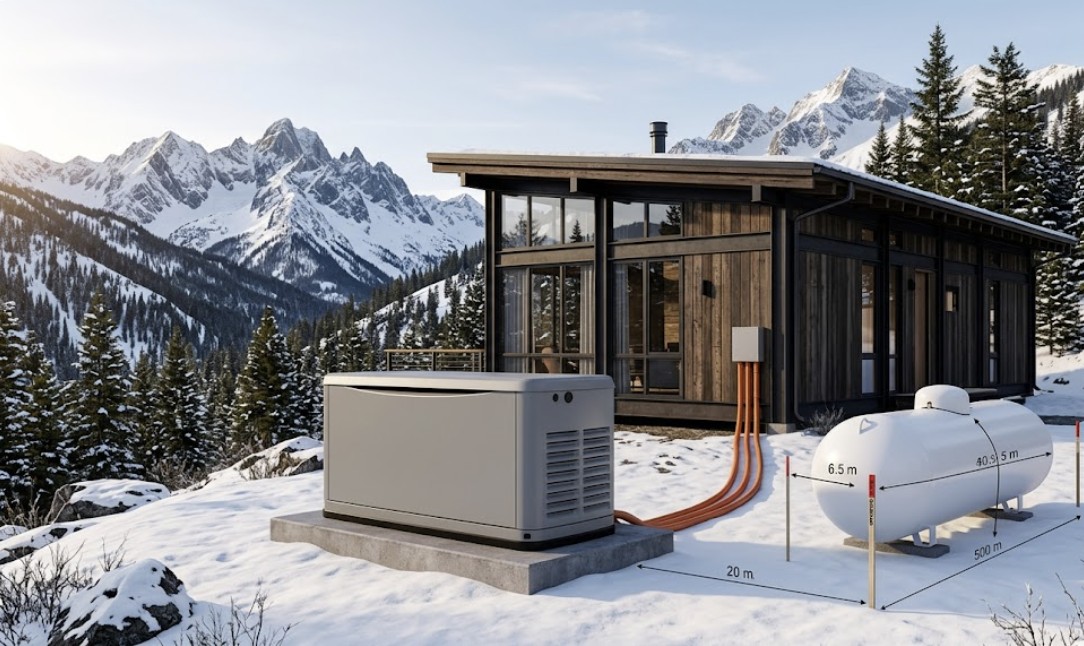
An improperly sized generator is one of the fastest ways to destroy an off-grid electrical system. Undersized generators overload and overheat. Oversized generators waste fuel, carbon up engine internals, and operate inefficiently at low loads. Proper off-grid cabin generator sizing requires electrical load calculations, surge analysis, fuel storage planning, altitude derating, transfer-switch protection, and compliance with NFPA safety codes.
This guide provides engineering-grade calculations and real-world generator sizing methodology for remote cabins operating on propane, gasoline, or diesel backup systems.
Table of Contents
Understanding Off-Grid Cabin Generator Sizing Fundamentals
Off-grid generators serve four critical functions:
- Battery bank charging
- Peak load support
- Emergency backup during inverter failure
- Seasonal high-load operation
Most cabins rely on hybrid inverter systems combined with solar arrays and battery storage. However, remember that capacity sizing is only half the battle; if the quality of the power waveform is poor, your equipment will reject it entirely. If you are already experiencing connection drops, read our troubleshooting guide on [why your generator won’t charge your lithium battery] to fix Total Harmonic Distortion (THD) and BMS faults.
Most cabins rely on hybrid inverter systems combined with solar arrays and battery storage. The generator exists to support loads when solar production drops or battery voltage falls below safe thresholds.
The core mistake in off-grid cabin generator sizing is calculating only appliance loads while ignoring battery charger demand.
Continuous Watts vs Surge Watts
Every generator has two ratings:
| Rating Type | Definition | Duration |
|---|---|---|
| Running Watts | Continuous sustainable output | Unlimited within design limits |
| Surge Watts | Temporary startup capacity | Usually 3–10 seconds |
Motor-driven equipment creates startup surges:
| Appliance | Running Watts | Surge Watts |
|---|---|---|
| Refrigerator | 700W | 2100W |
| Well Pump (1 HP) | 1000W | 3000W |
| Mini Split Heat Pump | 1200W | 3600W |
| Circular Saw | 1500W | 3000W |
| Air Compressor | 1800W | 5000W |
A generator must survive both continuous load and instantaneous surge events.
The Engineering Formula
For accurate off-grid cabin generator sizing:
Generator Size = (Continuous Cabin Load + Battery Charging Load + Surge Margin) × Safety FactorExample:
| Parameter | Value |
|---|---|
| Cabin Load | 4,200W |
| Battery Charger Load | 2,800W |
| Surge Margin | 2,000W |
| Total | 9,000W |
Applying 20% reserve capacity:
9,000W × 1.2 = 10,800WRequired generator size:
11kW minimumOff-Grid Cabin Generator Sizing and the 80% Rule
The most important principle in generator engineering is the 80% Rule.
Pcontinuous=0.8×PratedGenerators should never operate continuously above 80% of rated capacity.
Why the 80% Rule Exists
Continuous operation at 100% causes:
- Alternator overheating
- Voltage instability
- Oil breakdown
- Stator insulation damage
- Excessive cylinder pressure
- Fuel inefficiency
- Thermal fatigue
Example:
| Generator Rating | Safe Continuous Output |
|---|---|
| 5kW | 4kW |
| 8kW | 6.4kW |
| 12kW | 9.6kW |
| 20kW | 16kW |
A cabin requiring 8kW continuous should use at least a 10kW generator.
Altitude Derating
Internal combustion engines lose approximately:
3% power per 1,000 feet elevationAt 7,000 feet elevation:
Ploss=0.03×7=21%A 12kW generator effectively becomes:
12kW × 0.79 = 9.48kWHigh-altitude cabins require significantly larger units during off-grid cabin generator sizing calculations.
Temperature Derating
Summer temperatures above 95°F reduce efficiency further:
| Ambient Temperature | Output Reduction |
|---|---|
| 95°F | 5% |
| 104°F | 10% |
| 113°F | 15% |
Combined altitude and heat derating can reduce output by 30% or more.
Load Calculation Method for Off-Grid Cabins
Step 1: Calculate Base Running Loads
| Appliance | Running Watts | Quantity | Total |
|---|---|---|---|
| LED Lighting | 12W | 15 | 180W |
| Refrigerator | 700W | 1 | 700W |
| Starlink Internet | 80W | 1 | 80W |
| Laptop Charging | 120W | 2 | 240W |
| Well Pump | 1000W | 1 | 1000W |
| Microwave | 1200W | 1 | 1200W |
| Mini Split | 1500W | 1 | 1500W |
Total continuous load:
4,900WStep 2: Add Battery Charger Demand
48V inverter charger at 70A:
P=V×I=48×70=3360WCombined cabin load:
4,900W + 3,360W = 8,260WStep 3: Apply the 80% Rule
Pgenerator=0.88260=10325WFinal recommendation:
10.5kW to 12kW generatorOff-Grid Cabin Generator Sizing for Solar Hybrid Systems
Hybrid solar systems dramatically alter generator requirements.
Inverter-Charger Coordination
Generators must match inverter input voltage:
| Inverter Type | Required Generator |
|---|---|
| 120V Inverter | 120V Generator |
| Split-Phase 120/240V | 120/240V Generator |
| Three-Phase Inverter | Three-Phase Generator |
Incorrect voltage matching causes:
- Charger lockout
- Frequency instability
- Inverter synchronization failure
- Alternator damage
Automatic Generator Start (AGS)
Off-grid systems should use generators with:
- Two-wire start capability
- Remote shutdown
- Frequency stability
- Low THD output (<5%)
Recommended Generator Headroom
| Inverter Size | Recommended Generator |
|---|---|
| 3kW | 6kW–8kW |
| 4kW | 8kW–10kW |
| 6kW | 12kW–14kW |
| 8kW | 15kW–18kW |
Propane Runtime Calculations for Off-Grid Cabins
Propane remains the dominant fuel for remote cabins due to:
- Long shelf life
- Clean combustion
- Cold-weather reliability
- Reduced carburetor varnishing
Propane Energy Density
| Fuel | BTU per Gallon |
|---|---|
| Propane | 91,500 BTU |
| Gasoline | 114,000 BTU |
| Diesel | 129,500 BTU |
Although propane has lower energy density, it stores indefinitely.
Propane Consumption Formula
Typical propane generator efficiency:
1 gallon propane ≈ 6.5 kWh generated20 lb Propane Cylinder Runtime
A standard 20 lb cylinder contains:
4.7 gallons propaneRuntime at 50% Load
Example: 5kW generator operating at 2.5kW load.
Fuel consumption:
0.6 gallons/hourRuntime:
t=0.64.7=7.83 hoursRuntime at 100% Load
Fuel consumption:
1.1 gallons/hourRuntime:
4.3 hours100-Gallon Propane Tank Runtime
Usable propane at 80% fill:
80 gallons| Generator Load | Fuel Burn | Runtime |
|---|---|---|
| 50% Load | 0.6 gal/hr | 133 hours |
| 100% Load | 1.1 gal/hr | 72 hours |
250-Gallon Propane Tank Runtime
Usable propane:
200 gallons| Generator Load | Runtime |
|---|---|
| 50% Load | 333 hours |
| 100% Load | 181 hours |
500-Gallon Propane Tank Runtime
Usable propane:
400 gallons| Generator Load | Runtime |
|---|---|
| 50% Load | 666 hours |
| 100% Load | 363 hours |
A 500-gallon tank can power an efficiently managed off-grid cabin for 2–4 weeks continuously.
Gasoline vs Propane Economics for Remote Cabins
Fuel Shelf Life
| Fuel | Shelf Life |
|---|---|
| Gasoline | 3–6 months |
| Stabilized Gasoline | 12 months |
| Propane | Indefinite |
| Diesel | 12–24 months |
Gasoline rapidly oxidizes and creates carburetor varnish.
Winter Reliability
| Fuel | Cold Weather Performance |
|---|---|
| Gasoline | Poor below freezing |
| Propane | Excellent |
| Diesel | Gelling risk below 15°F |
While propane solves the fuel delivery and engine starting issues in freezing environments, the battery bank itself faces severe chemical restrictions under 32°F. Review our engineering guide on [winter solar charging lithium batteries] to ensure your thermal management systems can handle the heavy bulk charge current provided by your newly sized generator.
Maintenance Impacts
Gasoline systems suffer:
- Carburetor clogging
- Fuel varnish
- Ethanol corrosion
- Moisture contamination
Propane systems remain cleaner internally.
If you already own a reliable gasoline unit and want to switch to propane to eliminate carburetor gumming, you do not need to buy a new system. Installing a certified Tri-Fuel Generator Conversion Kit allows your current engine to run seamlessly on propane or natural gas, dramatically reducing seasonal maintenance overhead.
Check Tri-Fuel Generator Conversion Kit current price on Amazon –>
Cost per kWh
Approximate values:
| Fuel | Cost per kWh |
|---|---|
| Gasoline | $0.55–$0.95 |
| Propane | $0.38–$0.72 |
| Diesel | $0.30–$0.60 |
Diesel is typically most efficient but has higher acquisition cost.
Generator Killers That Destroy Off-Grid Systems
Improper operation physically destroys generators.
Backfeeding Without a Transfer Switch
Backfeeding energizes utility lines through generator output.
Consequences:
- Electrocution risk
- Alternator destruction
- Fire hazard
- Utility transformer damage
To eliminate backfeeding risks and comply with local electrical codes, you must isolate your generator from the cabin’s main panel. Installing a dedicated manual transfer switch, such as the Reliance Controls 30-Amp 4-Prong Transfer Switch, provides a mechanically interlocked path that safely switches power sources without risking alternator destruction.
Check Reliance Controls 30-Amp 4-Prong Transfer Switch current price on Amazon –>
A transfer switch is mandatory.
Low Oil Shutdown Bypass
Operators sometimes bypass oil sensors.
Result:
- Bearing seizure
- Crankshaft scoring
- Rod failure
- Complete engine destruction
Thermal Overload
| Continuous overload above 80% causes: | Windings insulation failure Voltage drop Rotor overheating AVR burnout |
Dirty Fuel Contamination
| Water-contaminated fuel causes: | Injector corrosion Carburetor blockage Misfiring Internal rust |
Wet Stacking
Oversized diesel generators running at low load accumulate unburned fuel deposits.
| Consequences: | Carbon fouling Injector clogging Turbocharger contamination Reduced compression |
The 20/20/20 Rule and Generator Clearances
The 20/20/20 Rule is a critical safety protocol.
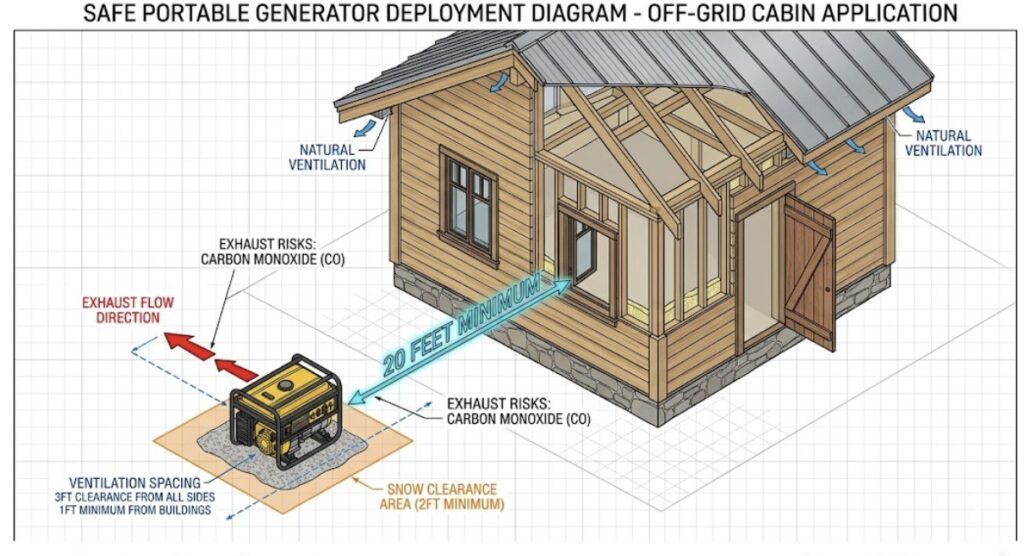
20 Feet from Openings
Generators should remain at least:
20 feet from:
- Windows
- Doors
- Soffit vents
- Crawlspace vents
- HVAC intakes
Maintaining a 20-foot safe distance means you cannot rely on standard hardware-store cords, which cause massive voltage drops under heavy load. Utilizing a heavy-duty, weather-resistant 50-Foot 10-Gauge Generator Extension Cord ensures that your 30-amp or 50-amp continuous current safely reaches the cabin inlet box without overheating.
Check 50-Foot 10-Gauge Generator Extension Cord current price on Amazon –>
This prevents carbon monoxide intrusion.
20 Minutes Before Refueling
Refueling hot engines ignites vapor clouds.
| Mandatory cooldown: | Minimum 20 minutes Longer in summer temperatures |
20 Inches Minimum Ventilation Clearance
Generators require airflow clearance for:
- Cooling
- Exhaust dispersion
- Fire prevention
NFPA 37 Generator Clearance Requirements
NFPA 37 governs stationary engine installations.
Minimum Generator Distances
| Location | Required Clearance |
|---|---|
| Combustible wall | 5 feet |
| Window or door | 5 feet |
| Mechanical intake | 5 feet |
| Overhang clearance | 5 feet minimum |
Manufacturers may require larger setbacks.
Exhaust Direction
Exhaust should never face:
- Buildings
- Propane tanks
- Walkways
- Air intakes
Snow Zones
In heavy snow regions:
- Elevate generator pads
- Provide snow drift clearance
- Maintain exhaust opening visibility
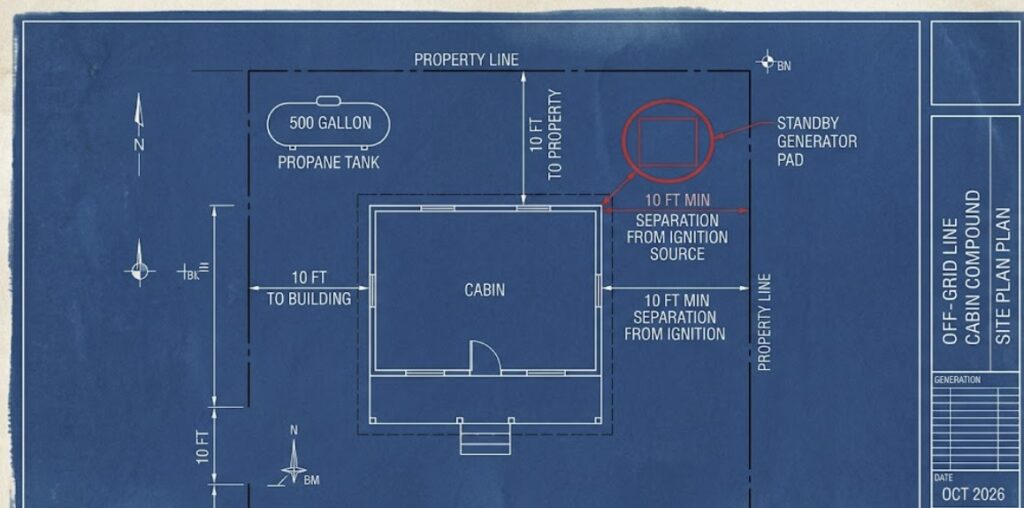
NFPA 58 Propane Tank Distance Requirements
NFPA 58 governs the structural standards for propane tank placement, liquid petroleum gas storage, and vaporizer installations across the United States. Compliance with the official protocols of the [National Fire Protection Association (NFPA)] is mandatory to safeguard your cabin against flash fires caused by accidental spark ignition.
100 lb Tanks
| Requirement | Distance |
|---|---|
| Building openings | 3 feet |
| Ignition sources | 5–10 feet |
250–500 Gallon Tanks
| Requirement | Distance |
|---|---|
| Buildings | 10 feet |
| Property lines | 10 feet |
| Ignition sources | 10 feet |
1000 Gallon Tanks
| Requirement | Distance |
|---|---|
| Structures | 25 feet |
| Property lines | 25 feet |
Generator-to-Propane Tank Separation
Generators are classified as ignition sources.
Minimum separation:
| Tank Size | Generator Clearance |
|---|---|
| Under 125 gallons | 10 feet |
| 250–500 gallons | 10 feet |
| 1000 gallons | 25 feet |
Recommended Generator Types for Off-Grid Cabins
Portable Inverter Generators
| Advantages | Disadvantages |
| Quiet operation Excellent fuel efficiency Clean sine wave output | Lower surge capacity Limited runtime Smaller fuel tanks |
Standby Air-Cooled Generators
| Advantages | Disadvantages |
| Automatic startup Whole-cabin integration AGS compatibility | Louder operation Higher fuel burn |
Liquid-Cooled Diesel Generators
| Advantages | Disadvantages |
| Long lifespan Superior fuel economy Heavy-duty operation | High initial cost Larger footprint |
1800 RPM vs 3600 RPM Generator Engineering
1800 RPM Generators
| Advantages | Disadvantages |
| Lower wear rate Longer lifespan Quieter operation Better fuel efficiency | 15,000–30,000 hours |
3600 RPM Generators
| Advantages | Disadvantages |
| Lower upfront cost Compact size Easier transport | 2,000–5,000 hours |
For full-time cabins, 1800 RPM systems provide superior lifecycle economics.
Off-Grid Cabin Generator Sizing for Seasonal Loads
Cabin demand changes dramatically by season.
Winter Peak Loads
Winter increases:
- Heat tape loads
- Well pump cycling
- Battery charging demand
- Lighting duration
Summer Peak Loads
Summer increases:
- Mini split runtime
- Refrigeration load
- Water pumping demand
Design generator capacity around worst-case seasonal demand.
Off-Grid Cabin Generator Sizing Checklist
Electrical Requirements
- Continuous wattage calculated
- Surge loads calculated
- Battery charging load included
- Altitude derating included
- Temperature derating included
Safety Requirements
- Transfer switch installed
- CO detectors installed
- NFPA clearances maintained
- Grounding electrode installed
- Exhaust orientation verified
Fuel Requirements
- Runtime goals defined
- Propane storage sized
- Winter fuel access planned
- Fuel stabilizers stocked
Maintenance Requirements
- Oil schedule established
- Air filters stocked
- Spark plugs stocked
- Fuel filters stocked
- Load-bank testing scheduled
Final Engineering Recommendations for Off-Grid Cabin Generator Sizing
Accurate off-grid cabin generator sizing balances:
- Continuous electrical demand
- Startup surge capacity
- Battery charging power
- Environmental derating
- Long-term fuel economics
- NFPA safety compliance
For most modern off-grid cabins:
| Cabin Type | Recommended Generator |
|---|---|
| Weekend Cabin | 4kW–8kW |
| Medium Hybrid Cabin | 10kW–14kW |
| Full-Time Residence | 15kW–24kW |
| Large Homestead | 24kW–40kW |
Always size around:
- 80% continuous loading
- 20% future expansion
- Seasonal peaks
- High-altitude derating
- Fuel availability during storms
Proper off-grid cabin generator sizing prevents catastrophic failures, extends equipment lifespan, minimizes fuel costs, and ensures uninterrupted power during severe weather and extended outages.
What size generator is best for an off-grid cabin?
The best generator size for an off-grid cabin depends on continuous electrical loads, surge startup requirements, battery charger demand, and seasonal power usage. Most small recreational cabins operate effectively with a 4kW to 8kW generator, while full-time off-grid homes commonly require 10kW to 20kW systems. Accurate off-grid cabin generator sizing must include appliances such as refrigerators, well pumps, HVAC equipment, and inverter charger loads operating simultaneously. A properly engineered system also maintains at least 20% reserve capacity so the generator never operates continuously above the 80% threshold that accelerates engine wear and alternator overheating.
How do you calculate off-grid cabin generator sizing correctly?
Proper off-grid cabin generator sizing begins with identifying the total running wattage of all cabin appliances, followed by calculating surge wattage from motors and compressors. The next step is adding battery charger demand because inverter chargers can consume several thousand watts while recharging lithium or lead-acid battery banks. After determining total continuous demand, operators apply the 80% Rule to maintain thermal headroom and long-term reliability. High-altitude installations require additional derating because internal combustion engines lose approximately 3% of available power for every 1,000 feet above sea level.
Can a generator charge batteries and run cabin loads simultaneously?
A properly sized off-grid generator can charge batteries and power cabin loads simultaneously if the generator capacity exceeds the combined electrical demand. In many hybrid solar systems, the battery charger alone can consume 2,000W to 5,000W depending on inverter configuration and battery voltage. If cabin appliances draw another 4,000W during charging, the generator must support both loads continuously without exceeding safe operating limits. This is why off-grid cabin generator sizing calculations always include inverter charger consumption rather than focusing only on appliances and lighting circuits.
Why is the 80% Rule important for generator longevity?
The 80% Rule protects generators from excessive heat buildup, winding insulation failure, and accelerated engine wear. Running a generator continuously at 100% capacity raises combustion temperatures and stresses internal components such as bearings, pistons, voltage regulators, and alternator windings. Continuous overload also destabilizes voltage and frequency output, which can damage sensitive electronics and inverter chargers. Off-grid cabin generator sizing should always include at least 20% reserve capacity to ensure the generator remains within safe thermal operating conditions during extended runtime.
How much propane does an off-grid cabin generator use per day?
Propane consumption varies according to generator size and electrical load. A typical 10kW standby generator operating at 50% load may consume approximately 1 to 1.2 gallons of propane per hour, resulting in roughly 24 to 29 gallons per day during continuous operation. At full load, the same generator may consume over 2 gallons per hour. Accurate fuel planning is a critical part of off-grid cabin generator sizing because insufficient propane storage can leave remote cabins without power during storms, winter freeze events, or prolonged cloud cover reducing solar production.
Is propane better than gasoline for off-grid generators?
Propane is generally superior to gasoline for long-term off-grid applications because propane does not degrade during storage, produces cleaner combustion, and significantly reduces carburetor contamination. Gasoline begins oxidizing within months and can form varnish deposits that clog jets and fuel passages. Propane systems also perform better during long standby periods because fuel remains stable indefinitely inside sealed tanks. While gasoline contains slightly higher energy density, propane offers greater reliability, lower maintenance requirements, and improved long-term storage characteristics for remote cabins.
What happens if a generator is undersized for an off-grid cabin?
An undersized generator experiences constant overload conditions that create excessive heat, unstable voltage, low-frequency output, and increased fuel consumption. Inverter chargers may fail to synchronize with the generator, causing charging interruptions or automatic shutdowns. Motors such as well pumps and refrigeration compressors may also fail to start properly due to insufficient surge capacity. Over time, overloaded generators suffer premature alternator winding failure, piston damage, and voltage regulator burnout. Correct off-grid cabin generator sizing prevents these mechanical and electrical failures while maintaining stable power delivery.
Can an oversized generator damage an off-grid system?
Oversized generators create efficiency problems rather than direct electrical damage. Large generators operating under extremely low loads burn fuel inefficiently and may accumulate carbon deposits inside combustion chambers and exhaust systems. Diesel generators are particularly vulnerable to wet stacking when operated below optimal load ranges for extended periods. Oversized systems also cost more to purchase, maintain, and fuel. Effective off-grid cabin generator sizing balances fuel efficiency with surge capacity and continuous load requirements rather than selecting the largest available unit.
How far should a generator be from an off-grid cabin?
Generators should generally remain at least 20 feet away from cabin openings such as windows, doors, crawlspace vents, and HVAC intakes to reduce the risk of carbon monoxide infiltration. NFPA 37 also establishes minimum clearances from combustible walls and openings for permanently installed standby generators. Portable generators require even greater caution because temporary placement near structures frequently causes carbon monoxide exposure incidents. Off-grid cabin generator sizing and layout planning must always include safe exhaust routing and adequate airflow clearance around the enclosure.
How far should propane tanks be from generators?
Propane tanks must remain separated from generators because generators qualify as ignition sources under NFPA 58 regulations. Typical 250-gallon and 500-gallon residential propane tanks require at least 10 feet of separation from generators, structures, and property lines. Larger 1,000-gallon tanks often require 25 feet of clearance depending on local code requirements and site conditions. Correct spacing reduces ignition risk during leaks, regulator failures, or fuel vapor accumulation and should always be incorporated into off-grid cabin generator sizing site plans.
Do off-grid generators need transfer switches?
Every permanently installed off-grid generator should use a properly rated transfer switch or interlock system to isolate generator power from utility or inverter circuits. Backfeeding without transfer isolation can destroy electrical equipment, injure utility workers, and create fire hazards inside the cabin electrical system. Automatic transfer switches also improve operational reliability because they prevent simultaneous connection of incompatible power sources. During off-grid cabin generator sizing, the transfer switch must be rated for the generator’s maximum output amperage and configured for split-phase or single-phase operation as required.
What is the best generator fuel for winter cabins?
Propane remains one of the best fuel choices for winter off-grid cabins because it stores indefinitely and avoids many cold-weather fuel problems associated with gasoline and diesel. Gasoline engines often experience hard starting during freezing temperatures, while diesel fuel can gel in severe cold unless treated with additives or heating systems. Propane vaporization remains reliable in most winter environments when tanks are properly sized. Many off-grid operators prefer propane systems because winter reliability directly affects heating systems, water pumping capability, and battery charging performance.
Should an off-grid cabin use a portable or standby generator?
Portable generators are useful for seasonal cabins and emergency backup situations, but permanently installed standby generators provide superior automation, reliability, and integration with solar battery systems. Standby systems support automatic generator start functions, remote monitoring, larger fuel storage, and long-duration operation without manual intervention. Portable generators typically require manual fueling, temporary wiring, and outdoor deployment during storms. The correct choice depends on runtime requirements, budget, cabin occupancy patterns, and overall off-grid cabin generator sizing objectives.
How long do off-grid cabin generators last?
Generator lifespan depends on engine speed, maintenance quality, fuel cleanliness, and operating load. Air-cooled 3600 RPM generators commonly last between 2,000 and 5,000 operating hours, while heavy-duty liquid-cooled 1800 RPM diesel generators may exceed 20,000 hours under proper maintenance conditions. Overloading, contaminated fuel, and poor lubrication dramatically shorten service life. Correct off-grid cabin generator sizing contributes directly to longevity because properly sized systems avoid chronic overload and excessive thermal stress during continuous operation.
What appliances create the highest startup surge in cabins?
Well pumps, refrigerators, air compressors, power tools, and HVAC systems generate the highest startup surge loads in most off-grid cabins. Motor-driven appliances can require two to five times their running wattage during startup cycles. A refrigerator consuming 700W during operation may briefly surge above 2,000W during compressor startup. These transient demands significantly affect off-grid cabin generator sizing because generators must sustain surge loads without voltage collapse or frequency instability.
Can solar panels eliminate the need for a generator?
Solar panels reduce generator runtime substantially but rarely eliminate generator requirements entirely in full-time off-grid applications. Extended winter storms, snow accumulation, wildfire smoke, and seasonal cloud cover reduce photovoltaic production for prolonged periods. Generators remain essential for emergency battery charging, peak winter demand, maintenance bypass operation, and extended bad-weather resilience. Most reliable off-grid systems integrate solar arrays, battery storage, and backup generators together rather than relying exclusively on a single energy source.
How often should an off-grid generator be maintained?
Most generators require oil changes every 100 to 250 operating hours depending on engine design and fuel type. Air filters, spark plugs, coolant systems, battery chargers, and fuel systems also require scheduled inspection intervals. Generators operating in dusty or snowy environments may need more frequent servicing due to airflow restriction and contamination risks. Preventive maintenance remains one of the most important factors influencing reliability, fuel efficiency, and operational lifespan in off-grid cabin generator sizing strategies.
Why do generators lose power at high elevation?
Internal combustion engines rely on atmospheric oxygen for combustion efficiency. As elevation increases, air density decreases, reducing the amount of oxygen available during combustion cycles. Most naturally aspirated generators lose roughly 3% of output power for every 1,000 feet above sea level. Cabins located at 8,000 feet may therefore experience over 20% power reduction. Proper off-grid cabin generator sizing accounts for altitude derating to prevent overload conditions in mountain installations.
What is the safest location for an off-grid generator?
The safest generator location includes stable ground, proper drainage, adequate ventilation, snow clearance, and required setbacks from structures and propane tanks. Generators should never operate inside garages, basements, crawlspaces, or partially enclosed sheds due to carbon monoxide hazards. Exhaust outlets should face away from occupied structures and prevailing wind patterns whenever possible. Engineering-grade off-grid cabin generator sizing always incorporates both electrical calculations and site safety planning to ensure long-term operational reliability.
Can a generator run continuously for several days?
High-quality standby and industrial generators can operate continuously for days or weeks if properly maintained, adequately cooled, and supplied with sufficient fuel. Continuous operation requires careful attention to oil levels, load percentage, coolant temperature, and airflow conditions. Portable generators often require more frequent shutdowns for inspection and refueling. Correct off-grid cabin generator sizing reduces stress during extended runtime events because oversized reserve capacity allows the engine and alternator to remain within stable thermal operating ranges.
How does battery bank size affect off-grid cabin generator sizing?
Battery bank capacity directly affects generator runtime, charging demand, and fuel consumption in hybrid solar systems. Large lithium battery banks can accept extremely high charging currents, forcing generators to sustain substantial continuous loads for several hours during recharge cycles. For example, a 48V lithium bank charging at 100 amps requires approximately 4,800 watts before accounting for inverter losses. When cabin loads operate simultaneously, the generator may need to sustain over 8kW continuously. Accurate off-grid cabin generator sizing therefore includes not only appliance consumption but also charging amperage, inverter efficiency, battery chemistry, and expected recharge windows during poor solar production periods.
What is the best generator frequency for off-grid cabins?
Most North American off-grid cabins operate on 60Hz electrical systems because residential appliances, well pumps, refrigerators, HVAC systems, and inverter chargers are engineered around that frequency standard. Frequency instability caused by overloaded or undersized generators can damage sensitive electronics and create synchronization problems with inverter chargers. Premium inverter generators maintain tighter frequency regulation under fluctuating loads compared to lower-cost portable models. During off-grid cabin generator sizing calculations, operators should prioritize generators with stable frequency control and low total harmonic distortion to protect modern electronics and lithium battery charging systems.
Can off-grid generators power air conditioning systems?
Generators can power air conditioning systems if they are properly sized for compressor startup surges and continuous cooling demand. Mini split systems are generally more generator-friendly because inverter-driven compressors reduce startup current compared to traditional central HVAC systems. However, even efficient air conditioners may require two to three times their running wattage during compressor startup. Incorrect off-grid cabin generator sizing often becomes apparent during summer cooling operation when generators struggle with compressor surges, voltage sag, and excessive fuel consumption. Soft-start modules can reduce startup demand significantly and improve compatibility with smaller generators.
Why are inverter generators popular for off-grid cabins?
Inverter generators produce cleaner electrical waveforms with lower harmonic distortion, making them ideal for electronics, battery chargers, communication systems, and variable-speed appliances. Unlike traditional generators operating at fixed RPM, inverter models can adjust engine speed dynamically according to electrical demand, improving fuel economy and reducing noise levels during light-load operation. Many off-grid operators prefer inverter generators because they integrate more effectively with solar hybrid systems and consume less fuel during low-demand nighttime charging cycles. For smaller installations, inverter technology can improve overall off-grid cabin generator sizing efficiency while reducing maintenance costs and acoustic impact.
How important are carbon monoxide detectors in off-grid cabins?
Carbon monoxide detectors are absolutely mandatory in cabins using combustion generators, propane appliances, wood stoves, or fuel-burning heating systems. Carbon monoxide is odorless, invisible, and capable of causing fatal poisoning within minutes under concentrated conditions. Portable generators placed too close to windows, soffit vents, crawlspaces, or attached garages frequently cause dangerous CO infiltration during storms and winter outages. Even correctly sized systems become life-threatening if ventilation and exhaust placement are ignored. Professional off-grid cabin generator sizing always includes comprehensive safety planning involving detector placement, exhaust routing, ventilation clearance, and emergency shutdown procedures.
1 thought on “Off-Grid Cabin Generator Sizing: Engineering Calculations, Propane Runtime Math, NFPA Codes, and Fuel Economics”