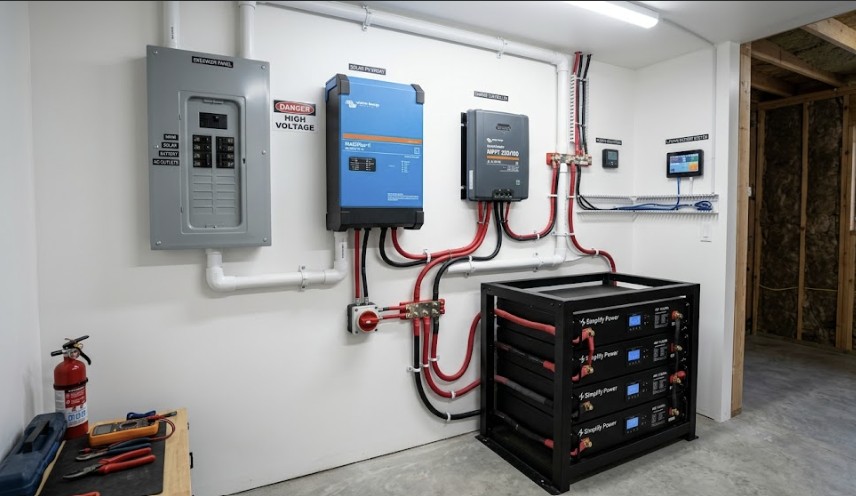
Building a reliable off-grid power system begins with selecting the right off-grid cabin electrical panels. The electrical panel serves as the central distribution point that safely routes power from batteries, inverters, generators, and solar charging systems to every circuit inside the cabin. A properly designed panel improves safety, simplifies maintenance, supports future expansion, and ensures long-term system reliability.
Whether powering a remote hunting cabin, seasonal vacation retreat, tiny home, or full-time off-grid residence, understanding panel sizing, breaker selection, conductor ampacity, voltage drop, grounding, and overcurrent protection is essential.
Table of Contents
Understanding Off-Grid Cabin Electrical Panels
Off-grid cabin electrical panels differ significantly from traditional utility-fed residential panels. Instead of receiving power from a utility service entrance, these systems receive power from:
- Solar photovoltaic arrays
- Battery banks
- Inverters
- Wind turbines
- Micro-hydro systems
- Backup generators
The panel distributes AC power throughout the cabin while protecting wiring and connected equipment through circuit breakers and overcurrent protection devices.
Key Components Inside an Off-Grid Electrical System
| Component | Function |
|---|---|
| Solar Panels | Generate DC electricity |
| Charge Controller | Regulates battery charging |
| Battery Bank | Stores energy |
| Inverter | Converts DC to AC power |
| Main Disconnect | Isolates power sources |
| Electrical Panel | Distributes electricity |
| Circuit Breakers | Protect branch circuits |
| Grounding System | Enhances safety |
A well-designed system integrates all these components into a coordinated electrical architecture.
Choosing the Right Off-Grid Cabin Electrical Panels
Selecting the correct panel depends on several factors:
Cabin Size
| Small cabins often require: | 60A panel 8–12 breaker spaces |
| Medium cabins generally need: | 100A panel 20–30 breaker spaces |
| Large full-time residences frequently require: | 200A panel 30–40 breaker spaces |
Future Expansion
Many cabin owners underestimate future electrical demand.
Common additions include:
- Heat pumps
- Well pumps
- Workshop equipment
- Electric water heaters
- EV charging
- Additional solar arrays
Choosing a panel with extra breaker spaces prevents expensive upgrades later.
Installer’s Choice: For a reliable 100A or 200A cabin build, the standard is the Square D by Schneider Electric QO Panel (100 Amp 20-Space) due to its premium copper busbars and high inductive surge tolerance.
Check current price on Amazon –>
Split-Phase Requirements
Most modern off-grid inverter systems provide:
- 120V output
- 120/240V split-phase output
Cabins operating:
- Deep well pumps
- Electric ranges
- Large air compressors
- Water heaters
Typically require a 120/240V split-phase panel configuration.
If you haven’t bought your power core yet, make sure your inverter architecture matches this layout. We did a massive technical dive into managing dynamic loads and balancing output in our complete guide to choosing an off-grid hybrid inverter split-phase setup.
Calculating Electrical Loads for Off-Grid Cabins
Accurate load calculations determine proper panel sizing.
Typical Cabin Loads
| Appliance | Running Watts |
| LED Lighting | 100–300W |
| Refrigerator | 150–800W |
| Well Pump | 700–2500W |
| Microwave | 1000–1500W |
| Coffee Maker | 800–1200W |
| Mini Split | 500–3000W |
| Laptop | 50–100W |
| Television | 50–300W |
Sample Daily Load Calculation
| Load | Watt Hours |
| Lighting | 1,200 Wh |
| Refrigerator | 1,800 Wh |
| Electronics | 800 Wh |
| Water Pump | 600 Wh |
| Kitchen Appliances | 2,000 Wh |
| Miscellaneous | 1,000 Wh |
| Total | 7,400 Wh |
This calculation directly influences inverter and panel sizing.
Off-Grid Cabin Electrical Panels and Breaker Sizing
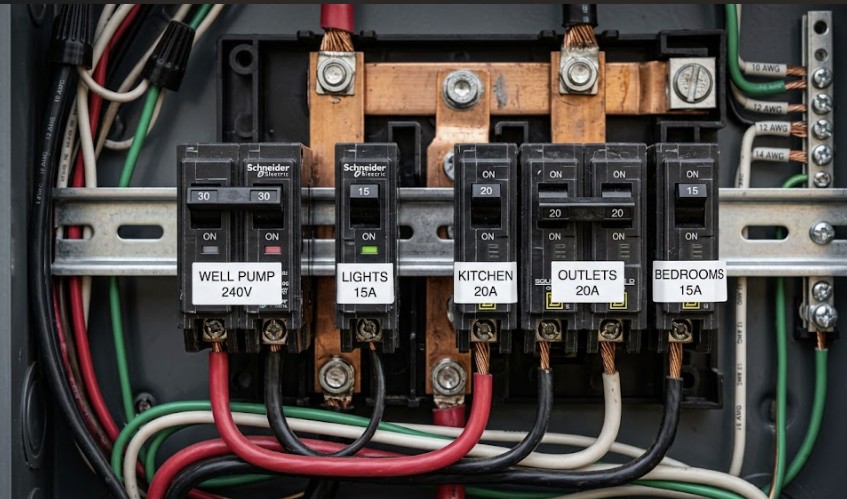
Proper breaker sizing is critical for conductor protection.
According to the official National Electrical Code (NEC) Article 240 guidelines via NFPA, circuit breakers primarily protect downstream conductors rather than the connected end equipment.
Standard Branch Circuit Ratings
| Circuit Type | Breaker Size |
| Lighting | 15A |
| General Receptacles | 20A |
| Microwave | 20A |
| Refrigerator | 20A |
| Water Heater | 30A |
| Mini Split | 20–40A |
Small Conductor Protection
Common conductor limits include:
| Copper Conductor | Maximum Breaker |
| 14 AWG | 15A |
| 12 AWG | 20A |
| 10 AWG | 30A |
These limits prevent overheating and remain among the most important requirements when wiring off-grid cabins.
Panel Sizing Based on Inverter Capacity
The inverter often determines the minimum panel rating.
Typical Inverter-to-Panel Relationships
| Inverter Size | Recommended Panel |
| 3000W | 60A Panel |
| 4000W | 100A Panel |
| 6000W | 125A Panel |
| 8000W | 200A Panel |
| 12000W | 200A+ Panel |
For example:
- 6000W ÷ 240V = 25A
- Applying continuous load factors and future growth generally supports using a 100A or 125A distribution panel.
Battery-Based Electrical Distribution Design
Most modern systems use lithium iron phosphate batteries.
Common battery bank configurations revolve around three industry baselines. If you are torn between which platform fits your infrastructure budget, read our real-world breakdown analyzing the 12V vs 24V vs 48V solar system efficiency metrics.
Why 48V Systems Dominate Modern Installations
Advantages include:
- Lower current
- Smaller conductors
- Reduced voltage drop
- Higher efficiency
- Easier expansion
Example: A 6000W inverter requires:
- 500A at 12V
- 250A at 24V
- 125A at 48V
Lower current significantly reduces cable costs.
Related Manual: Shifting to a 48V nominal setup also alters how you balance your cell banks. If you are building your own storage array from raw celdas, check out our step-by-step master blueprints for sizing lithium LiFePO4 battery banks for cabin workloads.
Recommended Wiring for Off-Grid Electrical Panels
Wire selection depends on:
- Current
- Temperature
- Installation method
- Distance
- Voltage drop
Common Wire Types
THHN/THWN-2
| Best for: | Conduit installations Indoor feeders Outdoor raceways |
| Characteristics: | 600V rated 90°C insulation |
XHHW-2
| Best for: | Long feeder runs High-temperature environments |
| Advantages: | Thick insulation Excellent durability |
NM-B Cable
Commonly used for:
- Interior branch circuits
- Dry cabin interiors
Conductor Bulk Buy: If you are wiring standard 20A kitchen and workshop receptacle loops, you will need a master roll of Southwire Romex Brand Simpull 12/2 WG NM-B Wire (250-ft Roll) to keep line resistance minimal.
Check current price on Amazon –>
UF-B Cable
Ideal for:
- Underground feeders
- Outdoor circuits
Voltage Drop Considerations
Voltage drop becomes increasingly important in remote cabin installations.
Long runs to:
- Solar arrays
- Well pumps
- Workshops
- Detached garages
often require upsized conductors.
Recommended Voltage Drop Limits
| Circuit Type | Maximum Drop |
| Branch Circuit | 3% |
| Feeder | 3% |
| Entire System | 5% |
Example
A 100A feeder located 200 feet away may require:
| Material | Recommended Size |
| Copper | 4/0 AWG |
| Aluminum | 300 kcmil |
Upsizing wire reduces losses and improves equipment performance.
Grounding and Bonding Requirements
Grounding is among the most misunderstood aspects of off-grid systems.
Proper grounding provides:
- Fault current paths
- Lightning protection
- Equipment protection
- Shock protection
Safety Note: Failing to secure a proper low-resistance fault current path violates federal electrical safety baselines. You can review the complete OSHA Electrical Safety Standards and Shock Mitigation Criteria to fully understand the biological hazards of improper grounding bonds.
Grounding Components
- Ground rods
- Grounding electrode conductors
- Equipment grounding conductors
- Bonding jumpers
Typical Grounding Layout
flowchart TD
    A[Solar Array] --> B[Charge Controller]
    B --> C[Battery Bank]
    C --> D[Inverter]
    D --> E[Main Disconnect]
    E --> F[Electrical Panel]

    F --> G[Branch Circuits]

    D --- H[Grounding System]
    E --- H
    F --- H
All grounding connections should follow applicable NEC Articles 250, 690, and 705 requirements where applicable.
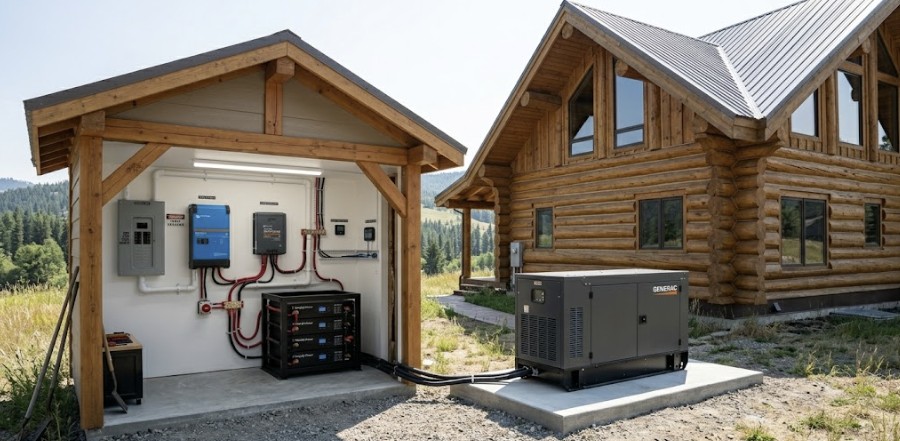
Generator Integration With Off-Grid Cabin Electrical Panels
Most off-grid cabins include backup generation.
Common generator sizes:
| Cabin Size | Generator Size |
| Small | 3–5 kW |
| Medium | 6–10 kW |
| Large | 10–20 kW |
Generator Connection Methods
To integrate a backup generator safely without dangerous backfeeding, you must install a dedicated physical interlock or transfer mechanism. We recommend using these heavy-duty contractor components:
The Power Inlet Box: This is mounted on the cabin exterior to connect the generator cord cleanly. Use an outdoor-rated Reliance Controls 30-Amp Power Inlet Box (PB30) for 120/240V configurations.
Check current price on Amazon –>
The Manual Transfer Switch: To safely isolate your cabin circuits from the inverter and switch to generator juice under load, run a Reliance Controls 30-Amp Manual Transfer Switch (306CRK) directly before your main panelboard distribution.
Check current price on Amazon –>
Benefits include:
- Battery charging during poor weather
- Winter backup power
- Emergency operation
Best Panel Configurations for Different Cabin Types
Small Weekend Cabin
| Electrical characteristics: | LED lighting Small refrigerator Electronics |
| Recommended: | 60A panel 3000W inverter 24V battery bank |
Medium Recreational Cabin
| Electrical characteristics: | Refrigerator Well pump Microwave Mini split |
| Recommended: | 100A panel 6000W inverter 48V battery bank |
Full-Time Off-Grid Residence
| Electrical characteristics: | Full kitchen Water systems HVAC Workshop loads |
| Recommended: | 200A panel 120/240V split-phase inverter Large lithium battery bank |
Common Mistakes When Installing Off-Grid Cabin Electrical Panels
Undersized Panels
Insufficient breaker spaces create future limitations.
Improper Breaker Selection
Oversized breakers may fail to protect conductors.
Ignoring Voltage Drop
Long wire runs without upsizing increase losses.
Poor Labeling
Every breaker should be clearly identified.
Inadequate Grounding
Improper grounding increases safety risks and equipment damage potential.
No Expansion Capacity
Future upgrades frequently require:
- Additional solar strings
- Battery expansion
- Generator upgrades
- New branch circuits
Selecting larger panels initially usually lowers lifetime ownership costs.
Advanced Safety Features for Modern Off-Grid Systems
Modern installations increasingly incorporate:
Arc-Fault Protection
Protects against dangerous arc conditions that may lead to fires.
Ground-Fault Protection
Reduces shock hazards.
Surge Protection Devices
Protect electronics from:
- Lightning
- Generator switching
- Inverter transients
Inverter Insurance: Do not leave your expensive hybrid inverter unprotected against lightning or generator switching spikes. Snap a Square D by Schneider Electric HEOMC2110SB Surge Protective Device directly onto your panel’s busbars.
Check current price on Amazon –>
Lockable Disconnects
Improve maintenance safety.
Battery Disconnect Switches
Provide rapid emergency isolation.
Maintenance Checklist for Off-Grid Electrical Panels
Inspect annually:
- Breaker condition
- Grounding connections
- Neutral terminations
- Torque values
- Corrosion
- Moisture intrusion
Every six months:
- Test generator transfer systems
- Verify inverter operation
- Confirm battery communication systems
Preventive maintenance dramatically extends system lifespan.
How to Future-Proof Off-Grid Cabin Electrical Panels
The most successful installations plan for future energy growth.
Recommended practices:
- Install larger conduit than currently needed.
- Reserve at least 25% spare breaker capacity.
- Select a panel with extra spaces.
- Design for battery expansion.
- Leave room for additional solar charge controllers.
- Include surge protection from the beginning.
- Use a split-phase inverter when future 240V loads are possible.
These strategies eliminate costly rewiring projects and simplify future upgrades.
Conclusion
Off-grid cabin electrical panels are the backbone of every independent power system. Proper panel selection, accurate load calculations, NEC-compliant breaker sizing, correct conductor selection, voltage drop management, grounding, and future expansion planning determine whether an off-grid electrical system remains safe and reliable for decades. By combining properly sized panels, quality overcurrent protection, robust grounding systems, and scalable inverter architecture, we create electrical infrastructure capable of supporting everything from a small seasonal cabin to a fully self-sufficient off-grid home.
What size electrical panel is best for an off-grid cabin?
The ideal size for off-grid cabin electrical panels depends on the inverter capacity, expected electrical loads, and future expansion plans. Small cabins with basic lighting and appliances may operate efficiently with a 60-amp panel, while most modern off-grid homes benefit from 100-amp or 200-amp panels that provide sufficient breaker spaces for additional circuits, solar equipment, battery systems, well pumps, and future upgrades.
Can off-grid cabin electrical panels support 240V appliances?
Yes, off-grid cabin electrical panels can support 240V appliances when connected to a split-phase inverter system that provides 120/240V output. This configuration allows the operation of deep well pumps, electric water heaters, workshop equipment, air compressors, and other higher-voltage loads commonly found in larger off-grid properties.
Do off-grid cabin electrical panels require a main breaker?
Most off-grid cabin electrical panels include a main breaker or disconnecting means to provide safe isolation of the electrical distribution system. The main breaker improves maintenance safety, simplifies troubleshooting, and helps protect conductors and equipment during fault conditions or emergency shutdown procedures.
How many circuits should an off-grid cabin have?
The number of circuits varies according to cabin size and electrical demand. A small seasonal cabin may only require four to eight branch circuits, while larger off-grid residences often need fifteen or more circuits to separate lighting, kitchen outlets, refrigeration, HVAC equipment, water pumps, workshops, and battery charging systems for improved reliability and easier maintenance.
Are off-grid cabin electrical panels different from standard residential panels?
While the physical panel construction is often similar, off-grid cabin electrical panels are designed to integrate with inverters, battery banks, solar charging systems, backup generators, and renewable energy equipment rather than receiving power directly from a utility service. The overall system design, grounding requirements, and power sources create important differences in installation and operation.
Can I install off-grid cabin electrical panels myself?
Many experienced DIY builders install off-grid cabin electrical panels successfully, but all work should comply with applicable electrical codes, manufacturer instructions, and safety standards. Incorrect conductor sizing, grounding, breaker selection, or inverter integration can create safety hazards, equipment damage, and system failures that are costly to correct.
What is the lifespan of off-grid cabin electrical panels?
High-quality off-grid cabin electrical panels can remain in service for several decades when installed properly and protected from moisture, corrosion, excessive heat, and physical damage. Periodic inspections, proper torque verification, and replacement of damaged breakers help maximize operational life and reliability.
Should solar panels connect directly to the electrical panel?
Solar panels do not connect directly to off-grid cabin electrical panels in most installations. Instead, solar energy passes through charge controllers and battery storage systems before being converted by an inverter into usable AC power that is distributed through the electrical panel to cabin circuits.
Why is breaker sizing important in off-grid cabin electrical panels?
Breaker sizing protects conductors from overheating during overloads, short circuits, and fault conditions. Properly sized breakers allow off-grid cabin electrical panels to operate safely while preventing wiring damage, reducing fire risks, and maintaining compliance with electrical code requirements.
Can lithium batteries be used with off-grid cabin electrical panels?
Lithium iron phosphate batteries are commonly paired with off-grid cabin electrical panels because they provide high efficiency, long cycle life, deeper discharge capability, and reduced maintenance requirements compared to traditional lead-acid battery technologies. Their performance characteristics make them particularly attractive for year-round off-grid living.
How often should off-grid cabin electrical panels be inspected?
A comprehensive inspection should be performed at least once each year to verify breaker condition, conductor integrity, grounding connections, enclosure condition, and proper operation of connected equipment. Cabins located in humid, coastal, or extremely cold environments may benefit from more frequent inspections.
Can a generator be connected to off-grid cabin electrical panels?
Yes, generators are commonly integrated with off-grid cabin electrical panels to provide backup power during extended periods of poor solar production or unusually high electrical demand. Depending on system design, the generator may supply loads directly, recharge batteries, or work through a hybrid inverter system.
What causes voltage drop in off-grid electrical systems?
Voltage drop occurs when electrical current travels through conductors over long distances and encounters resistance. In off-grid cabin electrical panels, excessive voltage drop can reduce equipment performance, lower efficiency, and increase energy losses, which is why conductor sizing becomes particularly important for remote solar arrays and outbuildings.
Do off-grid cabin electrical panels need surge protection?
Surge protection is strongly recommended because off-grid electrical systems often contain sensitive electronics including inverters, charge controllers, monitoring equipment, and battery management systems. Proper surge protection helps reduce the risk of damage from lightning activity, switching events, and transient voltage spikes.
Can off-grid cabin electrical panels be expanded later?
Most modern off-grid cabin electrical panels can be expanded if additional breaker spaces are available. Planning for future growth during the initial installation allows easier integration of new circuits, larger solar arrays, expanded battery storage, electric vehicle charging equipment, and additional outbuildings without requiring a complete panel replacement.
What are the most common mistakes made when selecting off-grid cabin electrical panels?
The most frequent mistakes include choosing a panel with too few breaker spaces, underestimating future electrical demand, ignoring voltage drop calculations, selecting improper breaker sizes, neglecting grounding requirements, and failing to provide adequate space for future solar, battery, or generator upgrades. Proper planning helps avoid expensive modifications and improves long-term system performance.
3 thoughts on “Off-Grid Cabin Electrical Panels: Complete Design, Sizing, Wiring, and NEC-Compliant Installation Guide”