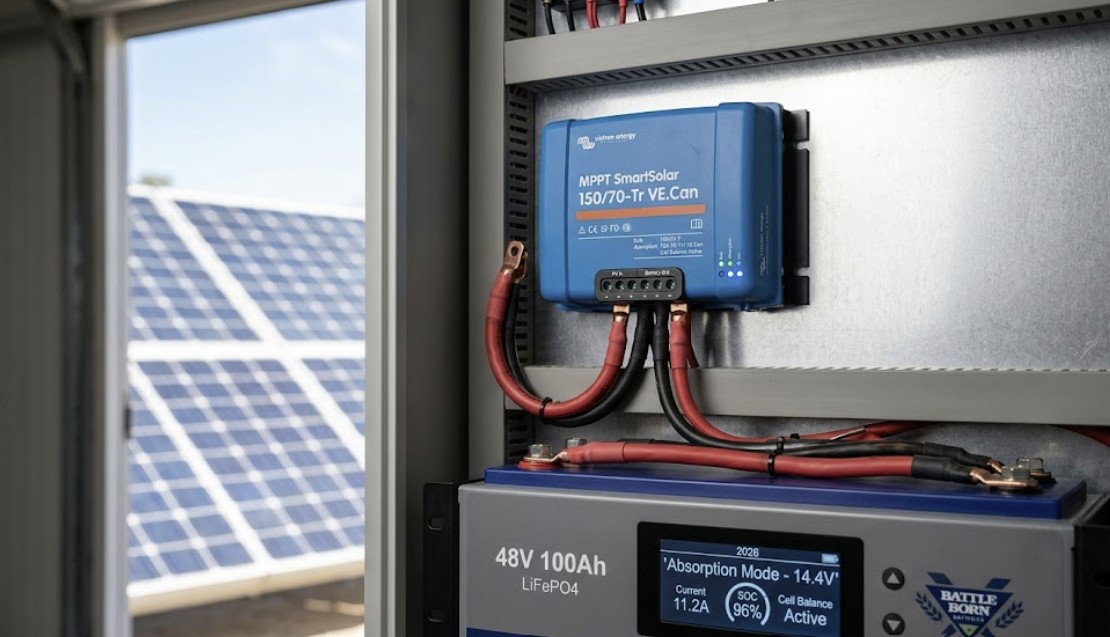
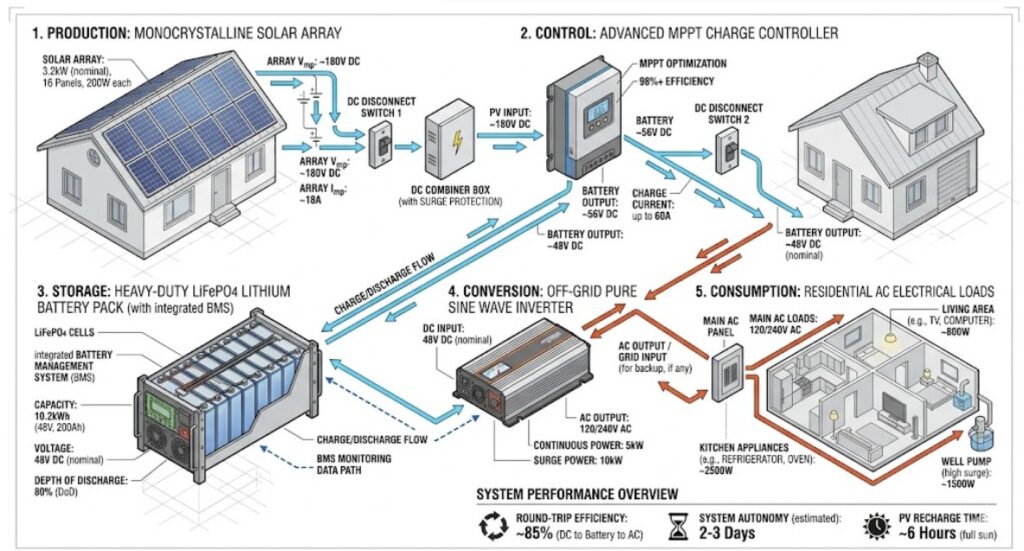
Designing an efficient off-grid or hybrid energy system requires far more than matching random panel wattage to a battery bank. Accurate solar panel to lifepo4 battery sizing demands a complete understanding of charging voltage curves, real-world solar derating, lithium C-rates, NEC compliance, and charge controller conversion behavior.
A poorly sized system causes chronic undercharging, excessive cycling stress, inverter shutdowns, thermal stress, and shortened battery lifespan. An optimized system delivers stable charging current, proper absorption timing, and predictable autonomy during low irradiance conditions.
This guide provides a complete engineering-level breakdown of solar panel to lifepo4 battery sizing using real formulas, code requirements, and practical examples.
Table of Contents
Solar Panel to LiFePO4 Battery Sizing Fundamentals
LiFePO4 batteries differ substantially from lead-acid batteries. Their flatter discharge curve, higher charging acceptance, lower internal resistance, and higher usable depth of discharge require different solar sizing logic.
The four primary engineering variables are:
| Variable | Description | Importance |
|---|---|---|
| Battery Capacity | Total stored energy in Ah or kWh | Determines runtime |
| System Voltage | 12V, 24V, or 48V architecture | Affects current flow |
| Solar Array Wattage | Total PV production capacity | Determines recharge speed |
| Peak Sun Hours (PSH) | Equivalent full irradiance hours/day | Determines daily production |
The baseline battery energy equation is:
Energy(Wh)=BatteryVoltage(V)×Capacity(Ah)Example:
- 12V 100Ah LiFePO4 battery: 12 × 100 = 1,200Wh
- 24V 200Ah LiFePO4 battery: 24 × 200 = 4,800Wh
Because LiFePO4 chemistry safely supports 80%–100% depth of discharge, usable capacity is dramatically higher than AGM systems.
| Battery Type | Typical Usable DoD | Usable Energy from 100Ah |
|---|---|---|
| Flooded Lead Acid | 50% | 600Wh |
| AGM | 50%–60% | 600–720Wh |
| LiFePO4 | 80%–100% | 960–1,200Wh |
Why Accurate Solar Panel to LiFePO4 Battery Sizing Matters
Oversized battery banks with undersized arrays create permanent partial-state-of-charge operation. This results in:
- Reduced cycle efficiency
- Increased balancing stress
- Longer absorption phases
- Chronic low-voltage operation
- BMS disconnect events
Conversely, oversized solar arrays can exceed recommended lithium charging C-rates if improperly configured.
The ideal system balances:
- Daily energy consumption
- Battery autonomy requirements
- Solar recharge capability
- Safe lithium charging current
- Seasonal irradiance losses
STC vs. Real-World Degradation in Solar Production
One of the largest design mistakes in solar panel to lifepo4 battery sizing is assuming a 400W solar panel continuously produces 400W.
It does not.
Solar modules are rated using Standard Test Conditions (STC):
| STC Parameter | Value |
|---|---|
| Solar Irradiance | 1000W/m² |
| Cell Temperature | 25°C |
| Air Mass | 1.5 |
Actual field conditions rarely match laboratory conditions.
Photovoltaic PVUSA Test Conditions (PTC) are more realistic:
| PTC Parameter | Value |
|---|---|
| Solar Irradiance | 1000W/m² |
| Ambient Temperature | 20°C |
| Wind Speed | 1 m/s |
PTC output is commonly 10%–15% lower than STC ratings.
Real-World Solar Loss Sources
| Loss Source | Typical Loss |
|---|---|
| Module Temperature | 5%–15% |
| Dust and Soil | 2%–7% |
| Wiring Losses | 2%–3% |
| MPPT Conversion Loss | 2%–5% |
| Atmospheric Haze | 2%–6% |
| Shading | 5%–100% |
| Panel Mismatch | 1%–3% |
A 400W panel often delivers only 300W–340W during real operation.
Temperature coefficient losses are especially important.
Most panels lose approximately:
Ploss =TemperatureCoefficient×(CellTemperature−25∘C)If a panel has a -0.35%/°C coefficient and operates at 65°C:
- Temperature rise above STC: 65 − 25 = 40°C
- Output loss: 40 × 0.35% = 14%
Thus: 400W × 0.86 ≈ 344W
This is why engineering-grade solar panel to lifepo4 battery sizing must include derating factors.
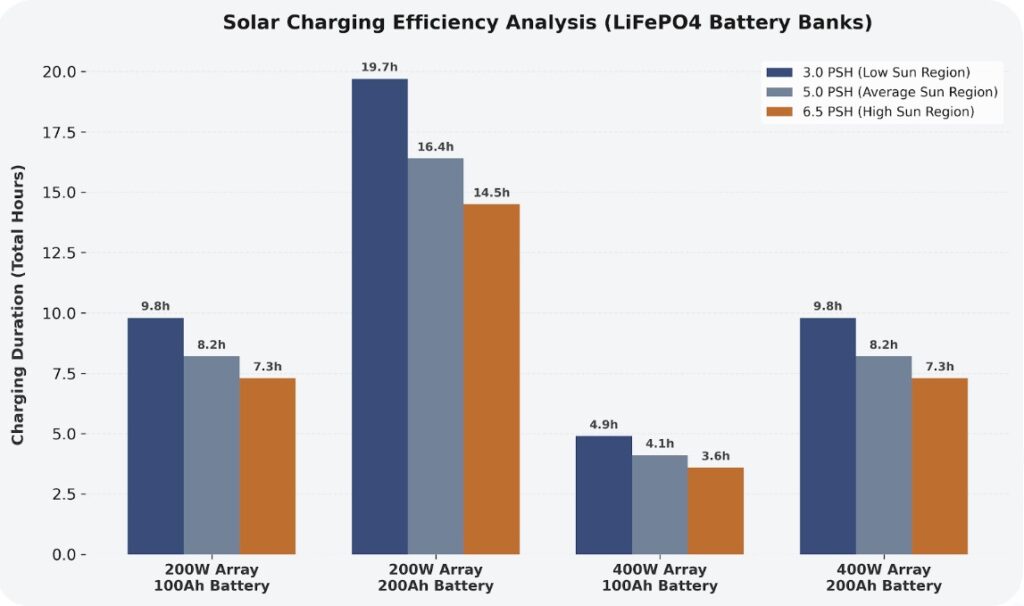
The 200W vs. 400W Mathematical Charging Showdown
The most common field question is:
“How long will a 200W or 400W solar array take to charge a LiFePO4 battery?”
We calculate using:
ChargingTime=SolarProduction(W)×EfficiencyBatteryEnergy(Wh)Assumptions:
- System efficiency: 80%
- Battery voltage: 12.8V nominal
- LiFePO4 charging efficiency: high
- No shading losses beyond baseline derating
Battery Capacities
| Battery | Energy |
|---|---|
| 100Ah LiFePO4 | 1,280Wh |
| 200Ah LiFePO4 | 2,560Wh |
Effective Solar Output After 20% Loss
| Array Rating | Effective Output |
|---|---|
| 200W Array | 160W |
| 400W Array | 320W |
Charging Time Calculations
100Ah Battery with 200W Array
t=1601280=8hours
100Ah Battery with 400W Array
t=3201280=4hours
200Ah Battery with 200W Array
t=1602560=16hours
200Ah Battery with 400W Array
t=3202560=8hours
For basic mobile builds or weekend campers, a compact Renogy 200W Monocrystalline Solar Kit delivers a solid stream of current for baseline 100Ah banks. However, if your setup requires charging a larger 200Ah system or needs to withstand winter irradiance drops, scaling up to a high-efficiency Renogy 400W (2x200W) Solar Panel Kit provides the crucial power overhead needed to avoid partial-state-of-charge stress.
Check Renogy 200W Monocrystalline Solar Kit current price on Amazon –>
Check Renogy 400W (2x200W) Solar Panel Kit current price on Amazon –>
Peak Sun Hour Impact Across the USA
| Region | Typical PSH | 200W Daily Output | 400W Daily Output |
|---|---|---|---|
| Arizona | 6.5 | 1.04kWh | 2.08kWh |
| Texas | 5.5 | 0.88kWh | 1.76kWh |
| Florida | 5.0 | 0.80kWh | 1.60kWh |
| New York | 4.0 | 0.64kWh | 1.28kWh |
| Pacific Northwest | 3.0 | 0.48kWh | 0.96kWh |
If you are designing an off-grid system for northern climates, managing sub-zero temperatures is just as vital as calculating panel wattage. Review our technical analysis on [winter solar charging lithium batteries] to safeguard your battery management system from cold-weather charging limitations.
A 200W array in Seattle may not fully recharge a 200Ah LiFePO4 bank during winter conditions.
MPPT vs. PWM Conversion Mechanics
Charge controller selection fundamentally changes system performance.
PWM Controllers
PWM controllers connect the panel directly to the battery using pulse modulation.
Major disadvantages:
- Panel voltage collapses to battery voltage
- Excess voltage becomes wasted heat
- Poor cold-weather performance
- Reduced lithium charging efficiency
Example:
- Solar panel Vmp = 40V
- Battery charging voltage = 14.2V
PWM wastes the voltage differential.
MPPT Controllers
MPPT controllers perform DC-to-DC conversion.
They:
- Track maximum power point voltage
- Down-convert voltage
- Increase charging amperage proportionally
Power conservation principle:
P=V×IExample:
| Parameter | Value |
|---|---|
| Solar Input | 40V × 10A = 400W |
| MPPT Output | 14.2V × 28A ≈ 398W |
Voltage decreases while current increases.
To actually harvest these mathematical gains when down-converting high-voltage panel strings into a lithium bank, you must avoid cheap hardware bottlenecks. Running your array through an intelligent controller like the Victron Energy SmartSolar MPPT 100/30 Charge Controller dynamically locks onto the absolute maximum power point, boosting actual current delivery by up to 30% over legacy PWM options.
Check Victron Energy SmartSolar MPPT 100/30 Charge Controller current price on Amazon –>
This is why MPPT controllers commonly outperform PWM units by 20%–30%, especially with lithium batteries.
Why MPPT Performs Better with LiFePO4
LiFePO4 batteries maintain higher acceptance current during bulk charging.
MPPT controllers exploit this by:
- Maintaining panel operation at Vmp
- Delivering higher current during bulk phase
- Reducing charging time
- Increasing winter efficiency
PWM controllers cannot efficiently charge high-voltage panel strings into lithium banks.
Lithium C-Rate Safety Calculations
C-rate defines battery charging current relative to capacity.
Formula:
C-Rate=BatteryCapacityChargeCurrentExample:
- 100Ah battery charged at 50A: 50 ÷ 100 = 0.5C
Recommended LiFePO4 Charge Rates
| C-Rate | Impact |
|---|---|
| 0.1C | Very conservative |
| 0.2C | Optimal longevity |
| 0.5C | Fast charging |
| 1.0C | Aggressive charging |
Most manufacturers recommend 0.2C–0.5C for long cycle life.
Solar Array Current vs Battery Capacity
| Battery Size | Recommended Solar Charge Current |
|---|---|
| 100Ah | 20A–50A |
| 200Ah | 40A–100A |
| 300Ah | 60A–150A |
For a 12V battery system:
| Solar Array | Approx MPPT Charge Current |
|---|---|
| 200W | 14A–16A |
| 400W | 28A–32A |
| 800W | 55A–60A |
A 400W array charging a 100Ah battery produces roughly 0.3C charging — ideal for many LiFePO4 systems.
Improper solar panel to lifepo4 battery sizing can create excessively high charge currents that increase:
- Cell heating
- BMS stress
- Balancing frequency
- Lithium plating risk in cold weather
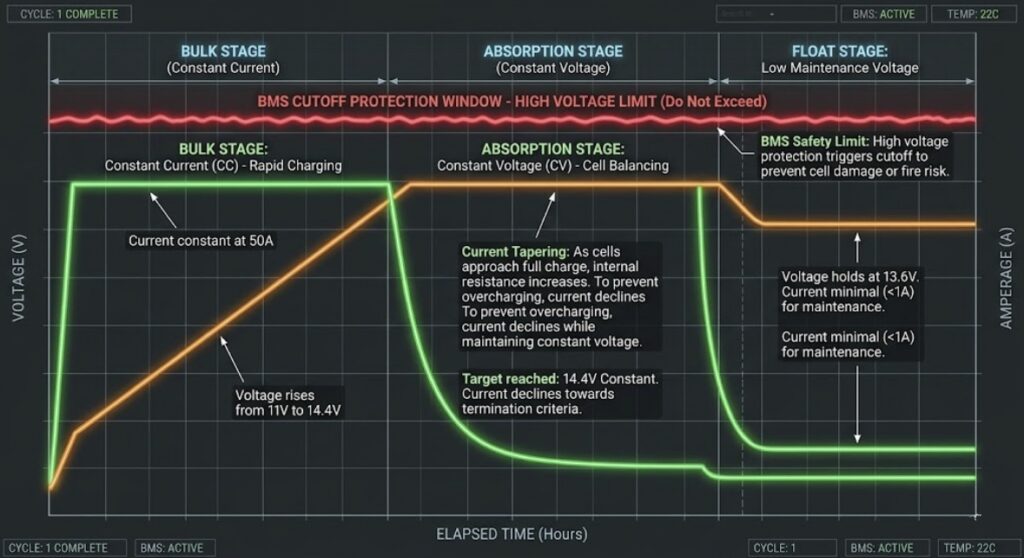
Battery Management System (BMS) Charge Termination Logic
LiFePO4 batteries do automatically stop charging when full.
This occurs through the Battery Management System (BMS).
The BMS continuously monitors:
- Cell voltage
- Pack voltage
- Charge current
- Temperature
- Cell balancing
Standard LiFePO4 Charging Stages
| Stage | Behavior |
|---|---|
| Bulk | Maximum current |
| Absorption | Constant voltage |
| Float/Idle | Minimal current |
Typical settings for a 12V LiFePO4 battery:
| Parameter | Typical Setting |
|---|---|
| Bulk/Absorption | 14.2V–14.6V |
| Float | 13.4V–13.6V |
| Low Voltage Disconnect | 10.5V–11V |
When cells reach maximum voltage:
- BMS reduces charging acceptance
- Controller current tapers
- Cell balancing activates
- BMS disconnects charging if limits are exceeded
Modern MPPT controllers synchronize effectively with lithium BMS logic.
PWM units frequently struggle with absorption-to-float transitions.
Solar Panel to LiFePO4 Battery Sizing for Off-Grid Autonomy
Engineering autonomy calculations determine how many days a battery bank can operate without solar input.
Formula:
BatteryCapacity=DoD×EfficiencyDailyLoad×DaysofAutonomyExample:
| Parameter | Value |
|---|---|
| Daily Consumption | 4kWh |
| Autonomy | 2 days |
| DoD | 90% |
| System Efficiency | 85% |
Calculation:
Capacity=0.9×0.854×2=10.46kWhA practical system would use:
- 10kWh–12kWh LiFePO4 storage
- 2kW–3kW solar array depending on PSH
Recommended Solar-to-Battery Ratios
| Battery Capacity | Suggested Solar Array |
|---|---|
| 1kWh | 200W–400W |
| 5kWh | 1kW–2kW |
| 10kWh | 2kW–4kW |
| 20kWh | 4kW–8kW |
When designing for multi-day autonomy, scaling your solar array and battery bank must happen alongside a reliable fuel-based backup strategy. To ensure your emergency backup power matches your daily load demand, consult our comprehensive layout on [off-grid cabin generator sizing] to calculate continuous running wattage parameters.
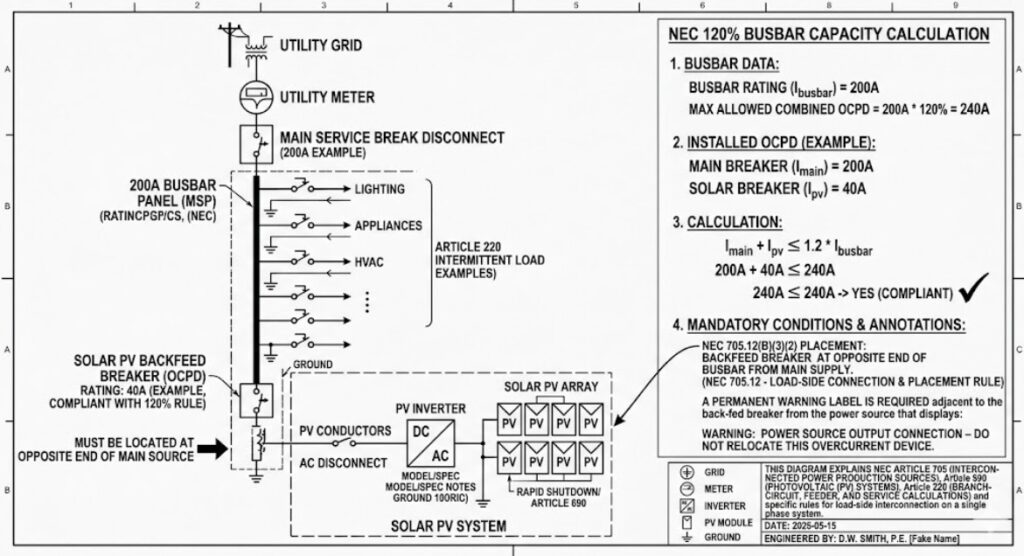
National Electrical Code NEC 120% Rule
The NEC 120% Rule is critical in grid-tied solar integration. It governs how much solar backfeed current may enter a panel busbar. Codified under Article 690 of the [National Electrical Code (NEC)], this safety standard prevents the accidental thermal overloading of interior distribution panel busbars when multiple power feeds operate simultaneously.
It governs how much solar backfeed current may enter a panel busbar.
Formula:
MaxPVBreaker=(Busbar×1.2)−MainBreakerExample: 200A Panel
| Parameter | Value |
|---|---|
| Busbar Rating | 200A |
| Main Breaker | 200A |
Calculation: (200×1.2)−200=40A
Maximum PV breaker = 40A.
Continuous inverter output must then be derated using the 125% continuous load factor.
Thus: 40A breaker supports about 32A continuous inverter current.
At 240V AC:
P=240×32=7680WMaximum inverter size ≈ 7.68kW AC.
Why the NEC 120% Rule Exists
Without compliance:
- Busbars may overheat
- Simultaneous utility + PV current can exceed thermal design limits
- Fire risk increases
Solutions for larger systems:
- Main breaker downsizing
- Line-side tap
- Supply-side connection
- Dedicated solar subpanel
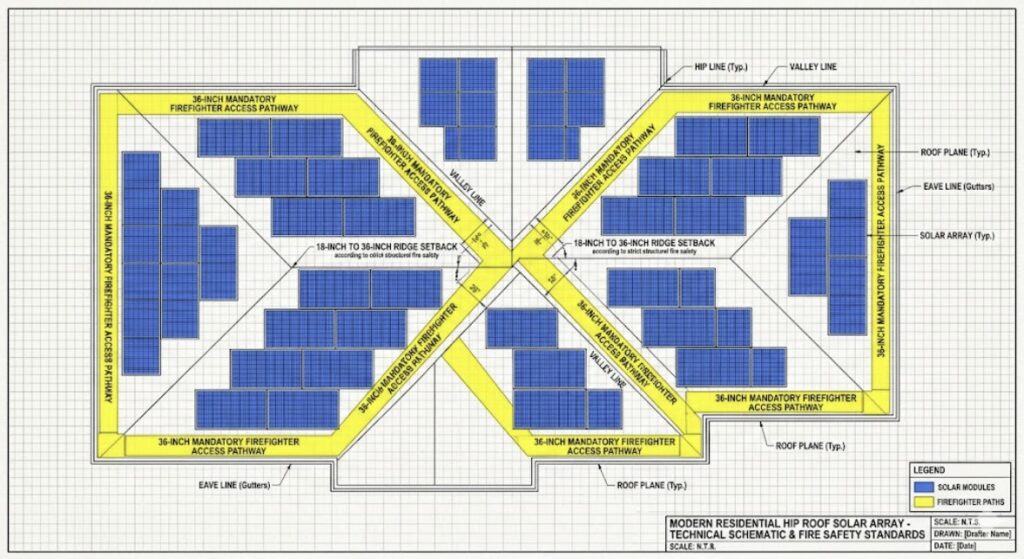
The 36-Inch Solar Clearance Rule
Roof-mounted arrays must comply with firefighter access regulations.
NFPA 1 and residential code R324 require rooftop pathways.
Access Pathway Requirements
| Requirement | Specification |
|---|---|
| Pathway Width | Minimum 36 inches |
| Ridge Setback | 18–36 inches |
| Roof Access | From gutter to ridge |
| Minimum Pathways | Two |
These pathways provide critical emergency roof access and smoke ventilation routes. These rooftop spatial boundaries, strictly enforced by the [International Code Council (ICC)], ensure structural access paths remain fully unobstructed for firefighter egress during emergency mitigation events.
Ridge Setback Rules
| Roof Coverage | Required Setback |
|---|---|
| ≤33% coverage | 18 inches |
| >33% coverage | 36 inches |
Sprinkler-equipped structures may allow modified setbacks.
Ignoring these rules can:
- Fail inspection
- Void permitting
- Delay interconnection approval
Real-World System Design Example
System Goal
Design a lithium backup system for:
- Refrigerator
- Lighting
- Internet
- Mini-split HVAC
- Laptop charging
Daily Consumption
| Load | Daily Energy |
|---|---|
| Refrigerator | 1.5kWh |
| Lighting | 0.5kWh |
| Internet | 0.2kWh |
| Mini-Split | 2.0kWh |
| Electronics | 0.5kWh |
Total = 4.7kWh/day
Battery Sizing
Assume:
- 2 days autonomy
- 90% DoD
- 85% efficiency
Capacity=0.9×0.854.7×2=12.3kWhRecommended battery bank:
- 48V 280Ah LiFePO4
- Approx. 13.4kWh
Solar Array Sizing
Assume:
- 5 PSH average
- 20% losses
Required array:
ArraySize=5×0.84700=1175WRecommended installed array:
- 1.5kW–2kW
When wiring multiple 200W or 400W modules together to build out this multi-panel array, the physical connection quality determines your resistance losses. Deploying heavy-duty BougeRV MC4 Y-Branch Connectors directly at the roof pass-through creates a weatherproof, low-resistance parallel split that keeps your voltage in check and your charging current running smoothly.
Check BougeRV MC4 Y-Branch Connectors current price on Amazon –>
This provides winter margin and faster recharge after cloudy periods.
Solar Panel to LiFePO4 Battery Sizing Best Practices
Use MPPT Controllers
MPPT controllers maximize lithium charging efficiency and reduce charging time.
Size for Winter Irradiance
Summer-only calculations produce chronic winter undercharging.
Maintain Proper C-Rates
Avoid continuous charging above 0.5C unless manufacturer approved.
Include Real-World Derating
Always assume at least: 15%–20% total system losses
Avoid Oversized Battery Banks
Massive storage with insufficient PV input creates low SOC cycling stress.
Monitor Cell Temperature
LiFePO4 charging below freezing can permanently damage cells without low-temp protection.
Final Engineering Recommendations
Successful solar panel to lifepo4 battery sizing depends on balancing production capability, lithium charging physics, NEC compliance, and real environmental conditions.
A properly engineered system should:
- Maintain safe lithium C-rates
- Fully recharge batteries during average PSH conditions
- Include realistic solar derating
- Use MPPT conversion technology
- Comply with NEC 120% busbar rules
- Respect rooftop firefighter clearance regulations
- Integrate properly with BMS charging logic
For most residential systems:
| System Size | Recommended Configuration |
|---|---|
| Small Backup | 400W–800W solar + 100Ah LiFePO4 |
| Cabin System | 1kW–2kW solar + 200Ah–400Ah LiFePO4 |
| Full Home Backup | 4kW–10kW solar + 10kWh–30kWh LiFePO4 |
When properly designed, LiFePO4 systems routinely achieve:
- 4,000–8,000 cycles
- 90%+ usable capacity
- High charging efficiency
- Minimal maintenance
- Stable long-term performance
Accurate engineering calculations eliminate guesswork and ensure the solar array and lithium storage system operate as a unified high-efficiency energy platform.
How many solar panels are required to charge a 100Ah LiFePO4 battery?
The number of solar panels required depends on battery voltage, daily energy usage, Peak Sun Hours, charge controller efficiency, and charging speed expectations. In most 12V systems, a single 200W panel can recharge a 100Ah LiFePO4 battery in ideal summer conditions within a full solar day, but real-world engineering calculations for solar panel to lifepo4 battery sizing usually recommend 300W to 400W of solar capacity to compensate for cloud cover, module temperature losses, wiring resistance, and seasonal irradiance reduction. Larger arrays also improve charging consistency during winter months and reduce the time spent in low state-of-charge conditions, which improves long-term lithium battery performance.
Can a 400W solar panel overcharge a LiFePO4 battery?
A properly configured MPPT charge controller prevents overcharging by regulating voltage and current according to lithium charging parameters. Even if a 400W panel produces high current during peak irradiance, the charge controller limits battery charging voltage during the absorption stage and transitions to float or standby mode once the battery reaches full capacity. Modern LiFePO4 batteries also include Battery Management Systems that disconnect charging if cell voltage exceeds safe thresholds. In practical solar panel to lifepo4 battery sizing, overcharging risks mainly occur when users bypass charge controllers or use incompatible PWM units with incorrect lithium profiles.
What size MPPT controller is needed for LiFePO4 batteries?
The correct MPPT controller size depends on total solar array wattage and system voltage. Engineers calculate controller amperage by dividing total panel wattage by battery charging voltage and then adding a 25% NEC safety margin. For example, an 800W solar array charging a 12V LiFePO4 bank may require approximately 67 amps of charging current under ideal conditions, making a 60A or 80A MPPT controller the proper selection depending on environmental derating and future expansion plans. Proper solar panel to lifepo4 battery sizing always includes controller headroom because lithium batteries can accept high charging current during bulk charging stages.
Do LiFePO4 batteries charge faster than AGM batteries with solar panels?
LiFePO4 batteries charge substantially faster because they maintain low internal resistance and high charging acceptance through most of the bulk charging cycle. AGM batteries progressively slow charging current as state-of-charge increases, while lithium batteries continue accepting near-maximum current until approaching full charge. This allows MPPT controllers to sustain higher energy transfer efficiency throughout the charging process. In solar panel to lifepo4 battery sizing applications, lithium systems often recover from overnight discharge much faster than lead-acid systems using the same solar array wattage.
What happens if the solar array is too small for the battery bank?
An undersized solar array creates chronic partial charging conditions where the battery rarely reaches full state-of-charge. This increases balancing stress on the BMS, reduces usable energy availability, and can lead to long-term degradation if the system repeatedly operates below optimal charge levels. Large battery banks paired with insufficient PV capacity also experience longer absorption phases and reduced charging efficiency during winter months. Correct solar panel to lifepo4 battery sizing ensures that the array can fully recharge the battery bank during average Peak Sun Hour conditions while accounting for real-world losses.
Can LiFePO4 batteries be charged during cloudy weather?
LiFePO4 batteries can still charge during cloudy weather, although charging current drops significantly because solar irradiance decreases. MPPT charge controllers improve low-light harvesting by continuously tracking the panel’s maximum power point, allowing some energy production even during overcast conditions. However, cloud cover may reduce solar output by 50% to 90% depending on atmospheric density and shading conditions. Effective solar panel to lifepo4 battery sizing therefore includes sufficient autonomy days and array oversizing to compensate for poor weather periods.
Why do solar panels rarely produce their rated wattage?
Solar panels are laboratory-rated under Standard Test Conditions at 25°C cell temperature and 1000W/m² irradiance, conditions that rarely occur on rooftops or ground-mounted systems. In real installations, panel temperature often exceeds 60°C, reducing voltage and output power through negative temperature coefficients. Additional losses come from dust accumulation, cable resistance, inverter inefficiency, atmospheric haze, and minor shading. This is why professional solar panel to lifepo4 battery sizing calculations typically assume total system losses between 15% and 25% rather than using theoretical panel ratings.
Is PWM charging safe for LiFePO4 batteries?
PWM charging can technically work with lithium batteries in very small systems, but it is generally less efficient and less precise than MPPT technology. PWM controllers force solar panels to operate near battery voltage rather than maximum power voltage, causing major energy losses when panel voltage is substantially higher than battery charging voltage. Many older PWM units also lack accurate lithium charging algorithms and proper absorption timing controls. For serious solar panel to lifepo4 battery sizing projects, MPPT controllers are strongly preferred because they maximize charging efficiency and provide superior voltage regulation.
How much battery capacity is needed for an off-grid cabin?
Battery sizing depends entirely on daily energy consumption and desired autonomy. A small cabin using LED lighting, refrigeration, internet equipment, and occasional appliance loads may consume 3kWh to 6kWh daily. With two days of autonomy and 90% usable depth of discharge, many systems require between 8kWh and 15kWh of LiFePO4 storage capacity. Solar panel to lifepo4 battery sizing for cabins must also account for seasonal weather variability, inverter efficiency, and future expansion such as air conditioning or water pumping systems.
Do LiFePO4 batteries stop charging automatically when full?
Modern LiFePO4 batteries stop charging automatically through coordinated operation between the charge controller and the internal Battery Management System. As the battery approaches full charge, charging current tapers during the absorption stage until current demand becomes minimal. If voltage exceeds programmed safety limits, the BMS disconnects charging to protect individual cells from overvoltage stress. Advanced MPPT controllers communicate effectively with lithium voltage curves, ensuring smooth transitions between charging stages during solar panel to lifepo4 battery sizing installations.
Can solar panels directly power appliances while charging batteries?
In hybrid and off-grid systems, solar panels can simultaneously power loads and charge batteries through the inverter and charge controller architecture. During daylight hours, solar energy first supports active loads, while surplus energy charges the battery bank. If loads exceed solar production, the battery supplements the deficit. Proper solar panel to lifepo4 battery sizing balances daytime production against both immediate consumption and stored energy requirements to prevent deep cycling and maintain system stability.
What is the ideal charge rate for LiFePO4 batteries?
Most LiFePO4 manufacturers recommend charging between 0.2C and 0.5C for optimal longevity and thermal stability. A 100Ah battery therefore performs best with charging current between 20A and 50A. Higher charging rates reduce charging time but increase internal heating and BMS stress, especially in hot climates. Correct solar panel to lifepo4 battery sizing ensures that the solar array produces enough current for efficient charging without consistently exceeding manufacturer-recommended C-rate limits.
How long do LiFePO4 batteries last in solar systems?
High-quality LiFePO4 batteries commonly achieve between 4,000 and 8,000 charge cycles depending on depth of discharge, charging temperature, and system design. In residential solar applications, this often translates to 10 to 20 years of operation. Systems that maintain moderate C-rates, avoid deep overdischarge, and use accurate MPPT charging profiles typically achieve the longest service life. Proper solar panel to lifepo4 battery sizing plays a major role because chronic undercharging or excessive charging current can shorten battery longevity.
Should solar arrays be oversized for lithium batteries?
Moderate solar oversizing is usually recommended because real-world irradiance rarely matches STC ratings. Oversizing improves winter charging performance, accelerates recovery after cloudy periods, and reduces the time batteries spend at low state-of-charge. However, excessive oversizing without proper controller configuration may exceed recommended lithium charging current limits. Most engineering-grade solar panel to lifepo4 battery sizing strategies target sufficient array capacity to fully recharge batteries within one average solar day while maintaining safe C-rates.
Can cold temperatures damage LiFePO4 batteries during charging?
Charging LiFePO4 batteries below freezing temperatures can cause lithium plating, which permanently damages cell chemistry and reduces capacity. Many premium batteries include low-temperature charging protection that disables charging when cell temperatures fall below 0°C. In cold-climate solar panel to lifepo4 battery sizing projects, battery enclosures often include insulation or heating systems to maintain safe charging conditions during winter operation.
Can a 200W solar panel fully charge a 200Ah LiFePO4 battery?
A 200W solar panel can charge a 200Ah LiFePO4 battery, but the charging speed is usually too slow for reliable daily cycling in most climates. A 12V 200Ah LiFePO4 battery stores approximately 2,560Wh of energy, and after accounting for real-world solar losses, a 200W array may only produce around 700Wh to 1,000Wh per day depending on Peak Sun Hours and weather conditions. This means several days of strong sunlight may be required to fully recharge the battery after a deep discharge event. In practical solar panel to lifepo4 battery sizing, installers normally pair a 200Ah lithium battery with at least 400W to 800W of solar capacity to ensure stable charging performance and proper recovery during cloudy periods.
Does inverter size affect solar panel to LiFePO4 battery sizing?
The inverter plays a major role because it determines the maximum AC load the battery system must support. Larger inverters can power higher startup surges from appliances such as refrigerators, air conditioners, compressors, and pumps, but they also increase idle power consumption. A system using a 3000W inverter typically requires a larger battery bank and heavier DC cabling than a system using a 1000W inverter. Proper solar panel to lifepo4 battery sizing therefore considers both continuous power demand and surge demand to avoid voltage sag, inverter shutdowns, and excessive battery current draw during high-load operation.
What voltage system is best for LiFePO4 solar storage?
Small mobile systems and RV installations commonly use 12V architectures because equipment availability is widespread and installation complexity is lower. However, larger off-grid systems benefit from 24V or 48V configurations because higher voltage reduces current flow, cable heating, voltage drop, and conductor size requirements. For example, a 3000W inverter operating at 12V may draw more than 250 amps under heavy load, while the same inverter at 48V draws only around 62 amps. Advanced solar panel to lifepo4 battery sizing projects therefore favor higher-voltage battery banks for improved efficiency and reduced thermal stress.
How does shading affect LiFePO4 solar charging performance?
Partial shading dramatically reduces solar production because photovoltaic modules operate as interconnected current-limited circuits. Even minor shading from trees, antennas, vent pipes, or debris can reduce array output disproportionately compared to the shaded area itself. This effect becomes more severe in series-connected panel strings where one shaded panel restricts current through the entire string. In solar panel to lifepo4 battery sizing calculations, shading analysis is critical because daily charging assumptions can become inaccurate if panel placement ignores seasonal sun angles and obstruction patterns.
Can LiFePO4 batteries power a house overnight?
LiFePO4 batteries can easily support overnight household loads when properly sized. A typical residential backup system using 10kWh to 20kWh of lithium storage can power refrigeration, lighting, networking equipment, televisions, and moderate HVAC usage throughout the night. Runtime depends on total energy consumption, inverter efficiency, and battery reserve settings. Professional solar panel to lifepo4 battery sizing includes detailed load analysis to determine whether the system can maintain acceptable overnight state-of-charge levels while still preserving emergency reserve capacity for cloudy weather or grid outages.
Why are LiFePO4 batteries preferred for solar energy systems?
LiFePO4 chemistry offers superior cycle life, higher charging efficiency, lower maintenance requirements, deeper usable discharge capacity, and greater thermal stability than traditional lead-acid batteries. Lithium iron phosphate cells also maintain stable voltage across most of the discharge curve, which improves inverter performance and reduces voltage-related shutdown events. Because of these advantages, modern solar panel to lifepo4 battery sizing strategies increasingly prioritize lithium systems for residential backup, off-grid cabins, marine installations, RV power systems, and commercial solar storage applications.
Actually no matter if someone doesn’t know after that its up to other users that they will assist, so here it takes place.