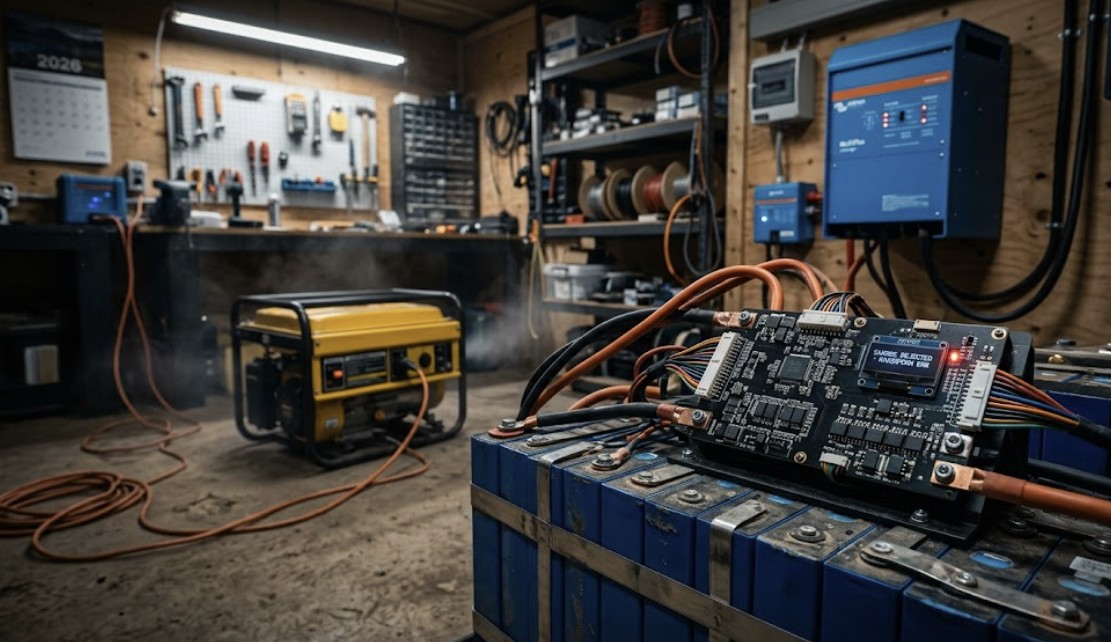
Portable generators and inverter/chargers frequently fail to charge lithium battery systems because the charging chain depends on waveform quality, stable frequency regulation, Battery Management System (BMS) communication logic, and correctly configured charger parameters. When a generator not charging lithium battery condition appears in RVs, off-grid cabins, marine systems, and backup power installations, the root cause is almost never the battery itself. The failure typically originates from AC waveform instability, charger rejection logic, undersized generator capacity, improper neutral bonding, or a locked-out LiFePO4 BMS.
This guide provides a field-level engineering procedure for diagnosing and correcting lithium charging failures with Victron Energy, Renogy, MultiPlus, Quattro, inverter chargers, portable generators, and hybrid off-grid systems.
Table of Contents
Understanding Why a Generator Not Charging Lithium Battery Problem Happens
Lithium battery charging systems are fundamentally different from lead-acid charging systems. LiFePO4 batteries rely on an internal Battery Management System that constantly monitors:
- Cell voltage
- Charge current
- Temperature
- Low-voltage cutoff
- High-voltage cutoff
- Short-circuit protection
- Cell balancing thresholds
If any parameter falls outside the BMS protection window, the battery disconnects internally. Once disconnected, the charger may see an open circuit and refuse to start charging.
At the same time, inverter/chargers like Victron MultiPlus or Renogy inverter chargers aggressively monitor incoming AC power quality. If the generator output waveform contains excessive distortion or unstable frequency, the charger disconnects AC input to protect downstream electronics.
The result is a classic generator not charging lithium battery scenario where:
- The generator appears operational
- AC voltage may look normal
- The inverter/charger repeatedly disconnects
- The lithium battery remains at low state of charge
- Charging current never stabilizes
Total Harmonic Distortion (THD): The Hidden Cause of Generator Charging Failure
Total Harmonic Distortion (THD) measures how far an AC waveform deviates from a pure sine wave. According to electrical standards defined by the [IEEE (Institute of Electrical and Electronics Engineers)], sensitive solid-state microprocessors inside lithium chargers require clean power configurations to prevent harmonic heating.
Utility-grade power follows a nearly perfect sine wave:
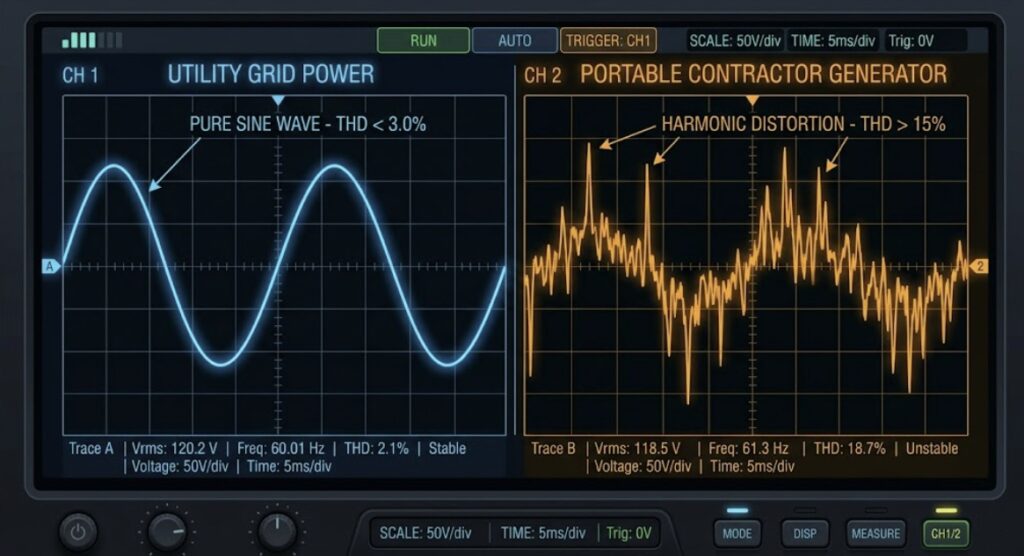
Low-quality generators produce waveform distortion caused by:
- Governor instability
- Poor alternator regulation
- Load transitions
- Mechanical RPM fluctuations
- Cheap AVR circuitry
- Nonlinear inductive loads
Why THD Matters in Lithium Charging Systems
Modern inverter/chargers analyze:
| Electrical Parameter | Acceptable Range |
|---|---|
| Voltage | Typically 108V–132V AC |
| Frequency | Usually 59–61 Hz |
| THD | Preferably below 5% |
| Waveform Stability | Continuous sine wave |
When THD exceeds acceptable thresholds:
- Transfer relays chatter
- AC input disconnects
- Charging cycles start and stop
- Chargers enter fault protection
- Sensitive electronics malfunction
A conventional contractor generator may produce:
| Generator Type | Typical THD |
|---|---|
| Open-frame contractor generator | 10–25% |
| Budget AVR generator | 6–15% |
| Premium inverter generator | 1–3% |
| Utility grid power | 2–3% |
High THD causes the charger to classify the generator output as “dirty power.”
This is one of the most common reasons for a generator not charging lithium battery condition in RV and off-grid installations.
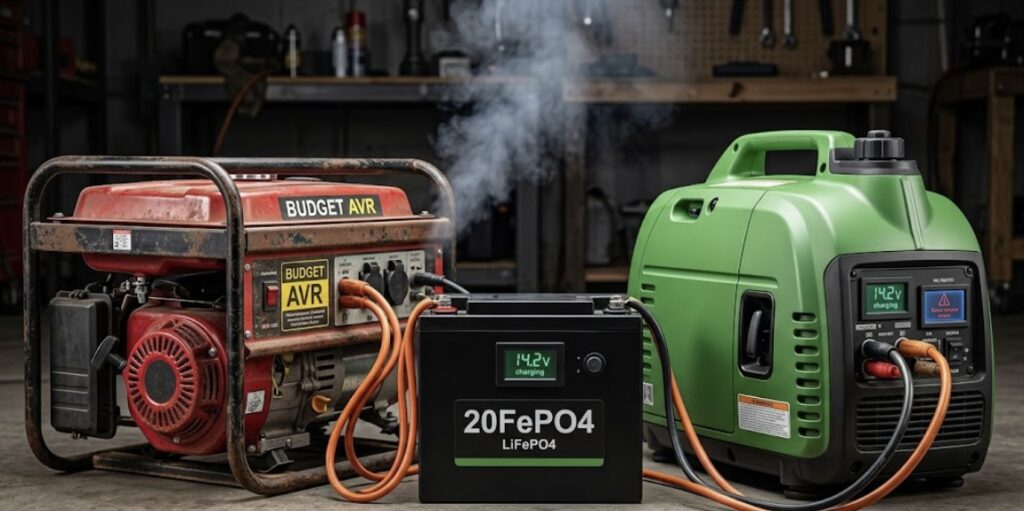
Generator not charging lithium battery: Conventional vs Inverter Generators
Conventional generators directly couple engine RPM to AC output frequency.
At 60 Hz operation:
f=120P×RPMAny RPM fluctuation immediately changes frequency and voltage stability.
Conventional Generator Characteristics
| Characteristic | Conventional Generator |
|---|---|
| Frequency Stability | Poor under varying loads |
| THD | High |
| Voltage Regulation | Moderate to poor |
| Fuel Efficiency | Lower |
| Noise | High |
| Charger Compatibility | Often problematic |
Inverter Generator Characteristics
Inverter generators use:
- Variable-speed alternator output
- AC-to-DC rectification
- DC bus stabilization
- PWM inverter reconstruction
- Microprocessor waveform control
This architecture creates:
- Stable 120V output
- Stable 60 Hz frequency
- Low harmonic distortion
- Improved charger compatibility
To avoid waveform corruption completely, field engineers rely on low-THD hardware. Premium units like the Honda EU2200i Inverter Generator deliver a true clean sine wave, while more budget-friendly options like the Champion 4500-Watt Dual-Fuel Inverter provide excellent stability on both gasoline and propane.
Check Honda EU2200i Inverter Generator current price on Amazon –>
Check Champion 4500-Watt Dual-Fuel Inverter current price on Amazon –>
| Characteristic | Inverter Generator |
|---|---|
| Frequency Stability | Excellent |
| THD | Typically <3% |
| Voltage Regulation | Excellent |
| Fuel Efficiency | High |
| Noise | Low |
| Lithium Charger Compatibility | Excellent |
For lithium systems using Victron, Renogy, Magnum, or Xantrex inverter chargers, inverter generators dramatically reduce charging rejection events.
Comprehensive Diagnostic Protocol for Generator Charging Failures
When troubleshooting a generator not charging lithium battery condition, avoid random settings changes. Use a structured verification process.
If you are still deciding on your core power electronics, check out our technical analysis on the [Renogy vs Victron Inverter Comparison] to see how their internal charging circuits handle variable grid power.
Step 1: Verify Open-Circuit Generator Voltage
Disconnect all loads.
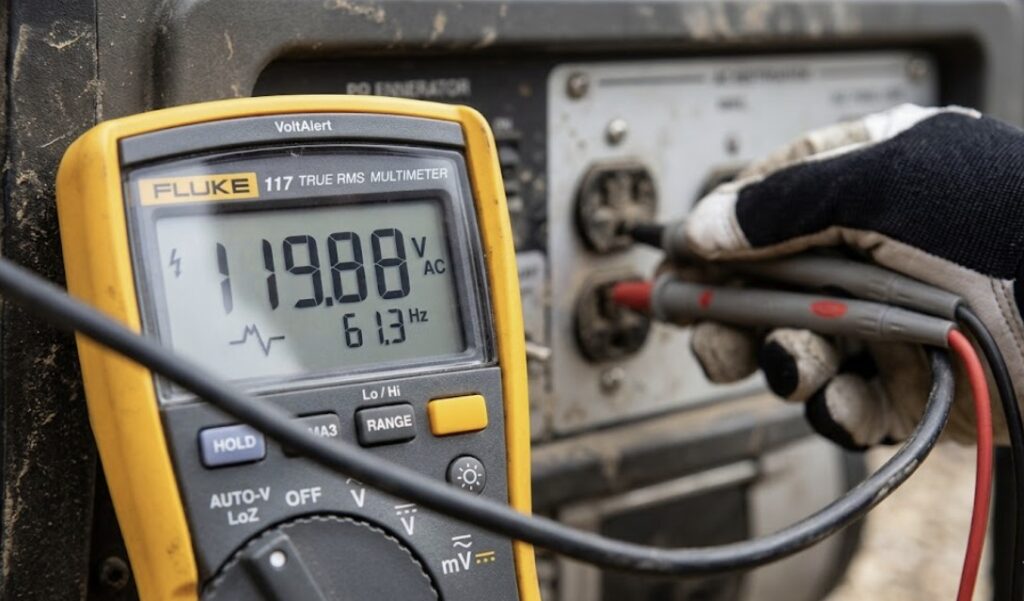
Measure generator AC voltage with a true RMS multimeter.
Standard multimeters will give false readings on distorted generator waves. Using a high-precision tool like the Fluke 117 True RMS Digital Multimeter or the more affordable Klein Tools MM720 Multimeter ensures you measure the actual effective voltage and frequency drift under load.
Check Fluke 117 True RMS Digital Multimeter current price on Amazon –>
Check Klein Tools MM720 Multimeter current price on Amazon –>
Expected values:
| Region | Expected Voltage |
|---|---|
| North America | 120V AC ±5% |
| Europe | 230V AC ±5% |
If voltage fluctuates excessively without load:
- Governor instability exists
- AVR failure may exist
- Engine RPM may be drifting
Step 2: Verify Generator Frequency Stability
Use a multimeter with frequency mode.
Measure:
| Acceptable Frequency | Warning Threshold |
|---|---|
| 59.5–60.5 Hz | Below 58 Hz or above 62 Hz |
Load the generator to approximately 50%.
Observe frequency drift.
Frequency Instability Causes Charger Rejection
Most inverter/chargers disconnect if:
- Frequency sags under heavy charging
- Frequency overshoots during load release
- Governor response is too slow
Step 3: Check Neutral-to-Ground Bonding
Many inverter chargers require correct bonding to recognize generator input.
Portable generators may be:
- Floating neutral
- Bonded neutral
- Switchable neutral
Improper bonding causes:
- AC input rejection
- Ground relay faults
- GFCI tripping
- Transfer switch errors
If your inverter/charger rejects the generator due to a missing ground relay link on floating-neutral portable generators, you do not need to modify internal wiring. Plugging a Southwire Neutral-Ground Bonding Plug directly into one of the generator’s empty AC outlets instantly creates the required bond to allow charging.
Check Southwire Neutral-Ground Bonding Plug current price on Amazon –>
Bonding Verification Procedure
Use continuity mode:
| Test Points | Expected Result |
|---|---|
| Neutral to frame | Depends on design |
| Ground to frame | Continuity required |
| Neutral to ground at service entrance | Bonded once only |
Improper double bonding creates circulating current issues.
Step 4: Measure Charger Input Current
If charger demand exceeds generator capacity:
- Voltage sags
- Frequency collapses
- Charger disconnects
- Transfer relay chatters
Continuous Wattage Calculation
Use continuous generator wattage, not surge rating.
Example:
| Parameter | Value |
|---|---|
| Generator continuous output | 2000W |
| AC voltage | 120V |
| Maximum safe current | 16.6A |
| Recommended 80% limit | 13A |
Apply:
P=V×IIf the charger attempts 18A input on a 2000W generator, instability occurs immediately.
generator not charging lithium battery Due to BMS Sleep Mode
Lithium batteries entering deep discharge often activate Low Voltage Disconnect (LVD). This protection protocol is exacerbated during cold weather operations. For a complete breakdown of temperature thresholds, see our guide on [winter solar charging lithium batteries] to understand how thermal stress alters BMS charging acceptance.
The BMS opens internal MOSFET protection circuitry to prevent:
- Copper dissolution
- Cell reversal
- Thermal instability
- Permanent capacity loss
Once disconnected, many chargers cannot detect the battery.
Symptoms of BMS Sleep Mode
| Symptom | Likely Cause |
|---|---|
| 0V output | BMS disconnected |
| Charger shows “No Battery” | BMS locked |
| Battery briefly wakes then disconnects | Cell undervoltage |
| No charging current | Protection active |
Safe Lithium Battery Wake-Up Procedure
Method 1: Smart Lithium Charger
Preferred method.
Procedure:
- Disconnect all loads
- Attach lithium-compatible charger
- Use low-current activation mode
- Allow gradual voltage rise
- Wait for BMS reconnection
Note that standard chargers will not output voltage if they detect 0V at the terminals. You must use a dedicated unit equipped with a force-activation protocol, such as the NOCO Genius GENIUS10 Smart Charger, which can force power into a sleeping LiFePO4 pack to wake up locked MOSFETs.
Check NOCO Genius GENIUS10 Smart Charger current price on Amazon –>
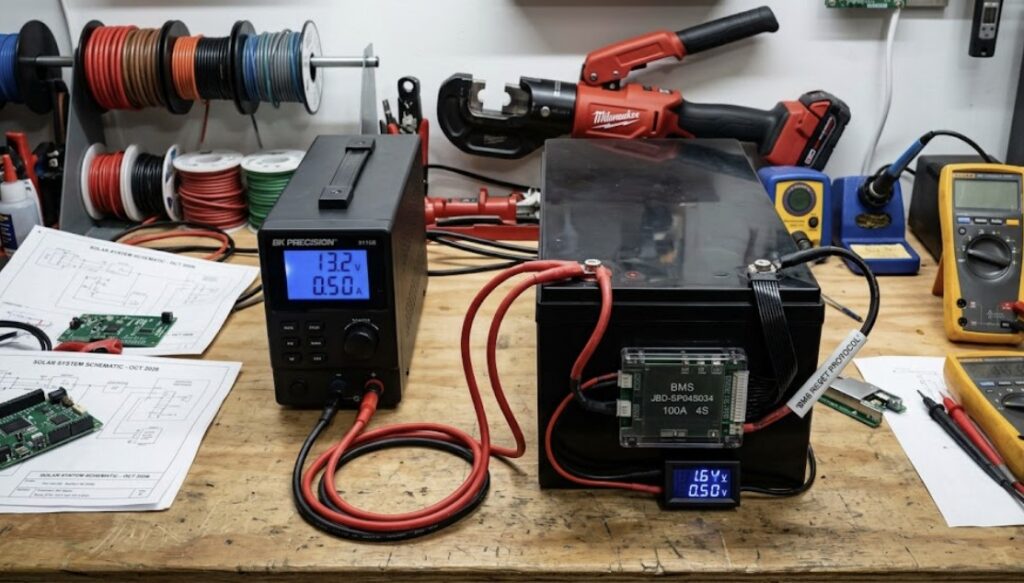
Method 2: Bench Power Supply
Technician-level controlled recovery.
| Parameter | Typical Setting |
|---|---|
| Current limit | 0.1–0.5A |
| Voltage | Match nominal battery voltage |
| Monitoring | Continuous |
For professional off-grid setups, keeping a Wanptek 30V 10A DC Bench Power Supply on hand allows you to dial in the exact current and voltage parameters required to manually reset a stubborn BMS without risking overcurrent damage.
Check Wanptek 30V 10A DC Bench Power Supply current price on Amazon –>
This method safely raises pack voltage until the BMS reactivates.
Method 3: Parallel Battery Activation
Temporary jump-start method.
Procedure:
- Connect positive terminals
- Connect negative terminals
- Wait briefly
- Disconnect
- Begin normal charging
This should only be used if controlled charging equipment is unavailable.
Victron MultiPlus and Quattro Generator Integration Settings
Victron inverter/chargers aggressively reject unstable AC input using default UPS-grade settings.
This commonly creates a generator not charging lithium battery problem.
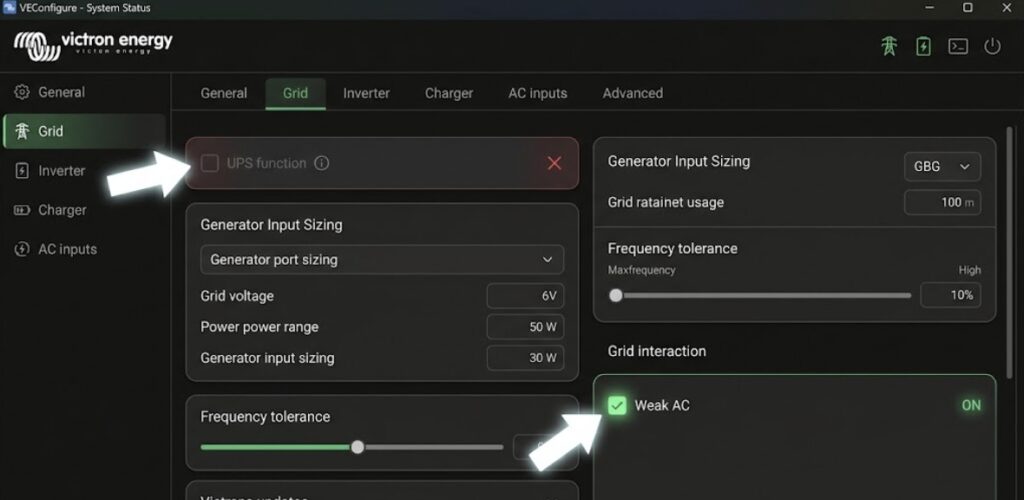
Disable UPS Function
Default UPS mode expects utility-quality power.
Why Disable UPS Mode
UPS mode uses:
- Extremely narrow voltage windows
- Extremely narrow frequency windows
- Fast transfer timing
Portable generators rarely meet those requirements.
VEConfigure Setting
| Navigate: | Grid tab Inverter tab |
| Disable: | “UPS Function” |
| Result: | Wider AC tolerance Reduced relay chatter Better generator acceptance |
Enable Weak AC Mode
Weak AC modifies charger behavior during unstable generator operation.
Weak AC Effects
| Behavior | Result |
|---|---|
| Reduced charger aggressiveness | Prevents overload |
| Better distorted waveform tolerance | Accepts dirty power |
| Adaptive current limiting | Stabilizes generator |
When to Enable Weak AC
Enable Weak AC when:
- THD is high
- Voltage sags under load
- Frequency drifts during charging
- Generator is undersized
- Open-frame generator is used
Enabling Weak AC allows the system to tolerate frequency shifts up to 66 Hz. For advanced multi-phase programming layouts and step-by-step software walkthroughs, refer directly to the official [Victron Energy Support Documentation] on generator synchronization.
Set Proper AC Input Current Limits
Incorrect AC current limits are a major cause of generator instability.
Correct Victron Input Limit Calculation
Example:
| Parameter | Value |
|---|---|
| Generator continuous power | 2200W |
| Voltage | 120V |
| Maximum current | 18.3A |
| Recommended AC input limit | 14A |
Never configure based on surge rating.
Recommended Safety Margin
Use:
- 75–80% of continuous output
- Additional margin for high ambient temperatures
- Additional margin for altitude derating
generator not charging lithium battery in Renogy Systems
Renogy inverter chargers may overload smaller generators during bulk charging.
Adjust Renogy AC Input Parameters
Key parameters include:
| Setting | Recommended Action |
|---|---|
| AC input current | Reduce below generator limit |
| Bulk charging current | Lower for weak generators |
| Transfer voltage window | Widen if available |
| Charger priority | Adjust for generator stability |
Why Renogy Chargers Trip Generators
Bulk charging current can suddenly demand:
- Large reactive current
- Rapid wattage increase
- Voltage collapse
- Frequency sag
Reducing charger current stabilizes operation.
Recommended Renogy Generator Pairings
| Generator Size | Recommended Charger Current |
|---|---|
| 2000W | 40–60A lithium charging |
| 3000W | 80–100A lithium charging |
| 5000W | 120A+ charging |
Actual values depend on charger efficiency and battery voltage.
System Hardening for Reliable Lithium Charging
Reliable off-grid charging requires proper installation engineering.
Wire Gauge Sizing for Long AC Runs
Undersized wire causes voltage drop.
Voltage drop creates:
- Charger instability
- Increased THD sensitivity
- Reduced charging efficiency
Recommended AC Wire Sizes
| Distance | Current | Recommended Wire |
| Under 25 ft | 30A | 10 AWG |
| 25–50 ft | 30A | 8 AWG |
| Over 50 ft | 30A | 6 AWG |
Using thin, residential-grade extension cords between the generator and your cabin inlet box will increase resistance, exacerbate voltage sag, and cause charger rejection. Always use a dedicated heavy-duty 10 AWG 30-Amp Generator Cord to handle the continuous bulk charging current safely over distance.
Check heavy-duty 10 AWG 30-Amp Generator Cord current price on Amazon –>

DC Cable Sizing for Inverter Chargers
High-current lithium charging systems require extremely low resistance.
Typical DC Cable Recommendations
| Inverter Size | Cable Length | Recommended Cable |
| 2000W | Under 5 ft | 2/0 AWG |
| 3000W | Under 5 ft | 4/0 AWG |
| 5000W | Under 5 ft | Dual 4/0 AWG |
Improper DC sizing causes severe voltage sag and ripple voltage under heavy generator loads. While AC lines require heavy gauge extensions, your main DC paths must follow strict length-to-thickness ratios similar to those outlined in our master guide on [solar panel wire size] limits.
Generator Sizing for Lithium Charging
Many charging problems originate from undersized generators.
Calculate Charger Demand Properly
Example:
| Parameter | Value |
|---|---|
| Charger output | 100A |
| Battery voltage | 14.4V |
| DC charging power | 1440W |
| Charger efficiency | 85% |
| Required AC power | ~1700W |
Add:
- Inverter overhead
- Cooling fans
- Other AC loads
- Startup transients
Recommended Generator Headroom
| Application | Recommended Margin |
|---|---|
| Lithium charging only | 25% |
| RV with appliances | 40% |
| Cabin systems | 50% |
Common Failure Modes and Solutions
| Symptom | Root Cause | Corrective Action |
|---|---|---|
| Charger repeatedly clicks | Frequency drift | Adjust governor |
| Charger rejects AC input | High THD | Use inverter generator |
| Generator bogs down | Excess charger current | Reduce AC input limit |
| Battery remains at 0V | BMS sleep mode | Controlled wake-up |
| GFCI trips immediately | Bonding issue | Verify neutral-ground configuration |
| Charging starts then stops | Voltage sag | Increase generator capacity |
| Victron “Low AC” alarm | Dirty waveform | Enable Weak AC |
Best Practices for Reliable Off-Grid Lithium Charging
Use Inverter Generators Whenever Possible
Preferred THD:
| Application | Maximum THD |
|---|---|
| Sensitive electronics | <3% |
| Lithium inverter chargers | <5% |
| General tools | <10% |
Avoid Operating Generators at Maximum Load
Continuous operation above 85% capacity increases:
- Frequency instability
- Voltage distortion
- Engine heat
- Harmonic generation
Maintain Proper Generator RPM
Dirty carburetors, clogged filters, and governor wear directly affect waveform stability.
Use True RMS Measurement Tools
Cheap multimeters often misread distorted generator waveforms.
Professional troubleshooting requires:
- True RMS multimeter
- Frequency meter
- Clamp ammeter
- Oscilloscope for advanced diagnostics
Final Engineering Recommendations
A generator not charging lithium battery condition is rarely solved by replacing random components. Stable lithium charging depends on the interaction between waveform quality, BMS logic, inverter/charger tolerances, grounding architecture, and correctly sized power systems.
The highest reliability is achieved when combining:
- Low-THD inverter generators
- Correct AC input current limits
- Proper neutral-ground bonding
- Victron Weak AC configuration
- UPS mode disabled
- Adequate generator headroom
- Proper cable sizing
- Controlled lithium BMS recovery procedures
When all electrical parameters remain within tolerance simultaneously, LiFePO4 charging becomes stable, repeatable, and safe even in demanding off-grid environments.
Why does my generator run normally but still refuse to charge my lithium battery bank?
A generator not charging lithium battery system is usually caused by unstable AC power rather than complete generator failure. Portable generators can maintain acceptable voltage while still producing excessive Total Harmonic Distortion, unstable frequency, or sudden waveform fluctuations that cause inverter chargers to reject incoming power. Lithium inverter chargers constantly monitor AC quality before allowing current flow into the battery bank, and even minor frequency drift under load can trigger repeated disconnect cycles. This problem becomes more common with open-frame contractor generators, aging voltage regulators, overloaded systems, or improperly configured inverter chargers using narrow UPS-grade tolerances.
Can a low-quality generator damage a LiFePO4 battery system permanently?
A low-quality generator rarely damages lithium cells directly because the Battery Management System protects the battery pack from unsafe charging conditions, but poor-quality AC power can severely stress inverter chargers, capacitors, relays, and sensitive electronics connected to the system. High harmonic distortion and unstable voltage create excessive internal heating inside power conversion equipment while repeated charging interruptions place additional stress on MOSFET switching components. Over time, unstable generator output can reduce inverter charger lifespan, create intermittent charging faults, and increase the likelihood of electronic component failure inside the off-grid power system.
Why does my Victron MultiPlus keep clicking on and off during a generator not charging lithium battery problem?
Continuous relay clicking during a generator not charging lithium battery situation usually indicates that the Victron MultiPlus or Quattro system is rejecting unstable AC input power. The inverter charger attempts to synchronize with incoming generator power, but unstable voltage or drifting frequency causes the internal transfer relay to disconnect repeatedly for system protection. Portable generators commonly fall outside the factory UPS-mode acceptance window because the default Victron settings are optimized for utility-grade shore power rather than fluctuating generator waveforms. Disabling UPS mode and enabling Weak AC mode significantly improves compatibility with portable generators by widening acceptable voltage and frequency tolerances.
What THD level is considered safe for lithium battery charging systems?
Most lithium charging systems operate reliably when Total Harmonic Distortion remains below 5%, although premium inverter chargers and sensitive electronics perform best when THD stays under 3%. Contractor-style generators frequently exceed these limits during load transitions because mechanical governor response cannot stabilize the waveform quickly enough under changing electrical demand. Inverter generators electronically reconstruct the AC sine wave using microprocessor-controlled circuitry, which dramatically lowers harmonic distortion and improves compatibility with lithium battery chargers, networking equipment, computers, and other sensitive devices commonly used in off-grid systems.
Why does my generator overload when lithium charging begins even though the wattage rating looks sufficient?
Lithium batteries accept charging current extremely aggressively during the bulk charging stage because LiFePO4 chemistry maintains very low internal resistance compared to lead-acid batteries. Many operators size generators based on advertised surge ratings instead of continuous running capacity, which creates instability when the charger suddenly demands large sustained power. Once charging begins, the generator governor may struggle to maintain RPM, causing voltage sag and frequency collapse that force the charger to disconnect. Reducing the inverter charger’s AC input current limit is often the most effective way to stabilize charging performance and prevent overload conditions.
Can cold temperatures create a generator not charging lithium battery condition?
Cold weather frequently contributes to a generator not charging lithium battery problem because LiFePO4 batteries typically block charging below freezing temperatures to prevent internal lithium plating damage. At the same time, portable generators often produce less stable output in cold conditions because thicker oil, incomplete warm-up, carburetor icing, and poor fuel atomization affect engine performance. The combined effect can create simultaneous generator instability and BMS charging lockout conditions that completely prevent battery charging until temperatures rise or internal battery heaters activate.
Why does my charger work perfectly on shore power but fail on generator power?
Shore power provides tightly regulated utility-grade electricity with stable voltage, low harmonic distortion, and extremely accurate frequency control, while portable generators often produce fluctuating AC output under varying loads. Even if a generator displays acceptable voltage on a standard multimeter, the actual waveform may contain distortion spikes, unstable sine wave characteristics, or frequency fluctuations severe enough to trigger inverter charger protection systems. Many generator charging failures occur because the charger detects dirty power conditions invisible without true RMS testing equipment or oscilloscope analysis.
What is the safest way to wake up a sleeping lithium battery?
The safest method for recovering a sleeping lithium battery involves using a lithium-compatible smart charger with built-in activation or recovery mode functionality. These chargers slowly introduce low current into the battery pack until cell voltage rises high enough for the BMS to reconnect internally. Controlled recovery prevents dangerous current surges and minimizes thermal stress inside deeply discharged cells. Professional technicians also use regulated bench power supplies with low current limits because they provide extremely precise control over recovery voltage and amperage during the BMS wake-up process.
Why does my lithium battery show zero volts even though it may still be recoverable?
A lithium battery displaying zero volts often means the Battery Management System has disconnected the external terminals rather than the cells themselves being permanently damaged. When cell voltage drops below safe operating thresholds, the BMS isolates the battery pack to prevent chemical degradation, copper dissolution, and irreversible cell damage. Although the battery terminals appear completely dead, the internal cells may still contain recoverable voltage if proper activation charging procedures are applied quickly enough. Many operators mistakenly replace batteries that are actually recoverable through controlled low-current wake-up procedures.
Can grounding problems cause a generator not charging lithium battery issue?
Improper grounding and incorrect neutral bonding are major causes of generator not charging lithium battery failures in RV, marine, and off-grid systems. Many inverter chargers verify neutral-to-ground relationships before accepting generator power, and portable generators often use floating neutral configurations that conflict with inverter transfer relay logic. If the charger cannot establish proper grounding reference conditions, it may reject incoming AC power or repeatedly disconnect during operation. Incorrect double-bonding can also create circulating currents, nuisance tripping, and unstable charging behavior.
Why do inverter generators work better with lithium battery systems?
Inverter generators electronically reconstruct AC power using DC bus stabilization and PWM-controlled inverter stages rather than relying entirely on alternator output directly linked to engine RPM. This design allows the generator to maintain cleaner sine wave output with stable voltage and frequency even during sudden load changes. Because lithium inverter chargers are highly sensitive to waveform quality, inverter generators dramatically reduce relay chatter, charger rejection events, and unstable charging behavior compared to conventional contractor generators with poor harmonic control.
How much generator capacity should I use for charging lithium batteries?
Reliable lithium charging systems usually require substantial overhead beyond the charger’s calculated wattage demand because portable generators lose efficiency under continuous heavy load conditions. Most off-grid systems perform best when the generator capacity exceeds charger demand by at least 25% to 50%, which compensates for engine governor response delays, temperature derating, altitude losses, startup transients, and simultaneous AC appliance loads. Undersized generators frequently create unstable frequency conditions that lead directly to charging rejection events.
Can long extension cords contribute to a generator not charging lithium battery problem?
Long AC cable runs and undersized extension cords frequently contribute to a generator not charging lithium battery condition because voltage drop increases significantly under heavy charging loads. As voltage drops across the cable, the inverter charger attempts to compensate by drawing additional current, which places even more stress on the generator. Excessive resistance also increases cable heating and worsens waveform instability. Heavy-gauge wiring with short cable runs is essential for maintaining stable charging performance in high-current lithium systems.
Why does generator frequency drop as soon as lithium charging begins?
Generator frequency directly depends on engine RPM, and lithium chargers can apply very sudden bulk charging loads that overwhelm smaller generators before the governor reacts. When charging begins, the engine speed may momentarily drop below the required RPM needed to maintain stable 60 Hz output. Inverter chargers constantly monitor frequency stability and disconnect immediately if frequency falls outside acceptable limits. This behavior is especially common in portable generators operating close to maximum continuous capacity or units with slow governor response characteristics.
Is continuous generator charging safe for lithium battery systems?
Continuous generator charging is generally safe when the charging system is properly configured and the generator has enough continuous power capacity to maintain stable output under sustained load. Problems typically occur when generators operate near maximum load for extended periods because heat buildup, governor instability, and fuel inefficiency increase dramatically under those conditions. Lithium batteries themselves handle continuous charging efficiently, but unstable generator operation can create harmful voltage fluctuations and elevated harmonic distortion that stress the inverter charger over time.
Why do some deeply discharged lithium batteries recover while others fail permanently?
Recovery success depends largely on how deeply the cells discharged before the BMS disconnected the battery and how long the cells remained in that low-voltage condition. Batteries left deeply discharged for extended periods may suffer electrolyte breakdown, internal resistance growth, and irreversible chemical damage that prevents safe recovery. Batteries recovered quickly after entering protection mode are far more likely to return to normal operation because the cell structure remains chemically stable during shorter discharge periods.
Can modified sine wave power create generator charging problems?
Modified sine wave output creates very high harmonic distortion compared to pure sine wave power, making it incompatible with many modern inverter chargers and lithium charging systems. The stepped waveform introduces excessive electrical noise, transformer heating, capacitor stress, and synchronization problems inside charger circuitry. Many inverter chargers reject modified sine wave input entirely because the waveform quality falls far outside acceptable operating tolerances. Pure sine wave inverter generators are strongly preferred for stable lithium charging performance.
Why does enabling Weak AC mode help stabilize charging?
Weak AC mode changes the internal charging behavior of the inverter charger by reducing charger aggressiveness and widening acceptable AC waveform tolerances. Instead of demanding maximum charging current immediately, the charger adapts dynamically to the generator’s actual capability, reducing overload events that would otherwise destabilize engine RPM and frequency. Weak AC mode is especially valuable for older generators, open-frame contractor units, and systems experiencing moderate waveform distortion during heavy charging loads.
Can high altitude worsen a generator not charging lithium battery issue?
High altitude significantly reduces generator engine performance because thinner air contains less oxygen for combustion, lowering overall engine power output. Most gasoline generators lose several percent of rated capacity for every thousand feet above sea level, which can unexpectedly push charging systems into overload conditions. Reduced engine power also worsens governor response and increases frequency instability during sudden charging transitions, making lithium charging systems more likely to reject generator power at elevation.
Why does my charger randomly stop charging during generator operation?
Random charging interruptions usually indicate unstable generator operation rather than a defective battery charger. Frequency drift, voltage sag, loose wiring connections, overheating components, clogged carburetors, fuel delivery problems, and failing automatic voltage regulators can all create temporary instability severe enough to trigger charger protection systems. As the generator heats up during prolonged operation, engine efficiency and voltage regulation often deteriorate further, increasing the frequency of charging interruptions and unstable inverter charger behavior.
2 thoughts on “Generator Not Charging Lithium Battery: Complete Engineering Diagnostics for LiFePO4 Charging Failures”