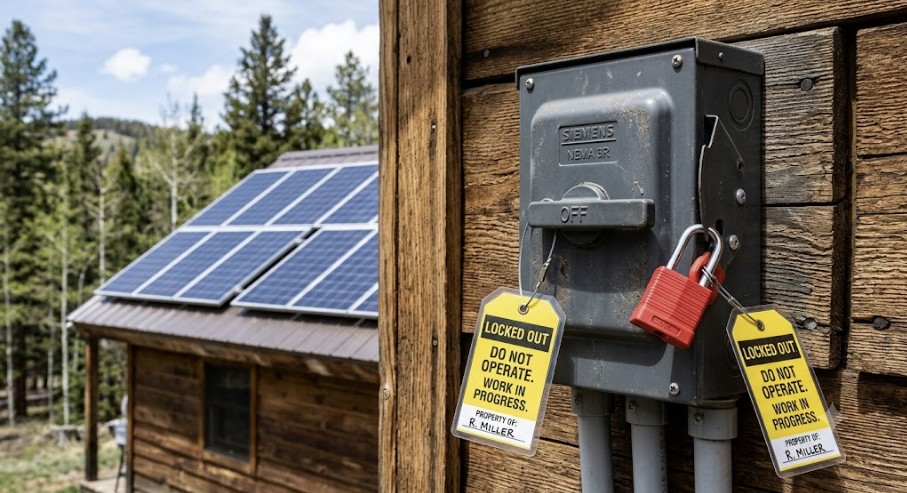
Selecting the best solar disconnect switch for cabins is not a matter of convenience; it is a fundamental requirement for electrical safety and system longevity. In an off-grid environment, you are the utility, the lineman, and the chief safety officer. A disconnect switch is your primary tool for manually isolating electrical energy, a non-negotiable component mandated by the National Electrical Code (NEC) and essential for safe maintenance, troubleshooting, and emergency shutdown. Unlike a circuit breaker, which is an automatic overcurrent protection device, a disconnect switch provides a verifiable, visible air gap in the circuit. This physical separation is the only way to be certain that a circuit is de-energized before you put your hands on it. This guide provides an exhaustive engineering analysis of the selection, sizing, and installation of solar disconnects, ensuring your cabin’s power system is both robust and unequivocally safe.
We will dissect the technical specifications, NEC calculations, and physical properties that differentiate a high-quality disconnect from a potential point of failure. The focus is on practical, real-world application for cabin systems, from small 12V setups to sophisticated 48V power plants. We will move beyond generic advice and into the specific formulas and safety protocols that professional off-grid engineers use daily. Understanding these principles is critical to building a power system that you can trust your life with.
Table of Contents
Why Your Off-Grid Cabin Needs More Than Just a Circuit Breaker
A common and dangerous misconception among DIY solar installers is that a DC circuit breaker can serve the same function as a true disconnect switch. While a breaker can interrupt a circuit, its primary role is automatic protection against overcurrent and short circuits. It is not designed or rated for the critical safety role of a disconnect switch. The distinction lies in three key engineering principles: visible break, load-break capability, and Lockout/Tagout (LOTO) provisions.
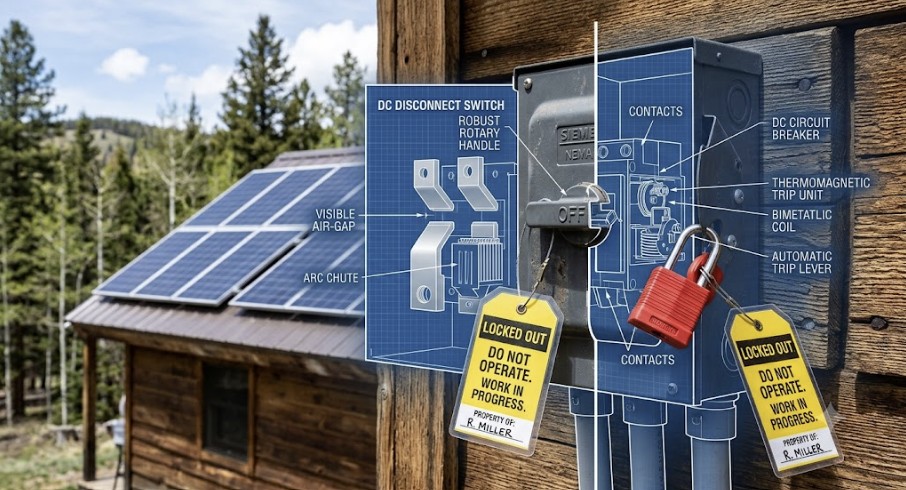
A true disconnect switch, often called a safety switch, is engineered to provide a “visible break.” This means you can physically verify, often through a small window or by the position of a blade, that the electrical contacts are separated by a significant air gap. This visual confirmation is the gold standard for electrical safety, as it eliminates the risk of a mechanically failed breaker that appears open but is internally welded shut. Most standard DC circuit breakers do not offer this feature. Furthermore, while breakers can be switched manually, they are not intended for the repeated, deliberate operation of a disconnect. The best solar disconnect switch for cabins is built for this manual isolation task, ensuring reliable mechanical action over decades of service.
The Physics of Isolation: Disconnect Switch vs. DC Circuit Breaker
From an engineering standpoint, these devices serve fundamentally different purposes. A DC circuit breaker is a thermomagnetic device. It uses a bimetallic strip that bends with heat (overload) and an electromagnet that trips instantly with high current (short circuit) to automatically open a circuit. Its purpose is to protect wiring and equipment.
A solar disconnect switch is a robust mechanical device designed for manual operation. Its key safety feature is Lockout/Tagout (LOTO) compliance, a requirement under OSHA and a best practice for any electrical work. This allows a padlock to be physically attached to the switch handle, preventing anyone from accidentally re-energizing the circuit while you are working on it. While some breakers have LOTO provisions, they are often less robust and not the primary design focus. A proper disconnect switch is the cornerstone of a safe work procedure, a topic we will cover in detail. Choosing the best solar disconnect switch for cabins means prioritizing this explicit safety function.
NEC Article 690: Code Requirements for Cabin Solar Systems
The National Electrical Code (NEC), specifically Article 690 for solar photovoltaic (PV) systems, is the law of the land for electrical installations, and its principles apply even if your off-grid cabin is not subject to formal inspection. Adhering to the NEC is the ultimate best practice for safety. Several sections are critical for disconnects:
- NEC 690.13 (Building or Structure Disconnecting Means): This requires a readily accessible disconnect to shut down the PV system conductors where they enter the building. The goal is to give homeowners and first responders a single, clear point to de-energize the solar array from the outside.
- NEC 690.15 (Equipment Disconnecting Means): This mandates that equipment like inverters and charge controllers must have a means of disconnection from all ungrounded conductors of all sources. This disconnect must be “within sight” of the equipment (visible and not more than 50 feet away) or be capable of being locked in the open position. This is your maintenance switch.
For a typical cabin, this means you need at least two primary disconnects: one for the solar array conductors entering the structure, and one between the battery bank and the main inverter. A generator input will also require its own disconnect. Following these code requirements is essential when specifying the best solar disconnect switch for cabins.
Decoding the Engineering Specs: How to Choose the Best Solar Disconnect Switch for Cabins
Selecting the appropriate disconnect switch is a process of precise electrical calculation and environmental assessment. Choosing an undersized or improperly rated switch is not a cost-saving measure; it is a catastrophic failure waiting to happen. The DC environment, especially from a solar array, is unforgiving. Unlike AC power which crosses zero volts 120 times per second (making it easier to extinguish an arc), DC power is a constant force. Attempting to interrupt a DC circuit with an underrated switch can create a sustained plasma arc, a phenomenon akin to a small lightning bolt, that can melt steel and cause a fire.
Voltage Rating (VDC): The Most Critical Parameter
The DC voltage rating is the single most important specification and must never be compromised. The switch’s voltage rating must be greater than the maximum possible system voltage of your solar array. This is not the nominal voltage (e.g., 12V, 24V, 48V) but the array’s maximum Open-Circuit Voltage (Voc), adjusted for cold temperatures.
Solar panel voltage increases as temperature drops. The NEC provides a formula in Table 690.7(A) to calculate this. You must find the panel’s Voc on its data sheet and the record low temperature for your cabin’s location.
Calculation Example:
- Panels: 3 x 400W panels in series.
- Panel Voc (at 25°C): 49.5V.
- Array Voc at 25°C: 3 x 49.5V = 148.5V.
- Record Low Temp for Cabin: -20°C (-4°F).
- NEC Correction Factor for -20°C: 1.14.
- Maximum System Voltage: 148.5V x 1.14 = 169.3V.
In this scenario, a 150VDC-rated disconnect is insufficient and dangerous. You must select a switch with the next standard rating up, which is typically 250VDC or 600VDC. Always choose a switch explicitly rated for DC voltage. Using an AC-rated switch in a DC circuit is a severe safety violation. As stated in the National Electrical Code (NEC) Section 690, equipment must be identified for its specific use. An AC switch has not been tested or designed to safely extinguish a DC arc.
Current Rating (Amps): Sizing for Safety and Performance
The continuous current rating of the disconnect must be sized to handle the maximum possible current from the solar array. The NEC has a two-part safety factor for this calculation, which totals to a multiplier of 1.56.
NEC Sizing Formula: Required Ampacity = Panel Short-Circuit Current (Isc) x 1.25 (for enhanced irradiance) x 1.25 (for continuous duty).
Calculation Example:
- Panels: 2 parallel strings of 3 panels each.
- Panel Isc: 10.5A.
- Array Isc: 2 strings x 10.5A = 21.0A.
- Required Ampacity: 21.0A x 1.56 = 32.76A.
You must select a disconnect with the next standard rating, which would be 40A or 60A. Undersizing the current rating will lead to overheating, premature failure, and a potential fire hazard. This calculation is a critical step in identifying the best solar disconnect switch for cabins. For more detailed guidance, our solar panel to LiFePO4 battery sizing guide provides in-depth calculations.
Load-Break vs. Non-Load-Break (Isolator) Switches
This specification is critical for safety. A “load-break” rated disconnect is designed with internal arc chutes and mechanisms to safely extinguish the DC arc that is formed when opening the switch while current is flowing (i.e., under load). A “non-load-break” switch, also known as an isolator, is not designed for this. Opening an isolator under load can draw a dangerous arc that could destroy the switch and cause injury.
For any solar application, a load-break rated switch is the only safe choice. Your cabin system will be producing power during the day, and you may need to disconnect it for maintenance or in an emergency. You cannot guarantee the system will be unloaded when you operate the switch. Therefore, the best solar disconnect switch for cabins must always be load-break rated.
Enclosure Ratings: NEMA 3R vs. NEMA 4X for Cabin Environments
The enclosure protects the switch mechanism from the environment. The rating you choose depends on where the disconnect will be mounted.
- NEMA 3R: This rating means the enclosure is weather-resistant. It protects against falling rain, sleet, snow, and external ice formation. It is suitable for most outdoor cabin installations, especially if mounted under an eave or in a somewhat protected location.
- NEMA 4X: This is a higher level of protection. It is watertight, dust-tight, and corrosion-resistant. The “X” signifies corrosion resistance, often achieved with stainless steel or heavy-duty polymer construction. A NEMA 4X enclosure is necessary for cabins in harsh environments, such as coastal areas with salt spray, or locations with high levels of dust or exposure to corrosive materials.
For most cabin owners, a NEMA 3R enclosure is sufficient and more cost-effective. However, if your cabin faces extreme weather, a NEMA 4X is a wise investment in reliability. Understanding this difference is key to finding the best solar disconnect switch for cabins that will last.
Fused vs. Non-Fused Disconnects
A disconnect switch can be either fused or non-fused. A fused disconnect combines the manual isolation switch and overcurrent protection (fuses) into a single enclosure. This can simplify wiring and reduce the number of components in your system. A non-fused disconnect provides only the switching function, and you must install a separate fuse or circuit breaker upstream for overcurrent protection.
For the main PV array disconnect, a fused switch is often an excellent choice, as it can serve as both the NEC-required disconnect and the overcurrent protection device (OCPD) for the array wiring. For a battery-to-inverter disconnect, a non-fused switch is typically used, with a separate, large Class-T fuse or ANL fuse providing the overcurrent protection for the high-current battery cables.
System Architecture: Where to Install Disconnect Switches in Your Cabin’s Solar Setup
Proper placement of disconnects is just as important as proper sizing. Each major segment of your solar electrical system requires a point of isolation to ensure safety and allow for targeted maintenance. A well-designed system will have multiple disconnects, each clearly labeled with its function. This systematic approach is the hallmark of a professional installation and is vital when determining the placement of the best solar disconnect switch for cabins.
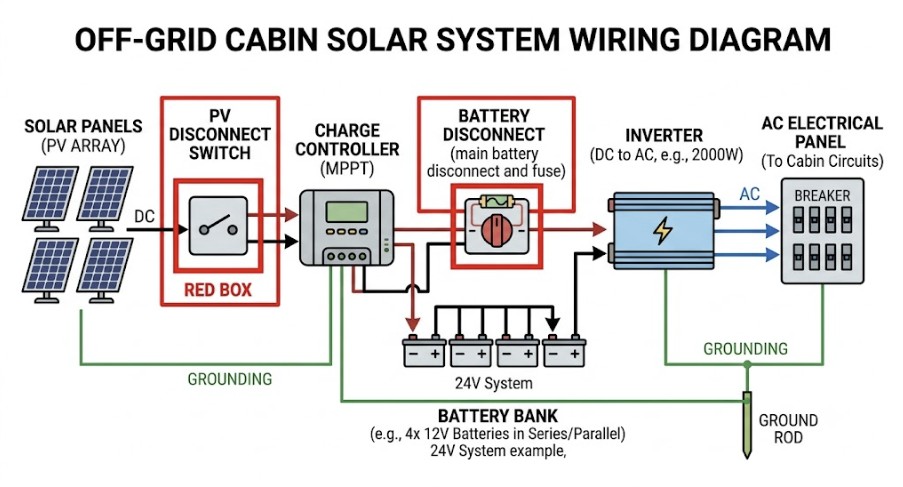
1. PV Array to Charge Controller/Inverter Disconnect: This is arguably the most important disconnect. It isolates the entire solar array, your power generation source, from the rest of the system. It must be located as close as practicable to the point where the array conductors enter the cabin, as required by NEC 690.13. It should be readily accessible on the exterior of the cabin. This switch is sized based on the array’s temperature-corrected Voc and 1.56 times its Isc.
2. Battery to Inverter Disconnect: This disconnect is crucial for any maintenance on your inverter or main DC bus bars. The battery bank is the most powerful and potentially dangerous part of your system. This switch allows you to safely isolate the inverter from the massive short-circuit current a battery bank can deliver. It is typically a heavy-duty, non-fused disconnect rated for high amperage (e.g., 200A, 400A) and is sized based on the inverter’s maximum continuous power draw. It must be paired with a catastrophic fuse (like a Class T fuse) located as close to the battery positive terminal as possible.
3. Inverter to AC Panel Disconnect: While your off-grid cabin electrical panel will have a main breaker, an additional disconnect for the inverter’s AC output can be beneficial. It provides a clear point of isolation between the power source (inverter) and the cabin’s AC loads, simplifying any work on the AC panel itself. Often, a back-fed breaker in the main panel with a breaker retainer clip can serve this purpose if properly labeled.
4. Generator Input Disconnect: If your cabin uses a backup generator, an AC disconnect at the generator input is mandatory. This is part of the generator interlock system, ensuring that the generator and the inverter can never supply power to the AC panel at the same time, preventing dangerous back-feeding that could destroy your inverter. Selecting a robust generator is also key; consult our guide on off-grid cabin generator sizing for details.
Engineer’s Top Picks: The 5 Best Solar Disconnect Switch for Cabins in 2024
Here are five carefully selected disconnect switches that meet the rigorous demands of off-grid cabin life. These selections cover a range of system sizes, budgets, and environmental conditions, ensuring there is a professional-grade option for every application. Each one is a candidate for the best solar disconnect switch for cabins, depending on your specific system architecture.
1. MidNite Solar MNPV6 Combiner/Disconnect
Engineering Analysis: The MidNite MNPV series is the industry standard for small to medium-sized off-grid systems. The MNPV6 is not just a disconnect; it’s a versatile combiner box that can hold up to six 150VDC DIN rail breakers or four 600VDC fuse holders. This integration simplifies wiring immensely. Its gray aluminum NEMA 3R enclosure is rainproof and durable. For a cabin with up to four parallel solar strings, this unit consolidates fusing, combining, and disconnecting into one safe, compact package. It allows you to build a clean, code-compliant array-side solution without multiple enclosures.
Ideal Application: The best solar disconnect switch for cabins with arrays up to 4 parallel strings and system voltages up to 600VDC. Perfect for the owner who values integration and a clean installation.
[Check Price for MidNite Solar MNPV6 on Amazon]
Check current price on Amazon –>
2. Schneider Electric QBL22225 Heavy Duty Safety Switch
Engineering Analysis: This is a quintessential, no-nonsense safety switch. The Schneider QBL22225 is a 60-Amp, 2-Pole, 240VAC/250VDC non-fused disconnect in a rugged NEMA 3R enclosure. While its AC rating is prominent, it carries a legitimate 250VDC rating, making it suitable for many cabin solar arrays (always verify the maximum Voc of your specific array). Its visible blade design allows for absolute certainty that the circuit is open. The mechanism is heavy-duty and satisfying to operate, and the enclosure has ample room for wiring. It’s a workhorse built for decades of reliable service.
Ideal Application: A superb choice as a main PV disconnect for a single-string array or as a battery-to-inverter disconnect in a smaller 12V or 24V system where a 60A rating is sufficient.
[Check Price for Schneider Electric QBL22225 on Amazon]
Check current price on Amazon –>
3. Siemens HNF362R Heavy Duty Safety Switch
Engineering Analysis: When you need a higher voltage rating, the Siemens HNF362R is a top contender. This is a 60-Amp, 3-Pole, 600VDC fused safety switch. Its NEMA 3R enclosure is robust, and the visible blade design with a side-mounted handle provides excellent safety feedback. Being a fused switch, it provides both isolation and overcurrent protection in one unit. The 600VDC rating makes it suitable for nearly any residential-scale off-grid array, providing a huge safety margin. The three-pole design can be used for switching both the positive and negative conductors in a DC circuit, with the third pole unused or for other applications.
Ideal Application: An excellent, high-quality fused disconnect for solar arrays with maximum Voc up to 600V. This is a professional-grade solution for larger, higher-voltage cabin systems and is often considered the best solar disconnect switch for cabins where safety margins are a top priority.
[Check Price for Siemens HNF362R on Amazon]
Check current price on Amazon –>
Installation & Safety Protocols: Executing a Code-Compliant Installation
Owning the best solar disconnect switch for cabins is only half the battle; installing it correctly and using it safely is what truly protects you and your property. A sloppy installation can negate the safety features of even the highest quality component. Adherence to established protocols is not optional.
Lockout/Tagout (LOTO) Procedures: Your Most Important Safety Habit
Before any work is done on your electrical system, the relevant disconnects must be shut off, locked, and tagged. LOTO is a formal safety procedure that ensures a circuit cannot be accidentally re-energized.
- Turn Off: Operate the disconnect handle to the “OFF” position.
- Lockout: Place a padlock through the designated hole in the handle mechanism. This physically prevents it from being turned back on. You should be the only person with a key to your lock.
- Tagout: Attach a “DANGER – DO NOT OPERATE” tag to the lock, with your name and the date.
- Verify: Use a quality multimeter to test the load-side terminals of the switch to confirm there is zero voltage. Never assume.
This simple, life-saving procedure must become second nature. For more information, refer to the official OSHA standard on The Control of Hazardous Energy.
Mounting, Accessibility, and Clearances
The NEC requires disconnects to be “readily accessible,” which means they can be reached quickly without using a ladder or moving obstacles. Mount your disconnects at a comfortable working height, typically with the handle center between 4.5 and 6.5 feet from the ground. Ensure there is adequate working clearance in front of the switch—a clear space at least 36 inches deep and 30 inches wide—as required by NEC 110.26.
Wiring and Torque Specifications
Use the correct wire size for the amperage of the circuit. A common cause of failure is loose connections. Every terminal screw on a disconnect switch has a specific torque value, measured in inch-pounds (in-lbs), specified by the manufacturer. Use a calibrated torque wrench or torque screwdriver to tighten every connection to its specified value. This prevents overheating from a loose connection and damage from an over-tightened one. Calculating proper wire size is also crucial to avoid issues, as detailed in our solar panel size and voltage drop guide.
Labeling for Clarity and Safety
Every disconnect in your system must have a permanent, weatherproof label that clearly identifies its function. Use an industrial label maker. Examples include: “PV ARRAY DISCONNECT,” “BATTERY-INVERTER DISCONNECT,” or “GENERATOR INPUT.” In an emergency, or for someone unfamiliar with your system, this clear labeling can prevent a dangerous mistake and is required by the NEC. This simple step is a critical part of installing the best solar disconnect switch for cabins.
Can a DC circuit breaker be used as the best solar disconnect switch for cabins?
No, a standard DC circuit breaker should not be used as a primary safety disconnect. The main reason is the lack of a “visible break.” A disconnect switch allows you to physically see that the contacts are separated by an air gap, guaranteeing isolation. A circuit breaker can fail internally in a closed (welded) state while its handle appears to be off. Additionally, disconnect switches are designed for manual operation and robust Lockout/Tagout procedures, which are critical for maintenance safety according to OSHA standards. While a breaker provides overcurrent protection, the best solar disconnect switch for cabins provides verifiable manual isolation, a fundamentally different and non-negotiable safety function as outlined in NEC 690.13 and 690.15.
How does extreme cold or heat affect my solar disconnect switch sizing?
Temperature has a significant impact. For voltage, extreme cold is the primary concern. As temperatures drop, a solar panel’s open-circuit voltage (Voc) increases. You must use the NEC 690.7 temperature correction factor based on the record low temperature for your location to calculate the maximum possible system voltage. Your disconnect’s VDC rating must exceed this calculated value. For current, extreme heat is the concern. Disconnect switches, like all electrical equipment, are de-rated for operation in high ambient temperatures. If your disconnect is mounted in direct sun in a hot climate, its effective continuous current capacity is reduced. You may need to choose a switch with a higher amperage rating than your calculations suggest to compensate for this thermal de-rating.
What is a DC arc flash and is it a real risk in a cabin solar system?
A DC arc flash is an electrical explosion caused by a massive release of energy when a fault occurs in a DC circuit. It is an extremely dangerous and very real risk. Unlike AC arcs that tend to self-extinguish, DC arcs are sustained and can create temperatures exceeding 35,000°F, vaporizing copper and creating a deadly plasma blast. This can happen if you attempt to open a non-load-break-rated switch under load or if a tool shorts across high-voltage DC terminals. Even a seemingly small 48V cabin system can produce a dangerous arc. Using the best solar disconnect switch for cabins, which is properly load-break rated and sized for the system voltage, is your primary defense against initiating an arc flash during operation.
Do I need a fused or non-fused disconnect for my main PV array?
For the main PV array, a fused disconnect is often an excellent and efficient choice. It combines the required overcurrent protection device (OCPD) and the disconnect switch into a single, code-compliant enclosure. The fuses are sized to protect the wiring from the array. This simplifies the installation, reduces the number of components, and provides a clear, single point of isolation and protection. A non-fused disconnect is also acceptable, but you would then be required to install a separate fuse block or circuit breaker box between the array and the disconnect switch to meet NEC requirements for overcurrent protection.
How is the battery-to-inverter disconnect sized differently from the PV disconnect?
They are sized based on entirely different criteria. The PV disconnect is sized based on the solar array’s potential output: its maximum voltage (temperature-corrected Voc) and maximum current (Isc x 1.56). The battery-to-inverter disconnect is sized based on the inverter’s maximum continuous input current. You calculate this by taking the inverter’s wattage rating (e.g., 4000W), dividing by the lowest operating battery voltage (e.g., 42V for a 48V bank), and adding a safety factor (typically 1.25x for continuous duty). The amperage here is much higher than the PV side, often requiring a 200A or 400A disconnect switch. This is why selecting the best solar disconnect switch for cabins involves analyzing each specific location in the system.
Is a 600VDC-rated disconnect necessary for a 48V nominal cabin system?
It depends entirely on the solar array configuration, not the battery’s nominal voltage. A 48V system can easily have a solar array with a maximum Voc exceeding 150V or even 200V, especially in cold weather. For example, four 400W panels in series could have a temperature-corrected Voc over 220V. In this case, a 250VDC or 600VDC disconnect is required. Using a 600VDC switch provides a massive safety margin and future-proofs your system if you decide to add more panels in series later. The cost difference is often minimal compared to the absolute safety guarantee it provides. The best solar disconnect switch for cabins is one that comfortably exceeds the maximum calculated voltage.
What is the difference between a 2-pole and 3-pole disconnect switch for a DC circuit?
In a simple DC solar circuit, you have a positive (+) and a negative (-) conductor. A 2-pole disconnect switch has two sets of contacts and terminals, allowing you to simultaneously switch both the positive and negative lines, which is a common practice for completely isolating a circuit. A 3-pole switch has three sets of contacts. For a DC circuit, you can use two of the three poles to switch the positive and negative, leaving the third pole unused. Sometimes, installers wire the positive or negative conductor through two poles in series to increase the arc-breaking capability, but this should only be done if specified by the manufacturer.
My cabin power system is inside a shed. Does the disconnect need to be outdoors?
According to NEC 690.13, a PV system disconnect must be “readily accessible” and is often located on the exterior of the structure where the PV conductors enter. This is primarily for first responder access in an emergency. If your entire power system is in a detached shed, the primary PV disconnect should be mounted on the outside of that shed near the point of entry. You will then have your equipment disconnects (e.g., battery-to-inverter) inside the shed, within sight of the equipment they protect. Placing the main shutdown switch on the exterior is a critical safety feature.
Do I need a disconnect switch for a small, portable solar generator or power station?
For a self-contained, portable power station where the solar panels plug directly into the unit with standard connectors like MC4, a hard-wired disconnect switch is generally not required. The act of unplugging the solar panel connector serves as the disconnecting means. However, if you are creating a more permanent installation where solar panels are mounted on a roof and their wires are run through walls into your cabin to charge a “portable” power station, then yes, you absolutely need a proper, hard-wired DC disconnect switch. As soon as you transition from a temporary, portable setup to a permanent wiring installation, all NEC rules for fixed installations apply.
What does “visible blade” mean on a safety switch?
“Visible blade” is a design feature in many high-quality safety switches that directly addresses the “visible break” safety principle. When you open the door of the disconnect enclosure, you can physically see the copper or aluminum blades of the switch pivot away from the energized line-side contacts. This provides irrefutable visual confirmation that the circuit is open and physically disconnected. It’s a premium safety feature that eliminates any doubt about the switch’s status, which is why many professional engineers consider it a key attribute of the best solar disconnect switch for cabins.
Can I use an AC disconnect switch for my generator input?
Yes, absolutely. Since the generator’s output is standard AC power (e.g., 120/240V AC), a standard AC-rated heavy-duty safety switch is the correct component to use. It should be sized to handle the generator’s maximum current output. For example, a 7,500-watt generator at 240V produces about 31 amps, so a 40A or 60A AC disconnect would be appropriate. This disconnect is a critical part of a safe generator connection, ensuring power is isolated during maintenance and preventing back-feeding when used with an interlock kit on your cabin’s AC panel.