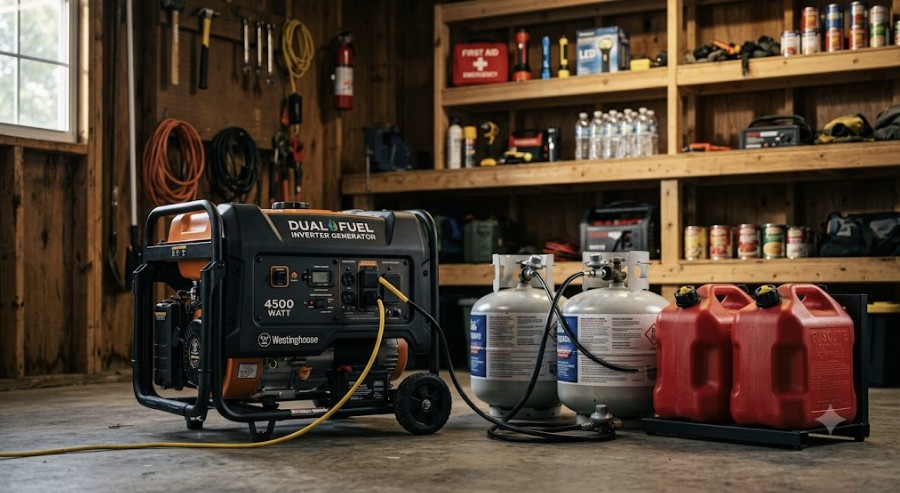
In a true grid-down, “SHTF” (Shit Hits The Fan) scenario, your ability to generate reliable, quiet, and efficient power is a non-negotiable survival metric. Many preppers default to loud, inefficient open-frame contractor generators, a mistake that broadcasts your position and depletes precious fuel reserves. The optimal solution is a modern inverter generator, a piece of equipment that is fundamentally superior for long-term operational security and resource management.
This guide moves beyond basic recommendations and dives into the core engineering principles that define the best inverter generator for SHTF. We will analyze fuel logistics, power quality, noise discipline, and the critical calculations you must perform before making a purchase. This is the definitive technical manual for securing your power independence when it matters most.
Table of Contents
Why Inverter Technology is Essential for SHTF Survival
The distinction between a conventional generator and an inverter generator is not trivial; it is a fundamental difference in electrical engineering that has profound implications for a survival scenario. A conventional generator’s engine is mechanically locked to a specific RPM (typically 3600 RPM) to produce 60 Hz AC power. This is mechanically simple but incredibly inefficient and loud, especially under light loads.
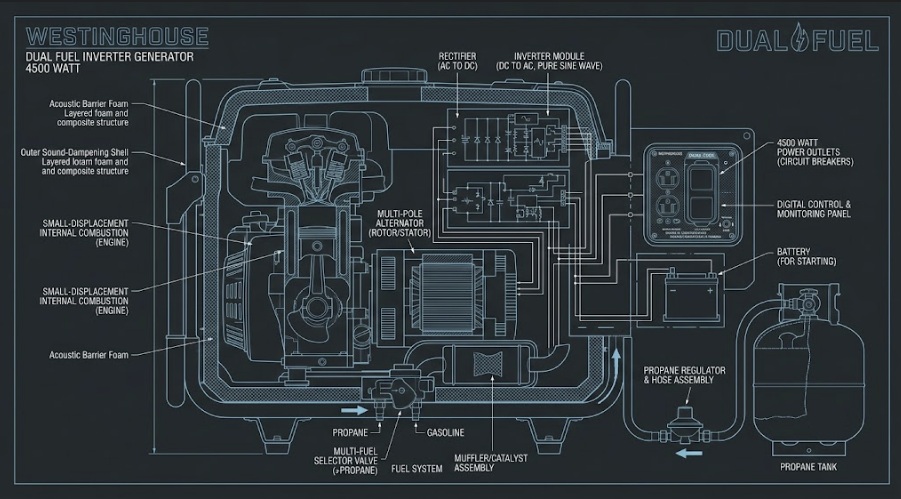
Inverter generators employ a more sophisticated, multi-stage process. The engine generates high-frequency AC power, which is then converted to DC, and finally “inverted” back into a perfectly stable, clean sine wave 60 Hz AC power. This electronic decoupling allows the engine’s speed to vary based on the electrical load, a feature often called “Eco Mode.” For SHTF, this is a game-changer for two primary reasons: fuel efficiency and noise reduction.
Fuel Efficiency and Operational Endurance
Fuel is a finite resource in a grid-down world. The ability of an inverter generator to throttle down its engine speed under light loads can extend its runtime by 30-50% compared to a conventional model powering the same load. This means your stored gasoline or propane will last significantly longer, extending your operational endurance.
Consider powering only a small freezer and some communication equipment overnight, a load of perhaps 400-500 watts. A conventional 5000W generator will run at a full 3600 RPM, burning fuel as if it’s under a much heavier load. The best inverter generator for SHTF will slow its engine to a quiet, low-speed hum, sipping fuel and dramatically extending the time between refueling.
Noise Discipline and Tactical Advantage
In a long-term emergency, noise is a liability. A loud generator is a beacon, signaling to others that you have resources like power, food, and fuel. Operational security demands stealth. Inverter generators are housed in sound-dampening enclosures and, thanks to their variable speed operation, are vastly quieter than their open-frame counterparts.
The difference is stark. A typical open-frame generator operates at 70-80 decibels (dB), comparable to a busy city street. A quality inverter generator can run as low as 50-60 dB under a 25% load, the level of a quiet conversation. This reduction is critical for maintaining a low profile.
| SHTF Metric | Inverter Generator | Conventional Generator |
|---|---|---|
| Noise Level (25% Load) | 50-60 dB (Stealthy) | 70-80 dB (Loud Beacon) |
| Fuel Efficiency | Excellent (Variable RPM) | Poor (Fixed 3600 RPM) |
| Power Quality (THD) | <3% (Safe for Electronics) | >10% (Risk to Electronics) |
| Portability | High (Compact Design) | Low (Bulky Open Frame) |
Engineering Criteria for Selecting the Best Inverter Generator for SHTF
Choosing the right unit requires a systematic evaluation of key engineering parameters. Your survival plan, location, and power requirements will dictate the ideal balance of these features. Do not just look at the maximum wattage; analyze the complete system.
Critical Fuel Strategy: Dual-Fuel and Tri-Fuel Capability
The single most important feature for a SHTF generator is fuel flexibility. While gasoline is ubiquitous, it has a short shelf life of only 3-6 months without stabilizers. Propane (LPG), however, is the ultimate survival fuel; it never goes bad. It is stored in a sealed, stable container and can be safely stockpiled for decades.
A dual-fuel generator that can run on both gasoline and propane provides maximum logistical advantage. You can use readily available gasoline for short-term needs while preserving your long-term propane reserve. This flexibility is the cornerstone of a resilient off-grid power strategy. Tri-fuel models that add natural gas capability are less critical for mobile or bug-out scenarios but can be valuable for home bug-in plans where a natural gas line is present, though its availability in a widespread disaster is not guaranteed.
Power Sizing: A Brutal Lesson in Electrical Math
Under-sizing your generator is a critical failure. You must calculate both running watts (the continuous power your loads require) and starting watts (the momentary surge required by motors in appliances like refrigerators and well pumps). The starting wattage, also known as Locked Rotor Amps (LRA), can be 3-5 times the running wattage.
First, list every essential device. A proper off-grid cabin generator sizing calculation is mandatory. Your goal is to run essential loads, not replicate a grid-tied lifestyle. Prioritize refrigeration, communications, lighting, and, if applicable, a well pump.
| SHTF Appliance | Typical Running Watts | Estimated Starting Watts |
|---|---|---|
| Chest Freezer (15 cu. ft.) | 150 – 200 W | 1200 – 1500 W |
| Refrigerator (20 cu. ft.) | 200 – 400 W | 1500 – 2000 W |
| 1/2 HP Well Pump (120V) | 800 – 1000 W | 2500 – 3000 W |
| Radio/Comms Gear | 50 – 100 W | ~100 W |
| LED Lighting (5 bulbs) | 50 W | 50 W |
| Charging LiFePO4 Battery Bank | 500 – 1500 W (Variable) | N/A |
Your generator’s peak wattage must exceed the single largest starting wattage plus the running wattage of all other concurrent loads. A generator in the 3500-4500 peak watt range is often the sweet spot for balancing power, portability, and fuel efficiency.
EMP Hardening and Electrical Resilience
While a direct EMP (Electromagnetic Pulse) event is a low-probability, high-impact threat, basic hardening is prudent. The solid-state electronics in an inverter generator are its primary vulnerability. The best inverter generator for SHTF should be stored in a protective enclosure when not in use.
A simple and effective method is to use nested Faraday cages or military-grade EMP bags. This involves placing the generator inside a conductive mesh bag or container, which is then placed inside a larger, insulated container. According to standards like MIL-STD-188-125-1, proper shielding can effectively shunt the harmful induced currents from an EMP, protecting the sensitive inverter board and controller.
Top Rated Models: The Best Inverter Generator for SHTF
Our selections are based on a rigorous analysis of fuel type, power output, noise level, reliability, and real-world user data. These are not simply the most popular models, but the ones that best meet the strict criteria for a long-term survival scenario.
1. Champion 4500-Watt Dual Fuel RV Ready Inverter Generator
The Champion 4500 stands out as a near-perfect balance of features for SHTF preparedness. Its dual-fuel capability is paramount, offering the strategic advantage of long-term propane storage. With 4500 starting watts and 3500 running watts, it has sufficient power to start a mid-size refrigerator or freezer while handling other essential loads. Its noise level of 61 dBA is manageable, and its enclosed design provides good portability.
- Pros: Dual-fuel (gasoline/propane) is a massive strategic advantage. Good power output for its size. Electric start is a welcome convenience. Parallel capable to double your power.
- Cons: Heavier than 2000W-class models. At 61 dBA, it’s not the absolute quietest option available.
[Check Price for Champion 4500-Watt Dual Fuel Inverter Generator on Amazon]
2. Honda EU2200i Super Quiet Inverter Generator
When absolute stealth and reliability are the top priorities, the Honda EU2200i is the undisputed leader. Operating at an astonishingly low 48 to 57 dBA, it is virtually undetectable from a short distance. While its 2200 starting watts limit it to smaller loads (it will struggle with a large fridge or well pump), it is the gold standard for powering sensitive electronics, communication gear, and small appliances with unmatched fuel efficiency and legendary reliability. It’s the ideal choice for a low-profile bug-out or for those prioritizing operational security above all else.
- Pros: Exceptionally quiet, setting the industry benchmark. Incredibly fuel-efficient on Eco-Throttle. Lightweight and highly portable. Unmatched reputation for engine longevity.
- Cons: Gasoline only. Limited power output cannot handle large startup loads. Premium price point.
[Check Price for Honda EU2200i Inverter Generator on Amazon]
3. Westinghouse WGen9500DF Dual Fuel Inverter Generator
For preppers with substantial power needs, such as running a well pump, multiple freezers, or a small cabin, the Westinghouse WGen9500DF is a formidable choice. It delivers a massive 12,500 peak watts and 9,500 running watts, enough for most home essentials. Crucially, it is a dual-fuel model, allowing you to leverage propane stockpiles. While it is larger and less portable, its raw power and fuel flexibility make it a top contender for a fixed-location, bug-in strategy.
- Pros: Immense power output can run demanding 240V loads like well pumps. Dual-fuel capability is essential for long-term scenarios. Includes remote electric start and a transfer switch-ready outlet.
- Cons: Very heavy (over 200 lbs) and not easily portable. Higher fuel consumption than smaller models. Louder than compact inverters.
[Check Price for Westinghouse WGen9500DF Dual Fuel Inverter Generator on Amazon]
Advanced SHTF Power System Integration
A generator is a component of a larger resilience strategy, not a standalone solution. For ultimate efficiency, integrate your generator into a solar and battery-based power system. This allows you to run the generator for only a few hours per day to recharge a large LiFePO4 battery bank, and then power your loads silently from the battery overnight.
This hybrid approach drastically reduces fuel consumption, engine wear, and your noise signature. However, be aware of the complexities. Some generators can have issues properly charging modern lithium batteries due to their voltage and current demands. You must ensure your system’s charge controller is compatible with the generator’s output, a topic we cover in our guide to what to do when a generator is not charging a lithium battery. An appropriately sized solar battery for a cabin can store enough energy to last through the night, making the generator a supplementary charging source rather than a primary power supply.
Safety Protocols: Mitigating the Silent Killers
Generator operation carries inherent risks that are magnified in a SHTF scenario where emergency services are unavailable. The primary threat is Carbon Monoxide (CO), an odorless, colorless gas produced by combustion that is lethal in enclosed spaces.
Adherence to safety codes, such as those outlined by the National Fire Protection Association (NFPA), is not optional. Your generator must *always* be operated outdoors, at least 20-25 feet away from any building, with the exhaust pointing away from all doors, windows, and vents. A battery-operated CO detector is a mandatory piece of safety equipment for any location near a running generator. Proper fuel storage is also critical; store gasoline in approved containers away from ignition sources and living spaces.
Frequently Asked Questions
How long can the best inverter generator for SHTF run continuously?
The continuous runtime of the best inverter generator for SHTF is limited by two factors: fuel capacity and engine oil life. Most portable inverter generators have fuel tanks that allow for 8 to 12 hours of operation at a 25-50% load. You could theoretically run it longer by refueling, but you must shut down the engine and allow it to cool before doing so to prevent a fire hazard. The more critical engineering limit is engine oil. Small air-cooled engines in these generators typically require an oil change every 50 to 100 hours of operation. Running an engine beyond this interval risks severe mechanical damage and failure, which would be catastrophic in a survival situation. Therefore, a practical continuous run cycle should not exceed 24-48 hours before you plan for a maintenance shutdown to check and potentially change the oil, making a stockpile of appropriate engine oil a critical prep.
What is the best fuel to stockpile for a SHTF generator?
Propane is, without question, the superior fuel for long-term SHTF stockpiling. Its chemical stability is its greatest asset; stored in a sealed tank, propane has an indefinite shelf life and will not degrade, gum up, or stratify like gasoline. Gasoline begins to degrade in as little as 3-6 months, and even with fuel stabilizers, its reliability diminishes after a year. This makes propane the ideal “set it and forget it” fuel reserve. For this reason, selecting the best inverter generator for SHTF heavily favors dual-fuel models that can utilize propane. This allows you to use more accessible but perishable gasoline for immediate or short-term needs while preserving your multi-year propane stockpile for a prolonged grid-down event.
Can an inverter generator survive an EMP attack?
An unprotected inverter generator is highly vulnerable to an Electromagnetic Pulse (EMP) due to its sensitive solid-state electronics, including the inverter module, controller board, and voltage regulator. A high-altitude EMP (HEMP) event induces powerful electrical currents that would likely destroy these components. To ensure survival, the generator must be stored in a Faraday cage or a certified EMP protection bag when not in use. These enclosures work by creating a conductive shield that intercepts the electromagnetic energy and shunts it around the protected contents. Simply having a generator is not enough; the best inverter generator for SHTF is one that you have taken proactive measures to harden against this specific, high-impact threat.
How do I calculate my fuel needs for a one-month SHTF scenario?
Calculating fuel needs requires a precise understanding of your expected daily load and generator runtime. First, determine your essential watt-hours per day (e.g., running a freezer for 8 hours, lights for 4 hours, comms for 2 hours). Next, consult your generator’s specifications for its fuel consumption rate, typically given in gallons per hour (gal/hr) at 25% and 50% load. Let’s say your generator uses 0.15 gal/hr at 25% load, and you plan to run it for 6 hours a day to power essentials and recharge batteries. The calculation is: 0.15 gal/hr * 6 hours/day * 30 days = 27 gallons of gasoline for the month. For propane, the consumption rate is different (approx. 1 lb/hr for a 2000W load), so you would calculate pounds needed. Always add a 25-50% surplus to your calculation for unexpected needs. This data-driven approach is essential for planning to have the best inverter generator for SHTF fully supported.
Is a dual-fuel model truly the best inverter generator for SHTF?
From a strategic and logistical standpoint, yes. The flexibility offered by a dual-fuel inverter generator is a massive force multiplier in a survival context. It removes the single point of failure associated with relying on only one type of fuel. In an extended crisis, gasoline may be scavenged or found, but its poor shelf-life makes it unreliable for storage. Propane is the opposite: difficult to find post-event but perfect for pre-event stockpiling. A dual-fuel model allows you to leverage both advantages, using whatever fuel is most practical at the moment. This adaptability is the core reason why a dual-fuel unit is almost always the best inverter generator for SHTF over a gasoline-only equivalent.
What is more important in a SHTF generator: power output or low noise?
This is a critical trade-off that depends on your specific survival plan. For a bug-in scenario in a remote, rural area, higher power output to run a well pump and multiple freezers might take precedence over absolute silence. However, for suburban or bug-out scenarios, noise discipline is paramount for operational security. A loud generator attracts unwanted attention, which can be more dangerous than the power outage itself. The ideal solution is a balance: an inverter generator in the 3500-4500 watt range often provides enough power for core essentials while operating at a reasonably quiet 55-65 dB. Ultimately, the best inverter generator for SHTF for your situation is the one that best aligns with your threat model and environment.
Can I connect the best inverter generator for SHTF directly to my house wiring?
Absolutely not. Connecting a generator directly to your house wiring via a “suicide cord” (a double-male-ended extension cord) is illegal, extremely dangerous, and can result in a practice called “back-feeding.” Back-feeding sends electricity back into the utility lines, which can electrocute line workers attempting to restore power. The only safe and correct way to connect a generator to your home’s circuits is through a professionally installed transfer switch. This device completely isolates your home from the grid before engaging the generator’s power, preventing back-feeding. Your off-grid cabin electrical panel must be set up with this safety feature in mind.
How does cold weather affect the performance of an inverter generator?
Cold weather presents several engineering challenges for inverter generators. First, engine oil viscosity increases, making the engine harder to start. Using the correct weight of oil as specified by the manufacturer for cold temperatures (e.g., 5W-30) is crucial. Second, battery performance for electric start models degrades significantly in the cold. Keep the battery warm if possible or be prepared to use the recoil starter. Third, propane has difficulty vaporizing in very low temperatures (below 0°F), which can cause fuel delivery problems. Keeping the propane tank slightly warmer than the ambient air can help, but gasoline is often more reliable in extreme cold. The best inverter generator for SHTF in a northern climate should be maintained with these factors in mind.
What is “parallel capability” and why is it useful for a SHTF generator?
Parallel capability is a feature that allows you to connect two identical inverter generators together with a special cable to double your available power output. For example, connecting two 2200W generators gives you 4400W of peak power. This offers incredible modularity and redundancy. You can run a single generator for light loads to save fuel, and then fire up the second one only when you need to power a larger appliance. It also provides a backup; if one generator fails, you still have the other. This redundancy makes a parallel-capable system a strong contender for the best inverter generator for SHTF strategy, as it mitigates the risk of a single point of failure.
Does the elevation of my location affect which generator I should choose?
Yes, high elevation has a significant impact on a generator’s performance due to the lower air density. A naturally aspirated gasoline engine loses approximately 3% of its power for every 1,000 feet of elevation gain above sea level. This means a generator rated for 4000 watts at sea level might only produce 3400 watts at 5,000 feet. If you live at a high altitude, you must oversize your generator to compensate for this power loss. Some manufacturers offer high-altitude jets for the carburetor to optimize the air-fuel mixture, which is a critical modification. When selecting the best inverter generator for SHTF, you must factor in this de-rating to ensure it can still meet your power requirements at your specific altitude.
How do I maintain the best inverter generator for SHTF during long-term storage?
Proper long-term storage is critical to ensure the generator starts when you need it. If storing with gasoline, you must add a quality fuel stabilizer to a full tank of ethanol-free gas and run the engine for 10-15 minutes to circulate the stabilized fuel through the carburetor. An even better method is to drain the fuel tank completely and run the carburetor dry until the engine stalls. This prevents gummy deposits from clogging the fuel system. For propane, no fuel treatment is needed. You should also change the engine oil before storage, disconnect the starter battery, and store the unit in a clean, dry location, preferably inside an EMP bag or protective enclosure. Regular maintenance is what ensures a tool is ready when needed.
What is Total Harmonic Distortion (THD) and why is it important for SHTF?
Total Harmonic Distortion (THD) is a measure of the “cleanliness” of AC power. Modern electronics, such as laptops, radios, and medical devices, rely on a pure sine wave power signal to function correctly. Conventional generators produce “dirty” power with high THD (often >10-20%), which can damage or destroy these sensitive devices. Inverter generators, by their nature, produce very clean power with a THD of less than 3%. In a SHTF scenario where your communication gear and diagnostic tools are vital, providing them with safe, clean power is non-negotiable. This low THD is a key engineering advantage that makes an inverter model the only logical choice for the best inverter generator for SHTF.