Living off-grid provides unparalleled freedom, but it also exposes your critical power system to the raw forces of nature. An electrical surge from a nearby lightning strike is not a matter of if, but when. For a remote cabin, this isn’t an inconvenience; it’s a catastrophic failure that can destroy thousands of dollars in sensitive electronics, leaving you without power for days or weeks.
A high-quality Surge Protective Device (SPD) is the single most important insurance policy for your solar investment. It’s an active defense mechanism that stands guard over your inverter, charge controller, and battery system. This guide provides the engineering-level detail you need to select, size, and correctly install the absolute best solar surge protector for off-grid cabin applications.
Table of Contents
Why Your Off-Grid Cabin is a Magnet for Electrical Surges
An off-grid power system is uniquely vulnerable to transient overvoltage events, far more so than a typical grid-tied home. This heightened risk stems from the fundamental design and location of your setup.
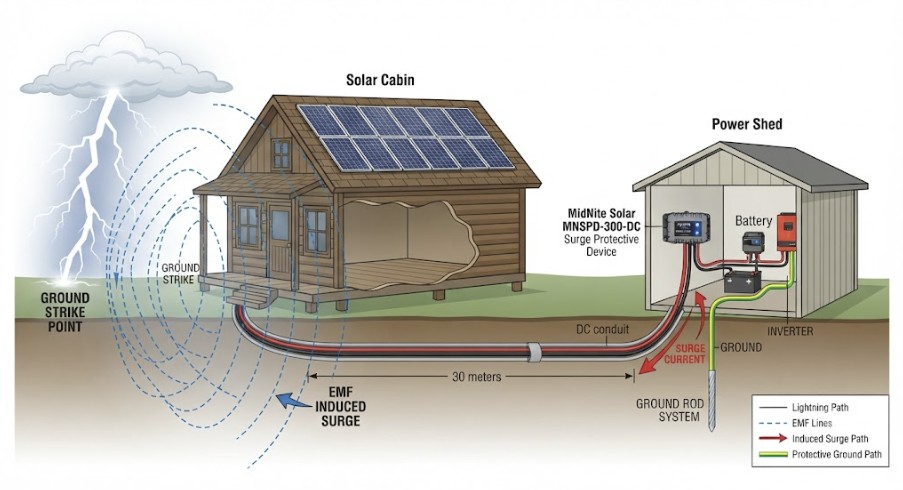
Your solar array, often covering hundreds of square feet, acts as a massive antenna. During an electrical storm, it can absorb induced energy from lightning strikes that land up to a mile away. Furthermore, the long DC cable runs from your panels to your power shed are perfect conduits for these high-voltage transients to travel directly to the heart of your system. Without the buffer of a massive utility grid, your isolated electronics must absorb the full impact of these events, making robust protection essential.
The Physics of Surge Protection: How SPDs Actually Work
A Surge Protective Device operates on a simple but incredibly fast principle. The core component inside most SPDs is a Metal Oxide Varistor (MOV), a special type of nonlinear resistor.
In its normal state, an MOV has extremely high resistance, making it virtually invisible to the circuit. However, when the voltage spikes above a specific threshold (its “clamping voltage”), the MOV’s resistance instantly plummets to near-zero within nanoseconds. This creates a safe, low-impedance path that diverts the dangerous surge current directly to your grounding system, protecting your downstream equipment. Once the voltage returns to normal, the MOV’s resistance goes back up, and it waits for the next event.
The Critical DC Arc Extinction Problem
You cannot use a standard AC surge protector on the DC side of your solar system. AC power alternates, crossing zero volts 120 times per second, which naturally extinguishes electrical arcs. DC power is constant; once an arc forms, it can sustain itself, potentially causing the SPD to overheat and catch fire.
DC SPDs, compliant with standards like IEC 61643-31, are specifically engineered with arc-extinguishing technology. This ensures that if an MOV fails or during a prolonged event, the device can safely interrupt the DC current flow without creating a fire hazard. This distinction is non-negotiable for system safety.
Critical Selection Criteria for the Best Solar Surge Protector for Off-Grid Cabin
Choosing the right SPD is a technical process. Selecting a device based on brand alone is a recipe for failure. You must match the device’s specifications to your system’s electrical characteristics. Failure to do so can render the protection ineffective or even create a safety hazard.
Step 1: Determine the Correct SPD Type
SPDs are categorized into types based on their intended location and the magnitude of surge they can handle. For an off-grid cabin, you’ll primarily encounter Type 1 and Type 2 devices.
| SPD Specification | Type 2 DC SPD | Type 1+2 DC SPD |
|---|---|---|
| Primary Use | Standard protection for induced surges from nearby lightning. The most common choice for off-grid cabins. | Handles induced surges AND partial direct lightning current. Required for high-risk areas. |
| Test Waveform | 8/20µs (Class II) | 10/350µs (Class I) + 8/20µs (Class II) |
| Required When | In all standard off-grid PV systems. | If the cabin has an external lightning rod system (LPS) or is in a region with very high lightning density. |
| Typical kA Rating (In) | 20kA | 20kA – 25kA |
For most cabin setups, a robust Type 2 DC SPD is the appropriate starting point. If you live in an area notorious for severe thunderstorms, such as Florida or the Rocky Mountains, investing in a Type 1+2 device provides an essential extra layer of defense.
Step 2: Calculate the Maximum Continuous Operating Voltage (Uc)
This is the most critical calculation in selecting an SPD. The device’s Maximum Continuous Operating Voltage (Uc) must be higher than your solar array’s maximum possible Open-Circuit Voltage (Voc). Solar panel voltage increases as temperature drops, so you must calculate the Voc for the coldest temperature your cabin will ever experience.
The formula, according to IEC standards, is: Uc ≥ 1.2 × Voc(max). First, find your temperature-corrected Voc(max): Voc(max) = Voc(STC) × [1 + |αVoc| × (25°C – Tmin)].
| Parameter | Description | Example Value |
|---|---|---|
| Voc(STC) | Your string’s total Voc at standard test conditions (25°C). Found on panel datasheet. | 140V DC |
| αVoc | The temperature coefficient of Voc. A negative percentage per degree Celsius. | -0.3%/°C |
| Tmin | The coldest recorded temperature for your cabin’s location. | -15°C |
| Calculated Voc(max) | 140V × [1 + 0.003 × (25 – (-15))] = 140V × 1.12 | 156.8V |
| Required Uc | 1.2 × 156.8V | ≥ 188.16V |
In this example, you would need to select a DC SPD with a Uc rating of at least 200V or higher. Selecting an undersized SPD will cause it to constantly leak current and fail prematurely. Always round up to the next available standard SPD voltage rating. Proper sizing is key, whether you are running a 12V, 24V, or 48V solar system.
Step 3: Verify the Voltage Protection Level (Up)
The Voltage Protection Level (Up), or clamping voltage, is the residual voltage that gets through the SPD during a surge event. This value must be lower than the maximum voltage your equipment can withstand. A lower Up value means better protection.
As a general rule, look for a DC SPD with a Up that is at least 20% below your inverter and charge controller’s surge withstand voltage rating. For most quality solar equipment, an SPD with a Up of 2.5kV or less is sufficient.
Top 3 Picks for the Best Solar Surge Protector for Off-Grid Cabin in 2026
Based on rigorous engineering principles, field reliability, and compliance with safety standards, these are the top choices for safeguarding your off-grid cabin.
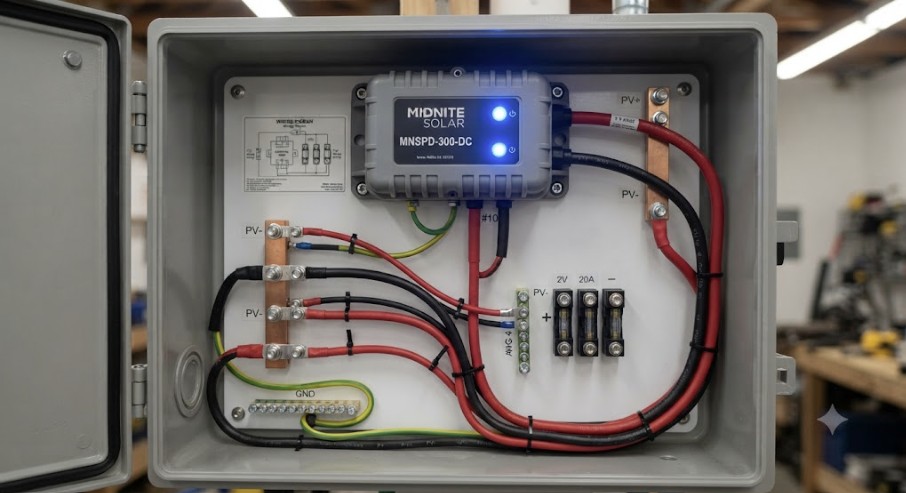
1. MidNite Solar MNSPD-300-DC
The MidNite Solar SPD is a legendary component in the off-grid community for a reason. It is a Type 2 device built like a tank and designed specifically for DC solar applications. Its easy-to-read blue LED indicators provide an instant status check.
- Pros: Extremely durable, well-respected brand, available in various voltage ratings (115, 300, 600V) to match any system, simple to install.
- Cons: Bulkier form factor than DIN rail models, may not fit inside some smaller combiner boxes.
[Check Price for MidNite Solar MNSPD-300-DC on Amazon]
2. Siemens FS140 Whole House Surge Protector (AC Side)
Your protection strategy is incomplete without addressing the AC side of your system. The Siemens FS140 is a Type 2 device that installs directly in your off-grid cabin’s electrical panel, protecting your inverter’s AC output and all your cabin’s appliances from surges generated by a backup generator or internal faults.
- Pros: Protects the entire cabin, commercial-grade build quality, robust 140,000A surge capacity, diagnostic LEDs.
- Cons: Requires available space in your main breaker panel for a 2-pole breaker.
[Check Price for Siemens FS140 on Amazon]
The Art of Installation: Placement and Wiring for Maximum Protection
Even the best solar surge protector for off-grid cabin setups will fail if installed incorrectly. Placement and wiring are just as critical as the device itself.
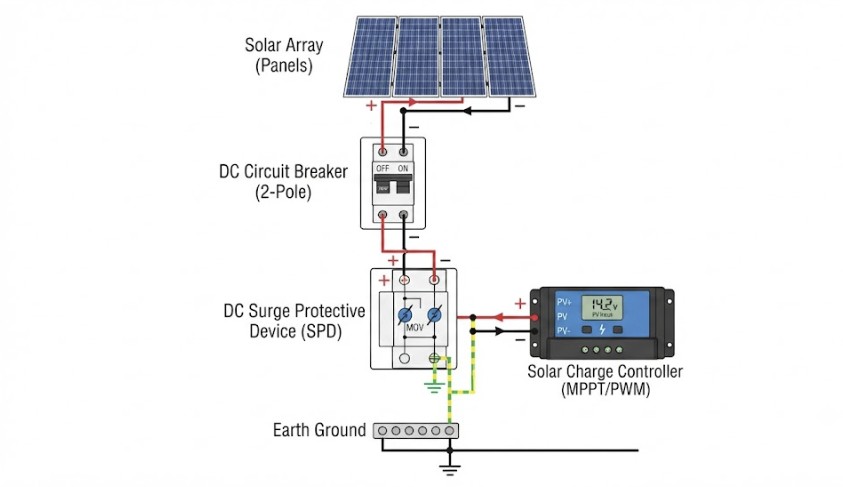
Wiring Order: Always After the Breaker
The SPD must be installed on the load side of the circuit’s overcurrent protection (fuse or breaker). It should be wired in parallel with the circuit it is protecting. If the SPD fails in a short-circuit mode (a common end-of-life state), the upstream breaker will trip, safely disconnecting the faulty SPD from the circuit without shutting down your whole array.
The 10-Meter Rule and Placement Strategy
If the DC wire run between your solar array and your inverter/charge controller is longer than 10 meters (about 33 feet), you need two SPDs. One should be installed in the combiner box at the array, and a second one should be installed at the inverter/controller end of the wire. The long wire acts as an antenna, and a surge can be induced anywhere along its length. Protecting both ends is the only way to ensure complete safety.
Keep Leads Short: The 0.5 Meter Rule
The wires connecting the SPD to the positive, negative, and ground bus bars must be as short and straight as possible, ideally less than 0.5 meters (20 inches) in total length. Every inch of wire adds inductance, which creates a voltage drop during a fast-acting surge, effectively increasing the clamping voltage and reducing the SPD’s effectiveness. Twist the positive and negative leads together to further reduce inductance.
A Robust Grounding System is Non-Negotiable
An SPD is useless without a low-resistance path to earth. It needs a reliable way to dump the immense surge energy. For an off-grid cabin, this means at least one 8-foot copper-clad ground rod driven fully into the earth. In rocky or sandy soil, you must install two or even three ground rods, spaced at least 6 feet apart and bonded together with heavy gauge copper wire (#6 AWG bare copper is standard). This is the foundation of your entire protection system. This aligns with requirements in the National Electrical Code (NEC).
Building a Complete Layered Defense Strategy
Finding the single best solar surge protector for off-grid cabin use is about creating a system, not just installing one device. A multi-layered strategy provides true peace of mind.
- Primary DC Defense: Install a Type 2 (or Type 1+2) DC SPD in your solar combiner box, as close to the panels as practical.
- Secondary DC Defense: If your wire run exceeds 10 meters, install a second DC SPD right at the PV input terminals of your solar charge controller. Comparing quality controllers like those from Victron vs. Renogy is important as their surge tolerance may differ.
- AC System Defense: Install a Type 2 AC “whole house” surge protector in your main AC panel to protect your inverter and all appliances from surges from a backup generator or other sources.
- Grounding Foundation: Ensure your entire system is bonded to a properly installed, low-resistance earth grounding electrode system.
By implementing this layered approach, you create a robust shield that can safely manage the immense energy of electrical surges, protecting your vital off-grid power system for years to come.
Frequently Asked Questions
What is the difference between a lightning arrester and a solar surge protector?
A lightning arrester, more accurately called an air terminal or lightning rod, is part of an external Lightning Protection System (LPS) designed to intercept a direct lightning strike and conduct its massive current safely to the ground, protecting the physical structure of your cabin. A solar surge protector (SPD) is an internal electrical device designed to protect your sensitive electronics from the secondary effects of lightning, such as induced voltage surges on your wiring, which can happen even from a strike a mile away. You need an SPD even if you don’t have an LPS, but if you do have an LPS, an SPD is absolutely mandatory to handle the residual energy that will inevitably enter your wiring. Finding the best solar surge protector for off-grid cabin safety means focusing on the SPD component to protect your electronics.
Can I use a regular AC surge protector for my solar panels?
No, you must never use a standard AC surge protector on the DC side of a solar power system. This is extremely dangerous. AC SPDs are not designed to extinguish a direct current (DC) arc. In the event of a failure, a DC arc can form inside the AC SPD and sustain itself, leading to overheating and a significant fire risk. Always use a surge protector specifically rated and certified under IEC 61643-31 for photovoltaic (PV) DC applications, as these contain the necessary technology to safely quench a DC arc.
How do I know what voltage SPD I need for my cabin’s solar system?
You must calculate the maximum possible voltage your solar array can produce, which occurs on the coldest possible day. First, find your solar panel string’s Open-Circuit Voltage at standard conditions (Voc STC) from the datasheet. Then, find the temperature coefficient (αVoc) on the same sheet. Use the formula: Voc(max) = Voc(STC) × [1 + |αVoc| × (25°C – Tmin)], where Tmin is the lowest temperature your location experiences. The SPD’s Maximum Continuous Operating Voltage (Uc) must then be at least 1.2 times this Voc(max) value. This calculation is the most critical step in choosing the best solar surge protector for off-grid cabin systems.
Where is the absolute best place to install the solar surge protector?
The best placement depends on your system’s layout. If your DC wire run from the panels to the charge controller is less than 10 meters (33 feet), the single best location is right at the PV input terminals of your charge controller or all-in-one inverter, with connection wires under 0.5 meters long. If the wire run is longer than 10 meters, you must use two SPDs: one at the solar array combiner box and a second one at the charge controller input. This dual-location strategy is essential for protecting against surges induced along the length of the long wire.
Do I need surge protection on both the DC and AC sides of my off-grid system?
Yes, a complete protection strategy requires protecting both sides. A DC surge protector guards your solar panels, wiring, and the DC input of your charge controller and inverter from surges originating at the array. An AC surge protector, typically installed in your main breaker panel, protects the AC output of your inverter and all your cabin’s appliances from surges created by a backup generator, large motor loads starting up, or faults within the AC system. Omitting one leaves a major vulnerability in your system.
How often should I replace the best solar surge protector for off-grid cabin?
Most modern SPDs have a service life of 5-10 years, but this can be much shorter in areas with frequent electrical storms. Reputable SPDs, like the MidNite Solar models, have a visual status indicator (often an LED light). You should inspect this indicator as part of your regular system maintenance, at least twice a year and always after a known severe storm. If the indicator shows a fault or is no longer lit, the device has sacrificed itself protecting your gear and must be replaced immediately to restore protection.
What does Type 1 vs Type 2 SPD mean for an off-grid cabin?
A Type 2 SPD is the standard for most off-grid cabins and is designed to handle induced surges from nearby lightning strikes, which are the most common threat. A Type 1 SPD is a more heavy-duty device designed to handle a portion of a direct lightning strike’s current. You would only need a Type 1 (or a combined Type 1+2) device if your cabin has an external lightning rod system installed, as this system is designed to channel direct strike energy, and the SPD must be robust enough to handle the residual current that gets onto the electrical lines.
Will an SPD protect my solar system from a direct lightning strike?
No, a standard solar surge protector (SPD) is not designed to handle the millions of volts and hundreds of thousands of amps from a direct lightning strike on your array. Its job is to protect against secondary induced surges from nearby strikes. Protection from a direct strike requires a specialized external Lightning Protection System (LPS) consisting of air terminals, heavy-duty down conductors, and an extensive grounding field, engineered to IEC 62305 standards. Even with an LPS, you still absolutely need SPDs to handle the residual energy.
How does poor soil affect my solar surge protection system?
Poor soil (sandy, rocky, or very dry) has high electrical resistance, which severely cripples your surge protection system. An SPD works by diverting surge current to the earth, and if the path to earth is resistive, the energy can’t dissipate effectively and will instead seek other paths, like through your sensitive electronics. In poor soil, a single 8-foot ground rod is insufficient. You must install a more robust grounding electrode system, often consisting of two or three ground rods spaced apart or even a buried ground plate or ring, to achieve a low-resistance connection to the earth.
Is the MidNite Solar SPD the best solar surge protector for off-grid cabin applications?
The MidNite Solar line of DC SPDs is widely considered one of the best and most reliable choices for DIY and off-grid solar applications due to its robust construction, proven track record, and specific design for DC circuits. While other excellent brands like CITEL and Eaton exist, the MidNite SPD’s combination of performance, durability, and ease of installation makes it a top-tier candidate and often the go-to recommendation for the best solar surge protector for off-grid cabin owners who prioritize reliability and straightforward implementation.
Does the length of my solar panel wires matter for surge protection?
Yes, absolutely. The length of your DC wire run is a critical factor. Longer wires act as larger antennas, making them more susceptible to picking up induced voltage from nearby lightning. The rule from engineering standards is that if your wire run between the solar array and the power electronics exceeds 10 meters (about 33 feet), you have a “long run” and require two separate SPDs: one located at the array end (in a combiner box) and another at the equipment end (near the charge controller/inverter inputs) for complete protection.
What happens if I wire my SPD before the circuit breaker?
Wiring an SPD before its dedicated circuit breaker is a common and dangerous installation mistake. SPDs are designed to fail in a short-circuit mode at their end-of-life after absorbing too much surge energy. If the SPD is wired before the breaker and it fails short, it will create a direct, unprotected short circuit on your solar array conductors. This can lead to dangerously high currents, potentially melting wires and creating a serious fire hazard. The breaker must be upstream of the SPD so it can trip and safely de-energize the failed device.