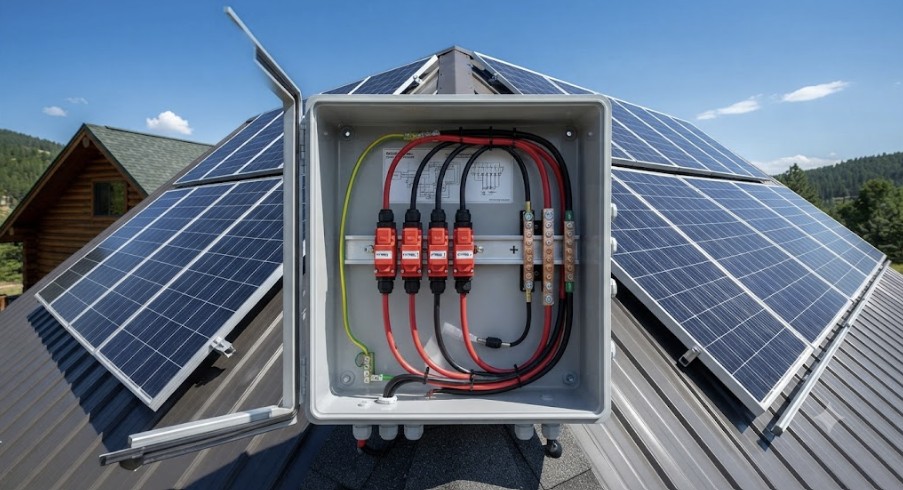
Choosing the correct overcurrent protection for your off-grid solar array is one of the most critical safety decisions you will make. It is a non-negotiable step that protects your entire system from catastrophic failure, including the risk of fire. Selecting the best inline fuse for solar panels to charge controller goes beyond picking a component; it requires a precise understanding of electrical code, physics, and your specific array configuration.
This definitive engineering guide will walk you through the exact calculations, code requirements, and hardware selections needed to ensure your system is safe, efficient, and compliant. We will move directly into the technical facts, providing the formulas and data necessary to build a robust and reliable off-grid power system.
Table of Contents
The Fundamental Role of a Fuse in a PV System
An inline fuse is a sacrificial overcurrent protection device (OCPD). Its core function is to interrupt the flow of dangerously high current by melting an internal wire, which permanently opens the circuit.
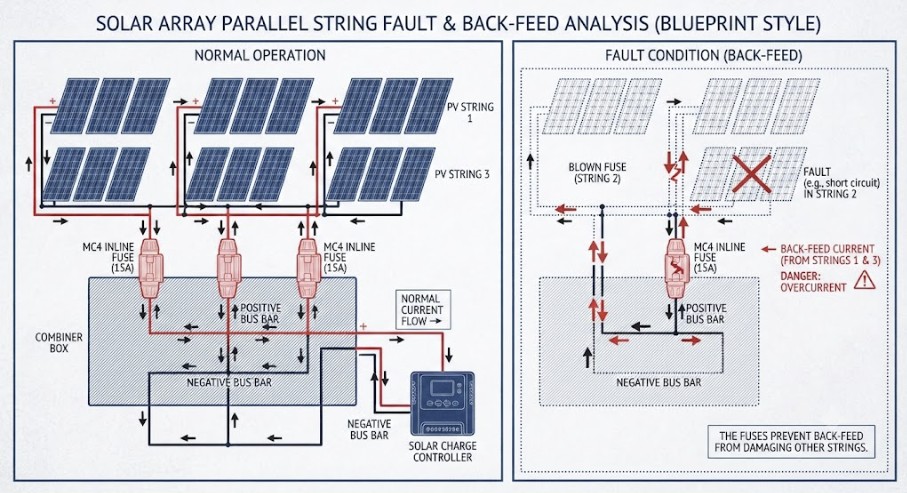
A common misconception is that this fuse primarily protects the solar charge controller. While it is part of the protection chain, its most crucial job is to protect the solar panels and their wiring from reverse current during a fault condition in a parallel-wired array.
When multiple solar panel strings are connected in parallel, they all feed into a common point. If one panel or its wiring develops a short circuit, it becomes the path of least resistance. The current from all the other healthy strings will instantly reverse direction and surge into the faulty string, creating an amperage level far higher than the panel or its wires can handle.
This back-feed current is the primary fire hazard. The best inline fuse for solar panels to charge controller is installed on each parallel string to prevent this specific failure mode, instantly isolating a faulty string before it can be destroyed by the others.
NEC Code and the Golden Rule: When Do You Need a Fuse?
The decision to fuse your solar array is not optional; it is dictated by the National Electrical Code (NEC). Specifically, NEC Article 690.9(A) provides the standard for overcurrent protection in photovoltaic systems.
The “Golden Rule” derived from the NEC is straightforward: you must use an OCPD on each solar string when the potential fault current from other sources (i.e., other parallel strings) can exceed the “Maximum Series Fuse Rating” specified on the solar panel’s data label.
In practical terms, this rule applies to most systems configured with three or more parallel strings of solar panels. A system with only one or two parallel strings is often exempt because the short-circuit current (Isc) from a single other string is typically lower than the panel’s maximum series fuse rating.
| Number of Parallel Strings | Potential Back-Feed Current | NEC Fuse Requirement |
|---|---|---|
| 1 (or a single series string) | 0 Amps | Not Required |
| 2 Strings | The Isc of one string | Usually Not Required (Verify against panel’s Max Series Fuse Rating) |
| 3 or More Strings | The combined Isc of (N-1) strings | Required by Code |
Always verify the Maximum Series Fuse Rating on your panel’s sticker. If a single string’s Isc is greater than this value, you must fuse even a two-string array, though this is rare with modern panels.
How to Calculate the Correct Fuse Size: The 1.56 Formula
Once you’ve determined a fuse is required, you must calculate the correct amperage. Using an incorrectly sized fuse is as dangerous as using no fuse at all. The industry-standard calculation is mandated by NEC guidelines for continuous-duty circuits.
The formula to size the best inline fuse for solar panels to charge controller is:
Fuse Amperage = Panel Isc x 1.56
The 1.56 multiplier is a product of two separate NEC safety factors. Solar circuits are considered “continuous duty” because they can operate at maximum output for more than three hours. The NEC requires that both the wiring and the OCPD be sized to handle 125% of the continuous load.
- First Factor (1.25): To account for continuous load (NEC 690.8). You multiply the panel’s Short-Circuit Current (Isc) by 1.25.
- Second Factor (1.25): For sizing the overcurrent protection device itself, which should not exceed 80% of its rating for a continuous load (1 / 0.80 = 1.25).
Multiplying these two factors gives you the total safety margin: 1.25 x 1.25 = 1.5625. This is commonly rounded to 1.56. After calculating the required fuse rating, you must round up to the next available standard fuse size (e.g., 10A, 15A, 20A, 25A, 30A).
| Panel Isc (Amps) | Calculation (Isc x 1.56) | Required Fuse Rating (Amps) | Select Standard Fuse Size |
|---|---|---|---|
| 5.75A | 5.75A x 1.56 | 8.97A | 10A |
| 9.8A | 9.8A x 1.56 | 15.29A | 20A |
| 13.2A | 13.2A x 1.56 | 20.59A | 25A |
Properly sizing your fuse is essential for finding the best inline fuse for solar panels to charge controller, ensuring it doesn’t cause nuisance trips under normal high-irradiance conditions but blows instantly during a fault.
Hardware Types: Finding the Best Inline Fuse for Solar Panels to Charge Controller
Overcurrent protection for the PV side of your system comes in several forms. The right choice depends on your array size, budget, and installation complexity. Each type serves the same core purpose but offers different advantages.
For DIY and smaller residential systems, MC4 inline fuse holders are often the most practical and cost-effective solution. For larger, more complex systems, a dedicated off-grid electrical panel or combiner box is the professional standard.
| Protection Type | Pros | Cons | Best Use Case |
|---|---|---|---|
| MC4 Inline Fuse Holder | Waterproof (IP67/IP68), simple plug-and-play installation, lowest cost. | Single-use (must be replaced after blowing), one needed per string. | DIY systems with 3 to 5 parallel strings where a combiner box is overkill. |
| DC-Rated Circuit Breaker | Resettable, doubles as a disconnect switch for maintenance. | Higher cost, bulkier, must be installed in a weatherproof enclosure, voltage rating is critical. | Systems that require frequent disconnection or are housed in a central power cabinet. |
| Combiner Box with Fuses | Centralizes wiring, very clean and safe, highly scalable for future expansion. | Highest initial cost, more complex to install and wire correctly. | Professional installations and larger arrays with 4 or more parallel strings. |
No matter the format, ensure any component you select is specifically “PV-rated” or “DC-rated” for a voltage higher than your solar array’s maximum open-circuit voltage (Voc), accounting for cold temperatures.
Top Hardware Picks for the Best Inline Fuse for Solar Panels to Charge Controller in 2026
Here are our top selections for reliable, code-compliant inline fuses that are readily available for DIY solar installers. These products are chosen for their durability, safety ratings, and ease of use.
1. BougeRV 15A MC4 Inline Fuse Holder
BougeRV offers a robust and widely trusted MC4 inline fuse holder that is perfect for protecting strings of 100W to 200W panels. Its build quality is excellent for long-term outdoor exposure.
- Pros: IP67 waterproof rating, made with high-quality PPO material, easy plug-and-play installation with standard MC4 connectors, UL recognized components.
- Cons: Only available in a limited range of amperage ratings, so double-check your calculations.
[Check Price for BougeRV 15A MC4 Inline Fuse Holder on Amazon]
2. Renogy 20A Solar Connector Waterproof In-Line Fuse Holder
From one of the biggest names in DIY solar, the Renogy inline fuse is a go-to choice for slightly larger panels or those with a higher Isc. It’s built to integrate seamlessly with other Renogy components.
- Pros: High-quality construction, IP67 waterproof, compatible with 10AWG to 12AWG PV wire, designed for high mechanical stress and extreme temperatures.
- Cons: Can be slightly more expensive than competing brands.
[Check Price for Renogy 20A Solar In-Line Fuse Holder on Amazon]
Selecting one of these options provides a reliable hardware solution when looking for the best inline fuse for solar panels to charge controller for your off-grid project.
Advanced Scenario: Fusing Over-Paneled Arrays
“Over-paneling” is an advanced technique where you install a solar array with a total wattage significantly higher than your charge controller’s rated power input. This strategy is used to maximize production during low-light conditions, such as in the winter or on overcast days, ensuring a more consistent charge for your solar batteries.
This creates a challenge for fuse sizing. The NEC requires you to size the main PV wire and its fuse based on the array’s *maximum potential current*, which in a heavily over-paneled array could be huge. For example, an array capable of producing 60A of Isc would, by code, require a very large and expensive fuse and heavy gauge wire, even if the charge controller it connects to has a 30A input limit.
The correct engineering solution is to use a combiner box:
- String-Level Fusing: Inside the combiner box, fuse each individual string according to its panel’s Isc. Use the standard `Isc x 1.56` formula. This protects each panel from back-feed current.
- Combiner Output Fusing: The wire running from the combiner box output to the charge controller input should be protected by a fuse or breaker sized for the *charge controller’s maximum input current*, not the array’s total potential current. For a 40A controller, you would use a 50A breaker (`40A x 1.25 = 50A`). This properly protects the wire while acknowledging the controller’s current-limiting function.
This hybrid approach satisfies the NEC by protecting all wiring for its rated ampacity while allowing you to safely and efficiently over-panel your array.
Final System Check: Breaker Between Controller and Battery
While our focus is the PV side, no system is safe without overcurrent protection between the charge controller and the battery bank. This fuse or breaker is arguably even more critical. Its purpose is to protect the wiring from the immense fault current a battery bank can deliver in a short circuit, which can be thousands of amps.
The sizing rule for this OCPD is simple and is based on the charge controller’s output rating. You apply the 1.25x continuous load factor to the controller’s maximum charging current.
Breaker Size = Charge Controller Max Amps x 1.25
For example, a Victron or Renogy 60A charge controller requires a breaker of at least `60A x 1.25 = 75A`. You would select the next standard size up, which is typically an 80A or 100A DC-rated circuit breaker. This ensures the wire connecting your controller and batteries is always protected.
Frequently Asked Questions
What happens if I don’t use the best inline fuse for solar panels to charge controller?
Failing to install the best inline fuse for solar panels to charge controller in an array with three or more parallel strings creates a significant fire risk. In the event of a short circuit in a single panel or its wiring, that faulty string becomes a low-resistance path for all the current generated by the other healthy strings. This reverse current, or back-feed, can easily reach dozens or even hundreds of amps, far exceeding the capacity of the PV wire and the panel’s internal components. This immense current will cause the wiring to overheat, melt its insulation, and potentially ignite surrounding materials. The panel itself can experience catastrophic failure, with cells overheating and the junction box melting, leading to an electrical fire on your roof or ground mount. This is not a theoretical risk; it is a well-documented failure mode that overcurrent protection is specifically designed to prevent according to NEC Article 690.9.
Can I use a standard AC fuse for my DC solar panel circuit?
Absolutely not. You must never use an AC-rated fuse or circuit breaker in a DC circuit, especially a high-voltage solar array. The physics of interrupting AC and DC circuits are fundamentally different. AC power alternates, crossing zero volts 120 times per second (in the US), which naturally helps to extinguish an electrical arc when a fuse blows or a breaker trips. DC power, however, is a constant flow of current at a sustained voltage. When a DC circuit is interrupted under load, it creates a powerful, self-sustaining plasma arc that can persist across the terminals of the blown fuse or breaker. An AC-rated device is not designed to quench this DC arc. The arc can maintain the connection, melt the fuse holder or breaker casing, and start a fire. Always use fuses and breakers that are specifically DC-rated or PV-rated for a voltage that exceeds your array’s maximum system voltage (Voc).
Where exactly do I install the inline fuse on the solar panel string?
The best inline fuse for solar panels to charge controller must be installed on the positive (+) conductor of each parallel string. The placement should be as close as practical to the point of parallel connection, which is typically inside a PV combiner box or at the Y-branch connectors where the strings are joined. Placing the fuse on the positive line is the industry standard and ensures the circuit is safely de-energized in a fault condition. Installing it close to the combination point minimizes the length of unprotected wire running from the panels. For systems using MC4 inline fuse holders, you would typically connect the panel’s positive lead to the fuse holder’s input and the fuse holder’s output to the branch connector or combiner box terminal.
Which is truly better for solar: a fuse or a circuit breaker?
Both fuses and circuit breakers are effective overcurrent protection devices, but they have different strengths. A PV-rated fuse is a “sacrificial” device that offers extremely fast response times and a very high interrupt capacity, making it excellent for handling the powerful fault currents in solar arrays. Fuses are also generally more cost-effective. A DC-rated circuit breaker has the significant advantage of being resettable, which means you don’t need to replace it after an overcurrent event. It also conveniently serves as a manual disconnect switch for maintenance. However, breakers are more expensive, physically larger, and can wear out over time if they are used to interrupt high fault currents repeatedly. For string-level protection in a combiner box, fuses are often preferred for their reliability and high ratings. For the main PV disconnect or between the charge controller and battery, a breaker is often preferred for its convenience as a switch.
Does the voltage rating of the inline fuse matter?
Yes, the voltage rating is critically important and must not be overlooked. The DC voltage rating of your chosen fuse or fuse holder must be greater than the maximum possible system voltage of your solar panel array. This maximum voltage is the array’s open-circuit voltage (Voc) under the coldest possible ambient temperature at your location, as voltage increases as temperature drops. A common mistake is to only consider the Voc at standard test conditions (STC). You must use the temperature coefficient for Voc (found on the panel’s datasheet) to calculate the true worst-case voltage. For example, an array with a calculated maximum Voc of 140V requires a fuse rated for at least 150V DC. Using an underrated fuse can result in the device failing to safely interrupt the circuit and quench the DC arc during a fault, posing a severe safety hazard.
Do I really need a fuse for my single 100W portable solar panel?
For a single solar panel, regardless of its wattage, you do not need an inline fuse between the panel and the charge controller. The panel itself is a current-limited device; it cannot physically produce more current than its rated short-circuit current (Isc), even if you short the leads together. Since there are no other parallel strings or power sources to contribute back-feed current, there is no risk of an overcurrent condition originating from the panel. The wiring supplied with most panels is already sized to handle its own Isc. Therefore, adding a fuse in this scenario provides no additional safety benefit and is not required by the NEC. Fusing is only necessary when you begin connecting multiple panels in parallel.
How does temperature affect my choice for the best inline fuse for solar panels to charge controller?
Temperature has two primary effects on your system that influence the choice of the best inline fuse for solar panels to charge controller. First, as discussed with voltage rating, colder temperatures increase a panel’s voltage, so your fuse’s voltage rating must be sufficient for the lowest expected temperature. Second, high temperatures can affect a fuse’s performance. Fuses are thermal devices, and their rated amperage is typically specified at a standard ambient temperature (e.g., 25°C or 77°F). In very hot environments, like a sun-baked combiner box on a roof, the fuse will be pre-heated. This means it may blow at a current slightly lower than its nameplate rating. Reputable manufacturers provide derating curves in their datasheets to account for this. While the 1.56 sizing factor provides a significant buffer, in extreme heat environments, you may need to consult these derating charts to ensure your chosen fuse does not cause nuisance trips.
What’s the difference between a “slow-blow” and “fast-acting” fuse for solar applications?
Fast-acting fuses are designed to blow almost instantaneously when their rated current is exceeded. Slow-blow (or time-delay) fuses are designed to tolerate a temporary inrush of current for a short period without blowing, which is common when starting motors or charging large capacitors. For protecting solar panel strings, you should generally use a fast-acting, PV-rated fuse (often designated with “gPV”). This is because a fault condition in a solar array, like a short circuit, results in an immediate and sustained overcurrent from back-feeding. You want the fuse to interrupt this fault current as quickly as possible to prevent damage. There is no large inrush current in a PV string that would necessitate a slow-blow fuse, making a fast-acting fuse the safer and more appropriate choice.
Can you re-explain why the 1.56 rule is so important for sizing the best inline fuse for solar panels to charge controller?
The 1.56 multiplier is a cornerstone of safe system design under the NEC and is crucial for sizing the best inline fuse for solar panels to charge controller. It is not an arbitrary number but a calculated safety factor derived from two separate NEC requirements. The first 1.25x factor addresses the fact that solar arrays are “continuous loads,” meaning they can produce their maximum current for three hours or more. The NEC mandates that circuits for such loads be sized to 125% of the maximum current to prevent overheating of wires and components over long periods. The second 1.25x factor applies to the overcurrent protection device itself, ensuring it operates safely within its thermal limits, effectively derating it to 80% of its maximum capacity for continuous use. By multiplying these two factors (1.25 * 1.25 = 1.5625), you get a fuse rating that is guaranteed not to blow under normal peak operating conditions (even with edge-of-cloud effects causing brief current spikes) but is still close enough to the panel’s Isc to blow very quickly during a dangerous fault condition. Skipping this calculation can lead to a fuse that either blows unnecessarily or fails to blow when it’s needed most.
Is it better to put fuses on both the positive and negative wires from the solar panels?
For most off-grid systems in North America, which are typically “negatively grounded” systems (where the negative conductor of the DC circuit is bonded to the equipment ground), you only need to install a fuse on the positive conductor. This is the ungrounded conductor. Fusing the positive line is sufficient to interrupt the circuit and stop the flow of current during a fault. Adding a fuse to the negative (grounded) conductor offers no additional safety benefit and can, in some rare fault scenarios, create a situation where the system appears dead but is still energized relative to ground, posing a shock hazard. The main exception is for “ungrounded” or “floating” arrays, such as some high-voltage transformerless grid-tie systems, where NEC code may require fusing on both positive and negative conductors. For typical cabin, RV, or van systems, a single fuse on the positive leg is the correct and standard practice.
What does a “PV-rated” fuse mean and is it a requirement?
A “PV-rated” fuse, often marked with “gPV,” is a fuse that has been specifically designed and tested for the unique demands of photovoltaic systems. These fuses have a DC voltage rating high enough for solar arrays (typically 600V, 1000V, or even 1500V DC) and are designed to safely interrupt DC fault currents without sustaining an arc. They are also built to withstand the cyclic nature of solar power, including years of daily thermal expansion and contraction from heating up in the sun and cooling down at night. While you could technically use any fuse that has the appropriate DC voltage and amperage rating, choosing a specifically PV-rated fuse ensures it has been certified by organizations like UL to meet the rigorous safety standards for solar applications. It is the gold standard and the recommended choice when selecting the best inline fuse for solar panels to charge controller.
How can I safely test if my inline fuse has blown?
To safely test a fuse, you will need a multimeter with a continuity setting (often indicated by a diode or sound symbol). First, you must completely de-energize the circuit. For a solar array, this means waiting until it is completely dark outside or covering the panels entirely with an opaque blanket. Then, disconnect the battery bank from your charge controller. Once you are certain there is no power in the circuit, you can remove the fuse from its holder. Set your multimeter to the continuity setting and touch one probe to each end of the fuse. If the fuse is good, the meter will beep and/or show a reading of near-zero ohms. If the fuse is blown, the meter will remain silent and show “OL” (over-limit) or infinity, indicating an open circuit. Never attempt to test a fuse while it is installed in a live circuit.