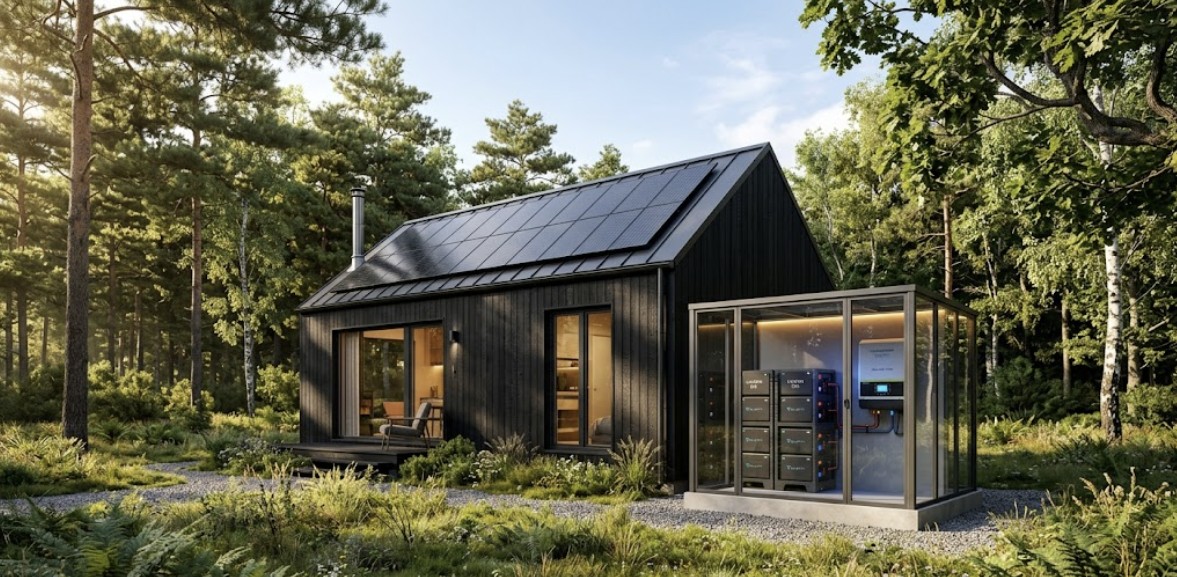
Tiny house living demands precision. Limited roof space, lower energy consumption, and mobility constraints make choosing the best solar panels for tiny house setups fundamentally different from traditional home installations. A poorly sized system results in constant battery drain, while an oversized system wastes budget and space.
Whether you are building on a trailer or a permanent foundation, finding the best solar panels for tiny house applications requires balancing weight, dimensions, and total wattage to match your specific lifestyle.
This comprehensive guide delivers real-world data, performance comparisons, and expert recommendations to help you select the best solar panels for tiny house living in 2026.
Table of Contents
Why Tiny Houses Require Specialized Solar Panel Selection
Tiny homes operate under constraints traditional homes never face:
- Limited roof space (typically 120–300 sq ft usable)
- Lower daily energy usage (1–8 kWh/day)
- Lightweight structural limits
- Often off-grid or hybrid installations
- Mobility considerations for tiny houses on wheels
Because of these constraints, the best solar panels for tiny house installations must prioritize:
| Feature | Why It Matters for Tiny Houses |
|---|---|
| High Efficiency (20%+) | More power in limited space |
| Lightweight Panels | Prevent structural strain |
| Expandability | Future energy upgrades |
| Durability | Off-grid weather exposure |
| Voltage Compatibility | Efficient battery charging |
Your panel array must match your battery voltage. Learn about the benefits of higher voltage in our [12V vs 24V vs 48V solar system] guide.
Unlike full homes requiring 8kW–15kW systems, tiny houses typically need:
- Minimal Setup: 400W–800W
- Moderate Living: 800W–1500W
- Full-Time Off-Grid: 1500W–3000W
How Much Solar Power Does a Tiny House Need?
Before choosing the best solar panels for tiny house, we calculate energy consumption.
Typical Tiny House Energy Consumption
| Appliance | Wattage | Hours/Day | Daily Usage |
|---|---|---|---|
| LED Lights | 40W | 5 hrs | 200Wh |
| Laptop | 60W | 4 hrs | 240Wh |
| Mini Fridge | 80W | 10 hrs | 800Wh |
| Water Pump | 100W | 1 hr | 100Wh |
| Vent Fan | 50W | 6 hrs | 300Wh |
| Phone Charging | 20W | 4 hrs | 80Wh |
Total Daily Consumption = ~1,720Wh (1.7kWh/day)
We add:
- 25% inefficiency buffer
- 20% cloudy weather buffer
Recommended System Size: 2.5kWh/day capacity
This equals roughly:
- 600W–800W solar array (minimum)
- 1000W–1500W (comfortable off-grid)
Calculating your load is the first step. For a more granular breakdown of appliance wattage and daily consumption, see our [400 sq ft cabin power needs] planning guide.
Best Solar Panels for Tiny House (Top 7 Picks for 2026)
These panels were selected based on:
- Efficiency
- Real-world performance
- Durability
- Expandability
- Cost per watt
1. Best Overall — 400W Monocrystalline High-Efficiency Panels
Best For: Full-time tiny house living
For a 400W requirement, I never recommend a single, massive 400W residential panel for a tiny house. They are a nightmare to ship and even harder to mount safely on a small roof. Instead, I specify the [Renogy 200W Mono Panel 2-Pack]. This gives you a 400W total array that is much more resilient: if one panel is shaded by a chimney or a tree, the other continues to produce at full capacity. It’s the most professional way to hit your wattage target while maintaining a redundant and easy-to-install system.
Check current price on Amazon –>
Why These Are Among the Best Solar Panels for Tiny House
- High power output per panel
- Reduced wiring complexity
- Faster battery charging
- Ideal for small roof footprint
Typical Tiny House Setup:
- 2 panels = 800W
- 3 panels = 1200W
- 4 panels = 1600W
Ensure your [solar panel wire size] can handle the output
When choosing these high-output panels, brand reliability is key. We’ve compared the industry leaders in our [Renogy vs Victron] 2026 shootout.
2. Best Lightweight Option — 200W Flexible Solar Panels
Best For: Tiny houses on wheels
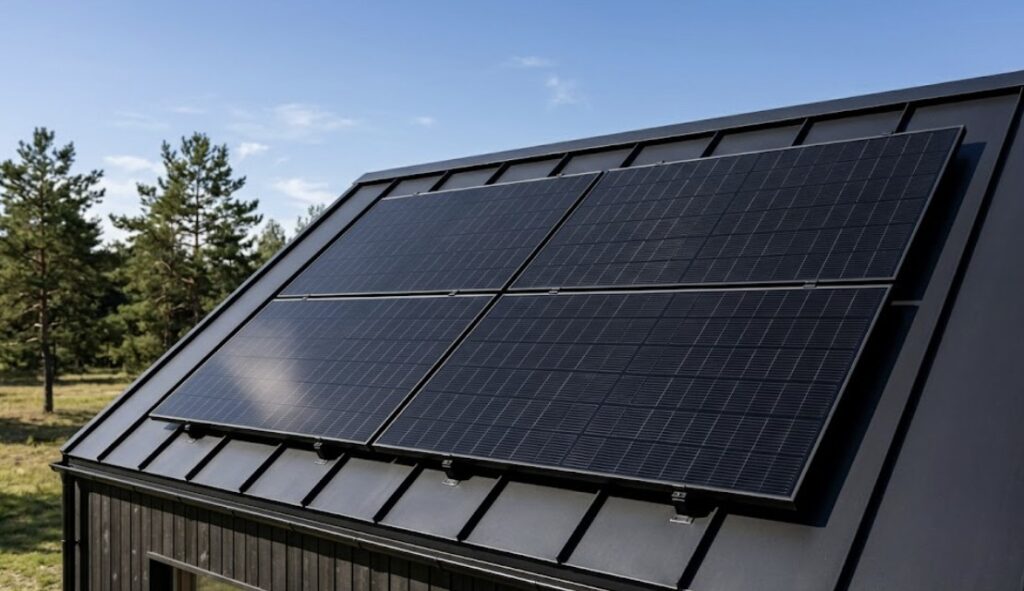
For tiny houses on wheels (THOWs), weight is everything. The [Renogy 200W Flexible Panel] is a masterpiece of engineering for this niche. At only 8 lbs, it is roughly 70% lighter than a rigid panel. But the real “favor” here is aerodynamics: you can glue these directly to a curved roof, eliminating the air gap that creates drag and noise while towing. It’s the best way to add 800W of power to a trailer without affecting your towing capacity.
Check current price on Amazon –>
Specifications:
- Weight: 5–8 lbs
- Efficiency: 18–21%
- Output: 200W per panel
Recommended Setup:
- 4 panels = 800W
- 6 panels = 1200W
Downside:
- Slightly shorter lifespan (10–15 years)
3. Best Budget Option — 100W Monocrystalline Panels
Best for beginners testing solar:
- Cost-effective
- Expandable
- Easy installation
Typical Configuration:
- 6 panels = 600W
- 10 panels = 1000W
If you’re starting on a tight budget, the [Renogy 100W Monocrystalline Panel] is your best building block. Most beginners make the mistake of buying an “off-brand” 100W panel and then find they can’t find the exact same size a year later when they want to expand. By sticking with the Renogy 100W standard, you ensure that you can add more “bricks” to your solar array in the future, keeping your roof layout symmetrical and your electrical strings balanced.
Check current price on Amazon –>
For larger arrays where 100W panels aren’t enough, we recommend looking into 400W options in our [best budget solar panels for off-grid cabin] buyer’s guide.
Best Solar Panel Types for Tiny Houses
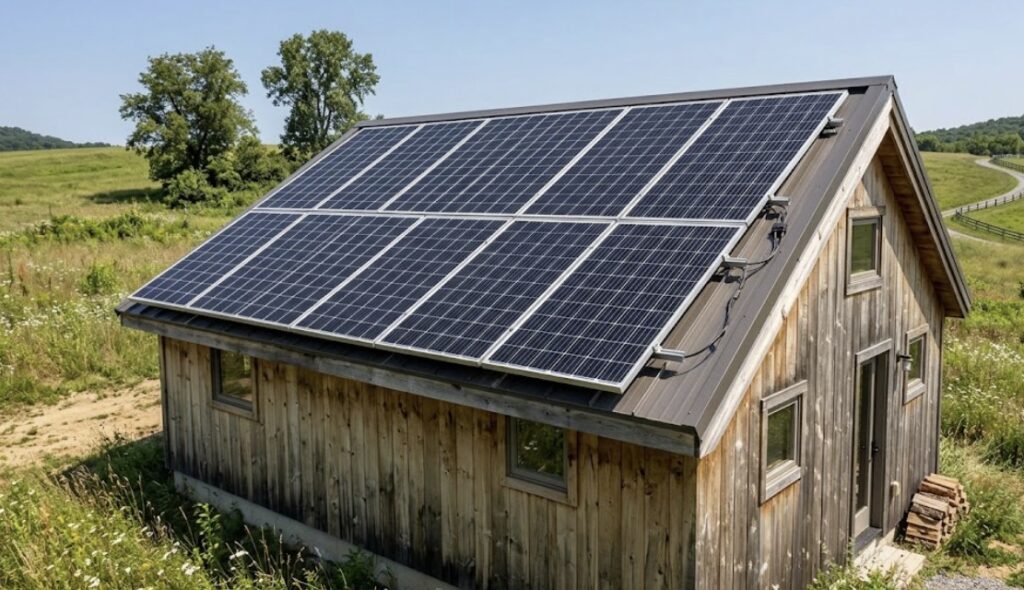
Monocrystalline Solar Panels (Recommended)
Advantages:
- Highest efficiency and longest lifespan, making them the best solar panels for tiny house space usage.
Efficiency Range: 20%–23%
Polycrystalline Panels (Budget Alternative)
Advantages:
- Lower cost
Disadvantages:
- Lower efficiency
- Larger footprint
Efficiency Range: 15%–17%
Bifacial Solar Panels (Advanced Option)
Advantages:
- 10–20% extra energy
- Better winter performance
Best For:
- Ground mount tiny houses
Best Solar Panels for Tiny House Off-Grid Systems
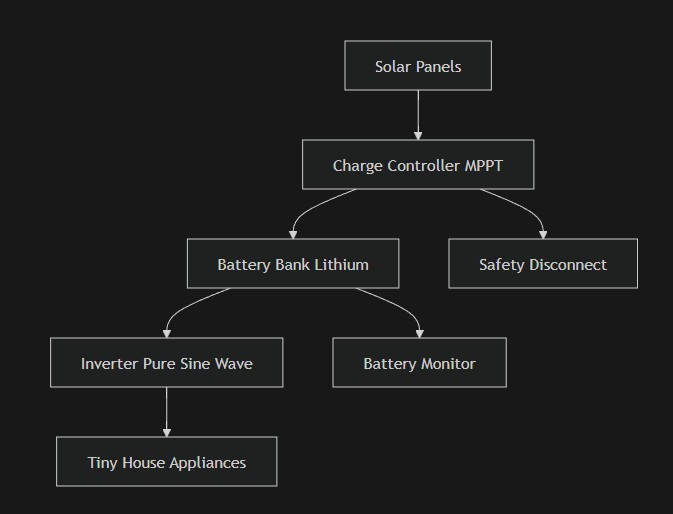
Off-grid tiny houses require:
- Solar panels
- Battery bank
- Charge controller
- Inverter
Typical Off-Grid Tiny House Setup
| Component | Recommended Size |
|---|---|
| Solar Panels | 800W–1500W |
| Battery | 5kWh–10kWh |
| Inverter | 2000W–3000W |
| Charge Controller | 40A–60A MPPT |
Battery Pairing for Tiny House Solar Panels
Lithium Batteries (Recommended)
Advantages:
- 4000+ cycles
- 80–100% usable capacity
- Lightweight
Lead Acid Batteries
Disadvantages:
- 50% usable capacity
- Short lifespan
- Maintenance required
Pairing your panels with the right storage is vital. Check our engineering picks for the [best solar battery for cabin] and tiny house systems to ensure your energy lasts through the night.
Battery Size Guide
| Usage | Battery Size |
|---|---|
| Weekend Tiny House | 2kWh–4kWh |
| Full-Time Tiny House | 5kWh–10kWh |
| High-Power Tiny House | 10kWh–15kWh |
Roof Space Considerations
Tiny house roof sizes:
- Small Tiny House: 120 sq ft
- Medium Tiny House: 180 sq ft
- Large Tiny House: 300 sq ft
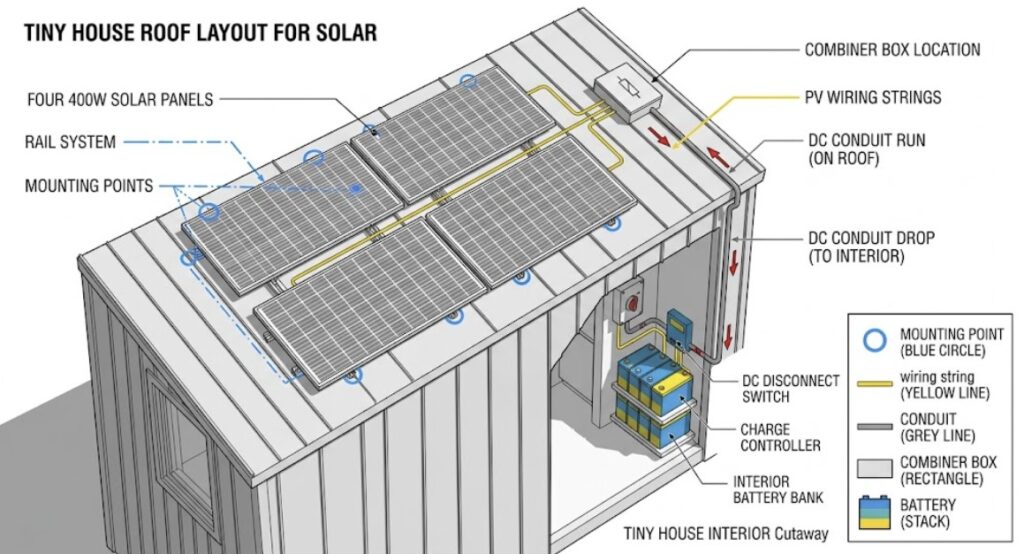
Panel Fit Example:
| Panel Size | Panels Fit |
|---|---|
| 100W | 6–12 |
| 200W | 3–6 |
| 400W | 2–4 |
Selecting the best solar panels for tiny house roofs is the only way to maximize available space.
Installation Options for Tiny House Solar Panels
Roof Mount
Roof mounting is the standard for the best solar panels for tiny house aesthetics, especially in permanent installations with limited space.
Advantages:
- Space efficient
- Clean design
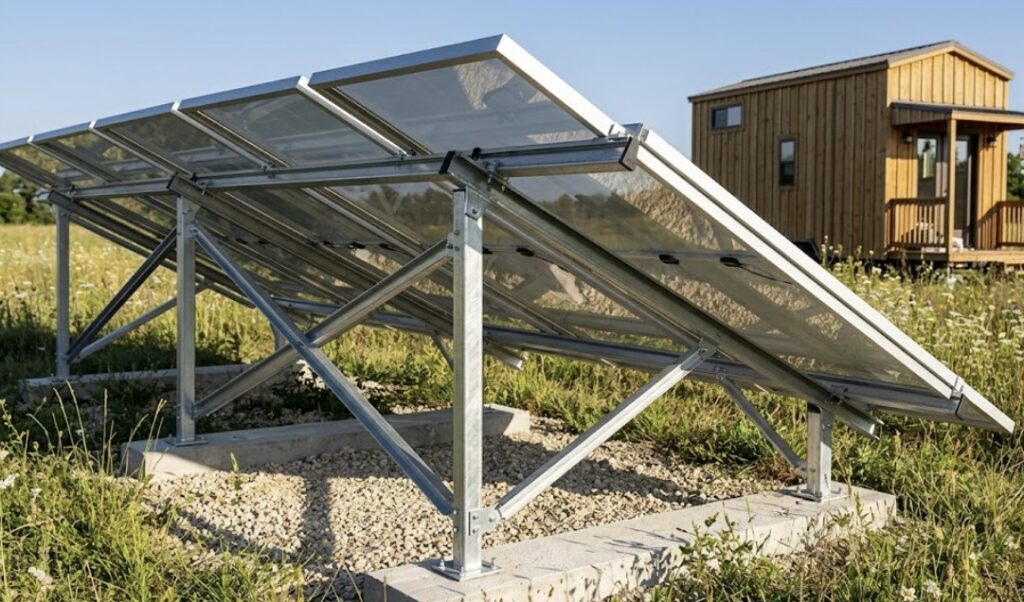
Ground Mount
Best for:
- Off-grid tiny homes
Advantages:
- Better angle control
- Easier maintenance
To find the perfect tilt angle for your specific latitude, consult the [Global Solar Atlas] for localized irradiance data.”
Portable Solar Panels
Best for:
- Mobile tiny houses
Advantages:
- Adjustable angle
- Expandable
Cost of Best Solar Panels for Tiny House
Typical Cost Breakdown
| System Size | Cost Range |
|---|---|
| 400W | $500–$900 |
| 800W | $900–$1,800 |
| 1200W | $1,500–$2,800 |
| 2000W | $2,500–$4,500 |
Equipment is only one part of the budget. For a full breakdown including tax credits and ROI, see our [solar panels for tiny home cost] 2026 pricing guide.
Battery cost:
- Lithium 5kWh: $2,000–$4,000
- Lithium 10kWh: $4,000–$7,000
Total System:
- Budget Tiny House Solar: $2,500
- Full Off-Grid Tiny House: $6,000–$12,000
Tiny House Solar System Design Diagram
Best Solar Panel Efficiency Comparison
| Panel Type | Efficiency | Lifespan | Best For |
|---|---|---|---|
| Monocrystalline | 20–23% | 25–30 yrs | Tiny houses |
| Polycrystalline | 15–17% | 20–25 yrs | Budget builds |
| Flexible Panels | 18–21% | 10–15 yrs | Mobile tiny homes |
| Bifacial | 20–24% | 25+ yrs | Ground mounts |
Efficiency ratings are constantly evolving. You can track the latest 2026 technological breakthroughs in the [NREL Photovoltaic Cell Efficiency Chart].
Best Solar Panels for Tiny House (Recommended Configurations)
Minimal Tiny House Setup
- 600W solar panels
- 2kWh battery
- 1500W inverter
Best for:
- Weekend cabins
- Minimal appliances
Standard Tiny House Setup
- 1000W solar panels
- 5kWh battery
- 2000W inverter
Best for:
- Full-time living
For systems of this size, running at 24V is essential to reduce heat and cable thickness. Read more about [why 24V off-grid solar systems are best for cabins] and tiny homes.
High-Power Tiny House Setup
- 1500W–2000W solar panels
- 10kWh battery
- 3000W inverter
Best for:
- Air conditioning
- Electric cooking
How to Choose the Best Solar Panels for Tiny House
Key Decision Checklist
- Calculate daily energy needs
- Measure roof space
- Select the best solar panels for tiny house requirements by prioritizing high-efficiency modules.
- Select lithium batteries
- Plan for expansion
Common Mistakes to Avoid
- Oversizing Batteries
- Undersizing Solar Panels
- Ignoring Roof Weight
- Buying Low-Efficiency Panels
- Skipping MPPT Controllers
Using a low-quality controller wastes the potential of your array. See our comparison of [Victron vs Renogy charge controllers] to find the right match for your panels.
If you are starting very small, you can follow our [solar setup for micro cabin] guide, but always leave room for future expansion
Final Verdict: Best Solar Panels for Tiny House in 2026
Best Overall: 400W Monocrystalline Panels
Best Budget: 100W Monocrystalline Panels
Best Lightweight: 200W Flexible Panels
Best High Output: Bifacial 500W Panels
If you have the ground space, bifacial modules are the ultimate efficiency play. We break down the installation requirements in our [bifacial solar panels for cabins] 2026 update
The best solar panels for tiny house installations combine:
- High efficiency
- Expandability
- Long lifespan
- Lightweight design
A properly sized system delivers:
- Reliable off-grid power
- Lower long-term costs
- Maximum energy independence
Selecting the right panels is just one piece of the puzzle. Integrate them into a [complete off-grid power blueprint for retreat cabins] for a truly resilient home.
With the right solar setup, a tiny house can operate fully off-grid for decades with minimal maintenance and maximum efficiency.
What size solar panel system is best for a tiny house?
The best solar panel system for a tiny house usually ranges between 600 watts and 1500 watts depending on your daily energy usage and whether you live full-time or part-time. A minimalist tiny house using basic appliances may only require around 600 to 800 watts, while full-time off-grid living with a refrigerator, water pump, and electronics typically requires closer to 1000 to 1500 watts. Climate also plays a role since areas with less sunlight require larger systems. High-efficiency panels are usually recommended because they produce more power in limited roof space. Adding extra capacity also helps maintain performance during cloudy days or winter months.
Are flexible solar panels good for tiny houses?
Flexible solar panels can be a great option for tiny houses, especially for mobile homes or tiny houses on wheels where weight matters. These panels are lightweight, easy to install, and can conform to curved roofs, making them ideal for compact or unconventional roof designs. However, flexible panels typically have a shorter lifespan compared to rigid monocrystalline panels and may produce slightly less power over time. They can also heat up more when mounted directly to the roof, which may reduce efficiency. Despite these limitations, flexible panels remain a practical solution for lightweight and portable tiny house solar systems.
How many solar panels does a tiny house need to run off-grid?
The number of solar panels required for an off-grid tiny house depends on your energy consumption and the wattage of each panel. Most tiny houses need between three and five high-efficiency panels rated at around 350 to 400 watts each. This usually provides enough energy to power lighting, small appliances, and essential electronics. Homes with higher power needs such as electric cooking or air conditioning may require more panels. Sunlight availability also affects system size, with cloudy regions needing additional panels. Choosing higher wattage panels helps reduce the number of panels needed and maximizes limited roof space.
What type of solar panels last the longest for tiny houses?
Monocrystalline solar panels typically last the longest and are widely considered the best option for tiny house installations. These panels often come with 25-year warranties and degrade more slowly than other types, maintaining strong performance over time. They also offer higher efficiency, which makes them ideal for small roofs where maximizing energy production is important. Bifacial panels are another durable option and can generate extra power by capturing reflected sunlight. Flexible panels, while convenient, usually have shorter lifespans. For long-term reliability, high-quality monocrystalline panels remain the most dependable choice.
Can a tiny house run completely on solar power?
Yes, a tiny house can run entirely on solar power if the system is properly designed and sized according to energy needs. Many off-grid tiny houses operate successfully using solar panels combined with lithium battery storage. Energy-efficient appliances such as LED lighting and compact refrigerators help reduce power demand and make full solar living easier. Battery storage ensures electricity is available at night or during cloudy weather. Some homeowners also include a backup generator for emergencies. With proper planning, solar power can provide complete energy independence for tiny house living.
How much does a tiny house solar system cost?
The cost of a tiny house solar system typically ranges from $2,500 to $12,000 depending on system size and battery storage. Smaller systems designed for weekend use cost less, while full-time off-grid systems with lithium batteries cost more. Batteries usually represent the largest portion of the total price, especially high-capacity lithium options. DIY installations can reduce costs significantly compared to professional installation. Although the initial investment may seem high, solar systems eliminate electricity bills and provide long-term savings. Over time, most tiny house solar systems pay for themselves.
Do tiny house solar panels work in winter?
Solar panels do work in winter, although they produce less electricity due to shorter days and lower sun angles. Cold temperatures can actually improve panel efficiency, which helps offset reduced sunlight. Snow covering panels may temporarily reduce output, but clearing snow restores performance quickly. Tilting panels at a steeper angle can also improve winter energy production. Larger battery storage helps maintain power availability during cloudy periods. Designing your system with winter conditions in mind ensures consistent energy production year-round.
Is it better to install solar panels on the roof or ground for a tiny house?
Roof-mounted solar panels are the most common option for tiny houses because they save space and keep the system compact. This setup works especially well for tiny houses on wheels or limited land areas. Ground-mounted systems, however, allow better angle adjustment and easier maintenance, which can improve performance. Ground mounts are also useful when roof space is limited or shaded. Permanent tiny houses often benefit from ground installations, while mobile homes typically use roof mounting. Both options can work effectively depending on your specific setup and energy needs.
Can I mix different wattage solar panels on my tiny house roof?
It is not recommended. Mixing different panels (e.g., a 100W with a 400W) will cause the entire array to perform at the level of the weakest panel or cause electrical imbalances. To maintain the status of the best solar panels for tiny house efficiency, always use identical panels in each string.
Do tiny house solar panels require special mounting for travel?
Yes. If your tiny house is on wheels, you must use high-wind rated mounts and potentially flexible panels to reduce wind resistance. We discuss mobility constraints in our solar setup for micro cabin guide.
How do I clean my tiny house solar panels safely?
Since tiny house roofs are often steep or difficult to access, we recommend using a telescopic soft-bristle brush and water. Never use harsh chemicals, as they can damage the anti-reflective coating that makes them the best solar panels for tiny house options for low-light performance.
How does partial shading affect the performance of my system?
Shading is a critical factor because tiny house roofs are often near trees or have obstructions like chimneys and skylights. Even a small shadow can disproportionately drop the voltage of an entire string of panels. When researching the best solar panels for tiny house setups, prioritize modules equipped with high-quality bypass diodes. These components allow electricity to flow around shaded cells, preventing a total system shutdown. For those living in wooded areas, combining the best solar panels for tiny house durability with individual micro-inverters or DC optimizers is the most effective way to ensure consistent power harvest despite challenging environmental shadows.
10 thoughts on “Best Solar Panels for Tiny House (2026 Complete Guide for Off-Grid & Grid-Tie Systems)”