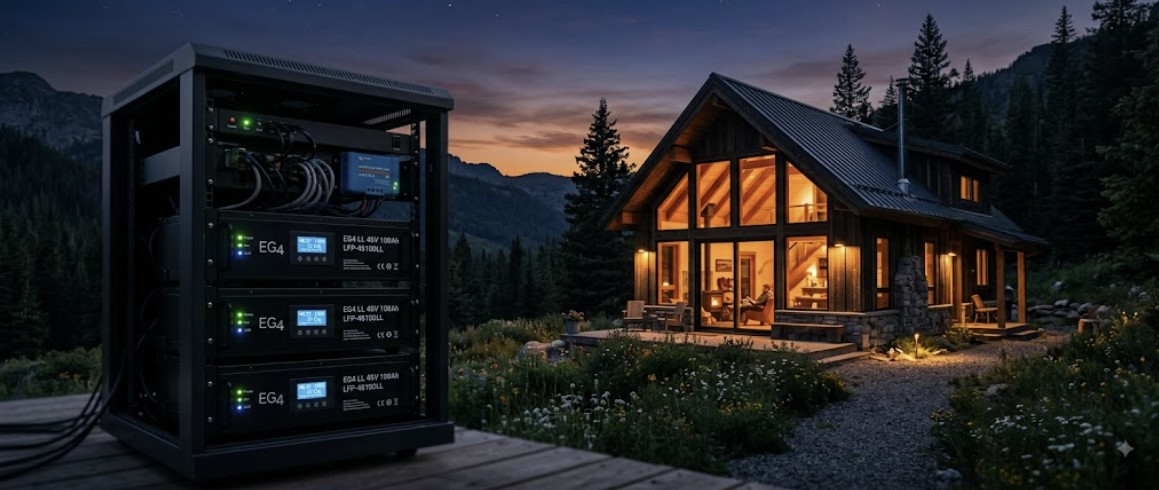
Powering a remote, off-grid cabin demands an energy storage solution that is not just reliable, but exceptionally robust, efficient, and safe. While various battery technologies exist, the engineering consensus points decisively towards a specific architecture for maximum performance. This guide provides a technical deep-dive into why the best 48V server rack LiFePO4 battery for cabins has become the gold standard for achieving true energy independence.
This format combines the superior efficiency of a 48-volt nominal system with the unmatched safety and longevity of Lithium Iron Phosphate (LiFePO4) chemistry. Its modular, rack-mountable design ensures a clean, space-saving, and scalable installation, perfectly suited for the unique constraints of a cabin environment.
Table of Contents
Why Choose the Best 48V Server Rack LiFePO4 Battery for Cabins? Core Engineering Advantages
The decision to build your cabin’s power system around a 48V LiFePO4 server rack battery is based on fundamental principles of electrical engineering and material science. This configuration delivers tangible benefits in efficiency, safety, and long-term cost of ownership that older technologies simply cannot match. It is the definitive choice when seeking the best 48V server rack LiFePO4 battery for cabins.
The Superiority of 48V Systems
Higher system voltage is inherently more efficient. According to Ohm’s Law (P = V × I), for a given power (P), a higher voltage (V) results in a lower current (I). Lower current minimizes resistive losses (heat) in wiring, allowing for the use of smaller, less expensive cables and increasing the overall round-trip efficiency of your energy storage.
LiFePO4 Chemistry vs. Lead-Acid
LiFePO4 stands apart from other lithium-ion chemistries and traditional lead-acid batteries due to its thermal stability and exceptional cycle life. It is the safest lithium chemistry available, making it the ideal core for the best 48V server rack LiFePO4 battery for cabins where unattended operation is common. The performance differences are stark.
| Feature | LiFePO4 (LFP) | Sealed Lead-Acid (AGM) |
|---|---|---|
| Cycle Life (at 80% DoD) | 6,000+ cycles | 500-1,000 cycles |
| Usable Capacity (DoD) | 80-100% | 50% recommended |
| Round-trip Efficiency | ~95% | ~80-85% |
| Safety | Extremely stable, no off-gassing | Risk of hydrogen off-gassing if overcharged |
| Maintenance | None required | Periodic terminal cleaning |
Server Rack Form Factor Benefits
The 19-inch server rack format offers unparalleled modularity and organization. Batteries can be stacked vertically in a secure, enclosed cabinet, minimizing the system’s footprint—a critical advantage in smaller cabins. This design simplifies wiring, improves airflow for cooling, and makes scaling the system by adding more batteries a clean and straightforward process.
Critical Technical Specifications for the Best 48V Server Rack LiFePO4 Battery for Cabins
When evaluating different models, you must look beyond the basic voltage and capacity ratings. Several key performance indicators determine whether a specific model is truly the best 48V server rack LiFePO4 battery for cabins. These specifications directly impact the battery’s ability to handle cabin loads, survive environmental conditions, and integrate with other solar components.
The following table outlines the essential engineering parameters to compare when selecting the best 48V server rack LiFePO4 battery for cabins.
| Specification | Importance for Cabin Applications |
|---|---|
| Usable Energy (kWh) | The true measure of energy storage, typically 5.12 kWh for a 100Ah module. This dictates your energy autonomy. |
| Continuous Discharge Current (Amps) | Must be sufficient to power all simultaneous cabin loads. A 100A rating is standard and supports over 5,000 watts continuously. |
| Peak Discharge Current (Amps) | Crucial for starting high-surge loads like well pumps, power tools, or compressors. Look for ratings of 200A or more for at least 5-10 seconds. |
| Low-Temperature Charging Cutoff | An essential BMS safety feature that prevents charging below 32°F (0°C), which can cause permanent damage (lithium plating). |
| Internal Self-Heating | A premium feature that uses incoming charge current to warm the cells, allowing for safe charging in sub-freezing conditions. Critical for four-season cabins. |
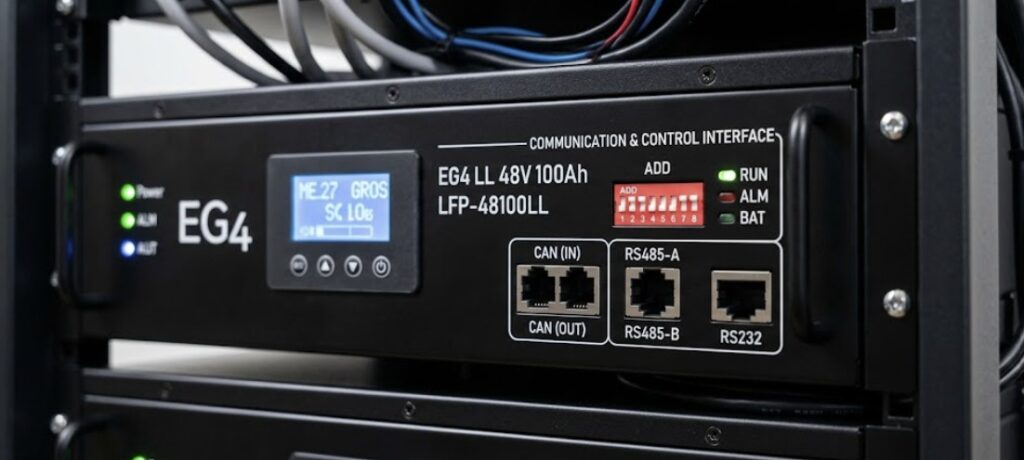
| BMS Communication Protocol | Support for CAN and RS485 allows for “closed-loop” communication with compatible inverters, enabling more accurate state-of-charge reporting and optimized charging. |
Understanding these parameters is key to making an informed engineering decision. A battery with a high peak discharge and self-heating, for example, is far better suited for a year-round mountain cabin than one without these features.
Sizing Your System: Calculating the Right Capacity
Properly sizing your battery bank is the most critical calculation in designing a reliable off-grid system. Under-sizing leads to power outages and premature battery degradation, while over-sizing results in unnecessary expense. The goal is to store enough energy to power your cabin through a predetermined number of sunless days, known as “days of autonomy.”
First, conduct a thorough load analysis by listing every appliance, its wattage, and its daily runtime. A detailed guide on this can be found in our solar panel to LiFePO4 battery sizing guide. This process will help you select the best 48V server rack LiFePO4 battery for cabins.
| Appliance | Power (Watts) | Hours/Day | Daily Energy (Wh) |
|---|---|---|---|
| LED Lights (x8) | 80 | 4 | 320 |
| Efficient Refrigerator | 120 | 8 (duty cycle) | 960 |
| Water Pump | 500 | 0.5 | 250 |
| Laptop & Phone Charging | 100 | 3 | 300 |
| Total Daily Usage | 1,830 Wh (1.83 kWh) |
With your daily usage calculated, use the following formula to determine the required battery bank capacity:
Total Capacity (kWh) = (Daily Usage kWh × Days of Autonomy) / (Depth of Discharge × System Efficiency)
For our example, targeting 3 days of autonomy with a LiFePO4 battery (90% DoD) and 90% system efficiency: (1.83 kWh × 3) / (0.90 × 0.90) = 6.78 kWh. This means you would need two 5.12 kWh server rack batteries to meet this requirement safely.
Top 2 Models: The Best 48V Server Rack LiFePO4 Battery for Cabins in 2026
Several manufacturers produce high-quality server rack batteries, but a few stand out for their robust engineering, feature sets, and proven reliability in off-grid applications. Here are our top engineering picks for the best 48V server rack LiFePO4 battery for cabins.
1. EG4 LL-S 48V 100Ah Battery
The EG4 LL-S is a top-tier choice, widely respected for its comprehensive feature set and UL certifications. It includes dual onboard fire suppression systems, an accessible 100A BMS, and a user-friendly LCD screen for quick diagnostics without external software.
- Pros: UL 9540A certified, tool-less 100A circuit breaker, integrated self-heating for cold climates, excellent closed-loop communication with many inverters.
- Cons: Can be slightly more expensive than non-UL listed competitors.
[Check Price for EG4 LL-S 48V 100Ah Battery on Amazon]
2. SOK 48V 100Ah Server Rack Battery (SK48v100)
SOK has earned a strong reputation for producing serviceable batteries with high-quality Grade A+ prismatic cells. Their server rack model is prized for its reliability, detachable metal cover for easy service, and a robust 7-year warranty.
- Pros: User-serviceable design, excellent build quality, reliable JBD BMS, integrated self-heating available as an option.
- Cons: Communication compatibility can be more limited than EG4.
[Check Price for SOK 48V 100Ah Server Rack Battery on Amazon]
Integrating with Your Cabin’s Electrical System
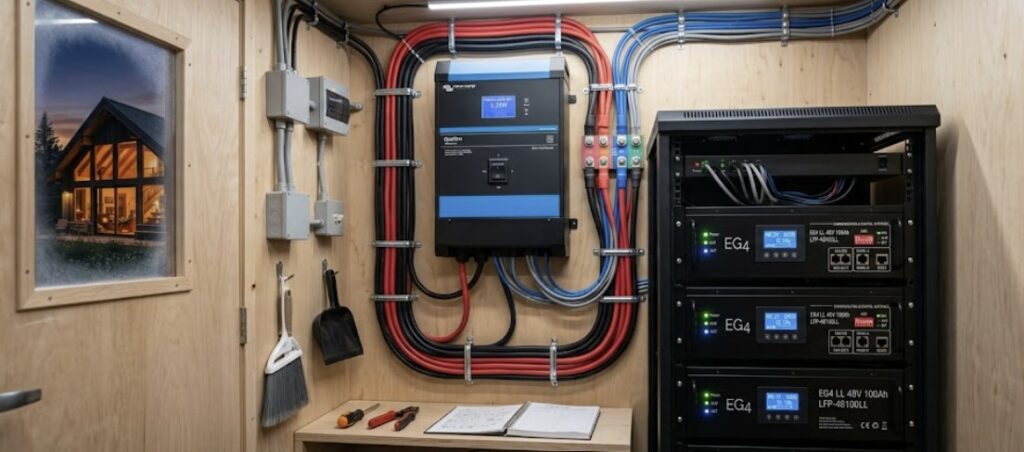
The battery is the core, but it must integrate seamlessly with other key components, primarily the inverter/charger. A high-quality hybrid inverter is essential for converting the battery’s DC power to AC for your appliances and for managing charging from your solar array. To learn more about component selection, our comparison of Renogy and Victron inverters is a valuable resource.
Proper integration is critical when installing the best 48V server rack LiFePO4 battery for cabins. This includes ensuring compatibility between the battery’s BMS and the inverter. Closed-loop communication via CAN or RS485 is highly desirable, as it allows the battery to actively manage the inverter’s charging parameters for optimal performance and longevity. You must also install correct overcurrent protection, such as DC-rated circuit breakers, as part of your off-grid cabin’s electrical panel.
Cold Weather Performance: A Crucial Factor for Cabins
Standard LiFePO4 cells cannot be safely charged at temperatures below freezing (32°F / 0°C). Attempting to do so can cause irreversible damage known as lithium plating, which permanently reduces capacity and can create internal short circuits. This is a non-negotiable principle of battery chemistry that must be addressed in any four-season cabin design.
This is why choosing the best 48V server rack LiFePO4 battery for cabins often means selecting a model with an integrated self-heating function. These smart batteries use a small amount of power from the incoming solar charge to warm the cells to a safe temperature before allowing the full charge current to flow. For a deep-dive on managing this, read our guide on winter charging for lithium batteries. Without this feature, you must keep the battery bank in a heated or well-insulated space that never drops below freezing.
Installation and Safety Best Practices According to NEC Standards
Installing any high-capacity battery bank requires strict adherence to safety protocols. The National Electrical Code (NEC), particularly Article 480, provides guidelines for stationary battery installations. Key safety considerations include proper overcurrent protection (fuses or breakers), adequate ventilation to dissipate heat, and secure mounting within a rack or enclosure.
All connections must be torqued to the manufacturer’s specifications to prevent loose, high-resistance connections that can generate dangerous heat. According to research from the National Renewable Energy Laboratory (NREL), thermal runaway events, while rare in LiFePO4, are often initiated by external factors like faulty wiring or physical damage. Ensuring a professional, code-compliant installation is the best way to guarantee the safety and longevity of your chosen best 48V server rack LiFePO4 battery for cabins.
Frequently Asked Questions
How many batteries are needed for a typical off-grid cabin?
The number of batteries required depends entirely on your daily energy consumption (kWh) and desired days of autonomy (backup time). A small, weekend-use cabin might only need one or two 5.12 kWh modules, while a larger, full-time residence could require four or more. The first step is always to perform a detailed load calculation to determine your energy needs before selecting the best 48V server rack LiFePO4 battery for cabins.
What is the expected lifespan of these batteries?
A high-quality LiFePO4 battery is rated for over 6,000 charge-discharge cycles while retaining at least 80% of its original capacity. In a typical off-grid cabin application where the battery is cycled daily, this translates to a service life of 15 years or more, making the total cost of ownership for the best 48V server rack LiFePO4 battery for cabins significantly lower than that of lead-acid alternatives that need replacement every 3-5 years.
Can I mix and match different brands or ages of server rack batteries?
It is strongly discouraged by engineers to mix batteries of different brands, capacities, or ages in the same parallel string. Even minor differences in internal resistance or BMS behavior can lead to imbalanced charging and discharging, causing premature degradation of the entire bank. For optimal performance and safety, always use identical models when building or expanding the best 48V server rack LiFePO4 battery for cabins.
What kind of solar inverter works best with these batteries?
A 48V hybrid or all-in-one inverter with a built-in solar charge controller is the ideal match. Look for models from reputable brands like Victron, Sol-Ark, or Growatt that support LiFePO4 charge profiles and, ideally, offer closed-loop communication (CAN/RS485) with your battery’s BMS. This ensures the system operates as an integrated unit when using the best 48V server rack LiFePO4 battery for cabins.
Do I need a specific type of solar charge controller?
If you are not using an all-in-one inverter, you will need a separate MPPT (Maximum Power Point Tracking) solar charge controller that is rated for a 48V battery bank and has a selectable or customizable LiFePO4 charge profile. Proper charge parameters (Bulk/Absorb voltage, Float voltage) are critical for the health of any system built around the best 48V server rack LiFePO4 battery for cabins. Our guide on Victron vs. Renogy charge controllers can help you choose.
How important is the Battery Management System (BMS)?
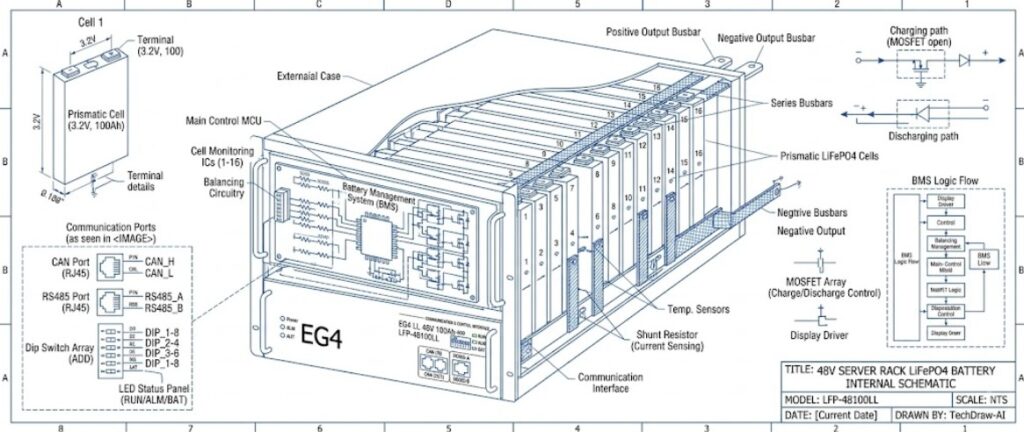
The BMS is arguably the most critical component for safety and longevity. It is a non-negotiable feature of the best 48V server rack LiFePO4 battery for cabins. This onboard computer protects the battery cells from over-voltage, under-voltage, over-current, short circuits, and extreme temperatures. It also manages cell balancing, which ensures all cells within the pack age evenly, maximizing the usable capacity and lifespan.
Is it safe to install the best 48V server rack LiFePO4 battery for cabins myself?
While many off-grid enthusiasts successfully perform DIY installations, working with a 48V DC system requires a solid understanding of electrical principles and safety procedures. The stored energy is significant and can be dangerous if mishandled. If you are not completely confident in your ability to follow schematics, torque connections correctly, and install proper overcurrent protection, it is always safer to hire a qualified solar installer for your best 48V server rack LiFePO4 battery for cabins.
What happens if one battery fails in a large parallel bank?
In a properly designed system, a failing battery’s BMS should disconnect it from the parallel bus to prevent it from affecting the other units. The remaining batteries will continue to operate, though with reduced overall capacity. High-quality models of the best 48V server rack LiFePO4 battery for cabins often have visual indicators (LEDs or an LCD screen) to help you quickly identify the faulted unit for troubleshooting or replacement.
How does extreme heat affect the lifespan of these batteries?
While LiFePO4 is very stable, consistently high ambient temperatures (above 90°F / 32°C) can accelerate calendar aging and slightly reduce long-term cycle life. The BMS will protect the battery by shutting it down if internal temperatures become critical. It is best practice to install the best 48V server rack LiFePO4 battery for cabins in a location that is cool, dry, and has adequate ventilation to maximize its service life.
What is closed-loop communication and why is it important?
Closed-loop communication is a data link (typically via a CAN or RS485 cable) between the battery’s BMS and the system’s inverter. This allows the battery to act as the “master” of the system, providing the inverter with highly accurate data on State of Charge (SoC), voltage, and temperature. The inverter then uses this data to optimize its charging and discharging behavior, resulting in better performance, efficiency, and longevity for the best 48V server rack LiFePO4 battery for cabins.
Can my cabin’s power system run heavy-duty tools?
Yes, a properly sized system can absolutely run demanding power tools. The key is to select a battery with a high peak discharge rating (e.g., 200A for 10 seconds) and an inverter with sufficient surge capacity to handle the motor startup current. Many users of the best 48V server rack LiFePO4 battery for cabins successfully power saws, drills, and even welders at their remote properties.
What is the difference between a server rack battery and a typical ‘drop-in’ LiFePO4 battery?
A ‘drop-in’ battery is designed to fit a standard group size (like a car battery) and often operates at 12V. In contrast, the best 48V server rack LiFePO4 battery for cabins is a self-contained, high-voltage module in a standardized 19-inch rack format. This design offers superior energy density, easier parallel connections with integrated busbars, advanced BMS communication features, and a much cleaner, more scalable installation for stationary power systems.
What is the maintenance schedule for a server rack battery system?
One of the primary advantages of LiFePO4 chemistry is that it is virtually maintenance-free. Unlike flooded lead-acid batteries, there is no need to check water levels or clean corrosion. A best practice for any system using the best 48V server rack LiFePO4 battery for cabins is to conduct an annual visual inspection to check for loose connections, dust buildup, or any signs of physical damage, but no routine chemical maintenance is required.