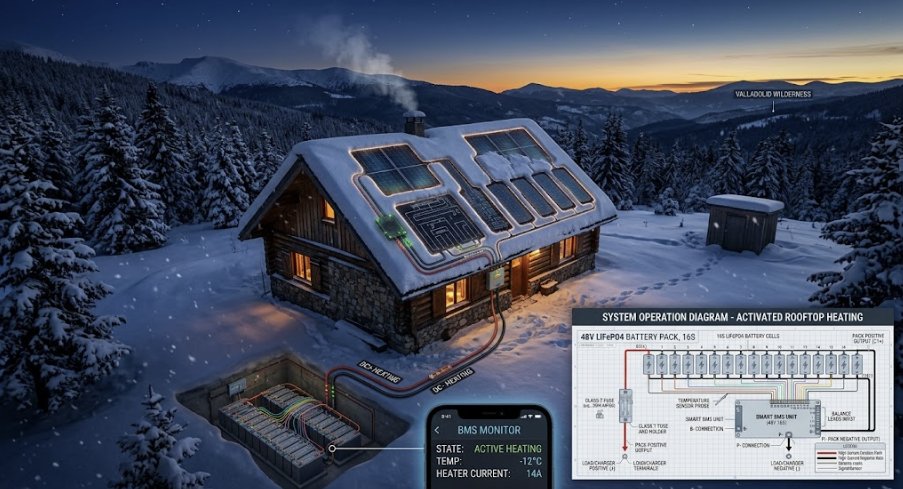
For off-grid cabins and homesteads in snowy climates, solar panels are a lifeline, but their performance is acutely vulnerable to winter weather. A blanket of snow can reduce a panel’s output to virtually zero, crippling an entire power system when energy is needed most.
Manual snow removal is often impractical, dangerous, and can damage the panels. The definitive engineering solution is an active de-icing system, and this guide provides a technical deep-dive into selecting and implementing the best solar panel heat tape for snow removal to ensure maximum energy harvest all winter long.
Table of Contents
The Physics of Solar Panel Snow Occlusion
The impact of snow on photovoltaic (PV) performance is not linear. Even a thin, uniform layer of snow can block the majority of incoming solar irradiance, effectively shutting down energy production.
Beyond simple light obstruction, snow accumulation introduces significant mechanical stress on both the solar panels and their mounting structures. The weight of heavy, wet snow can exceed the load ratings of racking systems, posing a severe structural risk. An effective de-icing system is therefore not just about performance, but also about protecting your hardware investment. This makes finding the best solar panel heat tape for snow removal a critical task for system longevity.
Core Technology: Self-Regulating vs. Constant Wattage Systems
The heating cable market is dominated by two distinct technologies. Understanding their operational differences is fundamental to choosing the best solar panel heat tape for snow removal for a demanding, temperature-sensitive application like a solar array.
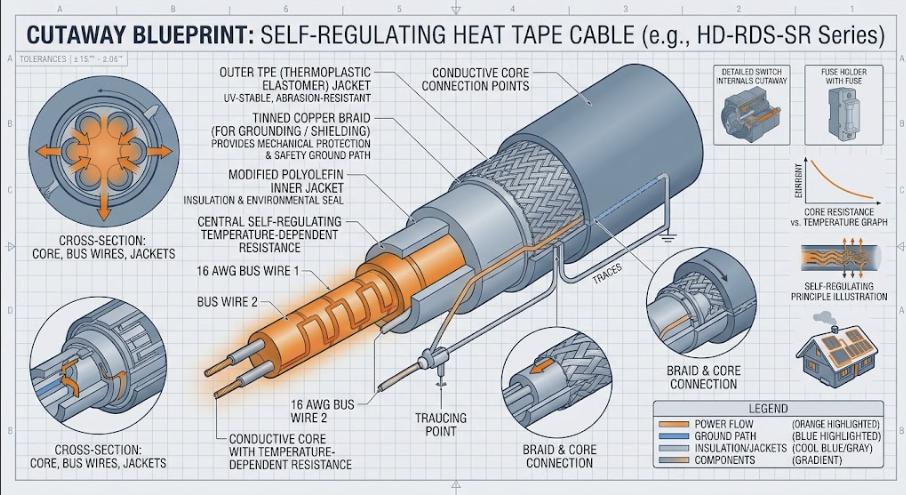
Self-regulating heat tape is the superior choice. It utilizes a special semiconductive polymer core extruded between two parallel bus wires. As the ambient temperature drops, the core contracts, creating more electrical pathways for current to flow, which in turn generates more heat. Conversely, as it warms, the core expands, reducing the number of pathways and lowering heat output. This allows the cable to adjust its power output along its entire length, making it incredibly energy-efficient and safe, as it cannot overheat even when overlapped.
Constant wattage cable is a simpler, less advanced technology. It functions like a standard resistor, producing a fixed amount of heat per foot regardless of the ambient temperature. While cheaper upfront, it consumes significantly more energy over a season and poses a fire risk if overlapped or installed improperly. For any solar application, self-regulating technology is the only professionally recommended option.
The technical parameters for the best solar panel heat tape for snow removal can be compared below:
| Parameter | Self-Regulating Heat Tape | Constant Wattage Heat Tape |
|---|---|---|
| Energy Efficiency | High (Varies output with temperature) | Low (Always at 100% output) |
| Safety (Overlap) | Safe to overlap; will not overheat | Cannot be overlapped; fire hazard |
| Lifespan | 10-20+ years | 5-10 years |
| Control Mechanism | Inherent in cable core; can be enhanced with thermostat | Requires external thermostat for any control |
| Initial Cost | Higher | Lower |
Critical Electrical Calculations for the Best Solar Panel Heat Tape for Snow Removal
Integrating a heat tape system is not a plug-and-play affair. It is a continuous electrical load that must be carefully calculated and provisioned for within your cabin’s power system, especially when running off-grid.
Circuit sizing is paramount. According to the National Electrical Code (NEC), branch circuits supplying continuous loads like de-icing equipment must be sized to 125% of the total load. This means both the wiring and the DC circuit breaker or fuse must be rated for this higher amperage to prevent overheating and nuisance tripping.
For example, if you install 100 feet of 6-watt/foot heat tape on a 120V AC circuit, the calculation is: (100 ft * 6 W/ft) / 120V = 5 Amps. The circuit must be rated for 5A * 1.25 = 6.25 Amps. Therefore, a 15-Amp circuit would be the minimum standard size required. It is crucial to perform these calculations to ensure the safe operation of your best solar panel heat tape for snow removal.
Below is a sample reference table for sizing circuits for a common 120V AC heat tape system.
| Total Cable Length (ft) | Power Output (@ 6 W/ft) | Calculated Load (Amps) | Required Circuit Rating (Amps x 1.25) | Recommended Breaker Size |
|---|---|---|---|---|
| 50 ft | 300 W | 2.5 A | 3.13 A | 15 A |
| 100 ft | 600 W | 5.0 A | 6.25 A | 15 A |
| 150 ft | 900 W | 7.5 A | 9.38 A | 15 A |
| 200 ft | 1200 W | 10.0 A | 12.5 A | 20 A |
Top 3 Best Solar Panel Heat Tape for Snow Removal in 2026
After extensive analysis of technical specifications, material durability, and field performance, we have identified the top-tier products suitable for this demanding application.
1. Radiant Solutions Heat Tape Pro
Heat Tape Pro is an industrial-grade, pre-terminated self-regulating heat cable designed specifically for roof and gutter de-icing, making it perfectly suited for solar panels. Its heavy-duty TPE outer jacket provides exceptional UV and weather resistance, which is critical for the exposed environment of a solar array.
The 16 AWG bus wires ensure minimal voltage drop and robust performance even in very long runs, a key factor when wiring large ground-mounted arrays. We consider this the professional’s choice for the best solar panel heat tape for snow removal.
- Pros: Industrial-grade durability, excellent UV resistance, available in long pre-terminated lengths (up to 150 ft), 10-year warranty.
- Cons: Higher initial cost compared to consumer-grade kits.
[Check Price for Radiant Solutions Heat Tape Pro on Amazon]
2. Frost King RC160 Automatic Electric Roof Cable Kit
The Frost King kit is a highly accessible, consumer-friendly option ideal for smaller solar arrays or DIY installers. It comes as a complete, pre-assembled kit with a built-in thermostat and roof clips included, simplifying the installation process significantly.
While not as robust as industrial-grade cables, its self-regulating technology and UL-listed status provide a safe and effective solution for residential-scale off-grid cabins. This is a solid contender for the best solar panel heat tape for snow removal on a budget.
- Pros: Affordable all-in-one kit, easy for DIY installation, built-in thermostat for automatic operation.
- Cons: Lighter-duty construction, shorter lifespan than premium options, limited length choices.
[Check Price for Frost King RC160 on Amazon]
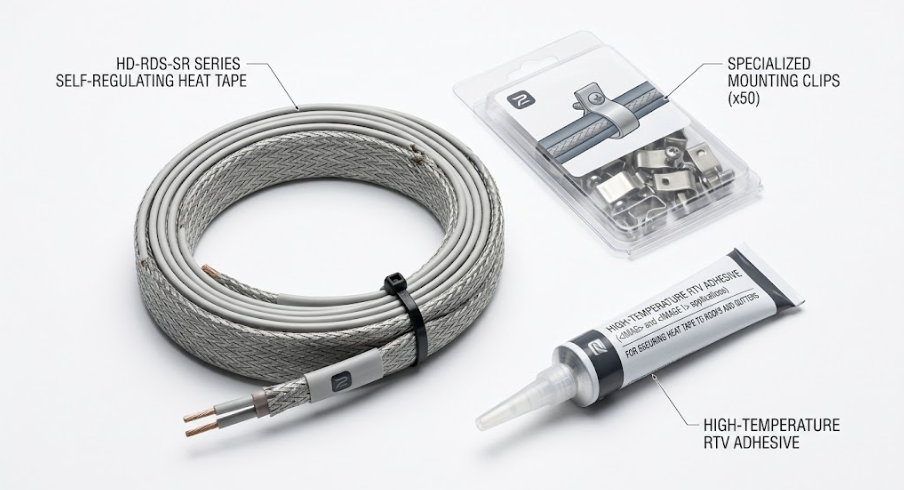
3. HEATIT Self-Regulating Pipe Heating Cable
Although marketed for pipe freeze protection, the Bylin self-regulating cable has the specifications required for solar panel use. Its key advantage is a slightly higher power output, typically in the 7-8 watt per foot range, which can provide faster melting in extremely cold or heavy snow regions.
The cable’s construction is durable and designed for direct weather exposure. When paired with appropriate roofing clips and a quality external thermostat, it becomes a high-performance system. This is an excellent choice if you need maximum melting power from the best solar panel heat tape for snow removal.
- Pros: Higher wattage output for faster melting, very durable construction, excellent value.
- Cons: Requires purchase of separate clips and a thermostat controller.
[Check Price for HEATIT Self-Regulating Heating Cable on Amazon]
Engineering Your Installation: Mounting and Wiring
Proper installation is just as important as product selection. A poorly mounted or wired system will fail prematurely and could pose a safety hazard. Protecting your investment in the best solar panel heat tape for snow removal requires adherence to engineering best practices.
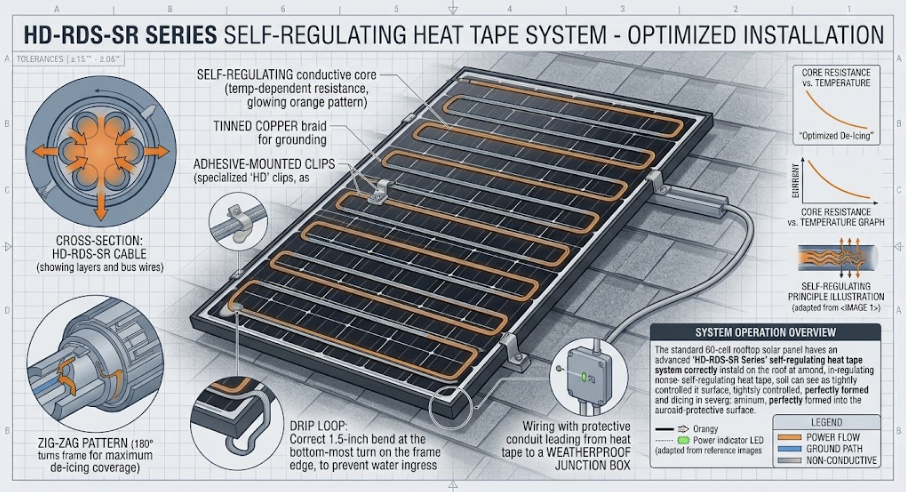
The preferred mounting strategy is a serpentine or zig-zag pattern across the panel face. This provides broad heat distribution. The cable should be secured with purpose-built roofing clips, which can be affixed to the aluminum panel frame using a high-temperature, UV-stable construction adhesive like SB-190. Never drill into the solar panel frame, as this will void the manufacturer’s warranty and can compromise its structural integrity.
For maximum energy savings, the system must be automated. Do not simply plug the heat tape in and leave it running all winter. A dedicated NEMA-rated outdoor thermostatic controller or a heavy-duty smart plug with temperature and moisture sensors will ensure the system only activates when conditions are right (e.g., below 38°F and moisture is present), drastically reducing the impact on your off-grid cabin’s electrical panel and power budget.
Consider this checklist for a successful installation of the best solar panel heat tape for snow removal.
| Component | Specification / Purpose |
|---|---|
| Mounting Clips | UV-resistant, non-penetrating (e.g., adhesive-mount or frame clips). |
| Adhesive | Industrial grade, UV-stable, rated for -40°F to 180°F. |
| Thermostatic Controller | NEMA 3R or 4X rated for outdoor use. Senses temperature and/or moisture. |
| Junction Box | Weatherproof (NEMA 3R minimum) for all electrical connections. |
| GFCI Protection | Mandatory for personnel safety on all de-icing circuits. |
Power Consumption Analysis for Off-Grid Systems
The energy required to run a de-icing system is a significant load that must be accounted for in your off-grid energy budget. Ignoring this consumption can lead to depleted batteries and system shutdowns during critical winter months.
A typical solar array of eight 400-watt panels might require approximately 20 feet of heat tape per panel. At 6 watts per foot, the total continuous load would be (8 panels * 20 ft/panel) * 6 W/ft = 960 Watts. If a snowstorm requires the system to run for 8 hours overnight, the total energy consumption would be 960 W * 8 h = 7.68 kWh. This single event could consume a substantial portion of a typical 48V LiFePO4 battery bank’s capacity.
Therefore, it’s essential to perform these calculations and ensure your solar battery bank and charging capabilities are sufficient. In many cases, running an inverter generator during or after a storm to power the heat tape and recharge batteries is a practical strategy. The best solar panel heat tape for snow removal is only effective if you can afford the energy to power it.
Conclusion: A Systems-Based Approach
Maximizing winter solar production is achievable with a properly engineered de-icing system. The solution goes beyond simply buying a product; it requires a holistic approach that considers electrical physics, material science, and careful energy budgeting.
By selecting a high-quality, self-regulating cable, sizing your electrical circuits according to NEC standards, implementing an intelligent control strategy, and accounting for the power consumption, you can build a reliable system. The best solar panel heat tape for snow removal is the one that is integrated seamlessly and safely into your unique off-grid power plant, ensuring you have the energy you need, no matter the weather.
Frequently Asked Questions
Can I use standard pipe heat tape on my solar panels?
While some high-quality, self-regulating pipe heat tapes are suitable, you must verify their specifications carefully. The cable must have a UV-resistant outer jacket (typically TPE or modified polyolefin) to withstand direct, prolonged sun exposure on a roof, which is far more intense than under pipe insulation. Constant wattage pipe heating cables should never be used on solar panels due to the significant risk of overheating and creating hot spots that can permanently damage the PV cells, making it a poor choice for the best solar panel heat tape for snow removal.
How much power does solar panel heat tape consume?
Power consumption is calculated based on the cable’s wattage per foot and the total length installed. Most self-regulating cables for this purpose are rated between 5 and 8 watts per foot at 32°F (0°C). For example, if you install 120 feet of 6-watt/foot cable, the total load will be 720 watts (120 ft x 6 W/ft) when active. Factoring this continuous load into your off-grid energy budget is a critical step when designing a system using the best solar panel heat tape for snow removal.
Will heat tape damage my solar panels or void the warranty?
If installed correctly, heat tape will not damage solar panels. The key is to never use mechanical fasteners that penetrate the panel frame, such as screws or rivets, as this will immediately void most manufacturer warranties. Always use approved, non-penetrating mounting methods like high-bond adhesive with specialized clips. The operating temperature of the best solar panel heat tape for snow removal is well within the thermal tolerance of modern PV panels and will not cause damage from heat alone.
What is the ideal temperature to turn on solar panel heat tape?
The optimal activation temperature is typically between 35°F and 38°F (1.7°C to 3.3°C). Turning the system on just above freezing allows the panels to warm up before precipitation begins, preventing an initial layer of ice or snow from bonding to the surface. Using a thermostatic controller with a moisture sensor is the most efficient method, as it ensures the system only runs when both temperature and precipitation conditions are met, saving considerable energy when considering the best solar panel heat tape for snow removal.
How do I control the heat tape in an off-grid system?
In an off-grid system, energy conservation is paramount. The best control method is a combination of a dedicated, hardwired thermostatic controller (rated for outdoor use) and a manual override switch. For advanced systems, a heavy-duty smart plug connected to your inverter’s AC output, controlled via a local Wi-Fi network (perhaps from a Starlink system), can allow for remote activation and scheduling based on weather forecasts, providing ultimate control over your best solar panel heat tape for snow removal.
Is DC or AC heat tape better for solar panels?
The vast majority of commercially available, high-quality self-regulating heat tape is designed for AC voltage (120V or 240V). While some low-voltage DC options exist, they are less common, typically have lower power output, and are harder to source. For most off-grid solar systems, it is more practical and effective to use standard 120V AC heat tape powered by your system’s inverter. This approach provides more product options and higher performance, which is why AC models dominate the market for the best solar panel heat tape for snow removal.
How many feet of heat tape do I need per solar panel?
The required length depends on the panel dimensions and the mounting pattern. For a typical 77×40 inch panel, a serpentine (S-shaped) pattern with two or three horizontal runs is effective. This usually requires between 15 and 25 feet of cable per panel to provide adequate coverage. The primary goal is to create cleared channels for snow to slide off and prevent an ice dam from forming at the bottom edge, a critical design factor for the best solar panel heat tape for snow removal.
Can I install solar panel heat tape myself?
A person with strong DIY skills and a solid understanding of electrical safety can often install a pre-terminated heat tape kit. However, any hardwired connections to your electrical system, especially connecting to a breaker in your electrical panel, should be performed by a qualified electrician to ensure it complies with the NEC and local codes. Safety is the top priority when working with any system, including the best solar panel heat tape for snow removal.
What is the lifespan of the best solar panel heat tape for snow removal?
The lifespan of a high-quality, self-regulating heat cable is typically 10 to 20 years, with some industrial-grade products lasting even longer. The primary factors affecting longevity are the quality of the outer jacket material and its resistance to UV degradation and extreme weather cycling. Constant wattage cables generally have a much shorter lifespan, often failing within 5 to 10 years, which is another reason self-regulating models are considered the best solar panel heat tape for snow removal.
Does the color of the heat tape outer jacket matter?
Yes, the color, or more specifically the material’s composition, is critical. A black outer jacket is standard because it indicates the material contains carbon black, which is a highly effective UV inhibitor. This additive is essential for protecting the polymer jacket from breaking down under years of intense sun exposure on a rooftop. A cable that is not black or explicitly rated for continuous sun exposure will become brittle and fail quickly, so this is a key specification when choosing the best solar panel heat tape for snow removal.
How do I test if my solar panel heat tape is working correctly?
Before winter, you can perform a simple functional test. On a cool day, plug the system in and wait 10-15 minutes; the cable should feel noticeably warm to the touch. For a more technical verification, a qualified electrician can use a clamp-on ammeter to measure the current draw of the circuit when active, which should align with the calculated load based on the cable’s length and wattage rating. Verifying proper amperage is a definitive way to test the functionality of the best solar panel heat tape for snow removal.
What are the NEC requirements for installing heat tape on a roof?
The primary NEC requirements revolve around safety. Article 426 covers Fixed Outdoor Electric De-Icing and Snow-Melting Equipment. It mandates that all systems must have Ground-Fault Circuit Interrupter (GFCI) protection for personnel. It also requires that circuits be sized to at least 125% of the total connected load, as it is considered a continuous load. Adherence to these codes is non-negotiable for a safe and compliant installation of the best solar panel heat tape for snow removal.
Can I power heat tape directly from a solar panel?
No, you cannot and should not attempt to power heat tape directly from a solar panel. A solar panel’s output (voltage and current) is highly variable and depends on sunlight intensity, which is precisely when heat tape is not needed. Heat tape requires a stable, regulated power source, which in an off-grid system is the battery bank (via an inverter for AC tape or a DC-DC converter for DC tape). An inverter and battery system provide the consistent power needed to operate the best solar panel heat tape for snow removal effectively during a storm, often at night or in low-light conditions.