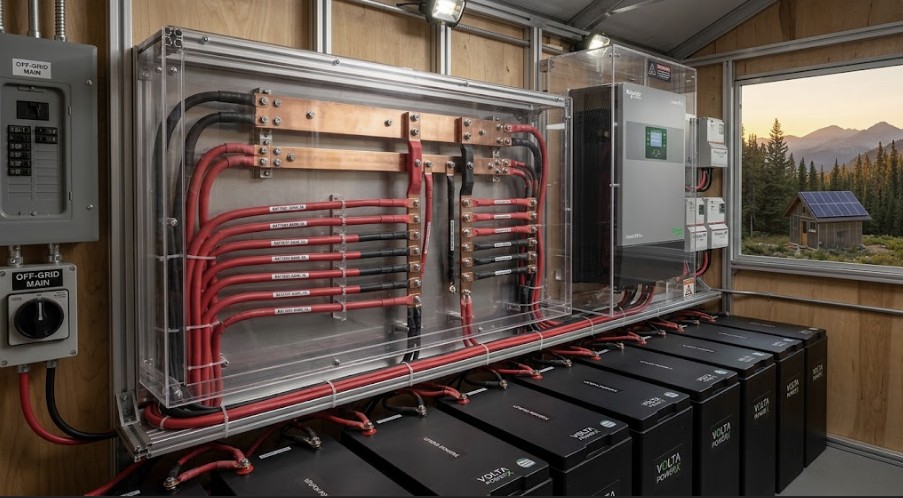
In high-power off-grid solar systems, the bus bar is not merely a component; it is the central nervous system of your battery bank. Selecting the wrong hardware introduces inefficiency, thermal risks, and a critical point of failure that can jeopardize your entire power infrastructure.
This guide moves beyond simple product recommendations to provide the engineering formulas, material science, and safety protocols required to specify the truly best solar bus bar for high amperage battery banks. We will dissect the physics of ampacity, compare conductor materials, and apply industry-standard calculations for a safe, reliable, and efficient power distribution hub.
Table of Contents
Why Your Bus Bar Choice is Critical for System Safety and Performance
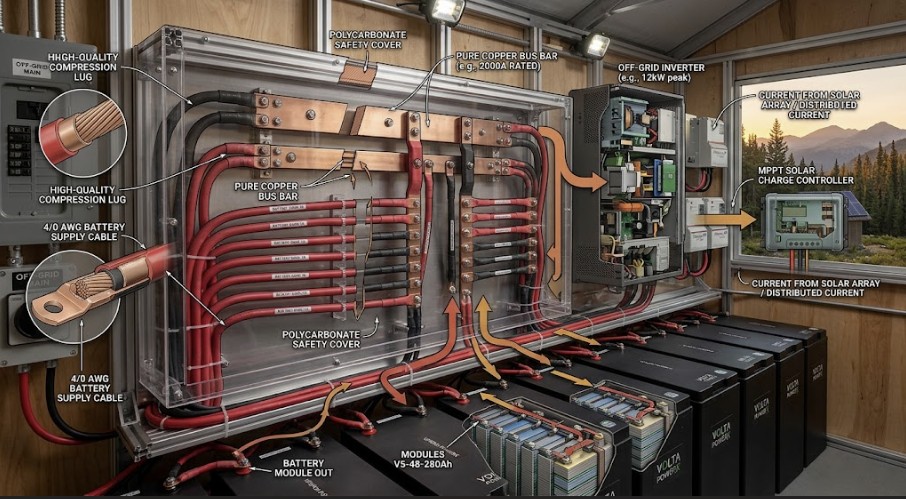
A bus bar serves as a common electrical junction, consolidating multiple large cables from your battery bank and distributing power to inverters, charge controllers, and DC load centers. Its primary function is to provide a low-resistance path for massive current flow.
A poorly chosen or undersized bus bar becomes a resistor, generating significant heat under load. This leads to dangerous voltage drop, wasted energy, and potential thermal runaway. Choosing the best solar bus bar for high amperage battery banks is a foundational step in building a robust electrical system.
The Physics of Failure: Voltage Drop and I²R Heating
Every connection point has resistance. According to Ohm’s Law and the power formula (P = I²R), the power lost as heat increases with the square of the current. In a system pulling 300A, even a tiny resistance of 0.0001 ohms (100 micro-ohms) results in 9 watts of continuous heat generation.
An undersized bus bar exhibits higher resistance, turning it into a heating element that degrades cable insulation and poses a fire risk. The best solar bus bar for high amperage battery banks is engineered to minimize this resistance, ensuring maximum power reaches your loads.
Conductor Material Science: Copper vs. Aluminum Explained
The material of your bus bar directly dictates its performance, size, and cost. While several materials exist, the primary choices for off-grid solar applications are copper and aluminum, often with specific plating to enhance connectivity and prevent corrosion.
Selecting the material is a key factor when looking for the best solar bus bar for high amperage battery banks. The choice impacts both electrical efficiency and long-term mechanical reliability, particularly when connecting to aluminum battery terminals, a common scenario in many DIY builds.
Comparing Key Electrical and Thermal Properties
The most critical properties for a bus bar are its electrical conductivity (how easily it carries current) and thermal conductivity (how well it dissipates heat). C110 Electrolytic Tough Pitch (ETP) Copper is the industry benchmark for performance.
The table below outlines the essential parameters for evaluating the best solar bus bar for high amperage battery banks.
| Property | C110 Copper | 6061-T6 Aluminum | Engineering Implication |
|---|---|---|---|
| Electrical Conductivity (S/m) | 5.96 × 10⁷ | ~3.77 × 10⁷ (Approx. 61% of Copper) | Copper carries more current for the same size. Aluminum requires a larger cross-section for equivalent ampacity. |
| Thermal Conductivity (W/m·K) | 401 | 237 | Copper dissipates I²R heat more effectively, running cooler under heavy load. |
| Oxidation Resistance | Moderate (Forms conductive oxides) | Low (Forms a hard, insulating oxide layer) | Aluminum requires surface preparation and anti-oxidant paste (e.g., Noalox) for reliable connections. |
| Cost & Weight | High & Heavy | Low & Light | Aluminum is cheaper and lighter, but requires more material for the same performance. |
The Role of Plating: Tin and Nickel
Plating is not just for appearance; it is a crucial engineering feature. Tin-plating is the most common and effective surface treatment for copper bus bars used in battery systems.
It provides excellent corrosion resistance and prevents galvanic corrosion when connecting copper bus bars to aluminum battery terminals. Nickel-plating offers superior durability and wear resistance but is less common and more expensive. When seeking the best solar bus bar for high amperage battery banks, tin-plated copper is the gold standard.
How to Calculate and Size the Best Solar Bus Bar for High Amperage Battery Banks
Proper sizing is not a guess; it is a calculation based on thermal physics. A bus bar’s ability to carry current (ampacity) is limited by its ability to dissipate heat without exceeding a specific temperature rise.
Unlike simple wire gauge charts, bus bar ampacity depends heavily on its shape and mounting orientation. The best solar bus bar for high amperage battery banks must have an adequate cross-sectional area and surface area to remain cool.
The Ampacity Formula: A Simplified Engineer’s Approach
While precise calculations are complex, a widely accepted empirical formula helps estimate ampacity based on allowable temperature rise. This is fundamental to specifying the best solar bus bar for high amperage battery banks.
The formula is: I = K × A × (ΔT)⁰.⁶²⁵ × (P / A)⁰.⁵ × F_mountThis equation considers material properties, physical dimensions, and installation environment to determine a safe continuous current rating. A breakdown of these variables helps clarify how the best solar bus bar for high amperage battery banks is selected.
| Variable | Description | Example Value / Note |
|---|---|---|
| I | Current Rating (Amperes) | This is the value we are solving for. |
| K | Material Constant | ~0.0804 for Copper, ~0.0674 for Aluminum. |
| A | Cross-Sectional Area (mm²) | Calculated as Width (mm) × Thickness (mm). |
| ΔT | Temperature Rise (°C) | (Max Operating Temp – Ambient Temp). A common target is 30°C rise. |
| P | Perimeter (mm) | Calculated as 2 × (Width + Thickness). A larger perimeter dissipates more heat. |
| F_mount | Mounting Factor | 1.0 for horizontal, 0.85 for vertical, 0.70 for enclosed. |
Simplified Rule of Thumb for Sizing
For quick estimations in open-air conditions, engineers often use current density rules. These are not a substitute for proper thermal calculations but provide a good starting point.
A common rule for copper is approximately 1.2 Amperes per square millimeter (A/mm²) of cross-sectional area. For a 300A system, you would need a bus bar with a cross-section of at least 300A / 1.2 A/mm² = 250 mm². A bar measuring 50mm wide by 5mm thick would be a suitable starting point for evaluation. This simplification helps narrow down options for the best solar bus bar for high amperage battery banks.
Top Rated Models: The Best Solar Bus Bar for High Amperage Battery Banks
Several manufacturers produce high-quality bus bars suitable for demanding off-grid solar applications. The key selection criteria are material (tin-plated copper), a high continuous amperage rating, a robust and insulated base, and high-quality stainless steel hardware (studs, washers, nuts).
We’ve analyzed the market to identify top contenders that qualify as the best solar bus bar for high amperage battery banks based on engineering principles and user feedback.
1. Victron Energy Lynx Distributor
The Lynx Distributor is more than a simple bus bar; it is a modular power distribution system. It features a 1000A rated copper bus bar with space for four individual mega fuses, providing both connection and protection in one unit.
Its professional, enclosed design and integration with the Victron ecosystem make it an exceptional, albeit premium, choice. For those building a high-end system with components from a single manufacturer like in a Renogy vs. Victron comparison, this is a top-tier option.
- Pros: Extremely high 1000A rating, integrated fusing, modular and expandable, high safety enclosure.
- Cons: Significantly more expensive than traditional bus bars, larger footprint.
[Check Price for Victron Lynx Distributor on Amazon]
2. Blue Sea Systems 600A PowerBar
Blue Sea Systems is a trusted name in marine and off-grid electrical components. Their 600A PowerBar is a purpose-built, heavy-duty bus bar featuring a 5/16″ thick tin-plated copper conductor for maximum conductivity and corrosion resistance.
The robust insulated base and included cover ensure safety and compliance with industry standards. Its straightforward, high-quality construction makes it a leading candidate for the best solar bus bar for high amperage battery banks.
- Pros: High 600A continuous rating, excellent build quality, thick tin-plated copper bar, trusted brand.
- Cons: Premium pricing for a non-fused bus bar.
[Check Price for Blue Sea Systems 600A PowerBar on Amazon]
3. IZTOSS 600A Heavy-Duty Bus Bar
This option offers incredible value for high-amperage applications. The IZTOSS 600A Heavy-Duty Bus Bar uses a nickel-plated pure copper bar, offering strong conductivity and durability. It comes in various stud configurations (e.g., 8 x M10 studs) to accommodate complex systems with many parallel battery connections.
Users praise its heavy-duty feel and robust construction, which rivals more expensive brands. When evaluating the best solar bus bar for high amperage battery banks, it’s critical to verify the seller is providing the copper version, as lower-rated brass versions also exist.
- Pros: Excellent price-to-performance ratio, high 600A rating, multiple stud configurations available, very solid build.
- Cons: Must confirm material is copper and not brass from the specific listing.
[Check Price forIZTOSS 600A Heavy-Duty Bus Bar on Amazon]
Product Comparison Matrix
This table provides a direct comparison of the specifications for what many consider the best solar bus bar for high amperage battery banks.
| Feature | Victron Lynx Distributor | Blue Sea Systems 600A PowerBar | AMOMD Marine 600A |
|---|---|---|---|
| Continuous Amp Rating | 1000A | 600A | 600A |
| Bar Material | Tin-Plated Copper | Tin-Plated Copper | Nickel-Plated Copper |
| Integrated Fusing | Yes (4 x MEGA Fuse) | No | No |
| Base Material | Reinforced Fiberglass | Reinforced Nylon | ABS Plastic |
| Price Point | Very High | High | Moderate |
Installation, Safety, and NEC Compliance
Installing your bus bar correctly is just as important as selecting the right one. A poor connection can create a high-resistance point, negating the benefits of a high-quality component.
Adherence to safety standards, such as those outlined by the National Electrical Code (NEC) and NFPA 70E, is paramount, especially in high-amperage DC systems where arc flash is a potential hazard.
Critical Installation Steps
First, ensure all surfaces are clean. The bus bar contact surface and the cable lug should be free of dirt, oil, and oxidation. For aluminum-to-copper connections, applying a thin layer of conductive anti-oxidant paste is mandatory to prevent long-term corrosion.
Second, use the correct hardware sequence: place the largest cable lug directly on the bus bar, followed by smaller lugs, a flat washer, a split lock washer, and finally the nut. This ensures maximum surface contact and prevents loosening from vibration.
Torque Specifications: The Most Overlooked Detail
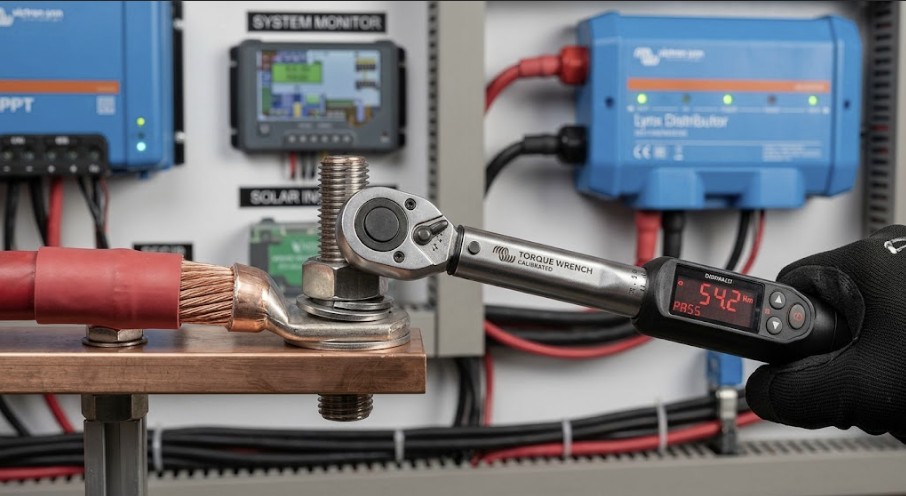
Under-tightening a connection creates a loose, resistive interface, while over-tightening can damage the stud or the bus bar’s base. Always use a calibrated torque wrench and adhere to the manufacturer’s specifications for the hardware size (e.g., M8 or M10 studs).
Failure to apply proper torque is a leading cause of electrical fires in DC systems. This step is non-negotiable for anyone installing the best solar bus bar for high amperage battery banks.
Compliance with NEC Article 320 for Battery Rooms
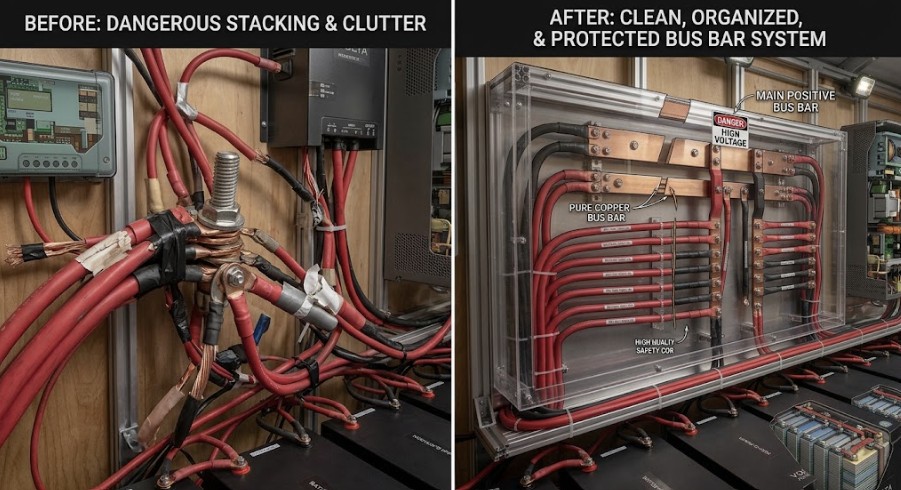
While the NEC does not explicitly forbid bare bus bars in all contexts, their use as open wiring in residential settings under 1000V is highly restricted. For off-grid cabins and homes, bus bars must be part of a listed assembly with a protective enclosure or cover.
Per NFPA 70E Article 320, battery rooms must be accessible only to authorized personnel, and all work on battery systems should be treated as energized work. A robust, covered bus bar is a key part of the required risk mitigation strategy and is a defining feature of the best solar bus bar for high amperage battery banks.
Properly sizing your power system, from the solar panels and LiFePO4 battery bank to the final load, ensures that every component, including the bus bar, operates safely within its design limits.
Final Engineering Verdict
The quest for the best solar bus bar for high amperage battery banks concludes with a clear set of engineering principles, not a single product. The ideal choice is always a generously sized, tin-plated copper bar mounted on a high-quality insulated base with a protective cover.
For most DIY and professional off-grid builders, the Blue Sea Systems 600A PowerBar or the AMOMD Marine 600A copper model provide the perfect balance of performance, safety, and value. For complex, high-budget systems, the Victron Lynx Distributor offers unparalleled integration and protection. Ultimately, applying the sizing calculations and installation best practices detailed in this guide will ensure your power distribution hub is a source of reliability, not a point of failure.
Frequently Asked Questions
What is the main advantage of using copper for a solar bus bar?
The primary advantage of using copper is its superior electrical and thermal conductivity compared to other common materials like aluminum. For a given cross-sectional area, a copper bus bar can carry significantly more current while generating less heat, which is a critical safety and efficiency factor when selecting the best solar bus bar for high amperage battery banks. This high conductivity allows for a more compact design for the same ampacity rating, which is beneficial in space-constrained electrical enclosures common in off-grid systems.
How does temperature affect the ampacity of a bus bar?
Temperature is a critical limiting factor for a bus bar’s ampacity, which is its maximum current-carrying capacity. As current flows, resistive (I²R) losses generate heat, and the bus bar’s temperature rises until it reaches thermal equilibrium with the surrounding air. A higher ambient temperature reduces the allowable temperature rise (ΔT), thereby lowering the safe continuous current a bus bar can handle. This is why properly sizing for your specific environment is essential when choosing the best solar bus bar for high amperage battery banks, as a unit installed in a hot, enclosed cabinet will have a lower effective ampacity than one in a cool, well-ventilated area.
Why is tin-plating important for the best solar bus bar for high amperage battery banks?
Tin-plating serves two crucial functions for a bus bar in a battery system. First, it provides excellent resistance to corrosion and oxidation, ensuring a low-resistance connection over many years, especially in humid or marine environments. Second, and most importantly, it prevents galvanic corrosion, a destructive electrochemical process that occurs when dissimilar metals like copper and aluminum are in direct contact, which is common when connecting a copper bus bar to the aluminum terminals found on many LiFePO4 cells. Therefore, tin-plating is a non-negotiable feature for the best solar bus bar for high amperage battery banks.
Can I make my own DIY bus bar from copper flat stock?
While it is physically possible to fabricate a bus bar from raw copper flat stock, it is generally not recommended for high-amperage DC systems unless you are an experienced electrical engineer with the proper tools. Commercial bus bars are manufactured to specific standards, use certified conductor grades, come with high-quality, flame-retardant insulated bases, and include protective covers to prevent accidental contact. For safety and liability reasons, purchasing a professionally manufactured and rated product is the safest approach to finding the best solar bus bar for high amperage battery banks.
What happens if I stack too many cable lugs on one bus bar stud?
Stacking too many cable lugs (generally more than four is discouraged) on a single stud creates a mechanically unstable and electrically inefficient connection. The pressure from the nut is distributed unevenly, leading to poor surface contact for the inner lugs and creating high-resistance hot spots. This increases the risk of the connection loosening over time due to thermal cycling and vibration, which can lead to catastrophic failure. A key feature of the best solar bus bar for high amperage battery banks is having enough studs to accommodate all your connections without excessive stacking.
Is a 300A bus bar sufficient for a 3000-watt inverter on a 12V system?
No, a 300A bus bar is likely insufficient and potentially dangerous for a 3000-watt inverter on a 12V system. A 3000W inverter can draw over 250A continuously (3000W / 12V = 250A), and surge currents can be much higher. Electrical code requires components to be sized with a safety margin, typically 125% of the continuous load, which would be 312.5A. Therefore, you should select a bus bar with a continuous rating significantly higher than 300A, such as 450A or 600A, to handle the load safely without overheating. Sizing with this margin is a core principle in selecting the best solar bus bar for high amperage battery banks.
Do I need to use an anti-oxidant paste with a tin-plated bus bar?
If you are connecting a tin-plated copper bus bar to tin-plated copper cable lugs, an anti-oxidant paste is not strictly necessary but is still considered good practice as it helps ensure an airtight, corrosion-free connection. However, if you are connecting the tin-plated copper bus bar to bare aluminum terminals or lugs, using a conductive anti-oxidant paste (like Noalox) is absolutely mandatory to prevent galvanic corrosion. Proper surface preparation is a hallmark of a professional installation when using the best solar bus bar for high amperage battery banks.
How does the bus bar’s shape (flat vs. square) affect its performance?
The shape of a bus bar significantly affects its heat dissipation capability, and thus its ampacity. A thin, wide, flat bar has a much larger surface-area-to-cross-sectional-area ratio compared to a square bar of the same cross-section. This increased surface area allows it to radiate and convect heat more effectively into the surrounding air, allowing it to run cooler and carry more current. This is why nearly all high-current conductors designed for air cooling, including the best solar bus bar for high amperage battery banks, use a flat rectangular profile.
What is the difference between a bus bar and a terminal block?
A bus bar is specifically designed to handle and distribute high currents from a single source to multiple outputs or combine multiple sources into one. It typically consists of a single, large conductive bar. A terminal block, on the other hand, is generally used for lower current signals or power distribution and consists of multiple individual, isolated connection points used to connect and organize wiring. You would use the best solar bus bar for high amperage battery banks for your main battery connections, and terminal blocks for smaller DC distribution circuits.
Why is stainless steel hardware (studs and nuts) preferred?
Stainless steel hardware is preferred for its strength and excellent corrosion resistance, especially in marine or humid environments where plated steel could rust and fail over time. While stainless steel is not as conductive as copper or brass, its role in a bus bar is purely mechanical—to clamp the highly conductive lugs tightly to the highly conductive bar. Its durability ensures that the clamping force remains consistent, preventing connections from loosening. This reliability is a key characteristic when identifying the best solar bus bar for high amperage battery banks.
How does a 48V system affect my bus bar choice compared to a 12V system?
Moving from a 12V to a 48V system dramatically reduces the amperage for the same amount of power (P=V×I). For example, a 3000W load at 12V draws 250A, but at 48V it only draws 62.5A. This means a 48V system requires a much smaller and less expensive bus bar to handle the lower current. However, the voltage rating of the bus bar’s insulating base and cover becomes more important at higher voltages. When searching for the best solar bus bar for high amperage battery banks, the “high amperage” context is relative to the system voltage.
Does the length of the bus bar impact its performance?
Yes, the length of the bus bar does impact its performance, though typically less than its cross-sectional area for the short lengths used in battery enclosures. A longer bus bar will have slightly higher total resistance, leading to a small increase in voltage drop from one end to the other. In very high-precision or extremely high-current applications, this can be a factor, but for most off-grid solar systems, the resistance of the bar itself is negligible compared to the resistance at the connection points (lugs and studs). The main consideration for the best solar bus bar for high amperage battery banks is ensuring it has adequate cross-section and sufficient studs for all connections.