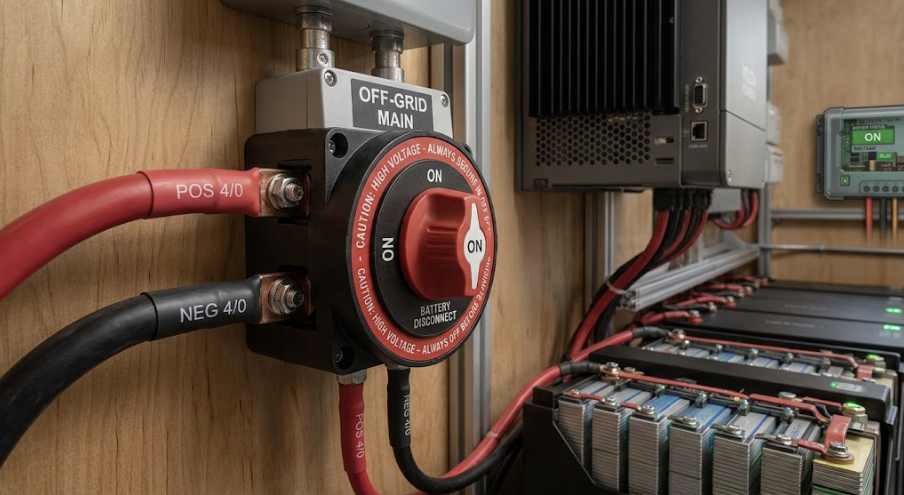
In any off-grid solar or high-current DC system, a battery disconnect switch is not an optional accessory; it is a non-negotiable critical safety device. It serves as the master kill switch, providing a physical air gap that isolates your expensive battery bank from the entire electrical system for maintenance, emergency shutdown, and preventing parasitic drain during long-term storage.
Choosing an underrated or poorly constructed switch introduces a dangerous weak point. A failure under load can lead to catastrophic damage, from melted terminals to equipment fires. This guide provides the engineering principles required to select, size, and properly install the best heavy duty battery disconnect switch 12V 24V 48V for your specific application, ensuring system reliability and safety.
Table of Contents
Understanding the Core Electrical Ratings of a Heavy Duty Disconnect Switch
The term “heavy duty” is defined by two primary amperage ratings: continuous and intermittent. Misunderstanding these values is the most common reason for switch failure in demanding off-grid solar and automotive applications. A switch must be rated to handle both the constant load of your system and the massive, short-duration surge from high-power equipment like inverters.
A properly specified switch ensures minimal voltage drop and safe thermal performance under all operating conditions. When evaluating the best heavy duty battery disconnect switch 12V 24V 48V, these ratings are paramount.
Continuous vs. Intermittent (Cranking) Amperage
The continuous rating is the maximum current a switch can handle indefinitely without overheating. This must be higher than the maximum sustained load of your system, which is typically dictated by your inverter’s continuous output or other large DC loads.
The intermittent rating, often called the cranking rating, specifies the maximum current the switch can handle for a very short period (e.g., 10-30 seconds). This rating is critical for handling the inrush current from large inductive loads like inverter startup surges or vehicle starter motors.
The technical parameters for the best heavy duty battery disconnect switch 12V 24V 48V can be compared below:
| Rating Type | Engineering Definition | System Sizing Consideration |
|---|---|---|
| Continuous Rating (Amps) | The amount of current the switch can safely pass 24/7 without exceeding its thermal design limits. | Must be at least 1.25x your inverter’s maximum continuous draw or the sum of all continuous DC loads, whichever is greater. |
| Intermittent Rating (Amps) | The peak current the switch can handle for a short duration (typically <30 seconds) without catastrophic failure of its internal contacts. | Must exceed the inverter’s maximum surge rating or the engine’s cold cranking amps (CCA) requirement. |
| Voltage Rating (VDC) | The maximum DC voltage the switch is designed to safely interrupt. Exceeding this can lead to arcing. | The switch must be rated for your system’s nominal voltage (12V, 24V, or 48V). Universal switches are common. |
For example, a 3000W 48V inverter can have a continuous draw of over 62.5A (3000W / 48V) and a surge of over 125A. Your selected switch must comfortably exceed both of these figures to ensure long-term reliability.
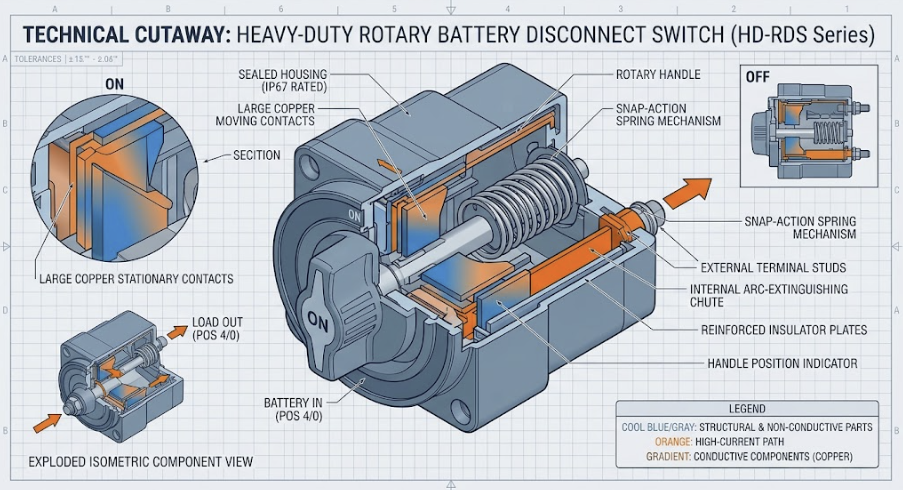
Key Engineering Criteria for the Best Heavy Duty Battery Disconnect Switch 12V 24V 48V
Beyond the core electrical ratings, several physical and material characteristics determine a switch’s durability and safety. In an off-grid cabin, RV, or marine environment, exposure to moisture, vibration, and temperature extremes is a given. Selecting a device built with robust materials is essential for long-term performance.
Material Science and Construction
The conductivity and corrosion resistance of the current-carrying components are critical. Look for switches with solid copper or tin-plated copper studs and contacts.
Tin plating provides excellent corrosion resistance, especially in marine or humid environments, ensuring a low-resistance connection over years of service. The housing should be made from a rugged, fire-retardant material like reinforced polycarbonate or a durable metal alloy. Selecting a high-quality best heavy duty battery disconnect switch 12V 24V 48V means scrutinizing these materials.
Environmental Protection: IP Ratings
The Ingress Protection (IP) rating defines how well a device is sealed against solids (dust, dirt) and liquids (water). This is a crucial specification for any component installed in a semi-exposed location, such as a vehicle engine bay, an exterior RV compartment, or a marine bilge.
A higher IP rating indicates better protection against environmental factors that can cause corrosion and premature failure. The IP rating is a critical factor for the best heavy duty battery disconnect switch 12V 24V 48V intended for outdoor use.
| IP Rating | Protection Against Solids (First Digit) | Protection Against Liquids (Second Digit) | Ideal Application |
|---|---|---|---|
| IP65 | 6: Dust Tight – No ingress of dust. | 5: Protected against water jets from any direction. | Engine bays, exterior compartments, areas subject to spray or rain. |
| IP67 | 6: Dust Tight – No ingress of dust. | 7: Protected against temporary immersion in water (up to 1m). | Marine applications, off-road vehicles, environments with high risk of submersion. |
Sizing and Installation: A Step-by-Step Technical Guide
Correctly sizing and installing your battery disconnect switch is just as important as selecting a quality unit. Improper installation can create a high-resistance point, leading to dangerous heat buildup and significant voltage drop, starving your downstream components of power.
Always adhere to guidelines from authoritative bodies like the National Electrical Code (NEC), which mandates a readily accessible disconnecting means for battery systems.
Calculating Your Amperage Requirements
To properly size your switch, you must know the maximum continuous and surge currents of your system. This is typically driven by the inverter.
For example, a 4000-watt 24V inverter has a maximum continuous current of approximately 167A (4000W / 24V). Applying a 1.25x safety factor as per NEC recommendations, you need a switch with a continuous rating of at least 209A. The switch’s intermittent rating must also exceed the inverter’s surge rating, which could be 2x its continuous rating (around 334A).
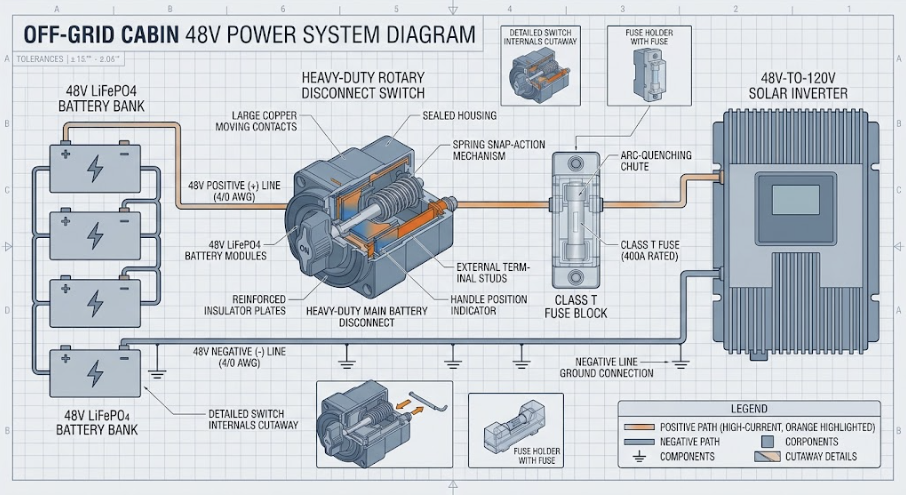
Positive vs. Negative Line Installation
There is some debate about whether to install the switch on the positive or negative battery cable. For most applications, including those governed by the American Boat and Yacht Council (ABYC), installation on the positive cable is standard practice. This ensures all downstream components are completely de-energized when the switch is open.
However, installing on the negative side can be marginally safer during installation, as an accidental touch of a tool between the live terminal and the chassis (ground) will not cause a short circuit. For any off-grid cabin or vehicle system, interrupting the positive line between the battery bank and your main Class-T fuse or primary bus bar is the recommended approach for total system isolation.
2026 Engineer’s Picks: The Best Heavy Duty Battery Disconnect Switch 12V 24V 48V
After analyzing technical specifications, material quality, and real-world reliability, we’ve selected the top-performing switches for demanding off-grid and heavy-duty applications. These models represent the best heavy duty battery disconnect switch 12V 24V 48V across different price points and use cases.
1. Blue Sea Systems m-Series (Model 6006) – Best Overall Performance
Blue Sea Systems is an industry benchmark for marine-grade electrical components, and the m-Series switch is a testament to their engineering. It offers a compact design without compromising on robust performance, making it perfect for tight installations in RVs, boats, and off-grid power centers.
- Pros: Ignition protected (safe for gasoline engine compartments), IP66 waterproof rating, tin-plated copper studs for maximum conductivity and corrosion resistance, compact footprint.
- Cons: Lower continuous rating than e-Series, may be insufficient for very large inverter systems (>3500W at 12V).
[Check Price for Blue Sea Systems m-Series 6006 on Amazon]
2. FASTSTORM 300A Heavy Duty Switch – Best Budget Option
For users who need reliable high-current switching without the premium price of marine-grade brands, the FASTSTORM 300A switch is a solid contender. Its heavy-duty metal housing and high amperage ratings provide excellent value for automotive, truck, and stationary off-grid systems where extreme water immersion is not a primary concern.
- Pros: Very high intermittent rating (1000A+), rugged aluminum alloy housing, includes battery cables in some kits, excellent value for the price.
- Cons: Lacks an official IP rating, making it less suitable for direct exposure to marine spray or high-pressure washing.
[Check Price for FASTSTORM 300A Heavy Duty Battery Disconnect Switch on Amazon]
3. Blue Sea Systems e-Series (Model 9003e) – High-Amperage King
When your system involves a massive inverter, large battery bank, or heavy-duty vehicle starter, the Blue Sea e-Series is the gold standard. It’s engineered to handle higher continuous and intermittent currents than the m-Series, making it the ideal choice for high-power 12V, 24V, or 48V systems. This is the top-tier selection when you need the absolute best heavy duty battery disconnect switch 12V 24V 48V for mission-critical applications.
- Pros: High 350A continuous and 600A intermittent ratings, meets all ABYC requirements, accepts large gauge cables (up to 4/0 AWG), can be surface or rear-panel mounted.
- Cons: Larger physical size than m-Series, higher price point.
[Check Price for Blue Sea Systems e-Series 9003e on Amazon]
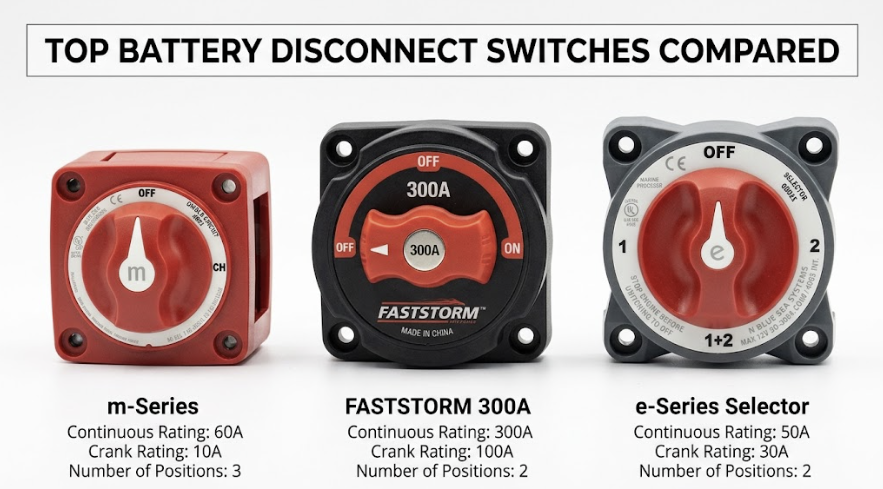
Here is a direct technical comparison of our recommended models to help you select the best heavy duty battery disconnect switch 12V 24V 48V for your system.
| Specification | Blue Sea Systems m-Series (6006) | FASTSTORM 300A | Blue Sea Systems e-Series (9003e) |
|---|---|---|---|
| Continuous Rating | 300A | 200A – 300A (Varies by model) | 350A |
| Intermittent Rating | 500A (5 min) | 1000A (30 sec) | 600A (5 min) |
| Max Voltage | 48V DC | 48V DC | 48V DC |
| Stud Material | Tin-Plated Copper | Copper | Tin-Plated Copper |
| IP Rating | IP66 | Not Rated | IP66 |
| Terminal Stud Size | 3/8″ (M10) | 3/8″ (M10) | 3/8″ (M10) |
Maintenance and Troubleshooting Your Heavy Duty Battery Switch
Even the best heavy duty battery disconnect switch 12V 24V 48V requires periodic inspection to ensure its integrity. These devices handle immense current, and a compromised connection can quickly become a significant failure point. A simple maintenance routine can prevent most issues.
The most common failure modes are loose terminal nuts and corrosion. Vibration can cause the nuts securing the heavy battery cables to loosen over time. This increases resistance, which generates heat (as defined by Joule’s first law, P = I²R), which can melt the switch housing and cable insulation. You should periodically check that these connections are torqued to the manufacturer’s specification. Corrosion acts as an insulator, creating the same high-resistance problem. Regularly inspect terminals for any signs of white or green buildup and clean them with a wire brush and appropriate contact cleaner if necessary. These checks are crucial for the longevity of your best heavy duty battery disconnect switch 12V 24V 48V.
Frequently Asked Questions
What is the primary purpose of a battery disconnect switch?
The primary purpose of a battery disconnect switch is to provide a safe and reliable method of completely isolating the battery bank from the rest of the electrical system. This is crucial for three main reasons: safety during maintenance by preventing accidental shocks or shorts, preventing parasitic loads from draining the battery during long-term storage, and offering a rapid shutdown method in case of an electrical emergency like a fire. Installing the best heavy duty battery disconnect switch 12V 24V 48V is a foundational safety measure for any high-current DC system.
Should I install the disconnect switch on the positive or negative battery cable?
While installation on the negative cable is technically feasible and slightly safer during the install process itself, the industry standard and recommendation from bodies like the ABYC is to install the switch on the positive line. Interrupting the positive conductor ensures that all downstream components are fully de-energized and cannot be accidentally grounded, providing a more complete and failsafe isolation. For robust safety in an off-grid setup, the best heavy duty battery disconnect switch 12V 24V 48V should be placed in series on the main positive cable before the primary fuse.
How do I determine the correct amperage rating for my system?
To determine the correct amperage rating, you must assess both the continuous and intermittent (surge) loads of your system. The switch’s continuous amp rating should be at least 125% of your system’s maximum sustained DC current, which is usually determined by your inverter’s full power draw. The intermittent or cranking rating must be higher than your inverter’s maximum surge rating or the engine’s cold cranking amps (CCA). Properly sizing is a critical step in selecting the best heavy duty battery disconnect switch 12V 24V 48V.
What does the IP rating (e.g., IP67) on a switch mean?
The IP (Ingress Protection) rating is an international standard that defines the level of sealing effectiveness of electrical enclosures against intrusion from foreign bodies (like dust) and moisture. The first digit represents protection against solids (6 is dust-tight), and the second digit represents protection against liquids (7 means it can be temporarily immersed in water). A switch with an IP67 rating is highly recommended for marine, off-road, or any application where the device might be exposed to water, which is a key feature of the best heavy duty battery disconnect switch 12V 24V 48V.
Can a faulty disconnect switch cause my batteries to not charge properly?
Yes, a faulty disconnect switch with high internal resistance can absolutely cause charging problems. This resistance creates a voltage drop between the battery and the charging source (like a solar charge controller or alternator). The charging source may read a falsely high battery voltage at its own terminals and prematurely reduce its charging current, leading to undercharged batteries. This is a common and often misdiagnosed issue, highlighting the importance of installing a quality best heavy duty battery disconnect switch 12V 24V 48V.
What’s the difference between a disconnect switch and a circuit breaker?
A disconnect switch is a manually operated device designed to isolate a circuit, providing a visible air gap for safety. A DC circuit breaker is an automatic overcurrent protection device that trips to open the circuit when it detects a current higher than its rating, protecting wires and components from damage. While some large breakers can be used as switches, a dedicated best heavy duty battery disconnect switch 12V 24V 48V is engineered for frequent manual operation and high-current isolation, whereas a breaker is primarily for safety interruption.
Why do some switches have an AFD (Alternator Field Disconnect) feature?
An Alternator Field Disconnect (AFD) is a safety feature found on some high-end switches designed for systems with externally regulated alternators. If you were to turn the switch off while the engine is running, the sudden disconnection from the battery (its primary load) could cause a voltage spike from the alternator that damages its internal diodes. The AFD circuit ensures that the alternator’s field circuit is interrupted a split second *before* the main contacts open, safely de-energizing the alternator and preventing damage. This is a specialized but important feature when selecting the best heavy duty battery disconnect switch 12V 24V 48V for certain vehicle applications.
What are the signs that my battery disconnect switch is failing?
The signs of a failing switch often manifest as intermittent electrical problems. These can include slow or labored engine cranking, flickering lights, unexplained power loss to your inverter, or the switch itself feeling physically hot to the touch after use. A significant voltage drop across the switch’s terminals when under load is a definitive sign of high internal resistance and impending failure. If you experience these symptoms, you should immediately inspect or replace your best heavy duty battery disconnect switch 12V 24V 48V.
Is a more expensive, marine-grade switch worth it for a cabin or RV?
For applications where moisture, humidity, and vibration are present, a marine-grade switch from a reputable brand like Blue Sea Systems is almost always worth the investment. These switches use superior materials like tin-plated copper and have higher IP ratings, which provides significantly better long-term protection against corrosion—the number one killer of electrical connections. The higher cost reflects a more robust design and better materials, which is a wise investment when choosing the best heavy duty battery disconnect switch 12V 24V 48V for a system you depend on.
What size battery cables should I use with my disconnect switch?
The battery cable size must be chosen based on the maximum amperage of the circuit and the total length of the cable run to keep voltage drop within acceptable limits (typically under 3%). Your disconnect switch does not determine the wire size; the load does. You must ensure, however, that the switch’s terminal studs are large enough to accept the lugs for the required cable gauge, such as 1/0, 2/0, or 4/0 AWG. This is a key part of properly integrating the best heavy duty battery disconnect switch 12V 24V 48V into your electrical design.
Can I use a disconnect switch to manage two separate battery banks?
A simple ON/OFF disconnect switch is for a single circuit. To manage two battery banks (e.g., a starter battery and a house battery), you need a selector switch, often labeled “1-2-BOTH-OFF”. This allows you to draw power from battery 1, battery 2, or combine them in parallel for emergency starting. While it functions as a disconnect in the “OFF” position, its primary role is bank selection, which is a different application than a simple best heavy duty battery disconnect switch 12V 24V 48V.
How do I test for voltage drop across my disconnect switch?
To test for voltage drop, you need a multimeter set to DC volts. Place your system under its maximum continuous load (e.g., turn on your inverter and a large appliance). Carefully place the positive probe of the multimeter on the input terminal stud of the switch and the negative probe on the output terminal stud. The reading on the multimeter is the voltage being lost as heat within the switch. A good, healthy switch should show a very low reading, typically less than 0.1 volts. A higher reading indicates a problem, which is a critical diagnostic for the best heavy duty battery disconnect switch 12V 24V 48V.