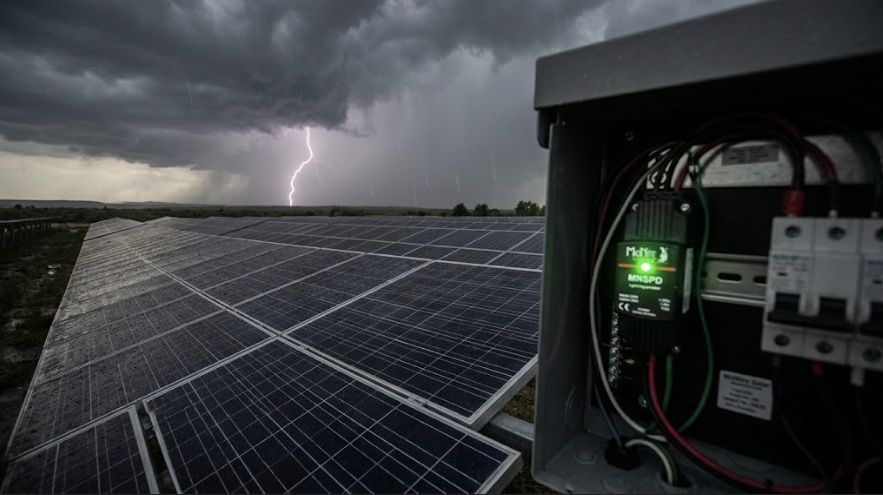
An off-grid solar installation represents a significant investment in energy independence. However, this independence is critically vulnerable to one of nature’s most powerful and unpredictable forces: lightning.
A single nearby strike can induce surges powerful enough to destroy inverters, charge controllers, and battery management systems in microseconds. Standard grounding and basic circuit breakers are simply not engineered to handle such extreme events, making specialized protection essential. This guide provides an engineering-level breakdown of how to select and implement the best lightning arrester for off-grid solar systems to safeguard your critical power infrastructure.
Table of Contents
The Physics of Failure: Why Standard Grounding Isn’t Enough
Proper equipment grounding is a fundamental safety requirement mandated by the National Electrical Code (NEC). It provides a safe path for fault currents and helps stabilize system voltages.
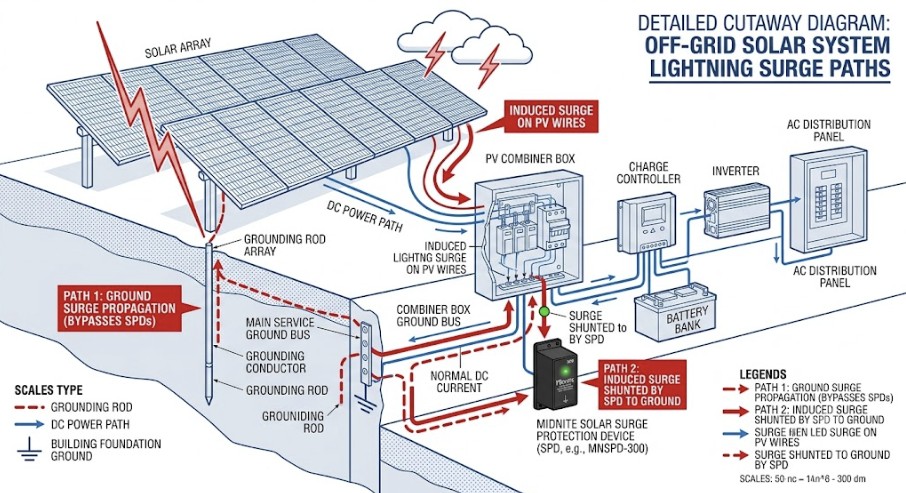
However, grounding alone is a passive system. It cannot stop the destructive energy of a lightning-induced surge. Lightning events generate transient overvoltages that travel far too quickly for conventional fuses or breakers to react. These devices are designed for overcurrent protection over milliseconds, not overvoltage protection over microseconds. The primary threat to off-grid electronics comes from both direct and, more commonly, indirect strikes.
Indirect strikes can hit the ground miles away, causing a massive Ground Potential Rise (GPR) that travels through the earth and into your grounding system. It can also induce a powerful electromagnetic pulse (EMP) into long wire runs, such as those from a ground-mount solar array. Only a dedicated Surge Protective Device (SPD), commonly known as a lightning arrester, can react fast enough to divert this energy.
Core Engineering Principles for the Best Lightning Arrester for Off-Grid Solar Systems
Modern lightning arresters are technically referred to as Surge Protective Devices (SPDs). The core component inside most SPDs is the Metal Oxide Varistor (MOV). An MOV acts as a voltage-sensitive switch; at normal operating voltages, it has very high resistance and is effectively invisible to the circuit. When voltage rises above its clamping threshold, its resistance drops to near-zero in nanoseconds, creating a low-impedance path that shunts the surge current safely to ground.
Selecting the best lightning arrester for off-grid solar systems requires a deep understanding of its technical specifications. The following table breaks down the most critical parameters for evaluating an SPD.
| Specification | Engineering Definition | Off-Grid System Significance |
|---|---|---|
| SPD Type (1, 2, 3) | UL 1449 classification defining installation location and robustness. Type 1 is for the line side of the main service; Type 2 is for the load side. | Off-grid systems require a layered approach, typically using Type 1 or 2 at the array combiner and Type 2 at the charge controller and inverter. |
| MCOV (Max. Continuous Operating Voltage) | The maximum steady-state voltage the SPD can handle without conducting. | Crucial for DC SPDs. MCOV must be higher than your solar array’s maximum open-circuit voltage (Voc), accounting for cold temperature effects. For a 48V solar system, a 300Vdc or 600Vdc SPD is common depending on string configuration. |
| VPR (Voltage Protection Rating) | The clamping voltage; the maximum voltage the protected equipment will be exposed to during a surge event. | Lower is better. A lower VPR means less stress on your inverter and controller’s sensitive electronics. |
| Nominal Discharge Current (In) | The peak current an SPD can handle for at least 15 impulses (using an 8/20µs waveform) without failing. Indicates durability. | Higher ratings (e.g., 20 kA) signify a more robust device capable of withstanding multiple, smaller surge events common in high-lightning areas. |
SPD Types Explained: Matching the Device to the Location
SPDs are categorized into Types based on their intended installation point and their ability to handle different surge magnitudes. A robust protection strategy uses multiple types in a layered or “cascaded” approach.
Type 1 SPDs are the most heavy-duty. They are designed to be the first line of defense, installed at the solar array’s first point of disconnect. They are tested with a powerful 10/350µs current waveform to simulate a direct lightning current. They are essential for systems in high-exposure areas or with long DC wire runs.
Type 2 SPDs are installed downstream from the main disconnect, typically right at the equipment they are protecting, such as the charge controller’s PV input or the inverter’s AC output. They are tested with an 8/20µs waveform, which represents the residual surge energy let through by the Type 1 device or surges induced within the building’s wiring.
| SPD Type | Typical Installation Point | Protects Against | Key Specification |
|---|---|---|---|
| Type 1 | DC Combiner Box / Array Disconnect | Direct lightning currents and large induced surges | Impulse Discharge Current (Iimp) rating |
| Type 2 | Charge Controller PV Input / Inverter AC Output / Main AC Panel | Indirect surges and residual let-through voltage | Nominal Discharge Current (In) and VPR |
| Hybrid Type 1+2 | Combiner Box or Main Disconnect | Both direct and indirect surge events | Both Iimp and In ratings |
Strategic SPD Placement: A Multi-Layered Defense
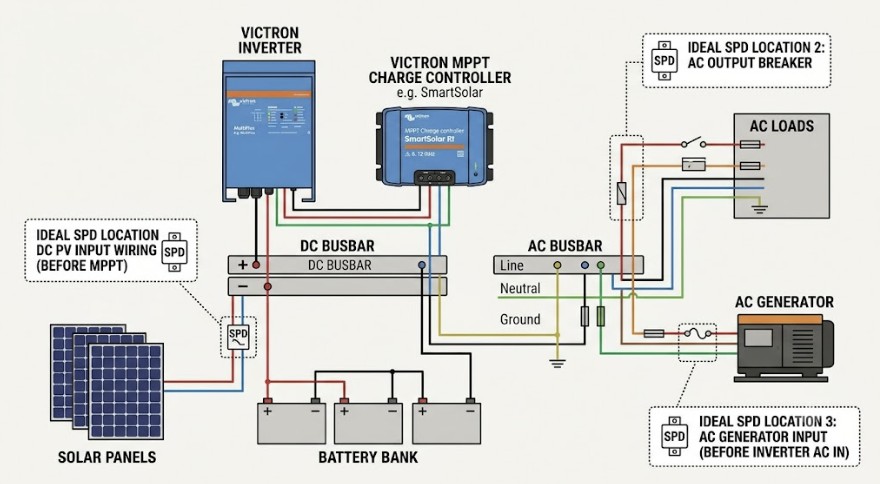
The effectiveness of the best lightning arrester for off-grid solar systems depends entirely on its correct placement. The goal is to intercept surges at every potential entry point into your system.
Layer 1: The Solar Array (Primary DC Protection)
Install a Type 1 or a robust Type 2 DC SPD inside your PV combiner box or at the first disconnect switch after the array. This is the most critical point of protection, especially for wire runs exceeding 50 feet. It diverts the vast majority of surge energy from the array before it can travel to your power shed or cabin.
Layer 2: The Charge Controller (Secondary DC Protection)
Even with protection at the array, some residual energy can travel down the wires. Install a second DC SPD (typically Type 2) as close as possible to the PV input terminals of your MPPT charge controller. This protects the most expensive and sensitive DC component in your system.
Layer 3: The Inverter and Loads (AC Protection)
Surges can enter from your AC loads or from a backup generator. Install a Type 2 AC SPD in your main off-grid cabin electrical panel to protect the inverter’s AC output. If you use a generator, an additional AC SPD should be installed on its input line to the inverter or transfer switch.
Top Rated Hardware: The Best Lightning Arrester for Off-Grid Solar Systems in 2026
Selecting the right hardware is critical. These models are trusted by professional installers and DIYers for their reliability, specifications, and adherence to safety standards. The choice of the best lightning arrester for off-grid solar systems should be based on your specific system voltage and exposure risk.
1. MidNite Solar MNSPD-300-DC
The MidNite Solar SPD is arguably the industry standard for residential off-grid DC protection. It’s a Type 2 device designed for easy installation inside combiner boxes or next to charge controllers. Its 300V MCOV is suitable for most 12V, 24V, and 48V systems with array Voc up to 300V.
- Pros: UL 1449 Listed, easy to wire, clear LED status indicators, excellent VPR for the price.
- Cons: Bulkier than some DIN-rail models, rated as Type 2 only.
[Check Price for MidNite Solar MNSPD-300-DC on Amazon]
2. Siemens FS140 Whole House Surge Protector
For AC-side protection, the Siemens FS140 is a high-performance Type 2 device that mounts directly onto a breaker in your main load center. It provides robust protection for your entire AC system, including the inverter’s output and all your sensitive household appliances.
- Pros: Extremely high surge current capacity (140,000A), very low VPR, four-quadrant protection (L1-N, L2-N, L1-L2, N-G), clear diagnostic LEDs.
- Cons: Requires two available breaker spaces in your panel.
[Check Price for Siemens FS140 Whole House Surge Protector on Amazon]
The Unfailing Foundation: Advanced Grounding Techniques
An SPD is merely a gate. Without a low-resistance path to send the surge, that gate leads nowhere. The best lightning arrester for off-grid solar systems is rendered completely ineffective by a poor grounding system.
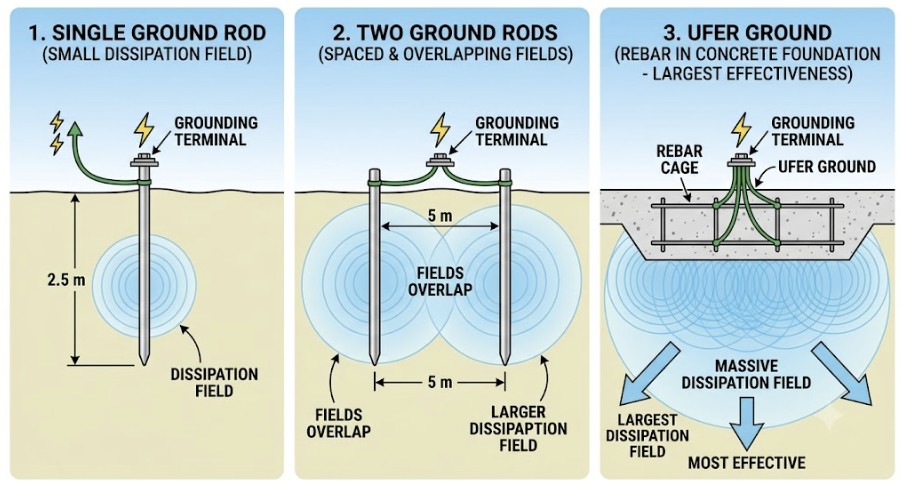
The NEC requires at least one 8-foot ground rod, but this is the bare minimum and often insufficient. In typical soil, a single rod can have a resistance of 25 ohms or more; for lightning, you need a path under 5 ohms. The best practice is to install at least two 8-foot ground rods spaced a minimum of 16 feet apart (more than twice their length) and bonded together with a continuous #6 AWG bare copper wire.
In dry, sandy, or rocky soil, a superior method is the Ufer ground, officially a Concrete-Encased Electrode. As detailed in NEC Article 250.52(A)(3), this involves embedding at least 20 feet of #4 AWG copper wire or 1/2″ rebar within the concrete footing of your power shed or array foundation. Concrete attracts and holds moisture, creating a massive, highly effective, low-resistance connection to the earth. The performance of the best lightning arrester for off-grid solar systems is directly tied to the quality of its grounding electrode system.
| Electrode Type | Pros | Cons | Best For |
|---|---|---|---|
| Single 8′ Ground Rod | Inexpensive, easy to install. | Often provides insufficient (high resistance) grounding. Not recommended as a standalone solution. | Meeting minimum code in very moist, loamy soil. |
| Multiple 8′ Ground Rods | Significantly lowers ground resistance. Redundant connection to earth. | Requires more space and material. Proper spacing is critical. | Most standard installations, especially in moderately conductive soil. |
| Ufer Ground (Concrete-Encased) | Extremely low and stable ground resistance. Highly effective dissipation. Uses existing foundation. | Must be planned and installed before concrete is poured. Cannot be retrofitted. | New construction, especially in dry, rocky, or otherwise poorly conductive soil. The gold standard. |
Ultimately, safeguarding your power system is not an area for compromise. The financial and operational cost of replacing thousands of dollars in fried electronics far outweighs the modest investment in a comprehensive protection strategy.
By combining a robust, low-impedance grounding system with a layered defense of properly specified and strategically placed SPDs, you can significantly mitigate the risk of lightning damage. Making an informed choice on the best lightning arrester for off-grid solar systems is a critical step in ensuring the long-term reliability and resilience of your energy freedom.
Frequently Asked Questions
What is the difference between a lightning arrester and a surge protector?
The terms are often used interchangeably, but in modern electrical engineering, “lightning arrester” typically refers to heavy-duty devices used on utility transmission lines, while “Surge Protective Device” (SPD) is the correct term for the devices used in residential and commercial electrical panels and solar installations. An SPD is a more refined device designed to protect sensitive electronics with a lower clamping voltage. For practical purposes in this context, the best lightning arrester for off-grid solar systems is an SPD rated for your system’s voltage.
Do I need a Type 1 or Type 2 lightning arrester for my off-grid system?
Ideally, you need both in a layered system. A Type 1 SPD should be your first line of defense at the solar array combiner box, especially if you live in a high-lightning area or have wire runs over 100 feet. A Type 2 SPD should then be used to protect specific equipment, such as the inputs to your charge controller and the AC panel fed by your inverter. If you can only install one, a robust Type 2 device at the main DC disconnect offers significant protection. Sourcing the best lightning arrester for off-grid solar systems often involves using multiple coordinated devices.
How many lightning arresters do I need for my solar system?
A comprehensive strategy requires at least three SPDs. The first is a DC SPD at the PV combiner box or array disconnect. The second is another DC SPD located at the PV input of your charge controller. The third is an AC SPD installed in your main electrical panel to protect the inverter output and your loads. Some systems with a generator input may also add a fourth AC SPD on that line, ensuring every potential pathway for a surge is covered by the best lightning arrester for off-grid solar systems.
Will a lightning arrester protect my system from a direct strike?
No consumer-grade SPD can guarantee protection against a direct lightning strike on your solar array, which can contain hundreds of thousands of amps. A direct strike will likely cause catastrophic damage regardless of protection. However, direct strikes are statistically rare. The primary function of an SPD is to protect against the far more common threats of induced surges from nearby strikes and ground potential rise, which is the most frequent cause of equipment failure. Therefore, installing the best lightning arrester for off-grid solar systems is about mitigating the most probable risks.
How do I know if my lightning arrester has failed?
Most modern SPDs, like the MidNite Solar and Siemens models, have built-in LED status indicators. A green light typically means the device is functional and providing protection. If the light is off, red, or blinking, it indicates that the internal MOVs have been sacrificed during a surge event and the unit needs to be replaced immediately. Some advanced models, like those from DEHN, have modular cartridges with visual fault flags, making it easy to identify and replace only the failed component of the best lightning arrester for off-grid solar systems.
Can I install a lightning arrester myself?
If you are experienced with electrical wiring and comfortable working inside live electrical panels and combiner boxes, installing an SPD is a manageable DIY task. However, it is critical to follow the manufacturer’s instructions precisely, especially regarding wire length and connection points. Lead wires to the SPD should be as short and straight as possible to minimize impedance. If you have any doubt about your abilities or understanding of your system’s grounding, it is always safest to hire a qualified electrician to install the best lightning arrester for off-grid solar systems.
What is MCOV and why is it critical for my system voltage?
MCOV stands for Maximum Continuous Operating Voltage. It is the highest voltage an SPD can withstand indefinitely without activating. For a DC SPD connected to your solar array, the MCOV rating must be higher than your array’s maximum possible open-circuit voltage (Voc). You must calculate this Voc based on the coldest expected temperature at your location, as panel voltage increases in the cold. Choosing an SPD with an insufficient MCOV will cause it to prematurely conduct and fail, making this specification a critical factor when selecting the best lightning arrester for off-grid solar systems.
Does my soil type affect my lightning protection strategy?
Absolutely. Soil resistivity is a major factor in the effectiveness of your grounding system, which is the foundation of all surge protection. Moist, loamy, or clay-based soils are highly conductive and make it easier to achieve a low-resistance ground. Dry, sandy, or rocky soils have very high resistance, making standard ground rods ineffective. In these conditions, you must use more robust methods like multiple, deeply driven, and widely spaced ground rods or, ideally, a Ufer ground. The performance of the best lightning arrester for off-grid solar systems is directly dependent on the quality of its connection to the earth.
Is a lightning arrester required by the National Electrical Code (NEC)?
The NEC has increasingly emphasized surge protection. NEC 2017 and later revisions, specifically Article 230.67, mandate a Type 1 or Type 2 SPD for all new residential service entrances. While off-grid systems do not have a utility “service,” inspectors often apply this principle, and it is considered best practice. Furthermore, NEC 690.47 specifies grounding requirements for PV systems. While not always explicitly mandated for off-grid in every jurisdiction, installing the best lightning arrester for off-grid solar systems is a universally recommended practice for system reliability and safety.
Can I use an AC surge protector on the DC side of my system?
No, you absolutely cannot. AC and DC SPDs are engineered differently. The MOVs inside are rated for specific voltage types and waveforms. Using an AC SPD on a DC circuit can be extremely dangerous. A DC fault current does not have the zero-crossing of an AC waveform, meaning an arc, once started, may not extinguish itself, leading to a fire. You must always use a specifically listed and rated DC SPD for the DC portions of your system, which makes sourcing the correct device a key part of choosing the best lightning arrester for off-grid solar systems.
Why are there separate DC and AC lightning arresters?
Electrical current behaves differently in DC (Direct Current) and AC (Alternating Current) circuits. AC voltage alternates, crossing zero volts 120 times per second (in the US), which helps to extinguish electrical arcs naturally. DC voltage is constant, so an arc can sustain itself and become much more difficult to suppress. SPDs are designed with these properties in mind, featuring different internal components and safety mechanisms. Therefore, the best lightning arrester for off-grid solar systems includes distinct, purpose-built units for both the DC side (PV array) and the AC side (inverter output).
Does the length of my solar panel wire run matter for lightning protection?
Yes, immensely. A long wire run acts like a large antenna, making it highly susceptible to picking up induced voltage from a nearby lightning strike’s electromagnetic field. The longer the wire run from your array to your charge controller, the greater the potential for a dangerous surge. For any runs over 50 feet, it is considered essential to have an SPD at both ends of the wire: one at the array combiner box and another at the charge controller. This is a critical consideration when designing the layout for the best lightning arrester for off-grid solar systems.
Will my solar panel or inverter warranty cover lightning damage?
Almost universally, no. Manufacturer warranties for solar panels, inverters like those in our Renogy vs Victron inverter comparison, and charge controllers explicitly exclude damage from “acts of God,” which includes lightning strikes. The responsibility for protecting the equipment from environmental threats falls on the system owner and installer. This is why investing in a robust protection scheme is so important; it is a form of self-insurance for your equipment, and choosing the best lightning arrester for off-grid solar systems is a primary component of that protection.
How does the best lightning arrester for off-grid solar systems integrate with a 48V system?
For a 48V nominal system, the critical factor is the array’s maximum Voc (Open Circuit Voltage). Most 48V systems use PV strings with a Voc between 100V and 250V under standard conditions. When adjusted for cold weather, this can increase significantly. A DC SPD with an MCOV of 300V, like the MidNite Solar MNSPD-300-DC, is typically a perfect fit. It provides enough headroom above the maximum expected Voc without having an excessively high clamping voltage (VPR). Selecting the correct voltage rating is the most important step in choosing the best lightning arrester for off-grid solar systems.
What is the role of the best lightning arrester for off-grid solar systems in protecting my solar battery?
While an SPD is not typically installed directly on the battery terminals, it plays a vital indirect role in protecting your solar battery. A lightning surge that destroys your charge controller can cause it to fail in a dangerous state, potentially overcharging and destroying your expensive battery bank. Similarly, a surge that damages the inverter could harm the Battery Management System (BMS) through its communication or power connections. Therefore, by protecting the primary electronics, the best lightning arrester for off-grid solar systems provides essential downstream protection for your entire energy storage system.