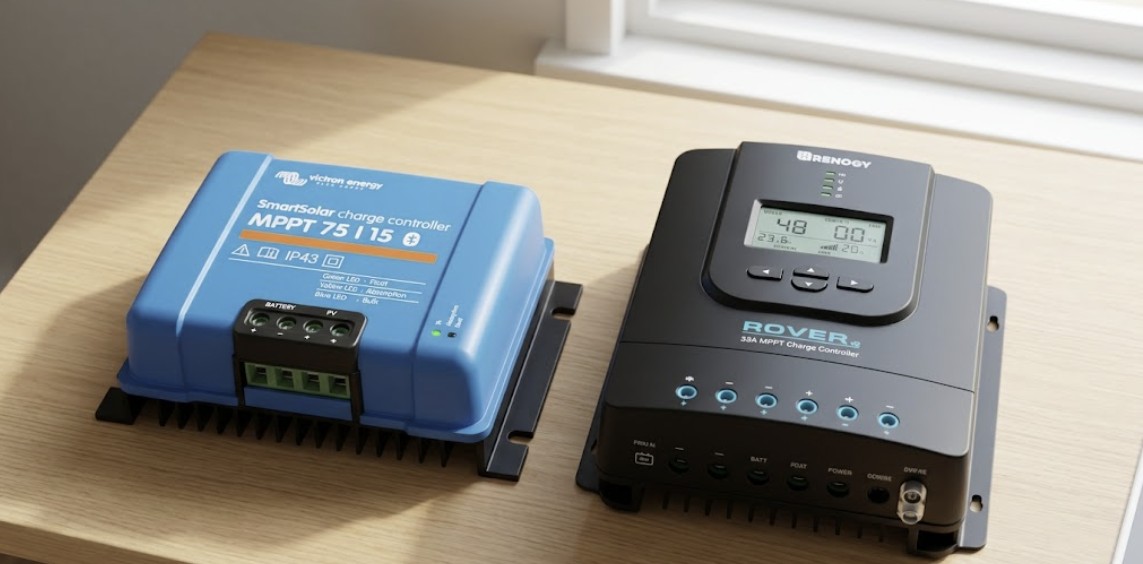
When designing a reliable solar power system, the charge controller determines efficiency, battery lifespan, and system scalability. In this Victron vs Renogy Charge Controllers comparison, we analyze performance data, real-world reliability, monitoring capabilities, ecosystem integration, and long-term cost efficiency.
This guide to Victron vs Renogy Charge Controllers is based on technical specifications, installer feedback, real-world testing, and system integration considerations.
Table of Contents
Victron vs Renogy Charge Controllers: Quick Technical Comparison
| Feature | Victron SmartSolar MPPT | Renogy Rover MPPT |
|---|---|---|
| MPPT Efficiency | Up to 98% | 95%–97% |
| Cooling | Passive (Fanless) | Active (Fan-cooled) |
| Build Quality | Industrial / Marine Grade | Consumer Grade |
| Bluetooth | Built-in (Most Models) | Optional / Some Models |
| Monitoring | Full Remote VRM Portal | Basic Renogy App |
| Battery Support | Fully Programmable | Limited Profiles |
| Lithium Support | Advanced Lithium Profiles | Basic Lithium Support |
| Voltage Support | 12V / 24V / 36V / 48V | Mostly 12V / 24V |
| Warranty | 5 Years | 1–2 Years (Some 5) |
| Ecosystem Integration | Full Victron Ecosystem | Limited Integration |
| Price Range | Premium | Budget-Friendly |
| Best For | Off-grid / Marine / Full-time | Small RV / DIY |
Victron handles up to 48V. Read [why 24V off-grid solar systems are best for cabins] to understand why this matters for efficiency.
Build Quality and Hardware Reliability
When evaluating Victron vs Renogy Charge Controllers, the physical construction of the units directly impacts durability.
Victron Build Quality
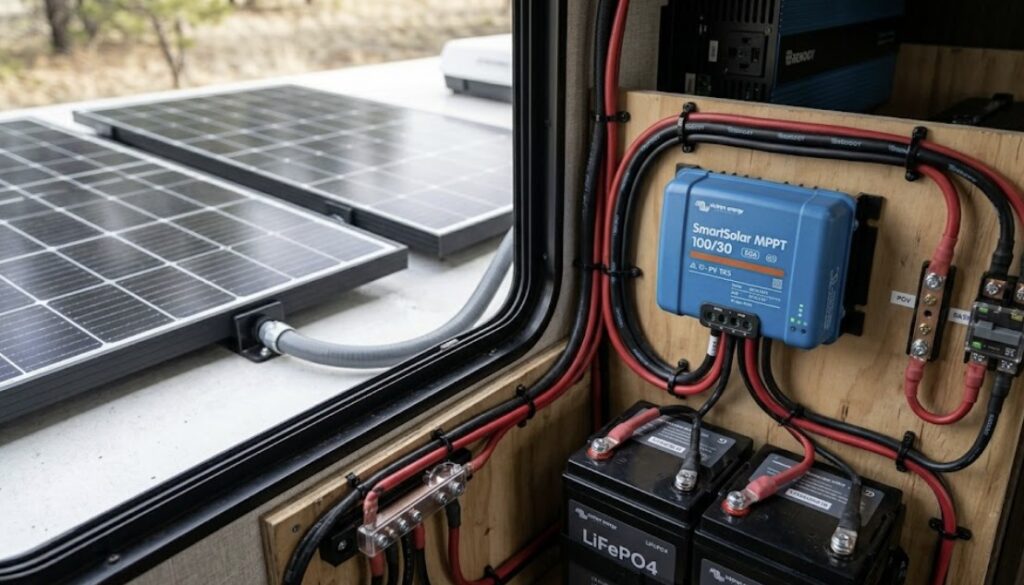
The biggest technical advantage of the [Victron SmartSolar MPPT 100/50] is actually what it doesn’t have: a cooling fan. In a dusty cabin or a salty marine environment, fans are the first thing to fail. Victron uses a massive aluminum heatsink for passive cooling, making it dead silent and virtually indestructible. It’s the professional’s choice for “set it and forget it” installations where maintenance access is difficult.
Check current price on Amazon –>
This passive cooling design eliminates one of the most common failure points: cooling fans.
Advantages include:
- Silent operation
- Longer lifespan
- Better performance in dusty environments
- Improved reliability in marine conditions
Renogy Build Quality
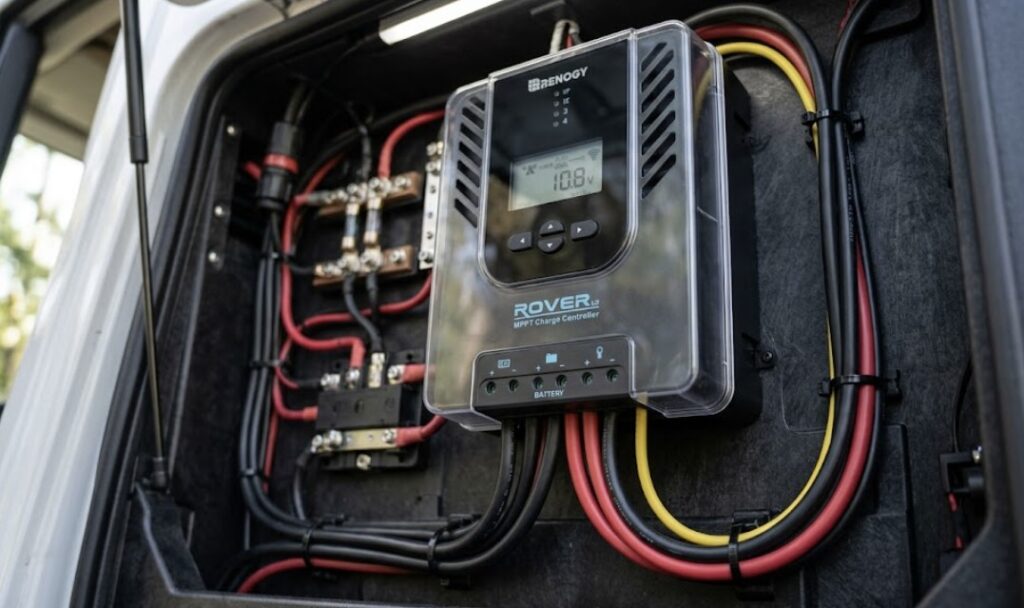
If you are building a weekend camper or a small 12V setup, the [Renogy Rover 40A MPPT] is unbeatable for the price. While it does use an internal fan for cooling, its “plug-and-play” simplicity and built-in LCD screen make it incredibly beginner-friendly. You get 97% tracking efficiency at a fraction of the cost of premium units, allowing you to allocate more of your budget toward higher-capacity batteries.
Check current price on Amazon –>
While sufficient for casual use, fan-cooled systems introduce:
- Mechanical wear, which is a key factor in the Victron vs Renogy Charge Controllers durability debate.
- Dust buildup risk
- Increased maintenance
MPPT Efficiency and Solar Harvest Performance
In any Victron vs Renogy Charge Controllers test, efficiency determines how much solar energy actually reaches your batteries.
Real-World MPPT Efficiency
| Condition | Victron | Renogy |
|---|---|---|
| Peak Sun Efficiency | 98% | 96% |
| Low Light Performance | Excellent | Moderate |
| Cloudy Conditions | Very Strong | Good |
| Partial Shade | Fast Tracking | Slower Tracking |
Technical benchmarks on [Maximum Power Point Tracking (MPPT) algorithms] show that ultra-fast tracking is superior in shaded environments.
Victron’s ultra-fast MPPT tracking allows it to:
- React faster to cloud movement
- Optimize power during variable sunlight
- Improve daily energy yield
In real-world RV and off-grid systems, Victron typically produces:
- 5–15% more daily energy
- Better morning/late afternoon output
- Improved performance in shaded installations
This 10-15% gain is vital when planning for tight energy budgets. See our [400 sq ft cabin power needs] guide to see how efficiency affects your total panel count.
Battery Compatibility and Charging Intelligence
Both Victron vs Renogy Charge Controllers must properly charge different chemistries, but their intelligence levels vary significantly.
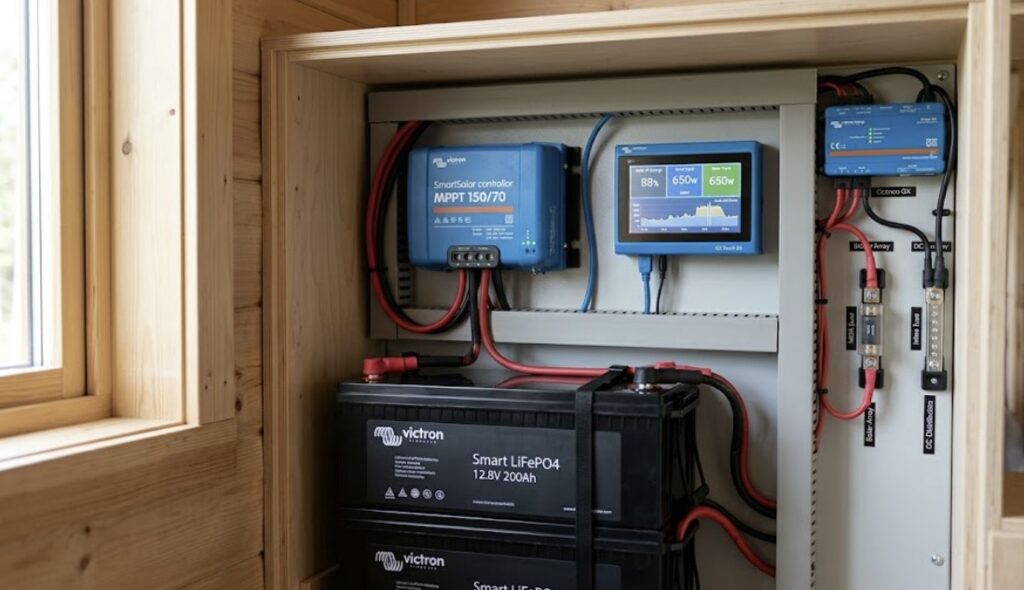
Victron Battery Support
Victron supports:
- Lithium (LiFePO4)
- AGM
- GEL
- Flooded Lead Acid
- Custom Battery Profiles
Advanced charging features include:
- Adaptive absorption charging
- Temperature compensation
- Battery lifespan optimization
- Programmable charge curves
This makes Victron ideal for:
- Lithium battery systems
- Multi-battery banks
- Large off-grid setups
Advanced profiles ensure your storage lasts. Check our picks for the [best solar battery for cabin] to see which units pair best with these controllers.
Renogy Battery Support
Renogy supports:
- AGM
- GEL
- Flooded
- LiFePO4 (basic support)
However, limitations include:
- Fewer programmable settings
- Less precise charging control
- Limited battery monitoring
Renogy works well for:
- Basic RV systems
- Small camper vans
- Entry-level solar setups
To understand how custom charge curves prevent lithium degradation, refer to the [Battery University guide on charging LiFePO4].
Monitoring and Smart Connectivity Comparison
Monitoring determines how effectively you manage the Victron vs Renogy Charge Controllers within your power system.
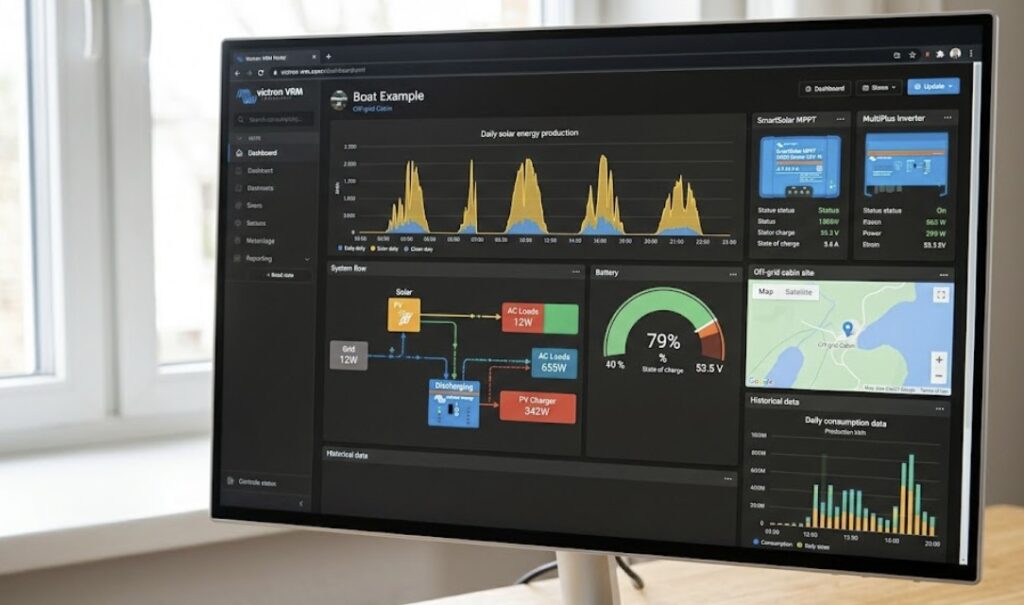
Victron Monitoring: VRM Portal + Bluetooth
Victron offers:
- Built-in Bluetooth
- VictronConnect app
- Remote cloud monitoring (VRM Portal)
- Multi-device integration
Features include:
- Historical performance data
- Remote configuration
- Alerts and notifications
- Multi-system monitoring
Efficiency Tip: If you’re planning to wire your solar panels in a long series string to reduce cable costs (as I recommend for 24V systems), you need a controller that handles high input voltage. I suggest the [Victron SmartSolar MPPT 150/35]. Its ability to handle up to 150V of solar input means you can run thinner 10 AWG wires over longer distances without sacrificing efficiency. Plus, the built-in Bluetooth is the most reliable in the industry—it’s the only one I trust for remote monitoring.
Check current price on Amazon –>
Renogy Monitoring System
Renogy monitoring includes:
- Bluetooth module (optional)
- Renogy app
- Basic local monitoring
Limitations:
- Limited historical data
- No advanced analytics
- Limited remote access
Victron vs Renogy Charge Controllers for RV Systems
When deciding between Victron vs Renogy Charge Controllers for a mobile home, choose:
Choose Victron for RV If
- Full-time RV living
- Lithium battery systems
- Large solar arrays
- Harsh weather conditions
- Long-term installations
Victron advantages for RV:
- Higher daily energy harvest
- Better battery health
- Remote system monitoring
- Expandable systems
Choose Renogy for RV If
- Weekend camping
- Small solar system
- Budget-focused builds
- Simple installations
Renogy advantages:
- Lower upfront cost
- Easy installation
- Good basic performanceFor simple, small-scale DIY projects, Renogy is a solid start. Follow our [solar setup for micro cabin] guide for a low-cost implementation.
Victron vs Renogy Charge Controllers for Off-Grid Systems
Off-grid installations demand:
- Reliability
- Scalability
- Monitoring
- Long-term performance
Victron dominates in off-grid environments due to:
- Smart integration
- Parallel system capability
- Advanced monitoring
- High reliability
Renogy remains suitable for:
- Small cabins
- Temporary setups
- Basic off-grid systems
For permanent remote sites, reliability is non-negotiable. Integrate these into a [complete off-grid power blueprint for retreat cabins].
System Integration and Ecosystem Comparison
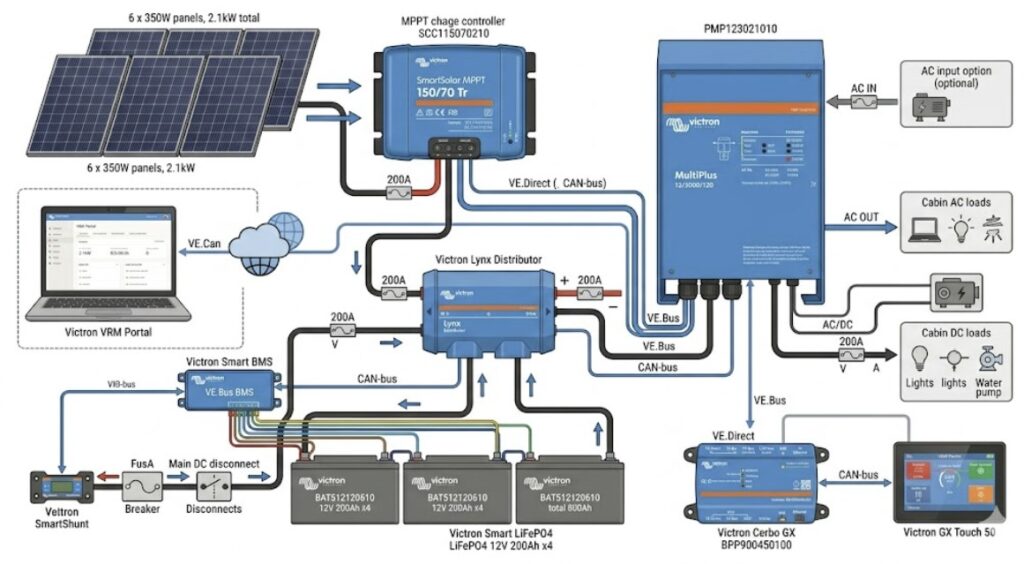
Victron Ecosystem
Victron integrates with:
- Inverters
- Battery monitors
- Battery management systems
- Remote monitoring systems
This creates a fully connected solar system.
Renogy Ecosystem
Renogy offers:
- Basic integration
- Standalone components
- Limited system expansion
Renogy is best for:
- Independent components
- Small systems
- Budget installations
Installation Complexity Comparison
| Factor | Victron | Renogy |
|---|---|---|
| Installation Difficulty | Moderate | Easy |
| Configuration | Advanced | Basic |
| Monitoring Setup | Advanced | Simple |
| Scalability | Excellent | Limited |
Victron requires:
- Initial configuration
- System planning
Renogy offers:
- Plug-and-play simplicity
- Quick installation
Properly integrating your controller into the array is essential. Follow our [24V solar system wiring diagram] for a safe sequence.
Long-Term Cost Analysis
he financial breakdown of Victron vs Renogy Charge Controllers reveals that long-term savings include:
- Better battery lifespan
- Higher energy harvest
- Fewer replacements
- Reduced maintenance
Example 5-Year Cost Comparison
| Factor | Victron | Renogy |
|---|---|---|
| Initial Cost | Higher | Lower |
| Efficiency Gain | +10% | Standard |
| Battery Longevity | Longer | Moderate |
| Replacement Risk | Low | Moderate |
Victron typically delivers:
- Lower total cost over 5–10 years
- Better reliability
Victron vs Renogy Charge Controllers: Real-World Performance Summary
Victron Strengths
- Highest efficiency
- Advanced monitoring
- Superior build quality
- Excellent lithium support
- Full ecosystem integration
Renogy Strengths
- Affordable pricing
- Beginner-friendly
- Easy installation
- Reliable basic performance
Recommended Use Case Breakdown
| Use Case | Best Choice |
|---|---|
| Full-time RV | Victron |
| Weekend Camper | Renogy |
| Off-grid Cabin | Victron |
| Small Solar Kit | Renogy |
| Marine Installation | Victron |
| Budget System | Renogy |
| Lithium Battery System | Victron |
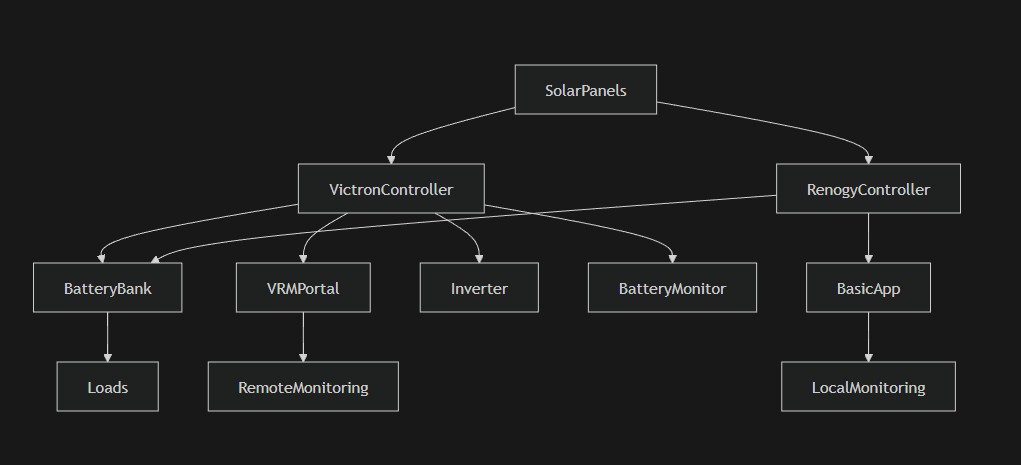
System Architecture Comparison Diagram
Final Verdict: Which Charge Controller Is Better
Victron charge controllers deliver:
- Professional-grade reliability
- Higher efficiency
- Smart monitoring
- Full system integration
Renogy charge controllers deliver:
- Budget-friendly performance
- Easy installation
- Reliable entry-level solar control
For serious off-grid, marine, or full-time RV systems, Victron provides superior long-term performance.
For small systems and budget installations, Renogy remains a practical and cost-effective option.
Hybrid Setup Recommendation
Many installers recommend:
- Renogy solar panels
- Victron charge controller
This combination provides:
- Lower panel cost
- Premium charging performance
- Best overall value
Using a Victron controller with the [best solar panels for tiny house] provides the best balance of cost and high-performance charging.
Conclusion
Choosing between Victron vs Renogy charge controllers depends on:
- Budget
- System size
- Battery type
- Long-term goals
Victron leads in performance, reliability, and smart integration.
Renogy remains a strong entry-level choice for simple solar setups.
For a broader look at how these brands compare across inverters and batteries, see our [Renogy vs Victron: The Ultimate 2026 Comparison].
For long-term solar investments, Victron delivers superior results.
Is Victron better than Renogy charge controllers?
Victron charge controllers are generally considered better in terms of efficiency, build quality, monitoring capabilities, and long-term reliability. Victron offers advanced MPPT tracking, built-in Bluetooth, remote monitoring through the VRM portal, and better lithium battery support. Renogy charge controllers, however, remain a strong choice for budget-friendly solar systems and smaller installations where advanced features are not necessary.
Are Victron charge controllers worth the higher price?
Victron charge controllers are worth the higher price for users building long-term off-grid, RV, or marine solar systems. Their higher efficiency, better battery charging algorithms, and advanced monitoring typically result in improved battery lifespan and higher energy harvest. Over time, this often offsets the higher upfront cost.
Can I use Renogy solar panels with a Victron charge controller?
Yes, Renogy solar panels work perfectly with Victron charge controllers. This is a very common setup because it combines affordable solar panels with premium charging technology. As long as voltage and current ratings match, there are no compatibility issues.
Which charge controller is better for lithium batteries, Victron or Renogy?
Victron is generally better for lithium battery systems because it offers advanced charging profiles, customizable parameters, and better battery protection features. Renogy supports lithium batteries but usually provides fewer configuration options and less precise charging control.
Do Victron charge controllers produce more power than Renogy?
Victron charge controllers can produce slightly more daily power due to faster MPPT tracking and higher efficiency, especially in cloudy or partially shaded conditions. In real-world use, Victron systems often generate between 5% and 15% more usable energy compared to similar Renogy setups.
Which is easier to install, Victron or Renogy charge controllers?
Renogy charge controllers are typically easier to install and configure because they are designed for beginners and simple solar systems. Victron controllers require more initial configuration but offer far more flexibility and control once installed.
Which brand is better for RV solar systems?
Victron is better for full-time RV users, large solar arrays, and lithium battery systems. Renogy is suitable for weekend campers, small RV systems, and users looking for a budget-friendly solution with reliable performance.
How long do Victron and Renogy charge controllers last?
Victron charge controllers often last longer due to their fanless cooling design and industrial-grade components. Many Victron units operate reliably for 8 to 15 years or more. Renogy controllers also provide good lifespan, but fan-cooled designs may require replacement sooner in demanding environments.
Which charge controller is better for off-grid cabins?
Victron is typically the better choice for off-grid cabins because of its reliability, scalability, and remote monitoring capabilities. Renogy works well for smaller cabins or temporary setups but may lack the advanced features needed for larger systems.
Do Victron and Renogy charge controllers support remote monitoring?
Victron offers full remote monitoring through the VRM Portal, allowing users to monitor systems from anywhere. Renogy offers basic Bluetooth monitoring and limited remote features depending on the model, but it does not match Victron’s advanced monitoring capabilities.
Is Renogy still a good brand for solar charge controllers?
Yes, Renogy remains a good brand for entry-level and mid-range solar charge controllers. They offer reliable performance, competitive pricing, and simple installation, making them popular among DIY solar users and budget-focused installations.
Which charge controller brand is more reliable in harsh environments?
Victron charge controllers are generally more reliable in harsh environments such as marine, desert, or cold climates. Their fanless design, rugged build quality, and advanced thermal management make them better suited for demanding conditions.
13 thoughts on “Victron vs Renogy Charge Controllers: The Complete Technical Comparison for RV, Marine, and Off-Grid Solar Systems”