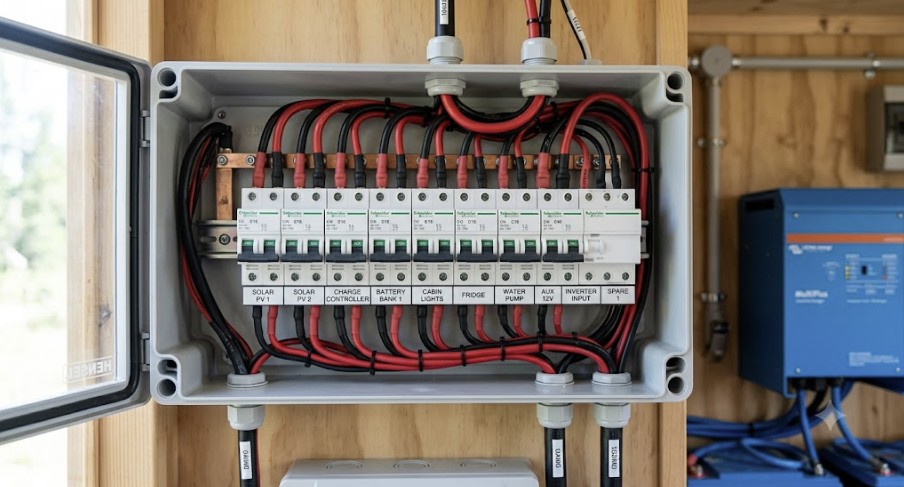
Selecting the correct overcurrent protection is the single most critical safety decision in any off-grid solar installation. An improperly chosen device can lead to catastrophic equipment failure, fire, and severe shock hazards. Unlike standard household AC wiring, the direct current (DC) from solar panels presents a unique and far more dangerous electrical environment.
This engineering guide provides the definitive methodology for calculating, specifying, and installing the best DC circuit breaker for solar arrays. We will cover the essential physics, National Electrical Code (NEC) formulas, and critical hardware specifications that ensure your system is both safe and reliable.
Table of Contents
Why a DC-Rated Breaker is Non-Negotiable for PV Systems
The fundamental difference between AC and DC power is the primary reason you cannot use a standard AC breaker in a solar array. AC power naturally crosses zero volts 120 times per second, which helps extinguish the electrical arc that forms when a breaker trips.
DC power, however, is a continuous, unrelenting flow. When a DC circuit is opened under load, it creates a sustained, high-temperature plasma arc that is extremely difficult to quench. Using an AC breaker in a DC circuit is a severe fire hazard because it lacks the internal mechanisms to safely extinguish this DC arc. This is why choosing the best DC circuit breaker for solar arrays is not just a recommendation; it’s a mandatory safety requirement.
For branch circuit protection in the United States, equipment must be listed under UL 489B, the standard specifically for Photovoltaic (PV) circuit breakers. A breaker listed only to UL 1077 is a “supplementary protector” and is not legally sufficient for primary solar string protection under NEC 690.9.
The technical specifications for the best DC circuit breaker for solar arrays can be compared below:
| Parameter | Standard AC Circuit Breaker | Properly Rated DC Circuit Breaker (UL 489B) |
|---|---|---|
| Arc Quenching | Relies on AC zero-crossing to help extinguish the arc. | Uses magnetic blow-out coils and specialized arc chutes to actively stretch and cool the sustained DC arc. |
| Voltage Rating | Rated for AC voltage (e.g., 120/240V AC). Not suitable for high-voltage DC. | Rated specifically for DC voltage, often up to 600Vdc, 1000Vdc, or even 1500Vdc. |
| Polarity | Non-polarized; terminals are interchangeable. | Often polarized, with dedicated Line (+) and Load (-) terminals to direct current flow correctly through the arc suppression mechanism. |
| Certification | UL 489 for AC branch circuit protection. | UL 489B for PV branch circuit protection, the required standard for code-compliant installations. |
The Core Sizing Formula for the Best DC Circuit Breaker for Solar Arrays
Sizing a DC breaker for a solar array string or combiner circuit is a precise calculation mandated by the NEC. You cannot simply match the breaker to the panel’s operating current (Imp). You must use the panel’s Short Circuit Current (Isc) and apply two critical safety factors.
The NEC formula, derived from Articles 690.8 and 690.9, treats solar circuits as continuous duty power sources that can also experience enhanced current under specific atmospheric conditions. A solid understanding of solar panel to battery sizing is foundational to these calculations.
The correct formula is:
Required Breaker Amperage = Panel Isc x 1.25 (for PV enhancement) x 1.25 (for continuous load)
This simplifies to:
Required Breaker Amperage = Panel Isc x 1.56
After calculating this value, you must round up to the next standard breaker size (e.g., 15A, 20A, 25A, 30A). Never round down. Finding the best DC circuit breaker for solar arrays starts with this fundamental math.
Here is a walkthrough for sizing the best DC circuit breaker for solar arrays based on a typical solar panel:
| Step | Action | Example Calculation |
|---|---|---|
| 1. Find Panel Isc | Locate the Short Circuit Current (Isc) on the solar panel’s data sheet. | Panel Isc = 9.85 Amps |
| 2. Apply Safety Factors | Multiply the Isc by the combined 1.56 NEC factor. | 9.85A x 1.56 = 15.366 Amps |
| 3. Round Up | Select the next available standard breaker size. | Round 15.366A up to a 20 Amp breaker. |
| 4. Final Selection | The minimum required protection for this solar string is a 20A DC-rated breaker. | Selected Breaker: 20A |
Calculating Maximum System Voltage: The Overlooked Factor
An equally critical calculation is determining the maximum system voltage. Solar panels produce higher voltage in colder temperatures. The Open Circuit Voltage (Voc) listed on the datasheet is rated at a standard test condition of 25°C (77°F).
As temperatures drop, this voltage rises. You must calculate the maximum possible voltage your array could produce on the coldest possible day at your location to ensure your breaker’s DC voltage rating (Vdc) is not exceeded. The NEC provides temperature correction factors in Table 690.7(A) for this calculation.
Max System Voltage = (Voc of one panel x Number of panels in series) x Temperature Correction Factor
For example, a string of 3 panels with a Voc of 47.5V in a location that could see -10°C (14°F) would use a correction factor of 1.12. The calculation would be (47.5V x 3) x 1.12 = 159.6V. You would need a breaker rated for at least 200Vdc or higher. This is a crucial step in selecting the best DC circuit breaker for solar arrays.
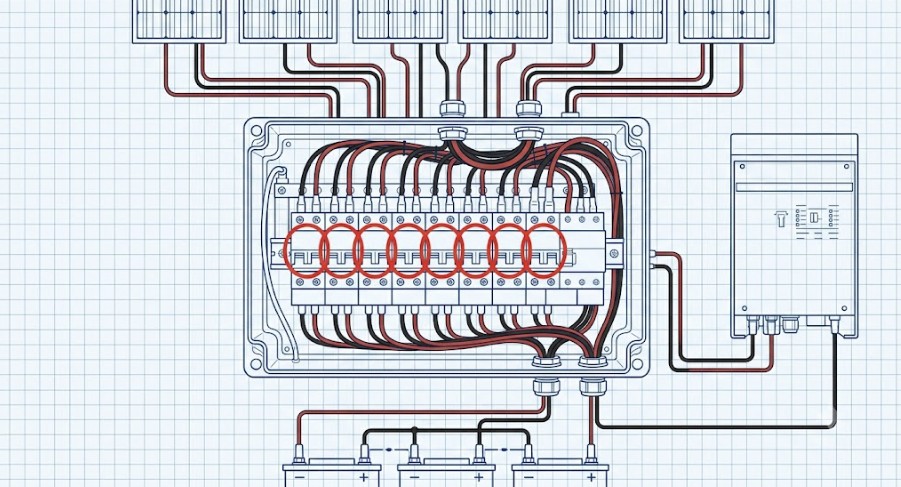
Top Picks: The Best DC Circuit Breaker for Solar Arrays in 2026
Based on UL listing, reliability, and field-proven performance, these are the top engineering choices for protecting your solar assets. Selecting the best DC circuit breaker for solar arrays involves prioritizing certified, reputable hardware.
1. Midnite Solar MNEPV Series (UL 489B)
Midnite Solar breakers are the industry standard for off-grid and residential solar, widely used in their own combiner boxes and E-Panels. They are hydraulic-magnetic, which means their trip point is not affected by ambient temperature—a major advantage over thermal-magnetic breakers.
These are UL 489B listed for PV applications and are the go-to choice for any code-compliant system. They provide the highest level of safety and reliability, making them a top contender for the best DC circuit breaker for solar arrays.
- Pros: UL 489B Listed, temperature stable, highly reliable, DIN rail mountable, available from 1 to 63 amps.
- Cons: Higher price point compared to non-listed alternatives.
[Check Price for Midnite Solar MNEPV15 DC Breaker on Amazon]
2. CHTAIXI 2P C125 (Budget-Friendly Option)
For smaller DIY projects or non-dwelling applications where UL listing may not be a strict requirement, brands like CHTAIXI offer an affordable alternative. These are commonly used in the van life and small cabin community for basic protection and as a manual disconnect switch.
It is critical to understand these are generally not UL 489B listed and should not be used where code compliance is required. However, for a simple, cost-effective solution in a small system, it can be considered a viable option if you understand the trade-offs in certification when seeking the best DC circuit breaker for solar arrays.
- Pros: Very affordable, DIN rail mount, high amperage ratings available in a compact size.
- Cons: Not UL 489B listed, quality can be inconsistent, may not provide the same level of safety as listed breakers.
[Check Price for CHTAIXI 2 Pole 125A DC Breaker on Amazon]
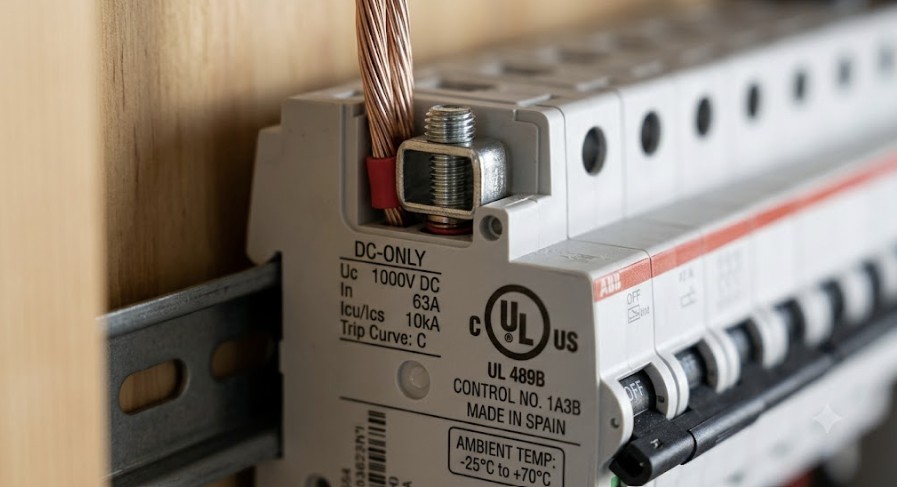
Critical Selection Criteria Beyond Amps and Volts
Choosing the best DC circuit breaker for solar arrays goes beyond the basic sizing calculations. Several other technical factors must be considered to ensure compatibility and safety, especially in complex systems involving batteries.
One of the most important but often misunderstood concepts is breaker polarity. This is especially vital when connecting to batteries, a common scenario in off-grid systems. The differences between a 12v, 24v, or 48v system can also impact breaker selection.
This checklist outlines the essential criteria for selecting the best DC circuit breaker for solar arrays:
| Criterion | Description | Engineering Recommendation |
|---|---|---|
| UL 489B Listing | Ensures the breaker has been tested and certified for PV branch circuit protection. | Mandatory for any installation requiring code compliance. Highly recommended for all others. |
| Polarized vs. Non-Polarized | Polarized breakers require current to flow in one direction for arc suppression to work. Non-polarized breakers work with bidirectional current. | Use polarized for unidirectional PV strings. Must use non-polarized for bidirectional battery circuits (charging and discharging). |
| Interrupting Capacity (kA) | The maximum fault current the breaker can safely interrupt without destroying itself. | Typically 10kA is sufficient for PV strings. For large lithium battery banks, a higher rating (20-25kA) may be needed. Check battery specs. |
| Temperature Derating | Breakers lose effective current capacity in high ambient temperatures (e.g., a hot combiner box in the sun). | For hot climates, select a breaker with a higher amp rating or choose a hydraulic-magnetic type (like Midnite Solar) that is not affected by temperature. |
| Mounting Type | Determines how the breaker is physically installed. Common types are DIN rail and panel mount. | DIN rail is standard for combiner boxes. Panel mount is used for larger, higher-amperage breakers. Ensure it fits your off-grid electrical panel. |
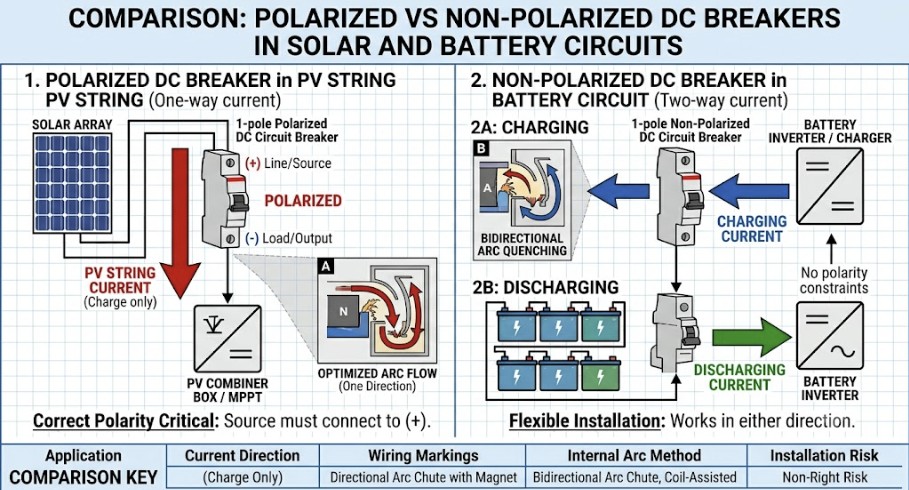
Installation Best Practices for Your DC Circuit Breaker
Correct installation is just as important as correct selection. A poorly installed high-quality breaker can be a point of failure. Following best practices ensures the device performs as designed, providing reliable protection for decades.
Proper wire sizing is paramount; a breaker is designed to protect the wire. You must account for factors like the distance of the wire run, which is detailed in our solar panel voltage drop guide. Finally, ensuring all connections are mechanically and electrically sound prevents heat buildup and potential hazards.
- Match Wire Gauge: Ensure the wire connected to the breaker is rated to handle the breaker’s amperage. A 30A breaker must have at least 10 AWG copper wire, a 20A breaker needs 12 AWG, and so on.
- Use a Torque Wrench: Loose connections are a primary cause of electrical fires. Use a calibrated torque screwdriver or wrench to tighten the terminal lugs to the manufacturer’s specified value (usually printed on the breaker).
- Respect Polarity: If using a polarized breaker, double-check that the positive (+) wire from the solar panel lands on the LINE terminal and the negative (-) wire lands on the corresponding LINE terminal. Reverse polarity can cause the breaker to fail during a fault.
- Provide Ventilation: Install breakers in an enclosure (like a combiner box) that has adequate ventilation, especially in hot climates. Overheating can cause nuisance tripping in thermal-magnetic breakers.
By adhering to these engineering principles and installation procedures, you can be confident in the safety and longevity of your solar electrical system. The investment in the best DC circuit breaker for solar arrays is a small price to pay for peace of mind and protection.
Frequently Asked Questions
Can I use a fuse instead of a DC circuit breaker for my solar array?
Yes, you can use a properly rated DC fuse (typically gPV type) for overcurrent protection, and in many cases, fuses are required for individual string protection in larger systems. However, a circuit breaker offers the significant advantage of being resettable and can also serve as a manual disconnect switch for maintenance. A fuse must be replaced after it blows, which can be inconvenient in a remote off-grid cabin. For this reason, many installers prefer using the best DC circuit breaker for solar arrays for combined circuits or as a main disconnect, while using fuses for individual string protection inside a combiner box.
What does the “trip curve” (e.g., B, C, or D) mean on a DC breaker?
The trip curve defines how quickly the breaker’s magnetic trip mechanism responds to a short-circuit fault. For most solar PV string applications, a C-curve is standard, providing a good balance of protection without being overly sensitive to minor inrush currents. A B-curve is more sensitive and may be used for resistive loads, while a D-curve is less sensitive and designed for high-inrush loads like large motors or transformers. When selecting the best DC circuit breaker for solar arrays, a C-curve is almost always the appropriate choice for protecting the circuits from the panels.
How does the number of solar panels in series affect the breaker choice?
The number of panels wired in a series string directly impacts the system’s open-circuit voltage (Voc). As you add more panels in series, their individual voltages add up. This total voltage, especially when adjusted for cold temperatures, must be lower than the maximum DC voltage rating of your breaker. For example, a string of 10 panels might exceed the voltage limit of a 600Vdc breaker. This voltage calculation is a critical step in choosing the best DC circuit breaker for solar arrays to prevent catastrophic failure from overvoltage.
Do I need a separate DC breaker for my charge controller?
Yes, you absolutely need DC breakers on both sides of the charge controller. A breaker is required between the solar array combiner box and the charge controller input, and another is required between the charge controller output and the battery bank. The breaker on the battery side is particularly important as it protects the controller from the massive fault currents a battery can deliver and allows you to safely isolate the controller for service. Selecting the best DC circuit breaker for solar arrays includes planning for all critical connection points in your system, including both sides of the charge controller, as recommended by manufacturers like Victron and Renogy.
What is the difference between a DC MCB and a DC MCCB?
MCB stands for Miniature Circuit Breaker, and MCCB stands for Molded Case Circuit Breaker. MCBs are typically smaller, DIN rail mountable, and used for lower amperage circuits, like individual solar strings (usually up to 63A). MCCBs are larger, more robust, panel-mounted breakers designed for much higher currents (100A to over 1000A) and higher fault levels. You would use an MCB for string protection and an MCCB for a main battery bank disconnect. The choice between them depends entirely on the current and fault protection required, and both types are available when searching for the best DC circuit breaker for solar arrays.
Why are some DC breakers for solar arrays so much more expensive than others?
The price difference in DC breakers is almost always tied to safety certifications, internal technology, and brand reputation. An expensive breaker from a brand like Midnite Solar is UL 489B listed, uses temperature-stable hydraulic-magnetic technology, and has undergone rigorous third-party testing to guarantee it will perform safely under fault conditions. A cheaper, non-listed breaker from an unknown brand has no such guarantee and may use inferior thermal-magnetic components that are affected by heat. When investing thousands in a solar system, the higher cost of a certified device is crucial for protection, making the certified option the best DC circuit breaker for solar arrays from a safety and reliability standpoint.
Can I use a 2-pole DC breaker to switch both the positive and negative conductors?
Yes, using a 2-pole (or double-pole) breaker is a common and often recommended practice, especially for main disconnects or on circuits where completely isolating the equipment is desired. It ensures that both the positive and negative lines are opened simultaneously, providing a greater level of safety. For ungrounded solar arrays, it is often required by code. When sizing a 2-pole breaker, the amperage calculation remains the same; you just need to ensure both poles are rated for the system’s maximum DC voltage. This is a key consideration when selecting the best DC circuit breaker for solar arrays for a fully isolated disconnect.
What happens if I use an undersized DC circuit breaker?
If you use a breaker with an amperage rating that is too low based on the Isc x 1.56 formula, you will experience nuisance tripping. The breaker will trip on bright, sunny days, even when there is no fault, because the normal operating current is too close to its trip threshold. This constant tripping will interrupt your power production and can prematurely wear out the breaker’s mechanism. Correctly sizing your protection is fundamental to finding the best DC circuit breaker for solar arrays that provides safety without unnecessary downtime.
What happens if I use an oversized DC circuit breaker?
Using an oversized breaker is extremely dangerous and creates a significant fire hazard. The primary purpose of a breaker is to protect the wiring from carrying more current than it can safely handle. If the breaker’s amp rating is too high (e.g., using a 40A breaker on a wire only rated for 30A), a fault condition could cause the wire to overheat, melt its insulation, and start a fire long before the breaker ever trips. This is why you must never “round up” beyond the next standard size when specifying the best DC circuit breaker for solar arrays.
Does the breaker’s voltage rating need to be exact or just “high enough”?
The breaker’s DC voltage rating must be higher than the maximum calculated system voltage, including temperature corrections; it does not need to be an exact match. It is perfectly acceptable and common to use a 600Vdc rated breaker on a system that has a calculated maximum voltage of 450Vdc. You simply need to ensure there is a sufficient safety margin. Never use a breaker with a voltage rating lower than your calculated maximum, as it could fail to extinguish the arc during a fault, leading to its destruction. Choosing the best DC circuit breaker for solar arrays means always prioritizing a Vdc rating that comfortably exceeds the array’s potential.
Is a non-polarized breaker better than a polarized one?
Not necessarily “better,” but more versatile and required for specific applications. For a solar array string where power only flows one way (from panels to charge controller), a polarized breaker is perfectly fine and often slightly less expensive. However, for a circuit connected to a battery, where current flows in to charge and out to discharge, a non-polarized breaker is mandatory. Using a polarized breaker on a battery circuit is hazardous because its arc suppression will only work in one direction. Therefore, the application dictates whether a polarized or non-polarized device is the best DC circuit breaker for solar arrays in that specific location.
How often should I test or replace my DC circuit breaker?
High-quality DC circuit breakers are designed for a long service life with many thousands of operations. It’s good practice to manually trip and reset your breakers annually as part of system maintenance to ensure the mechanism moves freely. Unless the breaker has tripped frequently due to faults or shows signs of overheating (discoloration, melting), there is generally no need to replace it on a fixed schedule. A high-quality, properly sized device will last the life of the system, which is a key characteristic of the best DC circuit breaker for solar arrays.