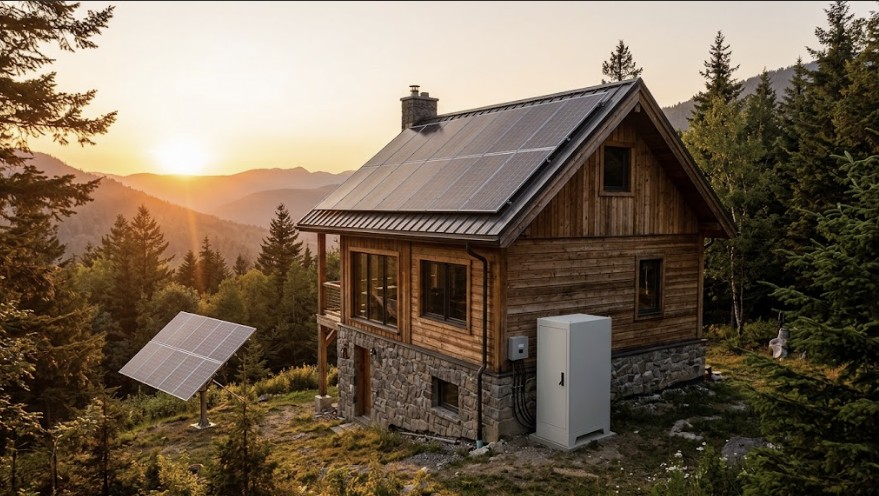
Selecting the optimal housing for your off-grid battery bank is not a trivial decision. A purpose-built server rack enclosure is the central nervous system for your power storage, providing structural support, thermal management, and critical protection from environmental hazards. It is a fundamental component for ensuring system longevity, safety, and performance.
This guide moves beyond generic advice to provide an engineering-level analysis of the criteria, standards, and products that define the best server rack battery enclosure for off-grid solar applications. We will dissect the critical specifications that differentiate a simple metal box from a high-reliability energy storage cabinet designed for decades of autonomous operation.
Table of Contents
Understanding the Core Function of a Server Rack Battery Enclosure
In a sophisticated off-grid system, the battery enclosure is far more than passive storage shelving. It is an active component engineered to maintain the LiFePO4 cells within their strict operational parameters, regardless of external conditions. The primary functions dictate the selection process.
A high-quality unit must provide robust physical protection, precise thermal regulation, and compliance with electrical safety codes like the NEC. Choosing the best server rack battery enclosure for off-grid solar is a decision that directly impacts the usable lifespan and safety of your entire battery investment. The correct enclosure simplifies wiring, improves serviceability, and contains potential thermal events.
The technical parameters for the best server rack battery enclosure for off-grid solar can be compared below:
| Engineering Parameter | Primary Function | Critical Importance for Off-Grid Systems |
|---|---|---|
| Environmental Protection (NEMA/IP Rating) | Shields batteries from dust, moisture, and corrosion. | Essential for installations in barns, sheds, or outdoor locations where ingress can cause catastrophic failure. |
| Thermal Management | Maintains battery cell temperature within the optimal operating window (approx. 40°F to 85°F). | Prevents BMS low-temp charging cutoff in winter and accelerates degradation in summer heat. Directly impacts battery lifespan. |
| Structural Integrity & Load Capacity | Safely supports the immense weight of multiple server rack batteries (100-150 lbs each). | Prevents structural failure, ensures proper alignment, and often includes seismic anchoring for resilience. |
| Code Compliance (UL, NEC) | Adheres to national safety standards for electrical installations and fire prevention. | Ensures the system is insurable, safe, and meets regulatory requirements for stationary energy storage. |
Decoding Environmental Ratings: NEMA and IP for Off-Grid Reliability
The first line of defense for your battery bank is the enclosure’s ability to resist environmental ingress. For off-grid scenarios, which often involve placement in non-climate-controlled spaces like sheds, garages, or even dedicated outdoor structures, this is a non-negotiable specification.
The National Electrical Manufacturers Association (NEMA) and Ingress Protection (IP) ratings provide a standardized measure of this capability. A common indoor-only NEMA 1 rating is wholly inadequate for most off-grid applications. You must specify an enclosure rated for the specific challenges of your environment. For example, a National Electrical Code (NEC) compliant outdoor installation would mandate a minimum of a NEMA 3R rating.
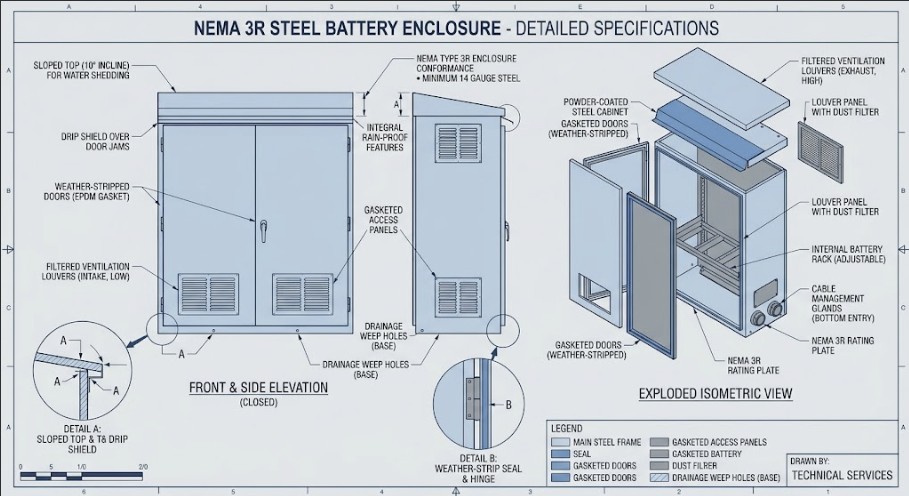
Comparing NEMA & IP Ratings for Solar Enclosures
Understanding the distinction between these ratings is crucial for selecting the best server rack battery enclosure for off-grid solar. A NEMA 3R rating protects against falling rain and sleet, but an IP65 rating adds protection against pressurized water jets and complete dust ingress, making it superior for coastal or desert environments.
Here is a direct comparison of ratings relevant to off-grid solar battery enclosures.
| Rating | Protection Against Solids | Protection Against Liquids | Ideal Off-Grid Location |
|---|---|---|---|
| NEMA 1 / IP20 | Fingers, large objects | None | Climate-controlled indoor room ONLY. Unsuitable for off-grid sheds. |
| NEMA 3R / IP24 | Falling dirt | Rain, sleet, snow | Sheltered outdoor locations, barns, open-air sheds. Minimum for any outdoor exposure. |
| NEMA 4 / IP66 | Windblown dust | Hose-directed water, heavy seas | Exposed outdoor locations, coastal areas, dusty environments. A very robust choice. |
| NEMA 4X / IP66 | Windblown dust, corrosion | Hose-directed water, corrosion | Marine environments, industrial settings with corrosive agents. |
Thermal Management: The Key to LiFePO4 Longevity
Lithium Iron Phosphate (LiFePO4) batteries, the standard for stationary storage, are highly sensitive to temperature. Most battery management systems (BMS) will prevent charging below 32°F (0°C) to avoid lithium plating, which causes permanent cell damage. Conversely, sustained operation above 113°F (45°C) dramatically accelerates capacity degradation.
The best server rack battery enclosure for off-grid solar incorporates an effective thermal management strategy. This is not optional; it is essential for protecting your investment. Strategies range from simple passive ventilation to sophisticated active heating and cooling systems. More information about winter charging for lithium batteries is critical for cold-climate planning.
Passive vs. Active Thermal Control
Passive systems rely on convection, using screened vents at the top and bottom of the enclosure to allow hot air to escape. This is only sufficient for mild climates without temperature extremes. For most of the US, an active thermal strategy is required for year-round reliability.
Active systems use thermostat-controlled fans to force air exchange when temperatures rise, and may incorporate heating pads for cold climates. These components ensure the battery cells remain in their ideal temperature range, maximizing both performance and lifespan. The choice of the best server rack battery enclosure for off-grid solar is often defined by its thermal capabilities.
The Top Rated Best Server Rack Battery Enclosure for Off-Grid Solar in 2026
Our engineering team has evaluated the market based on structural integrity, thermal performance, safety certifications, and overall value. These selections represent the best server rack battery enclosure for off-grid solar across different system scales and environmental conditions.
1. SUNGOLDPOWER Enclosed Battery Cabinet 6 Slot
The SUNGOLDPOWER Enclosed Battery Cabinet is a premier solution for indoor, climate-controlled off-grid installations such as a conditioned basement or dedicated power shed.
This unit is specifically designed as an indoor solution. For a clean room or conditioned outbuilding, it represents the best server rack battery enclosure for off-grid solar due to its integration and ease of use.
[Check Price for SUNGOLDPOWER Enclosed Battery Cabinet 6 Slot on Amazon]
2. Electrical Box Outdoor Enclosure
This is an outdoor-rated enclosure that offers a balance of capacity and weather resistance. It is certified to protect against rain, sleet, and external ice formation, making it a reliable choice for most North American climates.
This pre-wired cabinet simplifies installation significantly. This focus on ease of deployment and certified weather protection makes it a strong contender for the best server rack battery enclosure for off-grid solar, especially for medium-sized residential systems. Sizing a system for a small cabin can be tricky, but this enclosure simplifies the battery portion of the power planning for a 400 sq ft cabin.
[Check Price for Electrical Box Outdoor Enclosure on Amazon]
Critical Enclosure Feature Comparison
Choosing the best server rack battery enclosure for off-grid solar requires a direct comparison of key engineering specifications.
| Model | Max Battery Capacity | Environmental Rating | Integrated Thermal Mgmt. | Best Use Case |
|---|---|---|---|---|
| EG4 6-Slot Rack | 6 Batteries (~30 kWh) | None (Indoor Use Only) | Passive Ventilation | Conditioned basements, power sheds |
| SOK 10-Battery Cabinet | 10 Batteries (~51 kWh) | IP55 | Vented (Active add-on recommended) | Large-scale off-grid, exposed locations |
| Pytes V-BOX-OC | 4 Batteries (~20 kWh) | NEMA 3R | Active (Integrated Fans) | Medium residential off-grid systems |
Sizing and Safety Compliance: Beyond the Box
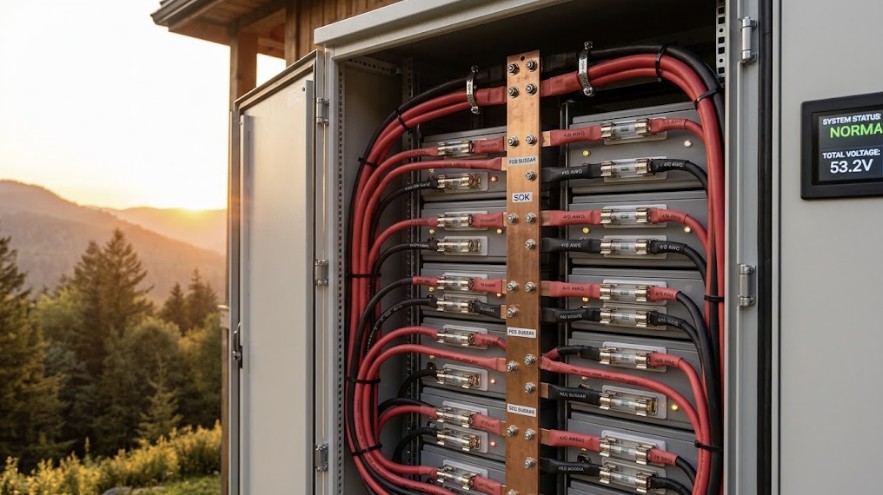
The physical size of the enclosure must accommodate your planned battery bank with adequate clearance for airflow. A general rule is to allow at least 2-4 inches of clearance around all sides of the batteries and 6 inches at the top and bottom for ventilation. Crowding batteries starves them of cooling air, which can lead to overheating.
Furthermore, ensure your chosen enclosure complies with relevant safety standards. According to research from the National Renewable Energy Laboratory (NREL), proper installation and adherence to standards like UL 9540A are paramount for fire safety in energy storage systems. Selecting the best server rack battery enclosure for off-grid solar means prioritizing safety and code compliance from the outset, including the proper use of off-grid electrical panels and overcurrent protection.
Frequently Asked Questions
What is the absolute minimum NEMA rating for an outdoor server rack battery enclosure?
The absolute minimum rating for any outdoor electrical equipment, including a battery enclosure, is NEMA 3R. This rating ensures protection against falling rain, sleet, snow, and external ice formation. However, for locations with wind-driven rain, high dust levels (like deserts), or coastal salt spray, a NEMA 4 or NEMA 4X rating is highly recommended to ensure long-term reliability. Selecting the best server rack battery enclosure for off-grid solar requires a realistic assessment of your specific environmental challenges, not just meeting the bare minimum code.
Can I use a standard IT server rack for my LiFePO4 batteries?
While physically possible, it is strongly discouraged. Standard IT server racks are not designed to support the immense weight of multiple 100-150 lb solar batteries, nor are they typically built with the robust ventilation or fire containment features required for energy storage. They often lack the proper grounding and busbar integrations, leading to unsafe and inefficient wiring. Investing in the best server rack battery enclosure for off-grid solar is a critical safety measure that provides the necessary structural support and thermal management that an IT rack cannot.
How do I calculate ventilation requirements for my battery enclosure?
Calculating ventilation involves determining the waste heat generated by your batteries during charging and discharging and ensuring enough airflow (measured in Cubic Feet per Minute or CFM) to dissipate it. A simplified formula is: CFM = (Total Watts of Heat) / (1.08 x Temperature Rise in °F). You can estimate heat watts as 1-3% of the total power flowing through the batteries. For a reliable setup, choosing the best server rack battery enclosure for off-grid solar with integrated, thermostatically controlled fans is a much safer and more effective approach than attempting to retrofit a passive enclosure.
Do I need active heating in my battery enclosure for a cold climate?
Yes, if your ambient temperature regularly drops below 32°F (0°C). Most LiFePO4 battery management systems will prevent charging in freezing temperatures to protect the cells from permanent damage. The best server rack battery enclosure for off-grid solar in cold climates will incorporate thermostatically controlled heating pads (typically 12V or 48V) that gently warm the batteries to keep them within their safe charging window, ensuring your system remains operational throughout the winter.
Is a steel or aluminum enclosure better for off-grid solar?
Both materials have their advantages. Steel is generally stronger and more cost-effective, making it common for larger, heavy-duty cabinets. However, it must be properly powder-coated or galvanized to prevent rust, especially in humid or coastal areas (NEMA 4X often uses stainless steel). Aluminum is naturally corrosion-resistant and lighter, but it is typically more expensive. The choice for the best server rack battery enclosure for off-grid solar often comes down to budget and the specific corrosive potential of your installation site.
What is seismic rating and do I need it for my enclosure?
A seismic rating, such as GR-487-CORE, certifies that an enclosure can withstand the vibrations and G-forces of an earthquake without structural failure, preventing heavy batteries from toppling over. While not required everywhere, it is a critical safety feature in seismically active regions like California and the Pacific Northwest. If you live in an earthquake-prone area, selecting the best server rack battery enclosure for off-grid solar with a certified seismic rating is an essential precaution.
How does an enclosure help with fire safety and containment?
A properly designed steel enclosure provides a critical layer of fire containment. In the rare event of a thermal runaway in a single battery, a robust, enclosed cabinet can help contain the event, limit its spread to adjacent batteries or structures, and manage the venting of off-gassing. Many advanced enclosures also have options for integrated fire suppression systems (e.g., aerosol-based extinguishers). Therefore, fire containment is a key reason to choose the best server rack battery enclosure for off-grid solar over an open-frame rack.
Can I build my own DIY server rack battery enclosure?
While possible for experienced fabricators, building a DIY enclosure that meets the same safety and performance standards as a certified unit is extremely challenging. You would need to correctly engineer for structural load, thermal management, weatherproofing (NEMA standards), and electrical grounding. Given the potential safety risks and the availability of certified products, purchasing the best server rack battery enclosure for off-grid solar from a reputable manufacturer is almost always the safer and more reliable option.
What is the difference between an enclosure and a cabinet?
In the context of battery storage, the terms are often used interchangeably. However, “enclosure” typically refers to the protective housing itself, focusing on its environmental rating and structural properties. “Cabinet” often implies a more complete, integrated system that may come pre-wired with busbars, circuit breakers, and thermal management systems already installed. The best server rack battery enclosure for off-grid solar is often sold as a complete cabinet to simplify installation.
How do I manage condensation inside an outdoor enclosure?
Condensation occurs when the temperature inside the enclosure drops below the dew point, which can happen during rapid temperature swings. The best way to manage this is through proper ventilation and, in some cases, a small heater. Screened vents or louvered panels allow moisture to escape, while active fan systems keep air circulating. In very humid climates, a small enclosure heater can keep the internal temperature just above the dew point, preventing moisture from forming on your expensive electronics. This is a critical consideration when choosing the best server rack battery enclosure for off-grid solar for a humid region.
What size busbars should be included in a high-quality enclosure?
Busbar sizing depends on the total amperage of the connected battery bank. A common 6-battery rack with 100Ah batteries (each with a 100A BMS) could theoretically supply 600A. Therefore, the busbars should be rated for at least 600A continuous current. High-quality busbars are made from thick, tin-plated copper to ensure low resistance and prevent corrosion. The best server rack battery enclosure for off-grid solar will include appropriately sized busbars to handle the full potential output of the batteries it is designed to hold.
Why is a lockable door important for an off-grid battery enclosure?
A lockable door serves two primary purposes: security and safety. First, it prevents theft of your valuable batteries, which is a real concern in remote or unsecured locations. Second, and more importantly, it restricts access to the high-voltage DC components inside, protecting untrained individuals, children, and animals from accidental electrocution. Adhering to NEC standards for electrical safety is paramount, which is why a secure, lockable design is a mandatory feature for the best server rack battery enclosure for off-grid solar.