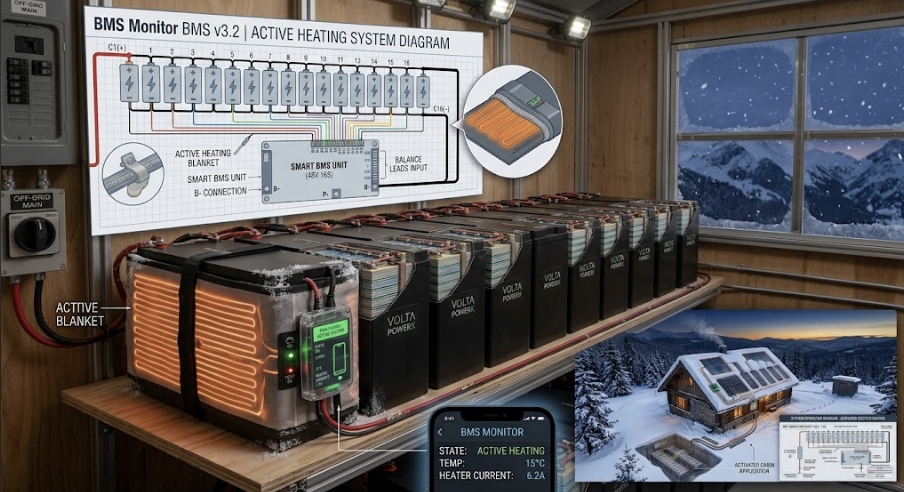
In off-grid solar engineering, sub-zero temperatures present a formidable, non-negotiable challenge. The operational physics of Lithium Iron Phosphate (LiFePO4) batteries dictates a critical limitation: they cannot be safely charged when their internal cell temperature is at or below 0°C (32°F).
Attempting to charge a frozen LiFePO4 battery initiates a destructive, irreversible process called lithium plating, which permanently degrades capacity and can lead to catastrophic failure. To ensure year-round energy independence, a heating solution is not a luxury; it is a fundamental system requirement. This guide provides a definitive technical breakdown of the most effective external solution: selecting and implementing the best battery heating blanket for cold weather solar applications.
Table of Contents
The Unyielding Physics of Cold Weather Battery Charging
The core issue with charging LiFePO4 batteries in the cold is a reduction in the diffusion rate of lithium ions within the electrolyte. When a charge current is applied below freezing, these ions fail to properly intercalate into the graphite anode. Instead, they accumulate on the anode’s surface as metallic lithium.
This “lithium plating” permanently removes lithium from the battery’s active cycle, reducing its capacity. Worse, it can form dendritic structures that may pierce the separator, causing an internal short circuit and potentially triggering a thermal runaway event. A high-quality Battery Management System (BMS) with low-temperature cutoff protection will prevent charging below a set point (typically 5°C or 41°F) to avert this damage, but this simply shuts down your energy collection during critical winter days. Using the best battery heating blanket for cold weather solar is the only way to overcome this physical barrier.
The following table outlines the general temperature limitations of common battery chemistries. This data underscores why active thermal management is paramount for LiFePO4 banks in cold climates.
| Battery Chemistry | Safe Charging Temperature Range | Safe Discharging Temperature Range |
|---|---|---|
| LiFePO4 (Lithium Iron Phosphate) | 0°C to 45°C (32°F to 113°F) | -20°C to 60°C (-4°F to 140°F) |
| AGM (Absorbent Glass Mat) | -20°C to 50°C (-4°F to 122°F) | -20°C to 50°C (-4°F to 122°F) |
| Flooded Lead-Acid | -20°C to 50°C (-4°F to 122°F) | -20°C to 50°C (-4°F to 122°F) |
Core Criteria for the Best Battery Heating Blanket for Cold Weather Solar
Selecting a battery heater is not as simple as buying any 12V heated pad. A systematic engineering approach is required to ensure safety, efficiency, and reliability. These are the critical selection criteria.
Thermostatic Control is Mandatory
The most critical feature of the best battery heating blanket for cold weather solar is precise thermostatic control. A simple, unregulated heater that is always “on” when powered is inefficient and dangerous, risking battery overheating. An integrated thermostat should activate the heating element only when the battery’s surface temperature drops below a safe threshold (e.g., 5°C / 41°F) and deactivate it once a target temperature is reached (e.g., 10°C / 50°F). This prevents parasitic energy waste and protects the battery from thermal damage.
Power Consumption and Voltage
The heater’s power draw, rated in watts, represents a direct parasitic load on your system. This load must be factored into your daily energy budget calculations, especially during winter when solar production is low. You must select a blanket that matches your system’s nominal voltage (12V, 24V, or 48V). Attempting to use a 12V blanket on a 24V system will destroy the heater and create a significant fire hazard.
Durability and Physical Construction
The blanket will be installed in a potentially harsh environment. Look for durable materials like silicone or heavy-duty polymers that can withstand vibration and temperature cycling. An IP rating (e.g., IP67) is highly desirable, indicating resistance to dust and moisture, which is crucial for batteries installed in unconditioned sheds, basements, or vehicle compartments.
Safety Certifications and Fusing
Prioritize products with safety certifications like UL (Underwriters Laboratories) or CE (Conformité Européenne). Furthermore, the power circuit for any battery heater must be protected by an appropriately sized fuse. A failure in the heater should blow a fuse, not start a fire. Connections should be made with high-quality wiring secured with proper terminals, such as those connected to a high-amperage bus bar.
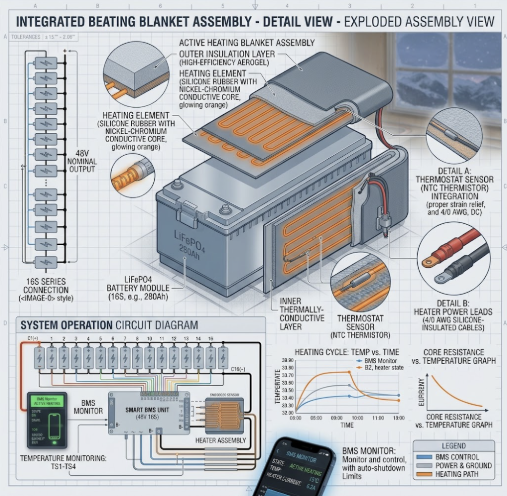
Top 3 Product Analysis: Finding the Best Battery Heating Blanket for Cold Weather Solar
Based on our engineering criteria, we’ve analyzed the market to identify top-tier options. Our evaluation focuses on thermostatic control, efficiency, and overall system safety, leading us to recommend specific products for different levels of off-grid system integration.
1. RecPro 12V Silicone Battery Heater Pad with Thermostat (Best Overall)
The RecPro heater is our top pick because it exemplifies the ideal design for this application. It features a robust silicone construction and, most importantly, a well-calibrated built-in thermostat.
The thermostat is engineered to turn the heating element on at 37°F (3°C) and turn it off at 55°F (13°C). This is the perfect temperature range to enable safe LiFePO4 charging without wasting excess energy. Its 36W power draw is a manageable parasitic load for most systems.
- Pros: Excellent built-in thermostatic control, low power draw, durable silicone construction, easy installation with 3M adhesive backing.
- Cons: Limited to 12V systems (requires series wiring for 24V/48V), adhesive may weaken over many years.
[Check Price for RecPro 12V Silicone Battery Heater Pad on Amazon]
2. Facon 12V Battery Heater Pad (Budget-Friendly Option)
For users on a strict budget, the Facon heater pad is a viable, though less precise, option. It includes a built-in thermostat, but it is set to maintain a temperature of 55°F
- Pros: Very low upfront cost, simple installation, includes a thermal cutoff for safety.
- Cons: Thermostat is set too high, leading to inefficiency; high 100W power consumption.
[Check Price for Facon 12V Battery Heater Pad on Amazon]
3. RecPro Pad + Inkbird ITC-1000 Controller (The Engineer’s Choice)
For maximum control and precision, the ultimate solution involves combining a high-quality heating pad with an external temperature controller. We recommend pairing the RecPro pad (used simply as the heating element) with an Inkbird ITC-1000 12V digital temperature controller.
This setup allows you to place the temperature probe directly on the battery cells and program your own precise on/off setpoints. This is the most efficient and technically robust implementation of a best battery heating blanket for cold weather solar, giving you complete authority over your system’s thermal management.
- Pros: Fully customizable temperature setpoints, extremely accurate temperature sensing, highest possible efficiency, professional-grade control.
- Cons: Requires more complex wiring and setup, higher total cost.
[Check Price for Inkbird ITC-1000 12V Temperature Controller on Amazon]
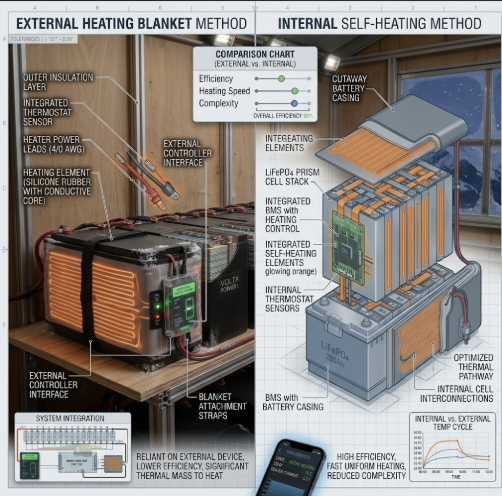
Technical Comparison: Heating Blanket vs. Self-Heating Battery
When designing a new system, engineers must decide between an external heating blanket and a battery with an integrated self-heating function. The best battery heating blanket for cold weather solar is ideal for retrofitting existing systems, while self-heating batteries offer a seamless solution for new installations.
The following technical matrix compares these two essential cold-weather technologies.
| Feature | External Heating Blanket | Integrated Self-Heating Battery |
|---|---|---|
| Upfront Cost | Low to Moderate ($30 – $100 per battery) | High (Premium price over standard battery) |
| Installation Complexity | Requires external wiring, fusing, and controller setup. | Plug-and-play; heating is managed internally by the BMS. |
| Efficiency | Good, but some heat is lost to the environment. Insulation is key. | Excellent; heat is applied directly to the cells internally. |
| Retrofit Capability | Excellent. Can be added to any existing battery bank. | Not possible. Requires purchasing a new battery. |
| Reliability | Depends on the quality of components and installation. | High. Integrated and tested by the manufacturer. |
| Power Source | Draws power from the battery bank itself. | Uses power from the incoming charge source (solar). |
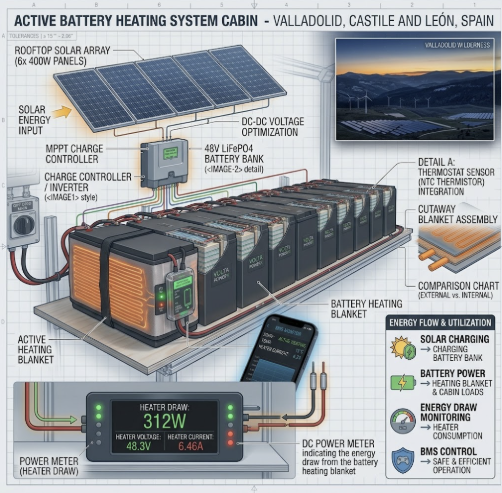
Calculating the Energy Cost: The Parasitic Load of a Battery Heater
The energy consumed by a battery heater is a critical variable in your off-grid power budget. It is a parasitic load that directly reduces the net energy available from your solar array. Failure to account for this load can lead to an energy deficit and an under-charged battery bank.
The calculation is straightforward: `Daily Energy Cost (Wh) = Heater Wattage (W) × Daily On-Time (hours)`. For example, a 36W ZEROFROST heater operating for 8 hours on a cold day will consume `36W * 8h = 288 Wh`. This energy must be replenished by your solar panels on top of your normal daily loads. For robust system design, you should always protect your array with the best DC circuit breaker for solar arrays.
The table below provides examples of the daily energy cost for different heater configurations. This is a vital calculation when sizing your winter solar charging system.
| Heater Wattage | Daily On-Time (4 hours) | Daily On-Time (8 hours) | Daily On-Time (12 hours) |
|---|---|---|---|
| 36 Watts (e.g., ZEROFROST) | 144 Wh | 288 Wh | 432 Wh |
| 50 Watts | 200 Wh | 400 Wh | 600 Wh |
| 100 Watts (e.g., K-Motor) | 400 Wh | 800 Wh | 1200 Wh |
Safety Protocols and Installation Best Practices for the Best Battery Heating Blanket for Cold Weather Solar
Proper installation is paramount to the safe and effective operation of your battery heating system. Adherence to electrical codes and best practices mitigates risks of fire and equipment damage. For a comprehensive overview of safety standards, refer to NFPA 855, Standard for the Installation of Stationary Energy Storage Systems.
Always fuse the positive lead to the heater as close to the power source as possible. Use a high-quality inline fuse holder and a fuse rated appropriately for the heater’s current draw (Amps = Watts / Volts). For a 36W, 12V heater, the current is 3A, so a 5A fuse would be appropriate.
If using an external controller, the temperature probe must be securely attached to the side of the battery, ideally near its center mass, to get an accurate reading. Insulate the probe from the ambient air with a small piece of foam to ensure it is measuring the battery temperature, not the air temperature. Finally, enclosing the entire battery and heater assembly within an insulated box, such as a well-ventilated server rack battery enclosure, is the single most effective way to improve efficiency. This traps the heat, significantly reducing the heater’s on-time and overall energy consumption.
In conclusion, the challenge of charging LiFePO4 batteries in winter is entirely solvable with proper engineering. A thermostatically controlled heating solution is the key to unlocking year-round performance from your solar investment. The best battery heating blanket for cold weather solar is one that is precisely controlled, correctly sized for your energy budget, and installed with an unwavering commitment to safety.
Frequently Asked Questions
What temperature should I set my battery heating blanket to?
The ideal temperature range for a LiFePO4 battery heater is to activate at or below 5°C (41°F) and deactivate around 10-15°C (50-59°F). This narrow band ensures the battery is warm enough to safely accept a charge without wasting energy by overheating it. Setting the temperature too high creates an unnecessary parasitic load on your system, which is why selecting the best battery heating blanket for cold weather solar with precise thermostatic control is absolutely critical for efficiency during low-sun winter months.
Can a battery heating blanket drain my entire battery bank?
Yes, if not managed correctly, a battery heater can drain your batteries. This is why a thermostat is essential. A well-implemented system only runs the heater when necessary. Additionally, your solar charge controller’s low voltage disconnect (LVD) settings should be configured to cut power to all non-essential loads, including the heater, before the battery reaches a critically low state of charge. The best battery heating blanket for cold weather solar must be integrated as a manageable load within your overall energy system, not as an uncontrollable drain.
Is a heating blanket better than a self-heating LiFePO4 battery?
Neither is definitively “better”; they serve different applications. A self-heating battery is a seamless, highly efficient solution ideal for new system installations. An external heating blanket is the superior choice for retrofitting and upgrading existing battery banks that lack a heating function. Therefore, the best battery heating blanket for cold weather solar is the most practical and cost-effective solution for the millions of non-heated LiFePO4 batteries already deployed in the field.
How do I power a battery heater in a 24V or 48V solar system?
Most battery heater pads are 12V devices. For a 24V system, you can wire two 12V pads in series. For a 48V system, you can wire four 12V pads in series. Alternatively, and often more simply, you can use a DC-DC buck converter to step down your system voltage (24V or 48V) to 12V to power the heater. This approach is often required when searching for the best battery heating blanket for cold weather solar, as higher voltage native options are less common.
Will a heating blanket work for AGM or lead-acid batteries?
While AGM and lead-acid batteries can be charged at much colder temperatures than LiFePO4, their performance and charge acceptance still decrease significantly in the cold. A heater can improve their winter charging efficiency and overall performance. However, the primary and most critical application for the best battery heating blanket for cold weather solar is to overcome the strict sub-freezing charging prohibition of LiFePO4 chemistry.
Can I make my own DIY battery heating blanket?
As a Senior Solar Engineer, I strongly advise against this. Creating a DIY heating element without proper materials, thermostatic control, and safety cutoffs poses a severe fire risk. Commercial products are designed and tested to meet safety standards like those from Underwriters Laboratories. The financial savings of a DIY solution are trivial compared to the risk of destroying your expensive battery bank or causing a fire. Always purchase a certified and properly engineered product when seeking the best battery heating blanket for cold weather solar.
How much power does the best battery heating blanket for cold weather solar use?
Power consumption varies by model, typically ranging from 30W to 100W. The total energy used per day depends on the heater’s wattage, the ambient temperature, and the quality of your battery box insulation. A well-insulated box with a 36W thermostatically controlled heater might only run for 6-8 hours a day, consuming 216-288 Wh. Poor insulation could cause it to run constantly, consuming much more. Sizing the best battery heating blanket for cold weather solar requires a careful calculation of this parasitic load.
Where is the best place to install the temperature sensor for a heater?
The temperature sensor or thermostat probe must be in direct contact with the side of the battery casing, preferably near the center of the battery’s mass. It should not be placed on the top or bottom, and it should be insulated from the outside air with a piece of closed-cell foam. This ensures you are measuring the battery’s core temperature, which is the goal of using the best battery heating blanket for cold weather solar, rather than the ambient air temperature inside the battery box.
Can I wrap multiple batteries with a single large heating blanket?
It is generally better to use one appropriately sized heater pad per battery. A single large blanket wrapped around multiple batteries can create uneven heating and may not effectively warm the batteries in the center of the bank. Furthermore, individual pads allow for better thermostatic control as each battery’s temperature can be monitored independently. Proper implementation of the best battery heating blanket for cold weather solar focuses on precise, individual battery thermal management.
Does a heating blanket pose a fire risk to my lithium batteries?
Any heating element introduces some level of risk, which is why safety features are paramount. A properly installed, UL-certified heater with a reliable thermostat and a correctly sized fuse is very safe. The risk of fire comes from unregulated DIY heaters, incorrect wiring, oversized or missing fuses, or a malfunctioning thermostat that allows for overheating. Adhering to electrical standards is non-negotiable when installing the best battery heating blanket for cold weather solar to prevent thermal runaway, as detailed by NREL’s research on lithium-ion battery safety.
How does insulation affect my battery heater’s performance?
Insulation is arguably as important as the heater itself. Placing your batteries and heaters inside a well-insulated box (using rigid foam board, for example) is the most critical step for efficiency. The insulation traps the heat generated by the blanket, drastically reducing its duty cycle (on-time) and minimizing the total energy consumed from your bank. Without insulation, the heater will fight a losing battle against the cold air, making the system highly inefficient. The effectiveness of the best battery heating blanket for cold weather solar is multiplied by proper insulation.
Can I power a battery heater directly from a solar panel?
No, you should never power a heater directly from a solar panel. The output of a solar panel is highly variable and unregulated, which would damage the heater. The heater must be powered by a stable DC voltage source, which is your battery bank, typically through the load terminals of your solar charge controller or a fused connection to your main bus bars. This ensures a stable voltage and allows for low-voltage disconnect protection, a key system safety feature for the best battery heating blanket for cold weather solar.